Thank you for visiting SNEWPapers!
Sign up free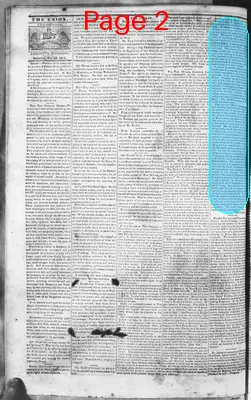
Editorial
May 22, 1841
Lexington Union
Lexington, Holmes County, Mississippi
What is this article about?
Editorial criticizes Whig party's policy to distribute public lands proceeds among states as unconstitutional, wasteful, and a pretext for protective tariffs that tax southern planting interests to subsidize northern manufacturers.
Clipping
OCR Quality
95%
Excellent
Full Text
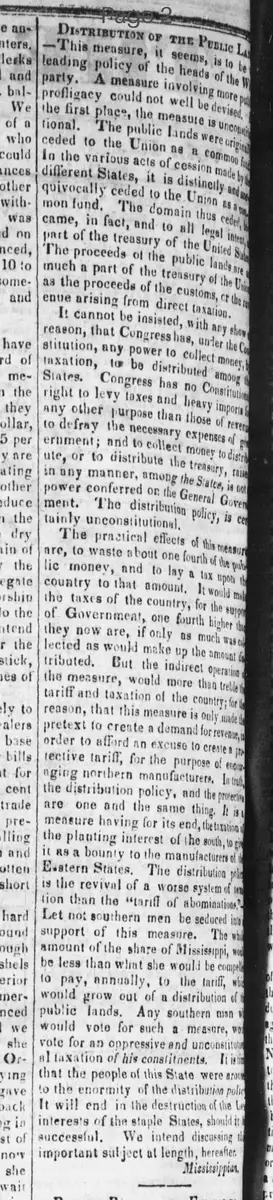
Distribution of the Public Lands.—This measure, it seems, is to be the leading policy of the heads of the whig party. A measure involving more public profligacy and corruption, could not have been first placed before the public. The measure of distributing the proceeds of the public lands among the States, is unconstitutional in origin.
The lands ceded to the Union by the different States in the various acts of cession distinctly made and by which they ceded them to the Union as a common domain, thus ceded as a part of the treasury of the Union.
The proceeds of the public lands are much a part of the treasury of the Union as the proceeds of the customs, or the revenue arising from direct taxation.
It cannot be insisted, with any show of reason, that Congress has, under the Constitution, any power to collect money, by taxation, to be distributed among States.
Congress has no Constitutional right to levy taxes and heavy imports for any other purpose than those of revenue to defray the necessary expenses of the government; and to collect money to distribute, or to distribute the treasury, raise in any manner, among the States, is not a power conferred on the General Government.
The distribution policy, is certainly unconstitutional.
The practical effects of this measure are, to waste about one fourth of the public money, and to lay a tax upon the country to that amount. It would make the taxes of the country, for the support of Government, one fourth higher than they now are, if only as much was collected as would make up the amount distributed. But the indirect operation of the measure, would more than treble the tariff and taxation of the country; for the reason, that this measure is only made a pretext to create a demand for revenue, in order to afford an excuse to create a protective tariff, for the purpose of encouraging northern manufacturers. In truth the distribution policy, and the protective are one and the same thing. It is a measure having for its end, the taxation of the planting interest of the south, to give it as a bounty to the manufacturers of the Eastern States. The distribution policy is the revival of a worse system of taxation than the "tariff of abominations."
Let not southern men be seduced into support of this measure. The whig amount of the share of Mississippi, would be less than what she would be compelled to pay, annually, to the tariff, which would grow out of a distribution of public lands. Any southern man who would vote for such a measure, would vote for an oppressive and unconstitutional taxation of his constituents. It is time that the people of this State were aroused to the enormity of the distribution policy. It will end in the destruction of the planting interests of the staple States, should it be successful. We intend discussing this important subject at length, hereafter.
Mississippian.
The lands ceded to the Union by the different States in the various acts of cession distinctly made and by which they ceded them to the Union as a common domain, thus ceded as a part of the treasury of the Union.
The proceeds of the public lands are much a part of the treasury of the Union as the proceeds of the customs, or the revenue arising from direct taxation.
It cannot be insisted, with any show of reason, that Congress has, under the Constitution, any power to collect money, by taxation, to be distributed among States.
Congress has no Constitutional right to levy taxes and heavy imports for any other purpose than those of revenue to defray the necessary expenses of the government; and to collect money to distribute, or to distribute the treasury, raise in any manner, among the States, is not a power conferred on the General Government.
The distribution policy, is certainly unconstitutional.
The practical effects of this measure are, to waste about one fourth of the public money, and to lay a tax upon the country to that amount. It would make the taxes of the country, for the support of Government, one fourth higher than they now are, if only as much was collected as would make up the amount distributed. But the indirect operation of the measure, would more than treble the tariff and taxation of the country; for the reason, that this measure is only made a pretext to create a demand for revenue, in order to afford an excuse to create a protective tariff, for the purpose of encouraging northern manufacturers. In truth the distribution policy, and the protective are one and the same thing. It is a measure having for its end, the taxation of the planting interest of the south, to give it as a bounty to the manufacturers of the Eastern States. The distribution policy is the revival of a worse system of taxation than the "tariff of abominations."
Let not southern men be seduced into support of this measure. The whig amount of the share of Mississippi, would be less than what she would be compelled to pay, annually, to the tariff, which would grow out of a distribution of public lands. Any southern man who would vote for such a measure, would vote for an oppressive and unconstitutional taxation of his constituents. It is time that the people of this State were aroused to the enormity of the distribution policy. It will end in the destruction of the planting interests of the staple States, should it be successful. We intend discussing this important subject at length, hereafter.
Mississippian.
What sub-type of article is it?
Constitutional
Economic Policy
Taxation
What keywords are associated?
Public Lands Distribution
Whig Policy
Unconstitutional
Protective Tariff
Southern Interests
Taxation
Northern Manufacturers
What entities or persons were involved?
Whig Party
Union
Congress
Southern Men
Mississippi
Northern Manufacturers
Eastern States
Editorial Details
Primary Topic
Opposition To Distribution Of Public Lands Proceeds
Stance / Tone
Strongly Against Whig Distribution Policy
Key Figures
Whig Party
Union
Congress
Southern Men
Mississippi
Northern Manufacturers
Eastern States
Key Arguments
Distribution Of Public Lands Proceeds Is Unconstitutional In Origin
Lands Ceded To Union As Common Domain And Part Of Treasury
Proceeds Equivalent To Customs Or Direct Taxation Revenue
Congress Has No Power To Distribute Money Among States
Measure Wastes One Fourth Of Public Money And Increases Taxes
Pretext For Protective Tariff To Encourage Northern Manufacturers
Taxes Southern Planting Interests To Benefit Eastern Manufacturers
Worse Than The Tariff Of Abominations
Southerners Should Oppose To Protect Constituents
Will Destroy Planting Interests Of Staple States