Thank you for visiting SNEWPapers!
Sign up free
National Gazette
Philadelphia, Philadelphia County, Pennsylvania
What is this article about?
Report from late Paris papers detailing the French national debt in 1792, divided into annuities (276M liv.), assignats (1.53B in circulation, backed by domains worth 1.83B), and exigible debts (1.53B, covered by resources yielding 1.6B surplus). Emphasizes solvency through public contributions, domains, and reductions.
Clipping
OCR Quality
Full Text
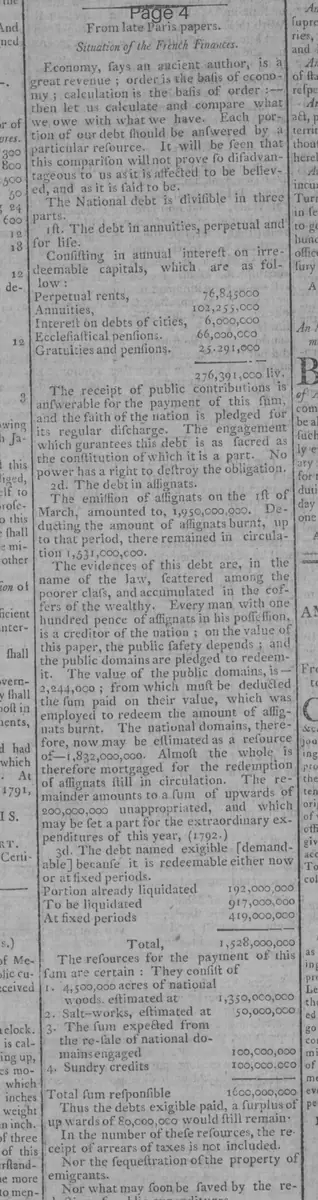
Situation of the French Finances.
Economy, says an ancient author, is a great revenue; order is the basis of economy; calculation is the basis of order:— then let us calculate and compare what we owe with what we have. Each portion of our debt should be answered by a particular resource. It will be seen that this comparison will not prove so disadvantageous to us as it is affected to be believed, and as it is said to be.
The National debt is divisible in three parts.
1st. The debt in annuities, perpetual and for life.
Consisting in annual interest on irredeemable capitals, which are as follow:
Perpetual rents, 76,845,000
Annuities, 102,255,000
Interest on debts of cities, 6,000,000
Ecclesiastical pensions. 66,000,000
Gratuities and pensions. 25,291,000
276,391,000 liv.
The receipt of public contributions is answerable for the payment of this sum, and the faith of the nation is pledged for its regular discharge. The engagement which guarantees this debt is as sacred as the constitution of which it is a part. No power has a right to destroy the obligation.
2d. The debt in assignats.
The emission of assignats on the 1st of March, amounted to, 1,950,000,000. Deducting the amount of assignats burnt, up to that period, there remained in circulation 1,531,000,000.
The evidences of this debt are, in the name of the law, scattered among the poorer class, and accumulated in the coffers of the wealthy. Every man with one hundred pence of assignats in his possession, is a creditor of the nation; on the value of this paper, the public safety depends; and the public domains are pledged to redeem it. The value of the public domains, is 2,244,000; from which must be deducted the sum paid on their value, which was employed to redeem the amount of assignats burnt. The national domains, therefore, now may be estimated as a resource of—1,832,000,000. Almost the whole is therefore mortgaged for the redemption of assignats still in circulation. The remainder amounts to a sum of upwards of 200,000,000 unappropriated, and which may be set a part for the extraordinary expenditures of this year, (1792.)
3d. The debt named exigible [demandable] because it is redeemable either now or at fixed periods.
Portion already liquidated 192,000,000
To be liquidated 917,000,000
At fixed periods 419,000,000
Total, 1,528,000,000
The resources for the payment of this sum are certain: They consist of
I. 4,500,000 acres of national woods, estimated at 1,350,000,000
2. Salt-works, estimated at 50,000,000
3. The sum expected from domains engaged 100,000,000
4. Sundry credits 100,000,000
Total sum responsible 1,600,000,000
Thus the debts exigible paid, a surplus of upwards of 80,000,000 would still remain:
In the number of these resources, the receipt of arrears of taxes is not included.
Nor the sequestration of the property of emigrants.
Nor what may soon be saved by the reduction of public expenditures.
What sub-type of article is it?
What keywords are associated?
Where did it happen?
Foreign News Details
Primary Location
Paris
Event Date
1st Of March 1792
Outcome
surplus of upwards of 80,000,000 after paying exigible debts; unappropriated domains worth over 200,000,000 for 1792 expenditures.
Event Details
The French national debt is divided into three parts: annuities totaling 276,391,000 liv. backed by public contributions; assignats in circulation at 1,531,000,000 backed by public domains valued at 1,832,000,000; and exigible debts of 1,528,000,000 covered by resources totaling 1,600,000,000 including national woods, salt-works, and credits. Additional resources from tax arrears, emigrant property, and expenditure reductions not included.