Thank you for visiting SNEWPapers!
Sign up free
Editorial
October 16, 1896
The Goodland Republic
Goodland, Sherman County, Kansas
What is this article about?
George C. Ward, a populist, urges support for William Jennings Bryan in the 1896 presidential election, criticizing 'middle of the road' populism and advocating unity of the masses against plutocrats, despite fusion with Democrats.
Clipping
OCR Quality
95%
Excellent
Full Text
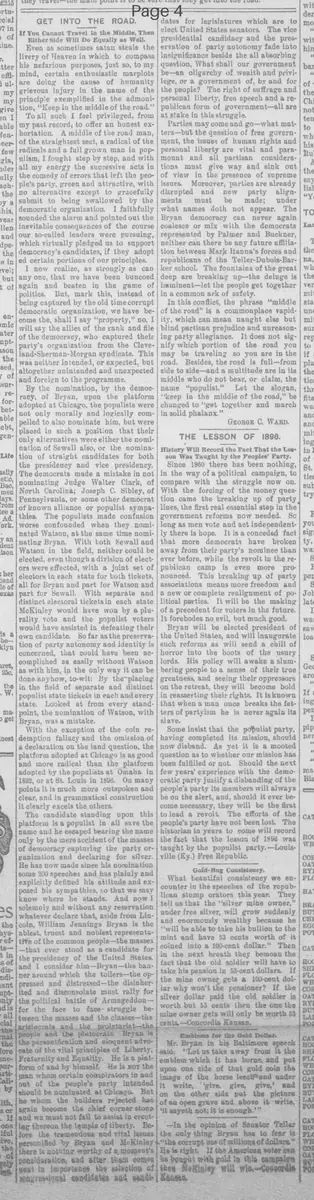
GET INTO THE ROAD.
If You Cannot Travel in the Middle, Then Either Side Will Do Equally as Well
Even as sometimes satan steals the livery of Heaven in which to compass his nefarious purposes, just so, to my mind, certain enthusiastic marplots are doing the cause of humanity grievous injury in the name of the principle exemplified in the admonition, 'Keep in the middle of the road.' To all such I feel privileged, from my past record, to offer an honest exhortation. A middle of the road man of the straightest sect, a radical of the radicals and a full grown man in populism, I fought step by step, and with all my energy the successive acts in the comedy of errors that left the people's party, green and attractive, with no alternative except to gracefully submit to being swallowed by the democratic organization. I faithfully sounded the alarm and pointed out the inevitable consequences of the course our so-called leaders were pursuing, which virtually pledged us to support democracy's candidates, if they adopted certain portions of our principles. I now realize, as strongly as can any one, that we have been buncoed again and beaten in the game of politics. But, mark this, instead of being captured by the old time corrupt democratic organization, we have become the, shall I say 'property,' no, I will say the allies of the rank and file of the democracy, who captured their party's organization from the Cleveland-Sherman-Morgan syndicate. This was neither intended, or expected, but altogether unintended and unexpected and foreign to the programme. By the nomination, by the democracy, of Bryan, upon the platform adopted at Chicago, the populists were not only morally and logically compelled to also nominate him, but were placed in such a position that their only alternatives were either the nomination of Sewall also, or the nomination of straight candidates for both the presidency and vice presidency. The democrats made a mistake in not nominating Judge Walter Clark, of North Carolina; Joseph C. Sibley, of Pennsylvania, or some other democrat of known alliance or populist sympathies. The populists made confusion worse confounded when they nominated Watson, at the same time nominating Bryan. With both Sewall and Watson in the field, neither could be elected, even though a division of electors were effected, with a joint set of electors in each state for both tickets, all for Bryan and part for Watson and part for Sewall. With separate and distinct electoral tickets in each state McKinley would have won by a plurality vote and the populist voters would have assisted in defeating their own candidate. So far as the preservation of party autonomy and identity is concerned, that could have been accomplished as easily without Watson as with him, in the only way it can be done anyhow, to-wit: By the placing in the field of separate and distinct populist state tickets in each and every state. Looked at from every standpoint, the nomination of Watson, with Bryan, was a mistake.
With the exception of the coin redemption fallacy and the omission of a declaration on the land question, the platform adopted at Chicago is as good and more radical than the platform adopted by the populists at Omaha in 1892, or at St. Louis in 1896. On many points it is much more outspoken and clear, and in grammatical construction it clearly excels the others. The candidate standing upon this platform is a populist in all save the name and he escaped bearing the name only by the mere accident of the masses of democracy capturing the party organization and declaring for silver. He has now made since his nomination some 200 speeches and has plainly and explicitly defined his attitude and exposed his sympathies, so that we may know where he stands. And now I solemnly and without any reservation whatever declare that, aside from Lincoln, William Jennings Bryan is the ablest, truest and noblest representative of the common people-the masses-that ever stood as a candidate for the presidency of the United States, and I consider him-Bryan-the banner around which the toilers-the oppressed and distressed-the disinherited and disconsolate must rally for the political battle of Armageddon-for the face to face struggle between the masses and the classes-the aristocrats and the proletariat-the people and the plutocrats. Bryan is the personification and eloquent advocate of the vital principles of Liberty, Fraternity and Equality. He is a platform of and by himself. He is not the man whom certain conspirators in and out of the people's party intended should be nominated at Chicago. But he whom the builders rejected has again become the chief corner stone and we must not fail to assist in erecting thereon the temple of liberty. Before the tremendous and vital issues personified by Bryan and McKinley there is nothing worthy of a moment's consideration, and after them comes next in importance the selection of congressional candidates and candidates for legislatures which are to elect United States senators. The vice presidential candidacy and the preservation of party autonomy fade into insignificance beside the all absorbing question, What shall our government be-an oligarchy of wealth and privilege, or a government of, by and for the people? The right of suffrage and personal liberty, free speech and a republican form of government-all are at stake in this struggle. Parties may come and go-what matters-but the question of free government, the issues of human rights and personal liberty are vital and paramount and all partisan considerations must give way and sink out of view in the presence of supreme issues. Moreover, parties are already disrupted and new party alignments must be made; under what names doth not appear. The Bryan democracy can never again coalesce or mix with the democrats represented by Palmer and Buckner, neither can there be any future affiliation between Mark Hanna's forces and republicans of the Teller-Dubois-Barker school. The fountains of the great deep are breaking up-the deluge is imminent-let the people get together in a common ark of safety.
In this conflict, the phrase 'middle of the road' is a commonplace vapidity, which can mean naught else but blind partisan prejudice and unreasoning party allegiance. It does not signify which portion of the road you may be traveling so you are in the road. Besides, the road is full-from side to side-and a multitude are in its middle who do not bear, or claim, the name 'populist.' Let the slogan, 'keep in the middle of the road,' be changed to 'get together and march in solid phalanx.'
GEORGE C. WARD.
If You Cannot Travel in the Middle, Then Either Side Will Do Equally as Well
Even as sometimes satan steals the livery of Heaven in which to compass his nefarious purposes, just so, to my mind, certain enthusiastic marplots are doing the cause of humanity grievous injury in the name of the principle exemplified in the admonition, 'Keep in the middle of the road.' To all such I feel privileged, from my past record, to offer an honest exhortation. A middle of the road man of the straightest sect, a radical of the radicals and a full grown man in populism, I fought step by step, and with all my energy the successive acts in the comedy of errors that left the people's party, green and attractive, with no alternative except to gracefully submit to being swallowed by the democratic organization. I faithfully sounded the alarm and pointed out the inevitable consequences of the course our so-called leaders were pursuing, which virtually pledged us to support democracy's candidates, if they adopted certain portions of our principles. I now realize, as strongly as can any one, that we have been buncoed again and beaten in the game of politics. But, mark this, instead of being captured by the old time corrupt democratic organization, we have become the, shall I say 'property,' no, I will say the allies of the rank and file of the democracy, who captured their party's organization from the Cleveland-Sherman-Morgan syndicate. This was neither intended, or expected, but altogether unintended and unexpected and foreign to the programme. By the nomination, by the democracy, of Bryan, upon the platform adopted at Chicago, the populists were not only morally and logically compelled to also nominate him, but were placed in such a position that their only alternatives were either the nomination of Sewall also, or the nomination of straight candidates for both the presidency and vice presidency. The democrats made a mistake in not nominating Judge Walter Clark, of North Carolina; Joseph C. Sibley, of Pennsylvania, or some other democrat of known alliance or populist sympathies. The populists made confusion worse confounded when they nominated Watson, at the same time nominating Bryan. With both Sewall and Watson in the field, neither could be elected, even though a division of electors were effected, with a joint set of electors in each state for both tickets, all for Bryan and part for Watson and part for Sewall. With separate and distinct electoral tickets in each state McKinley would have won by a plurality vote and the populist voters would have assisted in defeating their own candidate. So far as the preservation of party autonomy and identity is concerned, that could have been accomplished as easily without Watson as with him, in the only way it can be done anyhow, to-wit: By the placing in the field of separate and distinct populist state tickets in each and every state. Looked at from every standpoint, the nomination of Watson, with Bryan, was a mistake.
With the exception of the coin redemption fallacy and the omission of a declaration on the land question, the platform adopted at Chicago is as good and more radical than the platform adopted by the populists at Omaha in 1892, or at St. Louis in 1896. On many points it is much more outspoken and clear, and in grammatical construction it clearly excels the others. The candidate standing upon this platform is a populist in all save the name and he escaped bearing the name only by the mere accident of the masses of democracy capturing the party organization and declaring for silver. He has now made since his nomination some 200 speeches and has plainly and explicitly defined his attitude and exposed his sympathies, so that we may know where he stands. And now I solemnly and without any reservation whatever declare that, aside from Lincoln, William Jennings Bryan is the ablest, truest and noblest representative of the common people-the masses-that ever stood as a candidate for the presidency of the United States, and I consider him-Bryan-the banner around which the toilers-the oppressed and distressed-the disinherited and disconsolate must rally for the political battle of Armageddon-for the face to face struggle between the masses and the classes-the aristocrats and the proletariat-the people and the plutocrats. Bryan is the personification and eloquent advocate of the vital principles of Liberty, Fraternity and Equality. He is a platform of and by himself. He is not the man whom certain conspirators in and out of the people's party intended should be nominated at Chicago. But he whom the builders rejected has again become the chief corner stone and we must not fail to assist in erecting thereon the temple of liberty. Before the tremendous and vital issues personified by Bryan and McKinley there is nothing worthy of a moment's consideration, and after them comes next in importance the selection of congressional candidates and candidates for legislatures which are to elect United States senators. The vice presidential candidacy and the preservation of party autonomy fade into insignificance beside the all absorbing question, What shall our government be-an oligarchy of wealth and privilege, or a government of, by and for the people? The right of suffrage and personal liberty, free speech and a republican form of government-all are at stake in this struggle. Parties may come and go-what matters-but the question of free government, the issues of human rights and personal liberty are vital and paramount and all partisan considerations must give way and sink out of view in the presence of supreme issues. Moreover, parties are already disrupted and new party alignments must be made; under what names doth not appear. The Bryan democracy can never again coalesce or mix with the democrats represented by Palmer and Buckner, neither can there be any future affiliation between Mark Hanna's forces and republicans of the Teller-Dubois-Barker school. The fountains of the great deep are breaking up-the deluge is imminent-let the people get together in a common ark of safety.
In this conflict, the phrase 'middle of the road' is a commonplace vapidity, which can mean naught else but blind partisan prejudice and unreasoning party allegiance. It does not signify which portion of the road you may be traveling so you are in the road. Besides, the road is full-from side to side-and a multitude are in its middle who do not bear, or claim, the name 'populist.' Let the slogan, 'keep in the middle of the road,' be changed to 'get together and march in solid phalanx.'
GEORGE C. WARD.
What sub-type of article is it?
Partisan Politics
Economic Policy
What keywords are associated?
Bryan Nomination
Populism Fusion
1896 Election
Middle Of The Road
Party Autonomy
Chicago Platform
Silver Standard
Masses Vs Classes
Political Unity
William Jennings Bryan
What entities or persons were involved?
William Jennings Bryan
Populists
Democrats
Mckinley
Watson
Sewall
Cleveland
Sherman
Morgan
Judge Walter Clark
Joseph C. Sibley
Palmer
Buckner
Mark Hanna
Teller
Dubois
Barker
Lincoln
Editorial Details
Primary Topic
Support For Bryan Over Middle Of The Road Populism In 1896 Election
Stance / Tone
Strongly Pro Bryan And Anti Party Purity
Key Figures
William Jennings Bryan
Populists
Democrats
Mckinley
Watson
Sewall
Cleveland
Sherman
Morgan
Judge Walter Clark
Joseph C. Sibley
Palmer
Buckner
Mark Hanna
Teller
Dubois
Barker
Lincoln
Key Arguments
Populists Were Compelled To Nominate Bryan Due To Democratic Platform At Chicago.
Nomination Of Watson Alongside Bryan Was A Mistake That Confused The Party.
Chicago Platform Is Radical And Aligns With Populism Except On Coin Redemption And Land.
Bryan Is The Greatest Representative Of The Common People Since Lincoln.
Election Is A Battle Between Masses And Plutocrats; Party Autonomy Secondary.
Reject 'Middle Of The Road' For Unity In Solid Phalanx.
New Party Alignments Inevitable; Focus On Free Government And Human Rights.
Democrats Captured By Rank And File From Corrupt Syndicate.
Bryan Embodies Liberty, Fraternity, Equality.
Support Bryan To Build Temple Of Liberty.