Thank you for visiting SNEWPapers!
Sign up free
Editorial
September 11, 1907
The Evening World
New York, New York County, New York
What is this article about?
Editorial criticizes Mr. F. P. Earle's plan to remarry based on 'affinity,' arguing that marriage is a public institution essential for family and community well-being, not personal happiness. It defends traditional monogamy against free love and promiscuity, noting hypocrisy in hidden immoralities.
Clipping
OCR Quality
95%
Excellent
Full Text
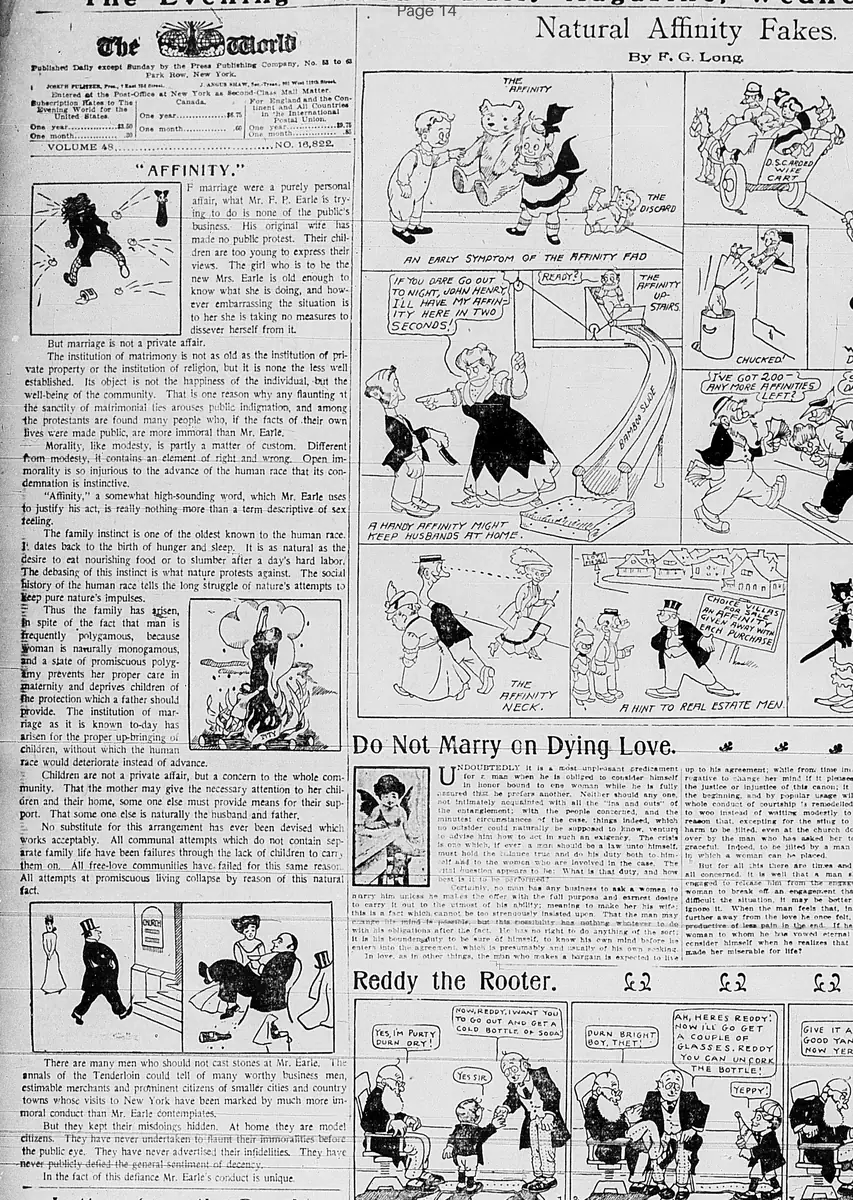
Natural Affinity Fakes.
If marriage were a purely personal affair, what Mr. F. P. Earle is trying to do is none of the public's business. His original wife has made no public protest. Their children are too young to express their views. The girl who is to be the new Mrs. Earle is old enough to know what she is doing, and however embarrassing the situation is to her she is taking no measures to dissever herself from it.
But marriage is not a private affair. The institution of matrimony is not as old as the institution of private property or the institution of religion, but it is none the less well established. Its object is not the happiness of the individual, but the well-being of the community. That is one reason why any flaunting of the sanctity of matrimonial ties arouses public indignation, and among the protestants are found many people who, if the facts of their own lives were made public, are more immoral than Mr. Earle.
Morality, like modesty, is partly a matter of custom. Different from modesty, it contains an element of right and wrong. Open immorality is so injurious to the advance of the human race that its condemnation is instinctive.
"Affinity," a somewhat high-sounding word, which Mr. Earle uses to justify his act, is really nothing more than a term descriptive of sex feeling.
The family instinct is one of the oldest known to the human race. It dates back to the birth of hunger and sleep. It is as natural as the desire to eat nourishing food or to slumber after a day's hard labor.
The debasing of this instinct is what nature protests against. The social history of the human race tells the long struggle of nature's attempts to keep pure nature's impulses.
Thus the family has arisen, in spite of the fact that man is frequently polygamous, because woman is naturally monogamous, and a state of promiscuous polygamy prevents her proper care in maternity and deprives children of the protection which a father should provide. The institution of marriage as it is known to-day has arisen for the proper up-bringing of children, without which the human race would deteriorate instead of advance.
Children are not a private affair, but a concern to the whole community. That the mother may give the necessary attention to her children and their home, some one else must provide means for their support. That some one else is naturally the husband and father.
No substitute for this arrangement has ever been devised which works acceptably. All communal attempts which do not contain separate family life have been failures through the lack of children to carry them on. All free-love communities have failed for this same reason. All attempts at promiscuous living collapse by reason of this natural fact.
There are many men who should not cast stones at Mr. Earle. The annals of the Tenderloin could tell of many worthy business men, estimable merchants and prominent citizens of smaller cities and country towns whose visits to New York have been marked by much more immoral conduct than Mr. Earle contemplates.
But they kept their misdoings hidden. At home they are model citizens. They have never undertaken to flaunt their immoralities before the public eye. They have never advertised their infidelities. They have never publicly defied the general sentiment of decency.
In the fact of this defiance Mr. Earle's conduct is unique.
If marriage were a purely personal affair, what Mr. F. P. Earle is trying to do is none of the public's business. His original wife has made no public protest. Their children are too young to express their views. The girl who is to be the new Mrs. Earle is old enough to know what she is doing, and however embarrassing the situation is to her she is taking no measures to dissever herself from it.
But marriage is not a private affair. The institution of matrimony is not as old as the institution of private property or the institution of religion, but it is none the less well established. Its object is not the happiness of the individual, but the well-being of the community. That is one reason why any flaunting of the sanctity of matrimonial ties arouses public indignation, and among the protestants are found many people who, if the facts of their own lives were made public, are more immoral than Mr. Earle.
Morality, like modesty, is partly a matter of custom. Different from modesty, it contains an element of right and wrong. Open immorality is so injurious to the advance of the human race that its condemnation is instinctive.
"Affinity," a somewhat high-sounding word, which Mr. Earle uses to justify his act, is really nothing more than a term descriptive of sex feeling.
The family instinct is one of the oldest known to the human race. It dates back to the birth of hunger and sleep. It is as natural as the desire to eat nourishing food or to slumber after a day's hard labor.
The debasing of this instinct is what nature protests against. The social history of the human race tells the long struggle of nature's attempts to keep pure nature's impulses.
Thus the family has arisen, in spite of the fact that man is frequently polygamous, because woman is naturally monogamous, and a state of promiscuous polygamy prevents her proper care in maternity and deprives children of the protection which a father should provide. The institution of marriage as it is known to-day has arisen for the proper up-bringing of children, without which the human race would deteriorate instead of advance.
Children are not a private affair, but a concern to the whole community. That the mother may give the necessary attention to her children and their home, some one else must provide means for their support. That some one else is naturally the husband and father.
No substitute for this arrangement has ever been devised which works acceptably. All communal attempts which do not contain separate family life have been failures through the lack of children to carry them on. All free-love communities have failed for this same reason. All attempts at promiscuous living collapse by reason of this natural fact.
There are many men who should not cast stones at Mr. Earle. The annals of the Tenderloin could tell of many worthy business men, estimable merchants and prominent citizens of smaller cities and country towns whose visits to New York have been marked by much more immoral conduct than Mr. Earle contemplates.
But they kept their misdoings hidden. At home they are model citizens. They have never undertaken to flaunt their immoralities before the public eye. They have never advertised their infidelities. They have never publicly defied the general sentiment of decency.
In the fact of this defiance Mr. Earle's conduct is unique.
What sub-type of article is it?
Moral Or Religious
Social Reform
What keywords are associated?
Marriage Sanctity
Family Instinct
Morality
Affinity
Mr Earle
Polygamy
Free Love
Child Rearing
What entities or persons were involved?
Mr. F. P. Earle
Original Wife
New Mrs. Earle
Protestants
Tenderloin
Editorial Details
Primary Topic
Critique Of Mr. F. P. Earle's Affinity Based Remarriage
Stance / Tone
Defensive Of Traditional Marriage And Family Institution, Critical Of Public Immorality
Key Figures
Mr. F. P. Earle
Original Wife
New Mrs. Earle
Protestants
Tenderloin
Key Arguments
Marriage Is A Public Institution For Community Well Being, Not Individual Happiness
Flaunting Matrimonial Infidelity Arouses Public Indignation
Affinity Is Merely A Term For Sex Feeling
Family Instinct Is Natural And Essential For Human Progress
Traditional Marriage Ensures Proper Child Rearing And Prevents Racial Deterioration
Communal And Free Love Experiments Fail Due To Lack Of Family Structure
Hidden Immoralities Are Common But Less Offensive Than Public Defiance