Thank you for visiting SNEWPapers!
Sign up free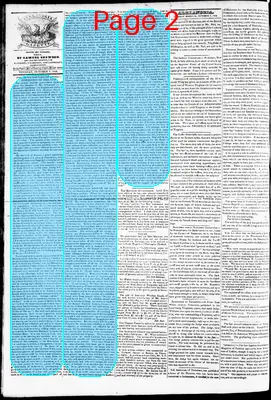
Phenix Gazette
Alexandria, Virginia
What is this article about?
Escalating political agitation in Ireland since O’Connell’s election to Parliament, with Catholic Association gaining strength and Orange societies reviving. Reports of large Protestant gatherings in Enniskillen and Derry, and a speech by Mr. Dawson urging resolution to avert revolution.
Clipping
OCR Quality
Full Text
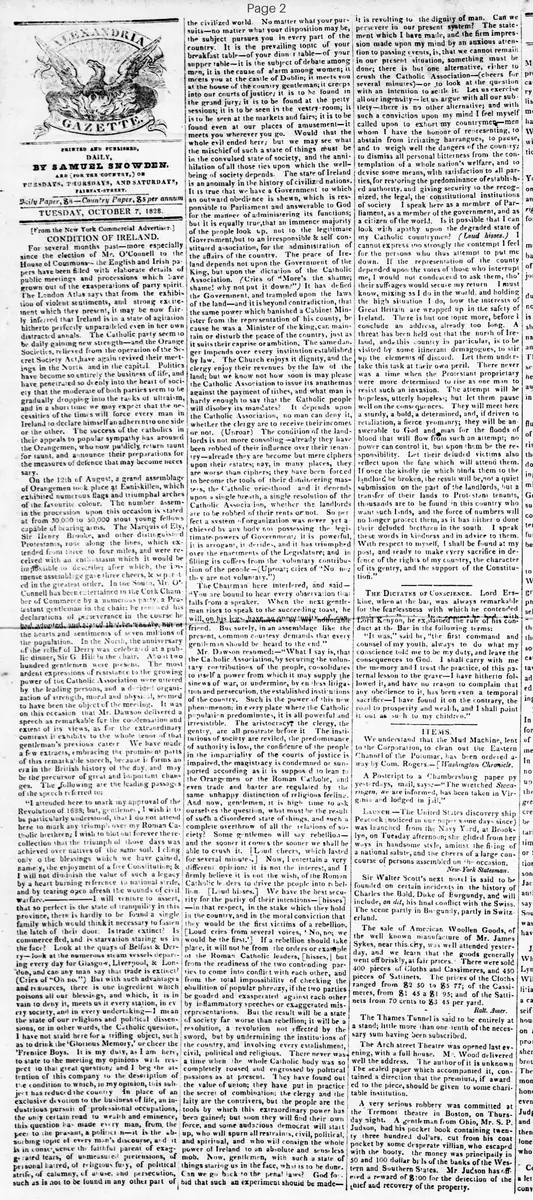
CONDITION OF IRELAND.
For several months past—more especially since the election of Mr. O’Connell to the House of Commons—the English and Irish papers have been filled with elaborate details of public meetings and processions which have grown out of the exasperations of party spirit. The London Atlas says that from the exhibition of violent sentiments, and strong excitement which they present, it may be now fairly inferred that Ireland is in a state of agitation hitherto perfectly unparalleled even in her own distracted annals. The Catholic party seem to be daily gaining new strength—and the Orange Societies, relieved from the operation of the Secret Society Act, have again revived their meetings in the North and in the capital. Politics have become so entirely the business of life, and have penetrated so deeply into the heart of society that the moderate of both parties seem to be gradually dropping into the ranks of ultraism, and in a short time we may expect that the necessities of the times will force every man in Ireland to declare himself an adherent to one side or the other. The success of the Catholics in their appeals to popular sympathy has aroused the Orangemen, who now publicly return taunt for taunt, and announce their preparations for the measures of defence that may become necessary.
On the 12th of August, a grand assemblage of Orangemen took place at Enniskillen, which exhibited numerous flags and triumphal arches of the favourite colour. The number assembled in the procession upon this occasion is stated at from 30,000 to 50,000 stout young fellows capable of bearing arms. The Marquis of Ely, Sir Henry Brooke, and other distinguished Protestants, rode along the lines, which extended from three to four miles, and were received with an enthusiasm which it would be impossible to describe: after which, the immense assemblage gave three cheers, & separated in the greatest order. In the South, Mr. O’Connell has been entertained in the Cork Chamber of Commerce by a numerous party, a Protestant gentleman in the chair: he renewed his declarations of perseverance in the course he had adopted, and stated that he doubted not of the hearts and sentiments of seven millions of the population. In the North, the anniversary of the relief of Derry was celebrated at a public dinner, Sir G. Hill in the chair. About two hundred gentlemen were present. The most ardent expressions of resistance to the growing power of the Catholic Association were uttered by the leading persons, and a decided organization of strength, moral and physical, seemed to have been the object of the meeting. It was on this occasion that Mr. Dawson delivered a speech as remarkable for the condensation and extent of its views, as for the extraordinary contrast it exhibits to the whole tenor of that gentleman’s previous career. We have made a few extracts, embracing the prominent parts of this remarkable speech, because it forms an era in the British history of the day, and may be the precursor of great and important changes. The following are the leading passages of the speech referred to:
“I attended here to mark my approval of the Revolution of 1688; but, gentlemen, I wish it to be particularly understood, that I do not attend here to mark any triumph over my Roman Catholic brethren; I wish to blot out forever the recollection that the triumph of those days was achieved over natives of the same soil. I cling only to the blessings which we have gained, namely, the enjoyment of a free Constitution; & I will not diminish the value of such a legacy by a heart burning reference to national strife, and by tearing open afresh the wounds of civil warfare.
—I will venture to assert, that so perfect is the state of tranquillity in this province, there is hardly to be found a single family which would think it necessary to fasten the latch of their door. Is trade extinct? Is commerce fled, and is starvation staring us in the face? Look at the quays of Belfast & Derry—look at the numerous steam vessels departing every day for Glasgow, Liverpool, & London, and can any man say that trade is extinct? (Cries of “Oh no.”) But with such advantages and resources, there is one ingredient which poisons all our blessings, and which, it is in vain to deny it, meets us at every station, in every society, and in every undertaking—I mean the state of our religious and political dissensions, or in other words, the Catholic question. I have not staid here for a trifling object, such as to drink the ‘Glorious Memory,’ or cheer the ‘Prentice Boys. It is my duty, as I am here, to state to the meeting my opinions with respect to that great question; and I beg the attention of this company to the description of the condition to which, in my opinion, this subject has reduced the country. In place of an exclusive devotion to the business of life, an industrious pursuit of professional occupations, the only certain road to wealth and eminence, this question has made every man, from the peer to the peasant, a politician—it is the absorbing topic of every man’s discourse, and it is in consequence the faithful parent of exaggerated fears, of unmeasured pretensions, of personal hatred, of religious fury, of political strife, of calumny, of abuse, and persecution, such as is not to be found in any other part of the civilized world. No matter what your pursuits—no matter what your disposition may be, the subject pursues you in every part of the country. It is the prevailing topic of your breakfast table—of your dinner table—of your supper table—it is the subject of debate among men, it is the cause of alarm among women; it meets you at the castle of Dublin; it meets you at the house of the country gentleman; it creeps into our courts of justice; it is to be found in the grand jury; it is to be found at the petty sessions; it is to be seen in the vestry-room; it is to be seen at the markets and fairs; it is to be found even at our places of amusement—it meets you wherever you go. Would that the whole evil ended here; but we may see what the mischief of such a state of things must be in the convulsed state of society, and the annihilation of all those ties upon which the well-being of society depends. The state of Ireland is an anomaly in the history of civilized nations. It is true that we have a Government to which an outward obedience is shewn, which is responsible to Parliament and answerable to God for the manner of administering its functions; but it is equally true, that an immense majority of the people look to, not to the legitimate Government, but to an irresponsible & self constituted association, for the administration of the affairs of the country. The peace of Ireland depends not upon the Government of the King, but upon the dictation of the Catholic Association. (Cries of “More’s the shame; shame! why not put it down!”) It has defied the Government, and trampled upon the laws of the land—and it is beyond contradiction, that the same power which banished a Cabinet Minister from the representation of his county, because he was a Minister of the king, can maintain or disturb the peace of the country, just as it suits their caprice or ambition. The same danger impends over every institution established by law. The Church enjoys its dignity, and the clergy enjoy their revenues by the law of the land; but we know not how soon it may please the Catholic Association to issue its anathemas against the payment of tithes, and what man is hardy enough to say that the Catholic people will disobey its mandates? It depends upon the Catholic Association, no man can deny it, whether the clergy are to receive their incomes or not. (Uproar) The condition of the land-lords is not more consoling—already they have been robbed of their influence over their tenantry—already they are become but mere ciphers upon their estates; nay, in many places, they are worse than ciphers; they have been forced to become the tools of their duncifying masters, the Catholic priesthood and it depends upon a single breath, a single resolution of the Catholic Association, whether the landlords are to be robbed of their rents or not. So perfect a system of organization was never yet achieved by any body not possessing the legitimate powers of Government; it is powerful, it is arrogant, it defies, and it has triumphed over the enactments of the Legislature; and in filling its coffers from the voluntary contribution of the people—(Uproar; cries of “No no; they are not voluntary.”)
The Chairman here interfered, and said—“You are bound to hear every observation that falls from a speaker. When the next gentleman rises to speak to the succeeding toast, he will, on his legs, shake with the thong the pit “not for a better friend. But surely, in an assemblage like the present, common courtesy demands that every gentleman should be heard to the end.”
Mr. Dawson resumed:—“What I say is, that the Catholic Association, by securing the voluntary contributions of the people, consolidates to itself a power from which it may supply the sinews of war, or undermine, by endless litigation and persecution, the established institutions of the country. Such is the power of this new phenomenon: in every place where the Catholic population predominates, it is all-powerful and irresistible. The aristocracy; the clergy, the gentry, are all prostrate before it. The institutions of society are reviled, the predominance of authority is lost, the confidence of the people in the impartiality of the courts of justice is impaired, the magistracy is condemned or supported according as it is supposed to lean to the Orangemen or the Roman Catholic, and even trade and barter are regulated by the same unhappy distinction of religious feeling. And now, gentlemen, it is high time to ask ourselves the question, what must be the result of such a disordered state of things, and such a complete overthrow of all the relations of society? Some gentlemen will say rebellion—and the sooner it comes the sooner we shall be able to crush it. (Loud cheers, which lasted for several minutes.) Now, I entertain a very different opinion: it is not the interest, and I firmly believe it is not the wish, of the Roman Catholic leaders to drive the people into rebellion. [Loud hisses.] We have the best security for the purity of their intentions—[hisses] in that respect, in the stake which they hold in the country, and in the moral conviction that they would be the first victims of a rebellion. [Loud cries from several voices, No, no; we would be the first.] If a rebellion should take place, it will not be from the orders or example of the Roman Catholic leaders, [hisses,] but from the readiness of the two contending parties to come into conflict with each other, and from the total impossibility of checking the ebullition of popular phrenzy, if the two parties be goaded and exasperated against each other by inflammatory speeches or exaggerated misrepresentations. But the result will be a state of society far worse than rebellion; it will be a revolution, a revolution not effected by the sword, but by undermining the institutions of the country, and involving every establishment, civil, political and religious. There never was a time when the whole Catholic body was so completely roused and engrossed by political passions as at present. They have found out the value of union; they have put in practice the secret of combination: the clergy and the laity are the contrivers, but the people are the tools by which this extraordinary power has been gained; but soon they will find their own force, and some audacious democrat will start up, who will spurn all restraints, civil, political, and spiritual, and who will consign the whole power of Ireland to an absolute and senseless mob. Now, gentlemen, with such a state of things staring us in the face, what is to be done. Can we go back to the penal laws? God forbid that such an experiment should be made—it is revolting to the dignity of man. Can we persevere in our present system? The statement which I have made, and the firm impression made upon my mind by an anxious attention to passing events, is, that we cannot remain in our present situation, something must be done; there is but one alternative, either to crush the Catholic Association—(cheers for several minutes)—or to look at the question with an intention to settle it. Let us exercise all our ingenuity—let us argue with all our subtlety—there is no other alternative; and with such a conviction upon my mind I feel myself called upon to exhort my countrymen whom I have the honour of representing, to abstain from irritating harangues, to pause, and to weigh well the dangers of the country; to dismiss all personal bitterness from the contemplation of a whole nation’s welfare, and to devise some means, with satisfaction to all parties, for restoring the predominance of established authority, and giving security to the recognized, the legal, the constitutional institutions of society. I speak here as a member of Parliament, as a member of the government, and as a citizen of the world. Is it possible that I can look with apathy upon the degraded state of my Catholic countrymen? (Loud hisses.) I cannot express too strongly the contempt I feel for the persons who thus attempt to put me down. If the representation of the county depended upon the votes of those who interrupt me, I would not condescend to ask them, tho their suffrages would secure my return. I must know, mixing as I do in the world, and holding the high situation I do, how the interests of Great Britain are wrapped up in the safety of Ireland. There is but one topic more, before I conclude an address, already too long. A threat has been held out that the north of Ireland, and this county in particular, is to be visited by some itinerant demagogues, to stir up the elements of discord. Let them undertake this task at their own peril. There never was a time when the Protestant proprietary were more determined to rise as one man to resist such an invasion. The attempt will be hopeless, utterly hopeless; but let them pause well on the consequences. They will meet here a sturdy, a bold, a determined, and, if driven to retaliation, a fierce yeomanry; they will be answerable to God and man for the floods of blood that will flow from such an attempt; no power can control it, but upon them be the responsibility. Let their deluded victims also reflect upon the fate which will attend them. If once the kindly tie which binds them to the landlord be broken, the result will be, not a quiet submission on the part of the landlords, but a transfer of their lands to Protestant tenants, thousands are to be found in this country who want such lands, and the force of numbers will no longer protect them, as it has hitherto done their deluded brethren in the south. I speak these words in kindness and in advice to them. With respect to myself, I shall be found at my post, and ready to make every sacrifice in defence of the rights of my country, the character of its gentry, and the support of the Constitution.”
What sub-type of article is it?
What keywords are associated?
What entities or persons were involved?
Where did it happen?
Foreign News Details
Primary Location
Ireland
Event Date
12th Of August
Key Persons
Outcome
escalating tensions between catholic association and orange societies; preparations for defense; warnings of potential revolution if unresolved.
Event Details
Reports of political agitation in Ireland, with Catholic party gaining strength and Orange societies reviving meetings. Grand Orangemen assemblage at Enniskillen on 12th August with 30,000-50,000 participants. O’Connell entertained in Cork, reaffirming support. Derry relief anniversary dinner where Mr. Dawson delivered a speech critiquing Catholic Association's power and urging resolution to Catholic question to prevent revolution.