Thank you for visiting SNEWPapers!
Sign up free
Domestic News
February 12, 1833
The New Hampshire Gazette
Portsmouth, Rockingham County, New Hampshire
What is this article about?
Senate speech by Mr. Hill of New-Hampshire on January 22, 1833, opposing a bill to distribute proceeds of public land sales to states, arguing it perpetuates high tariffs, harms national unity, and favors certain states like Mississippi over others.
Clipping
OCR Quality
95%
Excellent
Full Text
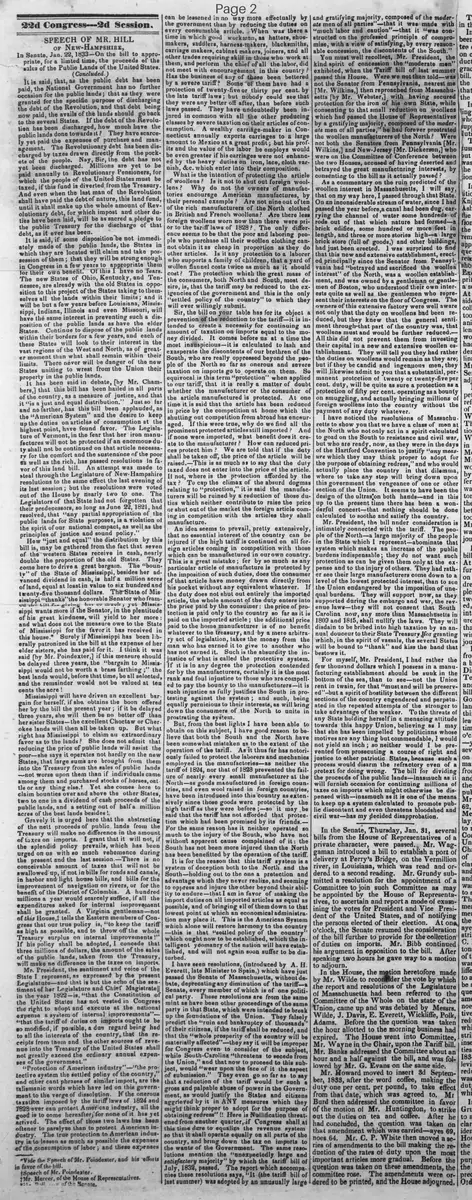
22d Congress—2d Session.
SPEECH OF MR. HILL,
Of New-Hampshire,
In Senate, Jan. 22, 1833—On the bill to appropriate, for a limited time, the proceeds of the sales of the Public Lands of the United States.
(Concluded.)
It is said, that, as the public debt has been paid, the National Government has no further occasion for the public lands; that as they were granted for the specific purpose of discharging the debt of the Revolution, and that debt being now paid, the avails of the lands should go back to the several States. If the debt of the Revolution has been discharged, how much have the public lands done towards it? They have scarcely by yet paid the expenses of purchase and management. The Revolutionary debt has been discharged by taxes drawn directly from the pockets of the people. Nay, Sir, the debt has not yet been discharged. Millions are yet to be paid annually to Revolutionary Pensioners, for which the people of the United States must be taxed, if this fund is diverted from the Treasury. And even when the last man of the Revolution shall have paid the debt of nature, this land fund, until it shall make up the whole amount of Revolutionary debt, for which impost and other duties have been laid, will be as sacred a pledge to the public Treasury for the discharge of that debt, as if it ever has been.
It is said, if some disposition be not immediately made of the public lands, the States in which they are located will claim and take possession of them; that they will be strong enough in Congress in a few years to appropriate them for their own benefit. Of this I have no fears. The new States of Ohio, Kentucky, and Tennessee, are already with the old States in opposition to this project of the States taking to themselves all the lands within their limits; and it will be but a few years before Louisiana, Mississippi, Indiana, Illinois and even Missouri, will have the same interest in preventing such a disposition of the public lands as have the elder States. Continue to dispose of the public lands within their borders for a few years, and each of these States will look to their interest in the public lands at every moment than what shall remain within their vast regions of the West and North, as of greater limits. There never will be danger of the new States uniting to wrest from the Union their property in the public lands.
It has been said in debate, [by Mr. Chambers,] that this bill has been hailed in all parts of the country, as a measure of justice, and that it "is a just and equal distribution." Just so far and no farther, has this bill been applauded, as the "American System" and the desire to keep up the duties on articles of consumption at the highest point, have found favor. The Legislature of Vermont, in the fear that her iron manufactures will not be protected if an enormous duty shall not be continued on that article necessary for the comfort and the sustenance of the poor as well as the rich, has passed resolutions in favor of this land bill. An attempt was made to steal through the Legislature of New-Hampshire resolutions to the same effect the last evening of its last session; but the resolutions were voted out of the House by nearly two to one. The Legislators of that State had not forgotten that their predecessors, so long as June 22, 1821, had resolved, that "any partial appropriation of the public lands for State purposes, is a violation of the spirit of our national compact, as well as the principles of justice and sound policy."
How "just and equal" the distribution by this bill is, may be gathered from the fact that seven of the western States receive in cash, nearly double the proportion of the old States. They come here to drive a great bargain. The "bounty" of the State of Mississippi, besides her advanced dividend in cash, is half a million acres of land, equal at least in value to six hundred and twenty-five thousand dollars. The State of Mississippi "thanks" the honorable Senator who framed the bill for giving her so much, yet Mississippi wants more if the Senator, in the plentitude of his great kindness, will yield to her more: and what does not the measure owe to the State of Mississippi for the favor it has received in this house. Surely if Mississippi has been liberally patronized in the bill at the expense of her elder sisters, she has paid for it. I think it was said [by Mr. Poindexter,] if this measure should be delayed three years, the "bargain to Mississippi would not be worth a brass farthing;" the best lands would, before that time, be all selected, and the remainder would not be valued at ten cents the acre!
Mississippi will have driven an excellent bargain for herself, if she obtains the boon offered her by the bill the present year; if it be delayed three years, she will then be no better off than her sister States—the excellent Choctaw or Cherokee lands will then all be taken up. But what right has Mississippi to claim an extraordinary favor as to the lands? She does not admit that reducing the price of public lands will assist the poor—she says it operates not hardly on the new States, that large sums are brought from them into the Treasury from the sales of public lands—not worse upon them than if individuals came among them and purchased stocks of horses, cattle or any thing else. Yet she comes here to claim bounties over and above the other States, two to one in a dividend of cash proceeds of the public lands, and a setting out of half a million acres of the best lands besides!
Gravely it is urged here that the abstracting of the net proceeds of public lands from the Treasury will make no difference in the amount of taxes on imports. I grant that it will not, if the splendid policy prevails, which has been urged on us with so much vehemence during the present and the last session.—There is no conceivable amount of taxes that will not be swallowed up, if not in bills for roads and canals, in harbor and light house bills, and bills for the improvement of navigation on rivers, or for the benefit of the District of Columbia. A hundred millions a year would scarcely suffice, if all the expenditures asked for internal improvement shall be granted. A Virginia gentleman—not of this House, tells the Eastern members of Congress that our true policy is, to keep the tariff as high as possible, and to throw off the whole Treasury surplus on internal improvements!"
If his policy shall be adopted, I concede that three millions of dollars, the amount of the sales of the public lands, taken from the Treasury, will make no difference in the taxes on imports. Mr. President, the sentiment and voice of the State I represent, as expressed by the present Legislature—and that is but the echo of the sentiment of her Legislature and Chief Magistrate in the year 1822—is, "that the Constitution of the United States has not vested in Congress the right to adopt and execute at the national expense a system of internal improvements"—
"that the tariff of duties on imports ought to be so modified, if possible, a due regard being had to all the interests of the country, that the receipts from them and the other sources of revenue into the Treasury of the United States shall not greatly exceed the ordinary annual expenses of the government."
"Protection of American industry": the protective system the settled policy of the country," and other cant phrases of similar import, are the talismanic words which have led on this government to the verge of dissolution. If the onerous taxation imposed by the tariff laws of 1824 and 1828 ever can protect American industry, all the good is to come hereafter, or none of it has yet arrived. The effect of those two laws has been oftener to paralyze than to protect American industry. The true protection to American industry is to lessen as much as possible the expenses of the consumption of labor; and these expenses can be lessened in no way more effectually by the government than by reducing the duties on every consumable article. When was there a time in which good workmen, as hatters, shoemakers, saddlers, harness-makers, blacksmiths, carriage makers, cabinet makers, joiners, and all other trades requiring skill in those who work at them, and perform the chief of all the labor, did not meet with encouragement in this country? Has the business of any of these been bettered by a severe tariff? Some of them have had a protection of twenty-five or thirty per cent. by the late tariff laws; but nobody could see that they were any better off after than before such laws passed. They have undoubtedly been injured in common with all the other producing classes by severe taxation on their articles of consumption. A wealthy carriage-maker in Connecticut annually exports carriages to a large amount to Mexico at a great profit; but his profits and the value of the labor he employs would be even greater if his carriages were not enhanced by the heavy duties on iron, lace, cloth varnish, &c. which enter into their composition.
What is the intention of protecting the article of woollens? Is it not to shut out foreign woollens? Why do not the owners of manufactories encourage American manufactures, by their personal example? Are not nine out of ten of the rich manufacturers of the North clothed in British and French woollens? Are there less foreign woollens worn now than there were prior to the tariff laws of 1828? The only difference seems to be that the poor and laboring people who purchase all their woollen clothing cannot obtain it as cheap in proportion as they do other articles. Is it any protection to a laborer who supports a family of children, that a yard of woollen flannel costs twice as much as it should cost? The protection which the great mass of the consumers, both North and South, most desire, is, that the tariff may be reduced to the exigencies of the government and this is the only "settled policy of the country" to which they will ever willingly submit.
Sir, the bill on your table has for its object a prevention of the reduction to the tariff—it is intended to create a necessity for continuing an amount of taxation on imports equal to the money divided. It comes before us at a time the most inauspicious—it is calculated to lash and exasperate the discontents of our brethren of the South, who are really oppressed beyond the people of the North so far as onerous and severe taxation on imports go to operate on them. So equivocal is this term "protection'' when applied to our tariff, that it is really a matter of doubt whether the manufacturer or the consumer of the article manufactured is protected. At one time it is said that the article has been reduced in price by the competition at home which the shutting out competition from abroad has encouraged. If this were true, why do we find all the prominent protected articles still imported? And if none were imported, what benefit does it create to the manufacturer? How can reduced prices protect him? We are told that if the duty shall be taken off, the price of the article will be raised.—This is as much as to say that the duty taxed does not enter into the price of the article. If not, where is the protection afforded by the tax? To cap the climax of the absurd dogmas relating to "protection," it is said the manufacturers will be ruined by a reduction of those duties which neither contribute to raise the price or shut out of the market the foreign article coming in competition with the articles they shall manufacture.
An idea seems to prevail, pretty extensively, that no essential interest of the country can be injured if the high tariff is continued on all foreign articles coming in competition with those which can be manufactured in our own country. This is a great mistake; for by so much as any particular article of manufacture is protected by the imposition of such duties, does the consumer of that article have money drawn directly from his pocket without any equivalent whatever. If the duty does not shut out entirely the imported article, the whole amount of the duty enters into the price paid by the consumer: the price of protection is paid only to the country so far as it is paid on the imported article; the additional price paid to the home manufacturer is of no benefit whatever to the treasury, and by a mere arbitrary act of legislation, takes the money from the man who has earned it to give to another who has not earned it. Such is the absurdity the injustice of what is called the protective system. If it is in any degree the protection contended for by the manufacturers, certainly it is the most rank and foul injustice to those who are compelled to pay the bounty to the manufacturers—it is such injustice as fully justifies the South in protesting against the system; and such, being equally pernicious to their interests, as will bring down the consumers of the North to unite in prostrating the system.
But, from the best lights I have been able to obtain on this subject, I have good reason to believe that both the South and the North have been somewhat mistaken as to the extent of the operation of the tariff. As it thus far has notoriously failed to protect the laborers and mechanics employed in the manufactories—as neither the tariff of 1824, nor that of 1828 prevented the failure of nearly every small manufacturer at the North—as goods manufactured in foreign countries, and even wool raised in foreign countries, have been introduced into this country as extensively since those goods were protected by the high tariff as they were before;—so it may be said that the tariff has not afforded that protection which had been promised by its friends.— For the same reason has it neither operated so much to the injury of the South, who have not without apparent cause complained of it: the South has not been more injured than the North has been benefitted by the operation of the tariff. It is for the reason that this tariff system is a system of deception both to the North and the South—holding out to the one a protection and advantage which they never realize, and seeming to oppress and injure the other beyond their ability to endure—that I am in favor of making the import duties on all imported articles as equal as possible, and of bringing all of them down to that lowest point at which an economical administration may place it. This is the American System which alone will restore harmony to the country—this is that "settled policy of the country" which ought now to be established, which the intelligent yeomanry of the nation will have established, and will not again soon suffer to be disturbed.
I have seen resolutions, (introduced by A. H. Everett, late Minister to Spain.) which have just passed the Senate of Massachusetts, without debate, deprecating any diminution of the tariff—a Senate, every member of which is of one political party. These resolutions are from the same mint as have been other proceedings of the same party in that State, which were intended to break up the foundations of the Union. They falsely predict the "ruin and bankruptcy of thousands of their citizens, if the tariff shall be reduced, and that the "whole prosperity of the country will be materially affected"—they say it will be improper for Congress even to consider of the subject, while South-Carolina "threatens to secede from the Union," and that now to proceed to this subject, would "wear upon the face of it the aspect of submission." They even go so far as to say that a reduction of the tariff would be such a gross and palpable abuse of power in the Government, as would justify the States and citizens aggrieved by it in ANY measures which they might think proper to adopt for the purpose of obtaining redress"!! Here is Nullification threatened from another quarter, if Congress shall at this time dare to equalize the revenue system so that it shall operate equally on all parts of the country, and bring down the tax on imports to the wants of the Government. The same resolutions mention the "unexpectedly large and satisfactory majority" by which the tariff bill of July, 1832, passed. The report which accompanies these resolutions says, "It (the tariff bill of last summer) was adopted by an unusually large and gratifying majority, composed of the moderate men of all parties"—that it was made with "much labor and caution"—that it "was constructed on the professed principle of compromise, with a view of satisfying, by every reasonable concession, the discontents of the South."
You must well recollect, Mr. President, the kind spirit of concession the "moderate men" exhibited, when the Tariff bill of last summer passed this House. Were we not then told—was not the Senator from Pennsylvania, nearest me [Mr. Wilkins,] then reproached from Massachusetts [by Mr. Webster,] with having secured protection for the iron of his own State, while consenting to that small reduction on woollens which had passed the House of Representatives by a gratifying majority, composed of the moderate men of all parties." he had forever prostrated the woollen manufacturers of the North? Were not both the Senators from Pennsylvania Mr. Wilkins,] and New-Jersey [Mr. Dickerson,] who were on the Committee of Conference between the two Houses, accused of having deserted and betrayed the great manufacturing interests, by consenting to the bill as it actually passed?
As a commentary on the ruin predicted of the woollen interest in Massachusetts, I will say, that on my way here. I passed through that State. On an inconsiderable stream of water, since I had passed the year before, a canal had been dug, carrying the channel of water some hundreds of rods out of that which nature had formed—a brick edifice, some hundred or more feet in length, and three or more stories high—a large brick store (full of goods.) and other buildings, had just been erected. I was surprised to find that this new and extensive establishment, erected principally since the Senator from Pennsylvania had "betrayed and sacrificed the woollen interest" of the North, was a woollen establishment, and was owned by a gentleman or gentlemen of Boston, who understood their own interests quite as well as the gentlemen who represent their interests on the floor of Congress. The owners of this extensive factory were well aware not only that the duty on woollens had been reduced, but they knew that the general sentiment through that part of the country was, that woollens must and would be further reduced.— All this did not prevent them from investing their capital in a new and extensive woollen establishment. They will tell you they had rather the duties on woollens would remain as they are; but if they be candid and ingenuous men, they will likewise admit to you that a substantial, permanent protection of twenty or twenty-five per cent. duty, will be quite as sure a protection as a protection of fifty per cent. operating as a bounty on smuggling, and actually bringing millions of foreign woollens into the country without the payment of any duty whatever.
I have noticed the resolutions of Massachusetts to show you that we have a class of men at the North who not only act in a spirit calculated to goad on the South to resistance and civil war, but who are ready, now, as they were in the days of the Hartford Convention to justify "any measure which they may think proper to adopt for the purpose of obtaining redress." and who would actually place the country in that dilemma where to take any step will bring down upon this government the vengeance of one or other section of the Union. It seems to have been the design of the ultras on both hands—and in this up to the present time there has been a wonderful concert—that nothing should be done calculated to soothe and satisfy the country.
Mr. President, the bill under consideration is intimately connected with the tariff. The people of the North—a large majority of the people in the State which I represent—abominate that system which makes an increase of the public burdens indispensable; they do not want such protection as can be given them only at the expense and to the injury of others. They had rather see their large manufacturers come down to a level of the lowest protected interest, than to see the Union endangered by the imposition of unequal burdens. They will support now, as they supported during the embargo and war, the revenue laws—they will not consent that South Carolina now, any more than Massachusetts in 1809 and 1815, shall nullify the laws. They will disdain to be bribed into high taxation by an annual douceur to their State Treasury, for granting which, in the spirit of vassals, the several States will be bound to "thank" and kiss the hand that bestows it.
For myself, Mr. President, I had rather the few thousand dollars which I possess in a manufacturing establishment should be sunk in the bottom of the sea, than to see—not the Union rent in twain, for that "must and will be preserved"—but a spirit of hostility between the different sections of the country engendered and perpetuated in the repeated attempts of the stronger to take advantage of the weaker. To the threats of any State holding herself in a menacing attitude towards this happy Union, believing as I may that she has been impelled by politicians whose motives are any thing but commendable, I would not yield an inch; so neither would I be prevented from prosecuting a course of right and justice to other patriotic States, because such a process would disarm the refractory even of a pretext for doing wrong. The bill for dividing the proceeds of the public lands—inasmuch as it will furnish occasion for continuing millions of taxes on imports which might otherwise be dispensed with—inasmuch as it is one of the means to keep up a system calculated to promote public discontent and even threatens bloodshed and civil war—has my decided disapprobation.
*Vide the Speech of Mr. Poindexter, and his efforts in favor of the bill.
Speech of Mr. Poindexter.
Mr. Mercer, of the House of Representatives.
of the Senate.
SPEECH OF MR. HILL,
Of New-Hampshire,
In Senate, Jan. 22, 1833—On the bill to appropriate, for a limited time, the proceeds of the sales of the Public Lands of the United States.
(Concluded.)
It is said, that, as the public debt has been paid, the National Government has no further occasion for the public lands; that as they were granted for the specific purpose of discharging the debt of the Revolution, and that debt being now paid, the avails of the lands should go back to the several States. If the debt of the Revolution has been discharged, how much have the public lands done towards it? They have scarcely by yet paid the expenses of purchase and management. The Revolutionary debt has been discharged by taxes drawn directly from the pockets of the people. Nay, Sir, the debt has not yet been discharged. Millions are yet to be paid annually to Revolutionary Pensioners, for which the people of the United States must be taxed, if this fund is diverted from the Treasury. And even when the last man of the Revolution shall have paid the debt of nature, this land fund, until it shall make up the whole amount of Revolutionary debt, for which impost and other duties have been laid, will be as sacred a pledge to the public Treasury for the discharge of that debt, as if it ever has been.
It is said, if some disposition be not immediately made of the public lands, the States in which they are located will claim and take possession of them; that they will be strong enough in Congress in a few years to appropriate them for their own benefit. Of this I have no fears. The new States of Ohio, Kentucky, and Tennessee, are already with the old States in opposition to this project of the States taking to themselves all the lands within their limits; and it will be but a few years before Louisiana, Mississippi, Indiana, Illinois and even Missouri, will have the same interest in preventing such a disposition of the public lands as have the elder States. Continue to dispose of the public lands within their borders for a few years, and each of these States will look to their interest in the public lands at every moment than what shall remain within their vast regions of the West and North, as of greater limits. There never will be danger of the new States uniting to wrest from the Union their property in the public lands.
It has been said in debate, [by Mr. Chambers,] that this bill has been hailed in all parts of the country, as a measure of justice, and that it "is a just and equal distribution." Just so far and no farther, has this bill been applauded, as the "American System" and the desire to keep up the duties on articles of consumption at the highest point, have found favor. The Legislature of Vermont, in the fear that her iron manufactures will not be protected if an enormous duty shall not be continued on that article necessary for the comfort and the sustenance of the poor as well as the rich, has passed resolutions in favor of this land bill. An attempt was made to steal through the Legislature of New-Hampshire resolutions to the same effect the last evening of its last session; but the resolutions were voted out of the House by nearly two to one. The Legislators of that State had not forgotten that their predecessors, so long as June 22, 1821, had resolved, that "any partial appropriation of the public lands for State purposes, is a violation of the spirit of our national compact, as well as the principles of justice and sound policy."
How "just and equal" the distribution by this bill is, may be gathered from the fact that seven of the western States receive in cash, nearly double the proportion of the old States. They come here to drive a great bargain. The "bounty" of the State of Mississippi, besides her advanced dividend in cash, is half a million acres of land, equal at least in value to six hundred and twenty-five thousand dollars. The State of Mississippi "thanks" the honorable Senator who framed the bill for giving her so much, yet Mississippi wants more if the Senator, in the plentitude of his great kindness, will yield to her more: and what does not the measure owe to the State of Mississippi for the favor it has received in this house. Surely if Mississippi has been liberally patronized in the bill at the expense of her elder sisters, she has paid for it. I think it was said [by Mr. Poindexter,] if this measure should be delayed three years, the "bargain to Mississippi would not be worth a brass farthing;" the best lands would, before that time, be all selected, and the remainder would not be valued at ten cents the acre!
Mississippi will have driven an excellent bargain for herself, if she obtains the boon offered her by the bill the present year; if it be delayed three years, she will then be no better off than her sister States—the excellent Choctaw or Cherokee lands will then all be taken up. But what right has Mississippi to claim an extraordinary favor as to the lands? She does not admit that reducing the price of public lands will assist the poor—she says it operates not hardly on the new States, that large sums are brought from them into the Treasury from the sales of public lands—not worse upon them than if individuals came among them and purchased stocks of horses, cattle or any thing else. Yet she comes here to claim bounties over and above the other States, two to one in a dividend of cash proceeds of the public lands, and a setting out of half a million acres of the best lands besides!
Gravely it is urged here that the abstracting of the net proceeds of public lands from the Treasury will make no difference in the amount of taxes on imports. I grant that it will not, if the splendid policy prevails, which has been urged on us with so much vehemence during the present and the last session.—There is no conceivable amount of taxes that will not be swallowed up, if not in bills for roads and canals, in harbor and light house bills, and bills for the improvement of navigation on rivers, or for the benefit of the District of Columbia. A hundred millions a year would scarcely suffice, if all the expenditures asked for internal improvement shall be granted. A Virginia gentleman—not of this House, tells the Eastern members of Congress that our true policy is, to keep the tariff as high as possible, and to throw off the whole Treasury surplus on internal improvements!"
If his policy shall be adopted, I concede that three millions of dollars, the amount of the sales of the public lands, taken from the Treasury, will make no difference in the taxes on imports. Mr. President, the sentiment and voice of the State I represent, as expressed by the present Legislature—and that is but the echo of the sentiment of her Legislature and Chief Magistrate in the year 1822—is, "that the Constitution of the United States has not vested in Congress the right to adopt and execute at the national expense a system of internal improvements"—
"that the tariff of duties on imports ought to be so modified, if possible, a due regard being had to all the interests of the country, that the receipts from them and the other sources of revenue into the Treasury of the United States shall not greatly exceed the ordinary annual expenses of the government."
"Protection of American industry": the protective system the settled policy of the country," and other cant phrases of similar import, are the talismanic words which have led on this government to the verge of dissolution. If the onerous taxation imposed by the tariff laws of 1824 and 1828 ever can protect American industry, all the good is to come hereafter, or none of it has yet arrived. The effect of those two laws has been oftener to paralyze than to protect American industry. The true protection to American industry is to lessen as much as possible the expenses of the consumption of labor; and these expenses can be lessened in no way more effectually by the government than by reducing the duties on every consumable article. When was there a time in which good workmen, as hatters, shoemakers, saddlers, harness-makers, blacksmiths, carriage makers, cabinet makers, joiners, and all other trades requiring skill in those who work at them, and perform the chief of all the labor, did not meet with encouragement in this country? Has the business of any of these been bettered by a severe tariff? Some of them have had a protection of twenty-five or thirty per cent. by the late tariff laws; but nobody could see that they were any better off after than before such laws passed. They have undoubtedly been injured in common with all the other producing classes by severe taxation on their articles of consumption. A wealthy carriage-maker in Connecticut annually exports carriages to a large amount to Mexico at a great profit; but his profits and the value of the labor he employs would be even greater if his carriages were not enhanced by the heavy duties on iron, lace, cloth varnish, &c. which enter into their composition.
What is the intention of protecting the article of woollens? Is it not to shut out foreign woollens? Why do not the owners of manufactories encourage American manufactures, by their personal example? Are not nine out of ten of the rich manufacturers of the North clothed in British and French woollens? Are there less foreign woollens worn now than there were prior to the tariff laws of 1828? The only difference seems to be that the poor and laboring people who purchase all their woollen clothing cannot obtain it as cheap in proportion as they do other articles. Is it any protection to a laborer who supports a family of children, that a yard of woollen flannel costs twice as much as it should cost? The protection which the great mass of the consumers, both North and South, most desire, is, that the tariff may be reduced to the exigencies of the government and this is the only "settled policy of the country" to which they will ever willingly submit.
Sir, the bill on your table has for its object a prevention of the reduction to the tariff—it is intended to create a necessity for continuing an amount of taxation on imports equal to the money divided. It comes before us at a time the most inauspicious—it is calculated to lash and exasperate the discontents of our brethren of the South, who are really oppressed beyond the people of the North so far as onerous and severe taxation on imports go to operate on them. So equivocal is this term "protection'' when applied to our tariff, that it is really a matter of doubt whether the manufacturer or the consumer of the article manufactured is protected. At one time it is said that the article has been reduced in price by the competition at home which the shutting out competition from abroad has encouraged. If this were true, why do we find all the prominent protected articles still imported? And if none were imported, what benefit does it create to the manufacturer? How can reduced prices protect him? We are told that if the duty shall be taken off, the price of the article will be raised.—This is as much as to say that the duty taxed does not enter into the price of the article. If not, where is the protection afforded by the tax? To cap the climax of the absurd dogmas relating to "protection," it is said the manufacturers will be ruined by a reduction of those duties which neither contribute to raise the price or shut out of the market the foreign article coming in competition with the articles they shall manufacture.
An idea seems to prevail, pretty extensively, that no essential interest of the country can be injured if the high tariff is continued on all foreign articles coming in competition with those which can be manufactured in our own country. This is a great mistake; for by so much as any particular article of manufacture is protected by the imposition of such duties, does the consumer of that article have money drawn directly from his pocket without any equivalent whatever. If the duty does not shut out entirely the imported article, the whole amount of the duty enters into the price paid by the consumer: the price of protection is paid only to the country so far as it is paid on the imported article; the additional price paid to the home manufacturer is of no benefit whatever to the treasury, and by a mere arbitrary act of legislation, takes the money from the man who has earned it to give to another who has not earned it. Such is the absurdity the injustice of what is called the protective system. If it is in any degree the protection contended for by the manufacturers, certainly it is the most rank and foul injustice to those who are compelled to pay the bounty to the manufacturers—it is such injustice as fully justifies the South in protesting against the system; and such, being equally pernicious to their interests, as will bring down the consumers of the North to unite in prostrating the system.
But, from the best lights I have been able to obtain on this subject, I have good reason to believe that both the South and the North have been somewhat mistaken as to the extent of the operation of the tariff. As it thus far has notoriously failed to protect the laborers and mechanics employed in the manufactories—as neither the tariff of 1824, nor that of 1828 prevented the failure of nearly every small manufacturer at the North—as goods manufactured in foreign countries, and even wool raised in foreign countries, have been introduced into this country as extensively since those goods were protected by the high tariff as they were before;—so it may be said that the tariff has not afforded that protection which had been promised by its friends.— For the same reason has it neither operated so much to the injury of the South, who have not without apparent cause complained of it: the South has not been more injured than the North has been benefitted by the operation of the tariff. It is for the reason that this tariff system is a system of deception both to the North and the South—holding out to the one a protection and advantage which they never realize, and seeming to oppress and injure the other beyond their ability to endure—that I am in favor of making the import duties on all imported articles as equal as possible, and of bringing all of them down to that lowest point at which an economical administration may place it. This is the American System which alone will restore harmony to the country—this is that "settled policy of the country" which ought now to be established, which the intelligent yeomanry of the nation will have established, and will not again soon suffer to be disturbed.
I have seen resolutions, (introduced by A. H. Everett, late Minister to Spain.) which have just passed the Senate of Massachusetts, without debate, deprecating any diminution of the tariff—a Senate, every member of which is of one political party. These resolutions are from the same mint as have been other proceedings of the same party in that State, which were intended to break up the foundations of the Union. They falsely predict the "ruin and bankruptcy of thousands of their citizens, if the tariff shall be reduced, and that the "whole prosperity of the country will be materially affected"—they say it will be improper for Congress even to consider of the subject, while South-Carolina "threatens to secede from the Union," and that now to proceed to this subject, would "wear upon the face of it the aspect of submission." They even go so far as to say that a reduction of the tariff would be such a gross and palpable abuse of power in the Government, as would justify the States and citizens aggrieved by it in ANY measures which they might think proper to adopt for the purpose of obtaining redress"!! Here is Nullification threatened from another quarter, if Congress shall at this time dare to equalize the revenue system so that it shall operate equally on all parts of the country, and bring down the tax on imports to the wants of the Government. The same resolutions mention the "unexpectedly large and satisfactory majority" by which the tariff bill of July, 1832, passed. The report which accompanies these resolutions says, "It (the tariff bill of last summer) was adopted by an unusually large and gratifying majority, composed of the moderate men of all parties"—that it was made with "much labor and caution"—that it "was constructed on the professed principle of compromise, with a view of satisfying, by every reasonable concession, the discontents of the South."
You must well recollect, Mr. President, the kind spirit of concession the "moderate men" exhibited, when the Tariff bill of last summer passed this House. Were we not then told—was not the Senator from Pennsylvania, nearest me [Mr. Wilkins,] then reproached from Massachusetts [by Mr. Webster,] with having secured protection for the iron of his own State, while consenting to that small reduction on woollens which had passed the House of Representatives by a gratifying majority, composed of the moderate men of all parties." he had forever prostrated the woollen manufacturers of the North? Were not both the Senators from Pennsylvania Mr. Wilkins,] and New-Jersey [Mr. Dickerson,] who were on the Committee of Conference between the two Houses, accused of having deserted and betrayed the great manufacturing interests, by consenting to the bill as it actually passed?
As a commentary on the ruin predicted of the woollen interest in Massachusetts, I will say, that on my way here. I passed through that State. On an inconsiderable stream of water, since I had passed the year before, a canal had been dug, carrying the channel of water some hundreds of rods out of that which nature had formed—a brick edifice, some hundred or more feet in length, and three or more stories high—a large brick store (full of goods.) and other buildings, had just been erected. I was surprised to find that this new and extensive establishment, erected principally since the Senator from Pennsylvania had "betrayed and sacrificed the woollen interest" of the North, was a woollen establishment, and was owned by a gentleman or gentlemen of Boston, who understood their own interests quite as well as the gentlemen who represent their interests on the floor of Congress. The owners of this extensive factory were well aware not only that the duty on woollens had been reduced, but they knew that the general sentiment through that part of the country was, that woollens must and would be further reduced.— All this did not prevent them from investing their capital in a new and extensive woollen establishment. They will tell you they had rather the duties on woollens would remain as they are; but if they be candid and ingenuous men, they will likewise admit to you that a substantial, permanent protection of twenty or twenty-five per cent. duty, will be quite as sure a protection as a protection of fifty per cent. operating as a bounty on smuggling, and actually bringing millions of foreign woollens into the country without the payment of any duty whatever.
I have noticed the resolutions of Massachusetts to show you that we have a class of men at the North who not only act in a spirit calculated to goad on the South to resistance and civil war, but who are ready, now, as they were in the days of the Hartford Convention to justify "any measure which they may think proper to adopt for the purpose of obtaining redress." and who would actually place the country in that dilemma where to take any step will bring down upon this government the vengeance of one or other section of the Union. It seems to have been the design of the ultras on both hands—and in this up to the present time there has been a wonderful concert—that nothing should be done calculated to soothe and satisfy the country.
Mr. President, the bill under consideration is intimately connected with the tariff. The people of the North—a large majority of the people in the State which I represent—abominate that system which makes an increase of the public burdens indispensable; they do not want such protection as can be given them only at the expense and to the injury of others. They had rather see their large manufacturers come down to a level of the lowest protected interest, than to see the Union endangered by the imposition of unequal burdens. They will support now, as they supported during the embargo and war, the revenue laws—they will not consent that South Carolina now, any more than Massachusetts in 1809 and 1815, shall nullify the laws. They will disdain to be bribed into high taxation by an annual douceur to their State Treasury, for granting which, in the spirit of vassals, the several States will be bound to "thank" and kiss the hand that bestows it.
For myself, Mr. President, I had rather the few thousand dollars which I possess in a manufacturing establishment should be sunk in the bottom of the sea, than to see—not the Union rent in twain, for that "must and will be preserved"—but a spirit of hostility between the different sections of the country engendered and perpetuated in the repeated attempts of the stronger to take advantage of the weaker. To the threats of any State holding herself in a menacing attitude towards this happy Union, believing as I may that she has been impelled by politicians whose motives are any thing but commendable, I would not yield an inch; so neither would I be prevented from prosecuting a course of right and justice to other patriotic States, because such a process would disarm the refractory even of a pretext for doing wrong. The bill for dividing the proceeds of the public lands—inasmuch as it will furnish occasion for continuing millions of taxes on imports which might otherwise be dispensed with—inasmuch as it is one of the means to keep up a system calculated to promote public discontent and even threatens bloodshed and civil war—has my decided disapprobation.
*Vide the Speech of Mr. Poindexter, and his efforts in favor of the bill.
Speech of Mr. Poindexter.
Mr. Mercer, of the House of Representatives.
of the Senate.
What sub-type of article is it?
Politics
Economic
What keywords are associated?
Public Lands Bill
Tariff Protection
Senate Debate
Distribution Of Proceeds
American System
Mississippi Bounty
Revolutionary Debt
What entities or persons were involved?
Mr. Hill
Mr. Chambers
Mr. Poindexter
Mr. Wilkins
Mr. Webster
Mr. Dickerson
A. H. Everett
Mr. Mercer
Where did it happen?
United States Senate
Domestic News Details
Primary Location
United States Senate
Event Date
1833 01 22
Key Persons
Mr. Hill
Mr. Chambers
Mr. Poindexter
Mr. Wilkins
Mr. Webster
Mr. Dickerson
A. H. Everett
Mr. Mercer
Event Details
Mr. Hill delivers a speech in the Senate opposing the bill to distribute proceeds of public land sales to states, arguing it sustains high import tariffs, favors western states like Mississippi, undermines national unity, and fails to protect American industry as claimed.