Thank you for visiting SNEWPapers!
Sign up free
Story
December 8, 1869
The New York Herald
New York, New York County, New York
What is this article about?
A beautiful adopted English girl, discovering her origins via a 20-year-old Herald personal ad, faces hardships after leaving her adoptive home, commits a minor theft out of despair, and ends up in New York City Prison, yearning to uncover her true parentage.
Clipping
OCR Quality
95%
Excellent
Full Text
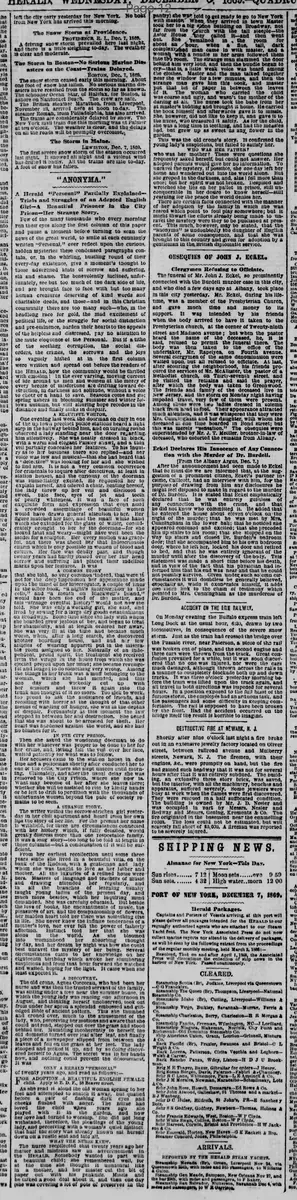
ANONYMA.
Herald "Personal" Partially Explained—Trials and Struggles of an Adopted English Girl—A Beautiful Prisoner in the City Prison—Her Strange Story.
Few of the many thousands who every morning run their eyes along the first column of this paper and pause a moment before turning to scan the news of the great world, to smile at each cunningly written "Personal," ever reflect upon the curious, hidden mysteries these condensed paragraphs contain, or, in the whirling, bustling round of their every-day existence, give a moment's thought to those advertised hints of sorrow and suffering, sin and shame. The benevolently inclined, unfortunately, see but too much of the dark side of life, and are brought face to face with but too many human creatures deserving of kind words and charitable deeds, and those—and in this Christian community there are too many such—who, in the headlong race for gold, the mad excitement of political life, or the struggle for social distinction and pre-eminence, harden their hearts to the appeals of the helpless and distressed, pay no attention to the mute eloquence of the Personal. But if a tithe of the seething corruption, the social disorders, the crimes, the sorrows and the joys so vaguely hinted at in the first column were written and spread out before the readers of the Herald, how the community would be thrilled with emotion! In the ever varying, moving current of life around us men and women at the mercy of every breeze of misfortune are drifting toward destruction, in darkness and solitude, without a voice to cheer or a hand to save. Seasons come and go: spring ushers in blooming summer and winter follows autumn, but still alluring hope recedes in the distance and finally sinks in despair.
A BEAUTIFUL VISITOR.
One evening last week the doorman on duty in one of the up town precinct police stations heard a light step in the hallway behind him, and on turning round observed a lady standing near the door regarding him attentively. She was neatly dressed in black, with a warm and elegant Paisley shawl, and a thin veil partially concealed her features. To his inquiry as to her business there she replied—and her voice was low and musical—that she had heard that a "detective" was looking for her and she wished to find him. It is not a very common occurrence for criminals to inquire after detectives, at least in station houses, and the curiosity of the doorman was immediately excited. He requested her to explain herself, and offered a chair. Seating herself, the lady threw up her veil and disclosed a sweet, pale face—eyes of jet and teeth of pearly whiteness. It was a face of such exquisite form and expression that even amid crowded assemblage of beautiful women would have drawn general attention to her. Her figure matched her face, and the small white hand which she extended for the glass of water, considerately brought to her by the doorman—for she looked faint and weary—might have well been the model for a sculptor. Her every motion was graceful, and there was about her that indescribable charm which is only possible in women of blood and culture. Her face was deadly pale, and though twenty years had hardly passed over her fair head sorrow and suffering had placed their indelible marks upon her features. It was
A COMMON STORY
that she told, so very common indeed, that were it not for the deep impression her appearance made upon the mind of her interrogator, a couple of lines in the office book, a night's incarceration in the cells, and a month on Blackwell's Island, would have been the end of the matter, and this "strange eventful history" would not now be told. She was only a working girl, she said, and lived by sewing for a large dry goods establishment on Broadway. Some time since the lady with whom she boarded grew jealous of her, and began to treat her shamefully, and at length ordered her away. She was very ill at the time and became much worse, when, after a long search, she discovered another boarding house, and had her few articles of wearing apparel put in the miserable room assigned to her. Naturally of an independent, proud spirit, the treatment she received from the virago in the house from which she was ejected preyed upon her mind; she became revengeful and longed to do something very wrong. Among the things in her trunk was a muff belonging to the woman, which she had mended, and this one day she wickedly cut up with her scissors and threw it again into the trunk and thought of it no more. Too sick to work, too proud to ask the assistance of friends, and recoiling with horror at the thought of that other means of warding off hunger, she was in the depths of despair. Fortunately at this moment the law stepped in between her and destruction. She heard that she was about to be arrested for theft. Her heart was hardened against the world, and she had no blushes for it.
IN THE CITY PRISON.
Then she asked the wondering doorman to do with her whatever was proper to be done to her for her crime, and, letting fall the veil over her face, waited patiently for what was to follow. Her accusers came to the station house in due time and a policeman shortly after conducted her to one of the cells, where she slept unseen until morning. Ultimately, and after the usual delay she was removed to the City Prison, where she now is. What may become of her after she leaves there; whether she will be assisted to rise by kindly hands or be left to drift to perdition with the thousands of unfortunate women beyond the pale of society remains to be seen.
A STRANGE STORY.
The writer visited the sorrow-stricken girl yesterday in her chill apartment and heard from her own lips the story of her life. For the present her name is withheld, for there are circumstances connected with her history which, if fully detailed, would greatly distress more than one respectable family. It was a long story—too long to be told at length in these columns—but a condensation of it will be sufficient.
From her earliest recollection until some three years since she lived in a beautiful villa, on the bank of the Hudson, with a gentleman and lady whom she was taught to love as her father and mother. All the luxuries of a refined home were hers. Masters of language and teachers of music and drawing attended her regularly, and in all the branches of learning usually taught young ladies of the present day, and much more besides, which her inquiring mind demanded. She was carefully educated. But beside the love of books, the enchantments of music, the pleasures of art, and the companionship of flowers, her maiden heart told her there was something else in life. She never knew the infinite tenderness of a mother's love, nor ever felt the power of fatherly affection. Instinct told her that she was alone in the world. As she bloomed into womanhood her absorbing thought by day, and her dream by night was how she could best unravel the mystery of her being. Several circumstances came to her knowledge on her eighteenth birthday which awoke her slumbering suspicions and from that hour forward she watched and waited, hoping for the light.
It came when she least expected it.
A DISCOVERY
The old crone, Agnes Corcoran, who had been her nurse and was then the trusted servant of the family, was sitting under a tree near the summer house, in which the young lady was reading one afternoon in August, and thinking herself unobserved, took out from under her apron a splendid embossed and gilt-edged Bible of ancient pattern. This she thumbed and crooned over, much to the amusement of the lady, who, perceiving her motions and aware that she could not read, stepped out over the grass and stood behind her. Mumbling incoherently to herself, the old domestic turned over leaf after leaf, and finally a piece of a newspaper slipped from between the leaves and fell on the grass at her feet. The lady stooped and picked it up, and by so doing discovered herself to Agnes. The secret was in her hands now, and nothing could prevent the dénouement.
It was
ONLY A HERALD 'PERSONAL'
FOR ADOPTION A BEAUTIFUL ENGLISH FEMALE CHILD. Apply to E. D. F., 88 Beaver street.
of twenty years ago, and read as follows:-
As she read it aloud the old woman sprang to her feet and attempted to snatch it away, but quailed before a pair of flashing dark eyes and cheeks flushed with anger. The nurse had loved the child when years ago she played with it in the garden, and now her love had turned to worship. She did not long withstand, therefore, the pleadings of the young lady, and perceiving with a woman's quiet instinct that half the story was already known sat herself down on a rustic seat and told all.
WHAT THE NURSE KNEW.
The nurse recollected that twenty years ago her master and mistress saw an advertisement in the Herald. Somebody wanted to part with a beautiful child; she remembered well, for at the time she thought it unnatural like in a mother, and her master cut the bit of paper out with his penknife. Missis and he talked a good deal about it, and then one day (she was covering a lot of pots of preserves in the pantry) she was told to get ready to go to New York with master. When they arrived in town Master took her to a big stone building on Broadway, not far from the church with the tall steeple—the Astor House they called it—and then went out. She remained in the room for about an hour, when a tall, dark complexioned man came in with master, and a woman with a bundle in her arms followed them into the room. The strange man slammed the door behind him very loud, and then the bundle began to cry—that is, a little weak voice was heard among the clothes. Master and the man talked together near the window for a few minutes, and then the strange man gave him this book, and master put that bit of paper in between the leaves of it. The woman who carried the child was coarse and ugly, and wasn't the mother of the darling at all. The nurse took the babe from her at master's bidding and brought it home. He carried the book himself and afterwards gave it to missis. She, however, did not like to keep it, and gave it to the nurse, who treasured it safely. As for the child she was a long time in teething, and had the measles bad, but grew sweet as any flower in the garden.
This was the old crone's story. It confirmed the young lady's suspicions, but failed to satisfy her.
WHO WAS HER FATHER?
who was her mother? These were questions she frequently asked herself, but could not answer. Her adopted parents would give her no information. To unravel the mystery, if possible, she one day left her home and wandered out into the world alone. But she groped in the darkness, and, alas! fell more than once; but her spirit was not broken. Despised and wretched she lies on her pallet in prison, still unconquerable in her desire to know herself—still yearning for the peace the world denies her. There are certain facts connected with the manner of her adoption by the family in which she was reared which point to foul play somewhere; but it might thwart the efforts already being made to unravel the mystery—were they to be published at present. This much, however, may be stated, that the "anonyma" is undoubtedly the daughter of English parents of some consequence, and that she was brought to this country and given for adoption by a gentleman in the British diplomatic service.
Herald "Personal" Partially Explained—Trials and Struggles of an Adopted English Girl—A Beautiful Prisoner in the City Prison—Her Strange Story.
Few of the many thousands who every morning run their eyes along the first column of this paper and pause a moment before turning to scan the news of the great world, to smile at each cunningly written "Personal," ever reflect upon the curious, hidden mysteries these condensed paragraphs contain, or, in the whirling, bustling round of their every-day existence, give a moment's thought to those advertised hints of sorrow and suffering, sin and shame. The benevolently inclined, unfortunately, see but too much of the dark side of life, and are brought face to face with but too many human creatures deserving of kind words and charitable deeds, and those—and in this Christian community there are too many such—who, in the headlong race for gold, the mad excitement of political life, or the struggle for social distinction and pre-eminence, harden their hearts to the appeals of the helpless and distressed, pay no attention to the mute eloquence of the Personal. But if a tithe of the seething corruption, the social disorders, the crimes, the sorrows and the joys so vaguely hinted at in the first column were written and spread out before the readers of the Herald, how the community would be thrilled with emotion! In the ever varying, moving current of life around us men and women at the mercy of every breeze of misfortune are drifting toward destruction, in darkness and solitude, without a voice to cheer or a hand to save. Seasons come and go: spring ushers in blooming summer and winter follows autumn, but still alluring hope recedes in the distance and finally sinks in despair.
A BEAUTIFUL VISITOR.
One evening last week the doorman on duty in one of the up town precinct police stations heard a light step in the hallway behind him, and on turning round observed a lady standing near the door regarding him attentively. She was neatly dressed in black, with a warm and elegant Paisley shawl, and a thin veil partially concealed her features. To his inquiry as to her business there she replied—and her voice was low and musical—that she had heard that a "detective" was looking for her and she wished to find him. It is not a very common occurrence for criminals to inquire after detectives, at least in station houses, and the curiosity of the doorman was immediately excited. He requested her to explain herself, and offered a chair. Seating herself, the lady threw up her veil and disclosed a sweet, pale face—eyes of jet and teeth of pearly whiteness. It was a face of such exquisite form and expression that even amid crowded assemblage of beautiful women would have drawn general attention to her. Her figure matched her face, and the small white hand which she extended for the glass of water, considerately brought to her by the doorman—for she looked faint and weary—might have well been the model for a sculptor. Her every motion was graceful, and there was about her that indescribable charm which is only possible in women of blood and culture. Her face was deadly pale, and though twenty years had hardly passed over her fair head sorrow and suffering had placed their indelible marks upon her features. It was
A COMMON STORY
that she told, so very common indeed, that were it not for the deep impression her appearance made upon the mind of her interrogator, a couple of lines in the office book, a night's incarceration in the cells, and a month on Blackwell's Island, would have been the end of the matter, and this "strange eventful history" would not now be told. She was only a working girl, she said, and lived by sewing for a large dry goods establishment on Broadway. Some time since the lady with whom she boarded grew jealous of her, and began to treat her shamefully, and at length ordered her away. She was very ill at the time and became much worse, when, after a long search, she discovered another boarding house, and had her few articles of wearing apparel put in the miserable room assigned to her. Naturally of an independent, proud spirit, the treatment she received from the virago in the house from which she was ejected preyed upon her mind; she became revengeful and longed to do something very wrong. Among the things in her trunk was a muff belonging to the woman, which she had mended, and this one day she wickedly cut up with her scissors and threw it again into the trunk and thought of it no more. Too sick to work, too proud to ask the assistance of friends, and recoiling with horror at the thought of that other means of warding off hunger, she was in the depths of despair. Fortunately at this moment the law stepped in between her and destruction. She heard that she was about to be arrested for theft. Her heart was hardened against the world, and she had no blushes for it.
IN THE CITY PRISON.
Then she asked the wondering doorman to do with her whatever was proper to be done to her for her crime, and, letting fall the veil over her face, waited patiently for what was to follow. Her accusers came to the station house in due time and a policeman shortly after conducted her to one of the cells, where she slept unseen until morning. Ultimately, and after the usual delay she was removed to the City Prison, where she now is. What may become of her after she leaves there; whether she will be assisted to rise by kindly hands or be left to drift to perdition with the thousands of unfortunate women beyond the pale of society remains to be seen.
A STRANGE STORY.
The writer visited the sorrow-stricken girl yesterday in her chill apartment and heard from her own lips the story of her life. For the present her name is withheld, for there are circumstances connected with her history which, if fully detailed, would greatly distress more than one respectable family. It was a long story—too long to be told at length in these columns—but a condensation of it will be sufficient.
From her earliest recollection until some three years since she lived in a beautiful villa, on the bank of the Hudson, with a gentleman and lady whom she was taught to love as her father and mother. All the luxuries of a refined home were hers. Masters of language and teachers of music and drawing attended her regularly, and in all the branches of learning usually taught young ladies of the present day, and much more besides, which her inquiring mind demanded. She was carefully educated. But beside the love of books, the enchantments of music, the pleasures of art, and the companionship of flowers, her maiden heart told her there was something else in life. She never knew the infinite tenderness of a mother's love, nor ever felt the power of fatherly affection. Instinct told her that she was alone in the world. As she bloomed into womanhood her absorbing thought by day, and her dream by night was how she could best unravel the mystery of her being. Several circumstances came to her knowledge on her eighteenth birthday which awoke her slumbering suspicions and from that hour forward she watched and waited, hoping for the light.
It came when she least expected it.
A DISCOVERY
The old crone, Agnes Corcoran, who had been her nurse and was then the trusted servant of the family, was sitting under a tree near the summer house, in which the young lady was reading one afternoon in August, and thinking herself unobserved, took out from under her apron a splendid embossed and gilt-edged Bible of ancient pattern. This she thumbed and crooned over, much to the amusement of the lady, who, perceiving her motions and aware that she could not read, stepped out over the grass and stood behind her. Mumbling incoherently to herself, the old domestic turned over leaf after leaf, and finally a piece of a newspaper slipped from between the leaves and fell on the grass at her feet. The lady stooped and picked it up, and by so doing discovered herself to Agnes. The secret was in her hands now, and nothing could prevent the dénouement.
It was
ONLY A HERALD 'PERSONAL'
FOR ADOPTION A BEAUTIFUL ENGLISH FEMALE CHILD. Apply to E. D. F., 88 Beaver street.
of twenty years ago, and read as follows:-
As she read it aloud the old woman sprang to her feet and attempted to snatch it away, but quailed before a pair of flashing dark eyes and cheeks flushed with anger. The nurse had loved the child when years ago she played with it in the garden, and now her love had turned to worship. She did not long withstand, therefore, the pleadings of the young lady, and perceiving with a woman's quiet instinct that half the story was already known sat herself down on a rustic seat and told all.
WHAT THE NURSE KNEW.
The nurse recollected that twenty years ago her master and mistress saw an advertisement in the Herald. Somebody wanted to part with a beautiful child; she remembered well, for at the time she thought it unnatural like in a mother, and her master cut the bit of paper out with his penknife. Missis and he talked a good deal about it, and then one day (she was covering a lot of pots of preserves in the pantry) she was told to get ready to go to New York with master. When they arrived in town Master took her to a big stone building on Broadway, not far from the church with the tall steeple—the Astor House they called it—and then went out. She remained in the room for about an hour, when a tall, dark complexioned man came in with master, and a woman with a bundle in her arms followed them into the room. The strange man slammed the door behind him very loud, and then the bundle began to cry—that is, a little weak voice was heard among the clothes. Master and the man talked together near the window for a few minutes, and then the strange man gave him this book, and master put that bit of paper in between the leaves of it. The woman who carried the child was coarse and ugly, and wasn't the mother of the darling at all. The nurse took the babe from her at master's bidding and brought it home. He carried the book himself and afterwards gave it to missis. She, however, did not like to keep it, and gave it to the nurse, who treasured it safely. As for the child she was a long time in teething, and had the measles bad, but grew sweet as any flower in the garden.
This was the old crone's story. It confirmed the young lady's suspicions, but failed to satisfy her.
WHO WAS HER FATHER?
who was her mother? These were questions she frequently asked herself, but could not answer. Her adopted parents would give her no information. To unravel the mystery, if possible, she one day left her home and wandered out into the world alone. But she groped in the darkness, and, alas! fell more than once; but her spirit was not broken. Despised and wretched she lies on her pallet in prison, still unconquerable in her desire to know herself—still yearning for the peace the world denies her. There are certain facts connected with the manner of her adoption by the family in which she was reared which point to foul play somewhere; but it might thwart the efforts already being made to unravel the mystery—were they to be published at present. This much, however, may be stated, that the "anonyma" is undoubtedly the daughter of English parents of some consequence, and that she was brought to this country and given for adoption by a gentleman in the British diplomatic service.
What sub-type of article is it?
Biography
Mystery
Family Drama
What themes does it cover?
Family
Misfortune
Deception
What keywords are associated?
Adoption Mystery
English Girl
Personal Ad
Prisoner Story
Family Secrets
What entities or persons were involved?
Anonyma
Agnes Corcoran
Where did it happen?
City Prison, New York; Villa On The Bank Of The Hudson
Story Details
Key Persons
Anonyma
Agnes Corcoran
Location
City Prison, New York; Villa On The Bank Of The Hudson
Event Date
Twenty Years Ago
Story Details
A young English girl adopted via a Herald personal ad discovers her origins through her nurse's story but faces hardships, leading to a minor theft and imprisonment while seeking her true identity.