Thank you for visiting SNEWPapers!
Sign up free
Editorial
April 26, 1838
Morning Herald
New York, New York County, New York
What is this article about?
The New York Herald pledges independent, philosophical coverage of the closely contested upcoming November state elections, which will determine Whig or Democratic control in New York and influence the 1840 presidential contest between Henry Clay and Martin Van Buren. The paper seeks detailed reports from across the state to analyze political movements.
Clipping
OCR Quality
98%
Excellent
Full Text
To the People of the United States.
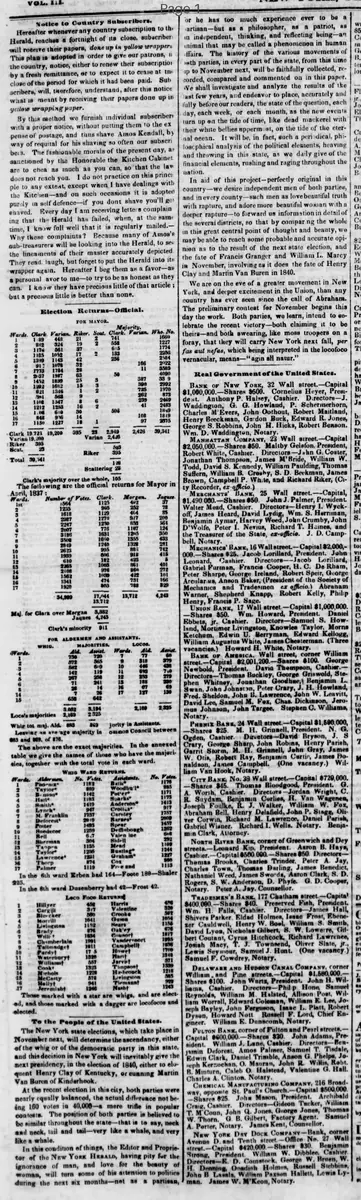
The New York state elections, which take place in November next, will determine the ascendancy, either of the whig or of the democratic party in this state, and this decision in New York will inevitably give the next presidency, in the election of 1840, either to eloquent Henry Clay of Kentucky, or cunning Martin Van Buren of Kinderhook.
At the recent election in this city, both parties were nearly equally balanced, the actual difference not being 160 votes in 40,000—a mere trifle in popular contests. The position of both parties is believed to be similar throughout the state—that is to say, neck and neck, tail and tail—very like a whale, and very like a whale.
In this condition of things, the Editor and Proprietor of the New York Herald, having pity for the ignorance of man, and love for the beauty of woman, will turn some of his attention to politics during the next six months—not as a partisan, or he has too much experience ever to be a artisan—but as a philosopher, as a patriot, as an independent, thinking, and reflecting being—an animal that may be called a phenomenon in human affairs. The history of the various movements of each parties, in every part of the state, from this time up to November next, will be faithfully collected, recorded, compared and commented on in this paper.
We shall investigate and analyze the results of the last few years, and endeavor to place, accurately and fully before our readers, the state of the question, each day, each week, or each month, as the new events turn up on the tide of time, like dead mackerel with their white bellies uppermost, on the tide of the eternal ocean. It will be, in fact, such a periodical, philosophical analysis of the political elements, heaving and throwing in this state, as we daily give of the financial elements, rushing and raging throughout the nation.
In aid of this project—perfectly original in this country—we desire independent men of both parties, and in every county—such men as love beautiful truth with rapture, and adore more beautiful woman with a deeper rapture—to forward us information in detail of the several districts, so that by comparing the whole in this great central point of thought and beauty, we may be able to reach some probable and accurate opinion as to the result of the next state election, and the fate of Francis Granger and William L. Marcy in November, involving as it does the fate of Henry Clay and Martin Van Buren in 1840.
We are on the eve of a greater movement in New York, and deeper excitement in the Union, than any country has ever seen since the call of Abraham. The preliminary contest for November begins this day the work. Both parties, we learn, intend to celebrate the recent victory—both claiming it to be theirs—and both swearing, like moss troopers on a foray, that they will carry New York next fall, per fas aut nefas, which being interpreted in the locofoco vernacular, means—'agin all natur.'
The New York state elections, which take place in November next, will determine the ascendancy, either of the whig or of the democratic party in this state, and this decision in New York will inevitably give the next presidency, in the election of 1840, either to eloquent Henry Clay of Kentucky, or cunning Martin Van Buren of Kinderhook.
At the recent election in this city, both parties were nearly equally balanced, the actual difference not being 160 votes in 40,000—a mere trifle in popular contests. The position of both parties is believed to be similar throughout the state—that is to say, neck and neck, tail and tail—very like a whale, and very like a whale.
In this condition of things, the Editor and Proprietor of the New York Herald, having pity for the ignorance of man, and love for the beauty of woman, will turn some of his attention to politics during the next six months—not as a partisan, or he has too much experience ever to be a artisan—but as a philosopher, as a patriot, as an independent, thinking, and reflecting being—an animal that may be called a phenomenon in human affairs. The history of the various movements of each parties, in every part of the state, from this time up to November next, will be faithfully collected, recorded, compared and commented on in this paper.
We shall investigate and analyze the results of the last few years, and endeavor to place, accurately and fully before our readers, the state of the question, each day, each week, or each month, as the new events turn up on the tide of time, like dead mackerel with their white bellies uppermost, on the tide of the eternal ocean. It will be, in fact, such a periodical, philosophical analysis of the political elements, heaving and throwing in this state, as we daily give of the financial elements, rushing and raging throughout the nation.
In aid of this project—perfectly original in this country—we desire independent men of both parties, and in every county—such men as love beautiful truth with rapture, and adore more beautiful woman with a deeper rapture—to forward us information in detail of the several districts, so that by comparing the whole in this great central point of thought and beauty, we may be able to reach some probable and accurate opinion as to the result of the next state election, and the fate of Francis Granger and William L. Marcy in November, involving as it does the fate of Henry Clay and Martin Van Buren in 1840.
We are on the eve of a greater movement in New York, and deeper excitement in the Union, than any country has ever seen since the call of Abraham. The preliminary contest for November begins this day the work. Both parties, we learn, intend to celebrate the recent victory—both claiming it to be theirs—and both swearing, like moss troopers on a foray, that they will carry New York next fall, per fas aut nefas, which being interpreted in the locofoco vernacular, means—'agin all natur.'
What sub-type of article is it?
Partisan Politics
What keywords are associated?
New York Elections
1840 Presidency
Henry Clay
Martin Van Buren
Whig Democratic Parties
Political Analysis
State Election
What entities or persons were involved?
Henry Clay
Martin Van Buren
Francis Granger
William L. Marcy
Whig Party
Democratic Party
New York Herald
Editorial Details
Primary Topic
New York State Elections Impact On 1840 Presidency
Stance / Tone
Independent Philosophical Analysis
Key Figures
Henry Clay
Martin Van Buren
Francis Granger
William L. Marcy
Whig Party
Democratic Party
New York Herald
Key Arguments
New York Elections Will Decide Party Ascendancy And 1840 Presidency
Parties Are Closely Balanced Statewide
Herald Will Provide Non Partisan Coverage And Analysis
Seeks Information From Independent Men In Counties
Anticipates Great Political Excitement