Thank you for visiting SNEWPapers!
Sign up free
The Meeker Herald
Meeker, Rio Blanco County, Garfield County, Colorado
What is this article about?
Article by W.A. Radford on building an efficient 34x36 ft plank dairy barn with modern features like ventilation, lightning protection, labor-saving carriers, stanchions, drinking cups, feed rooms, silo, and milk house for 12 cows and 6 horses to boost milk production and farm operations.
Merged-components note: Merged dairy barn construction article with its two accompanying illustrations based on spatial proximity and reading order.
Clipping
OCR Quality
Full Text
Type of Structure That Contains All Modern Equipment.
VENTILATION IS IMPORTANT
Design Provides Accommodations for Twelve Cows and Six Horses Well Built and Protected Against the Elements.
By W. A. RADFORD.
Mr. William A. Radford will answer questions and give advice FREE OF COST on all subjects pertaining to the subject of building work on the farm, for the readers of this paper. On account of his wide experience as Editor, Author and Manufacturer, he is without doubt, the highest authority on all these subjects. Address all inquiries to William A. Radford, No. 1827 Prairie avenue, Chicago, Ill., and only enclose two-cent stamp for reply.
Whenever you see a good looking herd of healthy cows, you can immediately conclude that they are well fed and housed. Unless a cow is protected by a modern, substantial home, she is not likely to be a heavy producer. There are several essential features in the construction of a dairy barn that will aid in increasing production and the barn shown here contains many of those features.
In the first place it should be firmly built and protected against the elements of wind, lightning, etc. If you will notice, this barn has been equipped with lightning rods. Every year the toll exacted by this single element amounts to $8,000,000. And the heaviest loss is found among farm buildings. In a recent report the United States department of agriculture stated that 95 per cent of this loss can be averted by the use of efficient lightning rod systems.
Another important feature of barn construction, and one that has been taken care of in this building, is ventilation. The health of the animals housed in a barn of this kind depends primarily on the supply and kind of air they have to breathe. Unless the barn has been built so as to provide a maximum of fresh air the effect will be noticed in the animals' output.
This barn has been fitted with the most modern ventilating system, and all the foul air is drawn off through foul air flues which lead from all parts of the barn.
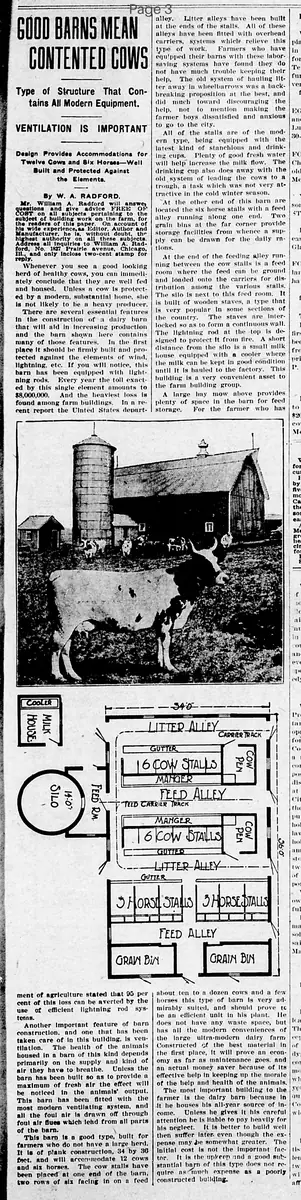
This barn is a good type, built for farmers who do not have a large herd. It is of plank construction, 34 by 36 feet, and will accommodate 12 cows and six horses. The cow stalls have been placed at one end of the barn, two rows of six facing in on a feed alley. Litter alleys have been built at the ends of the stalls. All of these alleys have been fitted with overhead carriers, systems which relieve this type of work.
Farmers who have equipped their barns with these labor-saving systems have found they do not have much trouble keeping their help. The old system of hauling litter away in wheelbarrows was a back-breaking proposition at the best, and did much toward discouraging the help, not to mention making the farmer boys dissatisfied and anxious to go to the city.
All of the stalls are of the modern type, being equipped with the latest kind of stanchions and drinking cups. Plenty of good fresh water will help increase the milk flow. The drinking cup also does away with the old system of leading the cows to a trough, a task which was not very attractive in the cold winter season.
At the other end of this barn are located the six horse stalls with a feed alley running along one end. Two grain bins at the far corner provide storage facilities from whence a supply can be drawn for the daily rations.
At the end of the feeding alley running between the cow stalls is a feed room where the feed can be ground and loaded onto the carriers for distribution among the various stalls.
The silo is next to this feed room. It is built of wooden staves, a type that is very popular in some sections of the country. The staves are interlocked so as to form a continuous wall. The lightning rod at the top is designed to protect it from fire.
A short distance from the silo is a small milk house equipped with a cooler where the milk can be kept in good condition until it is hauled to the factory. This building is a very convenient asset to the farm building group.
A large hay mow above provides plenty of space in the barn for feed storage.
For the farmer who has about ten to a dozen cows and a few horses this type of barn is very admirably suited, and should prove to be an efficient unit in his plant. He does not have any waste space, but has all the modern conveniences of the large ultra-modern dairy farm.
Constructed of the best material in the first place, it will prove an economy as far as maintenance goes, and an actual money saver because of its effective help in keeping up the morale of the help and health of the animals.
The most important building to the farmer is the dairy barn because in it he houses his all-year source of income. Unless he gives it his careful attention he is liable to pay heavily for his neglect. It is better to build well then suffer later even though the expense may be somewhat greater. The initial cost is not the important factor. It is the upkeep and a good substantial barn of this type does not require as much expense as a poorly constructed building.
What sub-type of article is it?
What keywords are associated?
What entities or persons were involved?
Story Details
Key Persons
Story Details
Description of a modern dairy barn design for 12 cows and 6 horses, featuring ventilation, lightning rods, stanchions, drinking cups, feed alleys, silo, and milk house to enhance production and worker satisfaction.