Thank you for visiting SNEWPapers!
Sign up free
Literary
September 8, 1899
Marshall County Independent
Plymouth, Marshall County, Indiana
What is this article about?
Humorous domestic tale of Mr. Boobingle negotiating with his wife over buying a new bonnet amid financial concerns, involving flattery and threats to his club membership. Includes backstory of the failed Bowler Bachelors' club reformed as Hearty Eaters. She gets the hat, costing $50 total.
Clipping
OCR Quality
98%
Excellent
Full Text
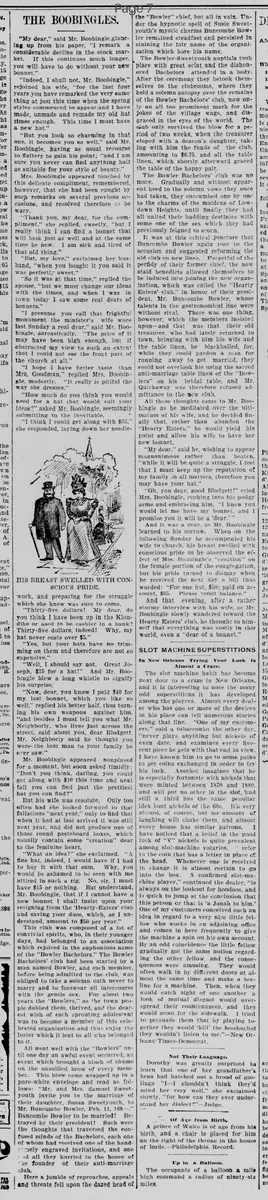
THE BOOBINGLES.
"My dear," said Mr. Boobingle, glancing up from his paper, "I remark a considerable decline in the stock market. If this continues much longer, you will have to do without your new bonnet."
"Indeed I shall not, Mr. Boobingle," rejoined his wife, "for the last four years you have remarked the very same thing at just this time when the spring styles commenced to appear, and I have made, unmade and remade my old hat times enough. This time I must have a new hat."
"But you look so charming in that one, it becomes you so well," said Mr. Boobingle, having as usual recourse to flattery to gain his point; "and I am sure you never can find anything half as suitable for your style of beauty."
Mrs. Boobingle appeared touched by this delicate compliment, remembered, however, that she had been caught by such remarks on several previous occasions, and resolved therefore to be wary.
"Thank you, my dear, for the compliment," she replied sweetly, "but I really think I can find a bonnet that will look just as well and at the same time be new. I am sick and tired of that old thing."
"But, my love," exclaimed her husband, "when you bought it you said it was perfectly sweet."
"So it was at that time," replied the spouse, "but we must change our ideas with the times, and when I was in town today I saw some real dears of bonnets."
"I presume you call that frightful monument the minister's wife wore last Sunday a real dear," said Mr. Boobingle, sarcastically. "The price of it may have been high enough, but it obstructed my view to such an extent that I could not see the front part of the church at all."
"I hope I have better taste than Mrs. Goodman," replied Mrs. Boobingle, modestly. "It really is pitiful the way she dresses."
"How much do you think you would need for a hat that would suit your ideas?" asked Mr. Boobingle, seemingly submitting to the inevitable.
"I think I could get along with $35," she responded, laying down her needlework, and preparing for the struggle which she knew was sure to come.
"Thirty-five dollars! My dear, do you think I have been up in the Klondike or used to be cashier in a bank? Thirty-five dollars, indeed! Why, my hat never costs over $5."
"Yes, but your hats have no trimming on them and therefore are not so expensive."
"Well, I should say not. Great Joseph, $35 for a hat!" And Mr. Boobingle blew a long whistle to signify his surprise.
"Now, dear, you know I paid $40 for my last bonnet, which you like so well," replied his better half, thus turning his own weapons against him, "and besides I must tell you what Mr. Neighborly, who lives just across the street, said about you, dear Blodgett. Mr. Neighborly said he thought you were the best man to your family he ever saw."
Mr. Boobingle appeared nonplused for a moment, but soon asked timidly:
"Don't you think, darling, you could get along with $10 this time and next fall you can find just the prettiest hat you can find?"
But his wife was resolute. Only too often had she looked forward to that fallacious "next year," only to find that when it had at last arrived it was still next year, and did not produce one of those round pasteboard boxes, which usually contain some "creation" dear to the feminine heart.
"What an idea!" she exclaimed. "A fine hat, indeed, I would have if I had to buy it with that sum. Why, you would be ashamed to be seen with me attired in such a rig. No, sir. I must have $15 or nothing. But understand, Mr. Boobingle, that if I cannot have a new bonnet I shall insist upon your resigning from the 'Hearty-Eaters' club and saving your dues, which, as I understand, amount to $50 per year."
This club was composed of a lot of convivial spirits, who, in their younger days, had belonged to an association which rejoiced in the euphonious name of the "Bowler Bachelors." The Bowler Bachelors' club had been started by a man named Bowler, and each member, before being admitted to the club, was obliged to take a solemn oath never to marry and to forswear all intercourse with the gentle sex. For about two years the "Bowlers," as the town people dubbed them, thrived, and the dearest wish of each sprouting adolescent was to become a member of this celebrated organization and thus enjoy the luster which it lent to all who belonged to it.
All went well with the "Bowlers" until one day an awful event occurred, an event which brought a blush of shame on the unsullied brow of every member. This blow came wrapped up in a pure-white envelope and read as follows: "Mr. and Mrs. Samuel Sweet youth invite you to the marriage of their daughter, Susan Sweetyouth, to Mr. Buncombe Bowler. Feb. 11, 188—."
Buncombe Bowler to be married! Betrayed by their president! Such were the thoughts that traversed the confused minds of the Bachelors, each one of whom had received one of the handsomely engraved invitations, and in all they hurried to the house of the founder of their anti-marriage club.
Here a jumble of reproaches, appeals and threats fell upon the dazed head of the "Bowler" chief, but all in vain. Under the hypnotic spell of Susie Sweetyouth's mystic charms Buncombe Bowler remained steadfast and persisted in staining the fair name of the organization which bore his name.
The Bowler-Sweetyouth nuptials took place with great eclat and the dishonored Bachelors attended in a body. After the ceremony they betook themselves to the clubrooms, where they held a solemn autopsy over the remains of the Bowler Bachelors' club, now only an all too prominent mark for the jokes of the village wags, and disgraced in the eyes of the world. The club only survived the blow for a period of two weeks, when the treasurer eloped with a deacon's daughter, taking with him the funds of the club, amounting to $6.75, and all the table linen, which shortly afterward graced the table of the happy pair.
The Bowler Bachelors' club was no more. Gradually and without apparent heed to the solemn vows they once had taken, they succumbed one by one to the charms of the maidens of Lowdown Heights, until finally they had all united their budding destinies with some one of the sex which they had previously feigned to scorn.
It was at this critical juncture that Buncombe Bowler again rose to the occasion and suggested reforming the old club on new lines. Forgetful of the perfidy of their former chief, the now staid benedicts allowed themselves to be induced into joining the new organization, which was called the "Hearty Eaters' club," in honor of their president, Mr. Buncombe Bowler, whose talents in the gastronomical line were without rival. There was one thing, however, which the members insisted upon—and that was that their old treasurer, who had lately returned to town, bringing with him his wife and the table linen, be blackballed, for while they could pardon a man for running away to get married, they could not overlook his using the sacred anti-marriage table linen of the "Bowlers" on his bridal table, and Mr. Quickaway was therefore refused admittance to the new club.
All these thoughts came to Mr. Boobingle as he meditated over the ultimatum of his wife, and he decided finally that, rather than abandon the "Hearty Eaters," he would yield his point and allow his wife to have her new bonnet.
"My dear," said he, wishing to appear magnanimous rather than beaten, "while it will be quite a struggle, I feel that I must keep up the reputation of my family in all matters, therefore you may have your hat."
"Oh, you dear, good Blodgett!" cried Mrs. Boobingle, rushing into his pudgy arms and embracing him. "I knew you would let me have my bonnet, and I promise you it will be a 'dear.'"
And it was a dear, as Mr. Boobingle learned to his sorrow. When on the following Sunday he accompanied his wife to church, his breast swelled with conscious pride as he observed the effect of Mrs. Boobingle's "creation" on the female portion of the congregation but his pride turned to dismay when he received the next day a bill thus worded: "For one hat, $50; paid on account, $35. Please remit balance."
And that evening after a rather stormy interview with his wife, as Mr. Boobingle slowly wandered toward the Hearty Eaters' club, he thought to himself that everything was costly in this world, even a "dear of a bonnet."
"My dear," said Mr. Boobingle, glancing up from his paper, "I remark a considerable decline in the stock market. If this continues much longer, you will have to do without your new bonnet."
"Indeed I shall not, Mr. Boobingle," rejoined his wife, "for the last four years you have remarked the very same thing at just this time when the spring styles commenced to appear, and I have made, unmade and remade my old hat times enough. This time I must have a new hat."
"But you look so charming in that one, it becomes you so well," said Mr. Boobingle, having as usual recourse to flattery to gain his point; "and I am sure you never can find anything half as suitable for your style of beauty."
Mrs. Boobingle appeared touched by this delicate compliment, remembered, however, that she had been caught by such remarks on several previous occasions, and resolved therefore to be wary.
"Thank you, my dear, for the compliment," she replied sweetly, "but I really think I can find a bonnet that will look just as well and at the same time be new. I am sick and tired of that old thing."
"But, my love," exclaimed her husband, "when you bought it you said it was perfectly sweet."
"So it was at that time," replied the spouse, "but we must change our ideas with the times, and when I was in town today I saw some real dears of bonnets."
"I presume you call that frightful monument the minister's wife wore last Sunday a real dear," said Mr. Boobingle, sarcastically. "The price of it may have been high enough, but it obstructed my view to such an extent that I could not see the front part of the church at all."
"I hope I have better taste than Mrs. Goodman," replied Mrs. Boobingle, modestly. "It really is pitiful the way she dresses."
"How much do you think you would need for a hat that would suit your ideas?" asked Mr. Boobingle, seemingly submitting to the inevitable.
"I think I could get along with $35," she responded, laying down her needlework, and preparing for the struggle which she knew was sure to come.
"Thirty-five dollars! My dear, do you think I have been up in the Klondike or used to be cashier in a bank? Thirty-five dollars, indeed! Why, my hat never costs over $5."
"Yes, but your hats have no trimming on them and therefore are not so expensive."
"Well, I should say not. Great Joseph, $35 for a hat!" And Mr. Boobingle blew a long whistle to signify his surprise.
"Now, dear, you know I paid $40 for my last bonnet, which you like so well," replied his better half, thus turning his own weapons against him, "and besides I must tell you what Mr. Neighborly, who lives just across the street, said about you, dear Blodgett. Mr. Neighborly said he thought you were the best man to your family he ever saw."
Mr. Boobingle appeared nonplused for a moment, but soon asked timidly:
"Don't you think, darling, you could get along with $10 this time and next fall you can find just the prettiest hat you can find?"
But his wife was resolute. Only too often had she looked forward to that fallacious "next year," only to find that when it had at last arrived it was still next year, and did not produce one of those round pasteboard boxes, which usually contain some "creation" dear to the feminine heart.
"What an idea!" she exclaimed. "A fine hat, indeed, I would have if I had to buy it with that sum. Why, you would be ashamed to be seen with me attired in such a rig. No, sir. I must have $15 or nothing. But understand, Mr. Boobingle, that if I cannot have a new bonnet I shall insist upon your resigning from the 'Hearty-Eaters' club and saving your dues, which, as I understand, amount to $50 per year."
This club was composed of a lot of convivial spirits, who, in their younger days, had belonged to an association which rejoiced in the euphonious name of the "Bowler Bachelors." The Bowler Bachelors' club had been started by a man named Bowler, and each member, before being admitted to the club, was obliged to take a solemn oath never to marry and to forswear all intercourse with the gentle sex. For about two years the "Bowlers," as the town people dubbed them, thrived, and the dearest wish of each sprouting adolescent was to become a member of this celebrated organization and thus enjoy the luster which it lent to all who belonged to it.
All went well with the "Bowlers" until one day an awful event occurred, an event which brought a blush of shame on the unsullied brow of every member. This blow came wrapped up in a pure-white envelope and read as follows: "Mr. and Mrs. Samuel Sweet youth invite you to the marriage of their daughter, Susan Sweetyouth, to Mr. Buncombe Bowler. Feb. 11, 188—."
Buncombe Bowler to be married! Betrayed by their president! Such were the thoughts that traversed the confused minds of the Bachelors, each one of whom had received one of the handsomely engraved invitations, and in all they hurried to the house of the founder of their anti-marriage club.
Here a jumble of reproaches, appeals and threats fell upon the dazed head of the "Bowler" chief, but all in vain. Under the hypnotic spell of Susie Sweetyouth's mystic charms Buncombe Bowler remained steadfast and persisted in staining the fair name of the organization which bore his name.
The Bowler-Sweetyouth nuptials took place with great eclat and the dishonored Bachelors attended in a body. After the ceremony they betook themselves to the clubrooms, where they held a solemn autopsy over the remains of the Bowler Bachelors' club, now only an all too prominent mark for the jokes of the village wags, and disgraced in the eyes of the world. The club only survived the blow for a period of two weeks, when the treasurer eloped with a deacon's daughter, taking with him the funds of the club, amounting to $6.75, and all the table linen, which shortly afterward graced the table of the happy pair.
The Bowler Bachelors' club was no more. Gradually and without apparent heed to the solemn vows they once had taken, they succumbed one by one to the charms of the maidens of Lowdown Heights, until finally they had all united their budding destinies with some one of the sex which they had previously feigned to scorn.
It was at this critical juncture that Buncombe Bowler again rose to the occasion and suggested reforming the old club on new lines. Forgetful of the perfidy of their former chief, the now staid benedicts allowed themselves to be induced into joining the new organization, which was called the "Hearty Eaters' club," in honor of their president, Mr. Buncombe Bowler, whose talents in the gastronomical line were without rival. There was one thing, however, which the members insisted upon—and that was that their old treasurer, who had lately returned to town, bringing with him his wife and the table linen, be blackballed, for while they could pardon a man for running away to get married, they could not overlook his using the sacred anti-marriage table linen of the "Bowlers" on his bridal table, and Mr. Quickaway was therefore refused admittance to the new club.
All these thoughts came to Mr. Boobingle as he meditated over the ultimatum of his wife, and he decided finally that, rather than abandon the "Hearty Eaters," he would yield his point and allow his wife to have her new bonnet.
"My dear," said he, wishing to appear magnanimous rather than beaten, "while it will be quite a struggle, I feel that I must keep up the reputation of my family in all matters, therefore you may have your hat."
"Oh, you dear, good Blodgett!" cried Mrs. Boobingle, rushing into his pudgy arms and embracing him. "I knew you would let me have my bonnet, and I promise you it will be a 'dear.'"
And it was a dear, as Mr. Boobingle learned to his sorrow. When on the following Sunday he accompanied his wife to church, his breast swelled with conscious pride as he observed the effect of Mrs. Boobingle's "creation" on the female portion of the congregation but his pride turned to dismay when he received the next day a bill thus worded: "For one hat, $50; paid on account, $35. Please remit balance."
And that evening after a rather stormy interview with his wife, as Mr. Boobingle slowly wandered toward the Hearty Eaters' club, he thought to himself that everything was costly in this world, even a "dear of a bonnet."
What sub-type of article is it?
Prose Fiction
Satire
Dialogue
What themes does it cover?
Social Manners
Commerce Trade
Moral Virtue
What keywords are associated?
Domestic Humor
Bonnet Negotiation
Marriage Satire
Bachelors Club
Hearty Eaters
Financial Woes
Literary Details
Title
The Boobingles.
Key Lines
"My Dear," Said Mr. Boobingle, Glancing Up From His Paper, "I Remark A Considerable Decline In The Stock Market. If This Continues Much Longer, You Will Have To Do Without Your New Bonnet."
"Thirty Five Dollars! My Dear, Do You Think I Have Been Up In The Klondike Or Used To Be Cashier In A Bank? Thirty Five Dollars, Indeed! Why, My Hat Never Costs Over $5."
"Mr. And Mrs. Samuel Sweet Youth Invite You To The Marriage Of Their Daughter, Susan Sweetyouth, To Mr. Buncombe Bowler. Feb. 11, 188—."
"For One Hat, $50; Paid On Account, $35. Please Remit Balance."
And That Evening After A Rather Stormy Interview With His Wife, As Mr. Boobingle Slowly Wandered Toward The Hearty Eaters' Club, He Thought To Himself That Everything Was Costly In This World, Even A "Dear Of A Bonnet."