Thank you for visiting SNEWPapers!
Sign up free
Washington Sentinel
Washington, District Of Columbia
What is this article about?
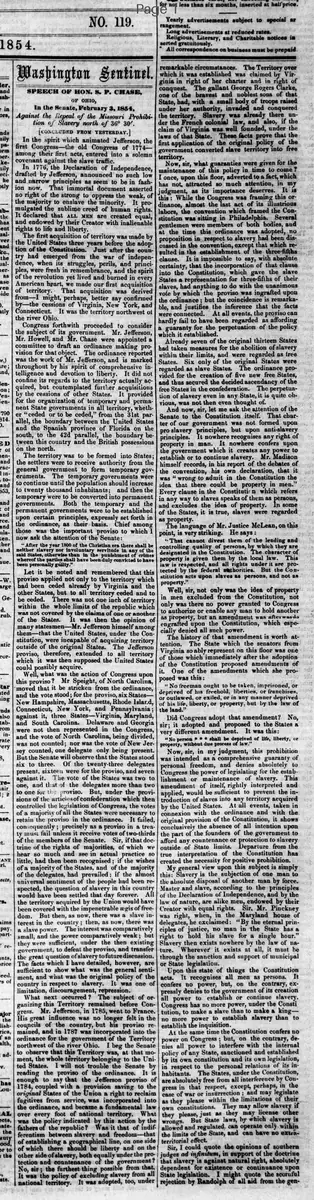
Sen. Salmon P. Chase's Senate speech against repealing the Missouri Compromise, citing historical anti-slavery policies from Jefferson's proviso and the 1787 Ordinance to argue that U.S. territorial policy favors freedom north of 36°30' and that repeal violates constitutional principles and national honor. (248 characters)
Merged-components note: Continuation of Senator S. P. Chase's speech on the Nebraska Bill and slavery prohibition, spanning from page 1 to page 2 with sequential reading order.
Clippings
1 of 2
OCR Quality
Full Text
In the Senate, February something,
Against the Repeal of the Missouri Prohibition of Slavery north of 36° 30'.
CONCLUDED FROM YESTERDAY.
In the spirit which animated Jefferson, the first Congress--the old Congress of 1774-- among their first acts, entered into a solemn covenant against the slave traffic.
In 1776, the Declaration of Independence, drafted by Jefferson, announced no such low and narrow principles as seem to be in fashion now. That immortal document asserted no right of the strong to oppress the weak, of the majority to enslave the minority. It promulgated the sublime creed of human rights.
It declared that ALL MEN are created equal, and endowed by their Creator with inalienable rights to life and liberty.
The first acquisition of territory was made by the United States three years before the adoption of the Constitution. Just after the country had emerged from the war of independence, when its struggles, perils, and principles, were fresh in remembrance, and the spirit of the revolution yet lived and burned in every American heart, we made our first acquisition of territory. That acquisition was derived from--I might, perhaps, better say confirmed by--the cessions of Virginia, New York, and Connecticut. It was the territory northwest of the river Ohio.
Congress forthwith proceeded to consider the subject of its government. Mr. Jefferson, Mr. Howell, and Mr. Chase were appointed a committee to draft an ordinance making provision for that object. The ordinance reported was the work of Mr. Jefferson, and is marked throughout by his spirit of comprehensive intelligence and devotion to liberty. It did not confine its regards to the territory actually acquired, but contemplated further acquisitions by the cessions of other States. It provided for the organization of temporary and permanent State governments in all territory, whether "ceded or to be ceded," from the 31st parallel, the boundary between the United States and the Spanish province of Florida on the south, to the 42d parallel, the boundary between this country and the British possessions on the north.
The territory was to be formed into States; the settlers were to receive authority from the general government to form temporary governments. The temporary governments were to continue until the population should increase to twenty thousand inhabitants; and then the temporary were to be converted into permanent governments. Both the temporary and the permanent governments were to be established upon certain principles, expressly set forth in the ordinance, as their basis. Chief among those was the important proviso to which I now ask the attention of the Senate:
"After the year 1800 of the Christian era there shall be neither slavery nor involuntary servitude in any of the said States, otherwise than in the punishment of crimes whereof the parties shall have been duly convicted to have been personally guilty."
Let it be noted and remembered that this proviso applied not only to the territory which had been ceded already by Virginia and the other States, but to all territory ceded and to be ceded. There was not one inch of territory within the whole limits of the republic which was not covered by the claims of one or another of the States. It was then the opinion of many statesmen--Mr. Jefferson himself among them--that the United States, under the Constitution, were incapable of acquiring territory outside of the original States. The Jefferson proviso, therefore, extended to all territory which it was then supposed the United States could possibly acquire.
Well, what was the action of Congress upon this proviso? Mr Speight, of North Carolina, moved that it be stricken from the ordinance, and the vote stood; for the proviso, six States-- New Hampshire, Massachusetts, Rhode Island, Connecticut, New York, and Pennsylvania; against it, three States--Virginia, Maryland, and South Carolina. Delaware and Georgia were not then represented in the Congress, and the vote of North Carolina, being divided, was not counted; nor was the vote of New Jersey counted, one delegate only being present.
But the Senate will observe that the States stood six to three. Of the twenty-three delegates present, sixteen were for the proviso, and seven against it. The vote of the States was two to one, and that of the delegates more than two to one for the proviso. But, under the provisions of the articles of confederation which then controlled the legislation of Congress, the votes of a majority of all the States were necessary to retain the proviso in the ordinance. It failed, consequently; precisely as a proviso in a treaty must fail unless it receive votes of two-thirds of the members of the Senate. Sir, if that doctrine of the rights of majorities, of which we hear so much and see in actual practice so little, had then been recognised; if the wishes of a majority of the States, and of the majority of the delegates, had prevailed: if the almost universal sentiment of the people had been respected, the question of slavery in this country would have been settled that day forever. All the territory acquired by the Union would have been covered with the impenetrable aegis of freedom. But then, as now, there was a slave interest in the country; then, as now, there was a slave power. The interest was comparatively small, and the power comparatively weak; but they were sufficient, under the then existing government, to defeat the proviso, and transfer the great question of slavery to future discussion.
The facts which I have detailed, however, are sufficient to show what was the general sentiment, and what was the original policy of the country in respect to slavery. It was one of limitation, discouragement, repression.
What next occurred? The subject of organizing this Territory remained before Congress. Mr. Jefferson, in 1785, went to France. His great influence was no longer felt in the councils of the country, but his proviso remained, and in 1787 was incorporated into the ordinance for the government of the Territory northwest of the river Ohio. I beg the Senate to observe that this Territory was, at that moment, the whole territory belonging to the United States. I will not trouble the Senate by reading the proviso of the ordinance. It is enough to say that the Jefferson proviso of 1784, coupled with a provision saving to the original States of the Union a right to reclaim fugitives from service, was incorporated into the ordinance, and became a fundamental law over every foot of national territory. What was the policy indicated by this action by the fathers of the republic? Was it that of indifferentism between slavery and freedom--that of establishing a geographical line, on one side of which there should be liberty and on the other side slavery, both equally under the protection and countenance of the government? No, sir; the furthest thing possible from that.
It was the policy of excluding slavery from all national territory. It was adopted, too, under remarkable circumstances. The Territory over which it was established was claimed by Virginia in right of her charter and in right of conquest. The gallant George Rogers Clarke, one of the bravest and noblest sons of that State, had, with a small body of troops raised under her authority, invaded and conquered the territory. Slavery was already there under the French colonial law, and also, if the claim of Virginia was well founded, under the laws of that State.
These facts prove that the first application of the original policy of the government converted slave territory into free territory.
Now, sir, what guaranties were given for the maintenance of this policy in time to come? I once, upon this floor, adverted to a fact, which has not attracted so much attention, in my judgment, as its importance deserves. It is this : While the Congress was framing this ordinance, almost the last act of its illustrious labors, the convention which framed the Constitution was sitting in Philadelphia. Several gentlemen were members of both bodies, and at the time this ordinance was adopted, no proposition in respect to slavery had been discussed in the convention, except that which resulted in the establishment of the three-fifths clause. It is impossible to say, with absolute certainty, that the incorporation of that clause into the Constitution, which gave the slave States a representation for three-fifths of their slaves, had anything to do with the unanimous vote by which the proviso was ingrafted upon the ordinance; but the coincidence is remarkable, and justifies the inference that the acts were connected. At all events, the proviso can hardly fail to have been regarded as affording a guaranty for the perpetuation of the policy which it established.
Already seven of the original thirteen States had taken measures for the abolition of slavery within their limits, and were regarded as free States. Six only of the original States were regarded as slave States. The ordinance provided for the creation of five new free States, and thus secured the decided ascendancy of the free States in the confederation. The perpetuation of slavery even in any State, it is quite obvious, was not then even thought of.
And now, sir, let me ask the attention of the Senate to the Constitution itself. That charter of our government was not formed upon pro-slavery principles, but upon anti-slavery principles. It nowhere recognises any right of property in man. It nowhere confers upon the government which it creates any power to establish or to continue slavery. Mr. Madison himself records, in his report of the debates of the convention, his own declaration, that it was "wrong to admit in the Constitution the idea that there could be property in men."
Every clause in the Constitution which refers in any way to slaves speaks of them as persons, and excludes the idea of property. In some of the States, it is true, slaves were regarded as property.
The language of Mr. Justice McLean, on this point, is very striking. He says:
"That cannot divest them of the leading and controlling quality of persons, by which they are designated in the Constitution. The character of property is given them by the local law. This law is respected, and all rights under it are protected by the federal authorities. But the Constitution acts upon slaves as persons, and not as property."
Well, sir, not only was the idea of property in men excluded from the Constitution, not only was there no power granted to Congress to authorize or enable any man to hold another as property, but an amendment was afterwards engrafted upon the Constitution, which especially denied all such power.
The history of that amendment is worth attention. The State which the senators from Virginia so ably represent on this floor was one of those which immediately after the adoption of the Constitution proposed amendments of it. One of the amendments which she proposed was this:
"No freeman ought to be taken, imprisoned, or deprived of his freehold, liberties, or franchises, or outlawed, or exiled, or in any manner deprived of his life, liberty, or property, but by the law of the land."
Did Congress adopt that amendment? No, sir; it adopted and proposed to the States a very different amendment. It was this:
"No person shall be deprived of life, liberty, or property, without due process of law."
Now, sir, in my judgment, this prohibition was intended as a comprehensive guaranty of personal freedom, and denies absolutely to Congress the power of legislating for the establishment or maintenance of slavery. This amendment of itself, rightly interpreted and applied, would be sufficient to prevent the introduction of slaves into any territory acquired by the United States. At all events, taken in connexion with the ordinance and with the original provision of the Constitution, it shows conclusively the absence of all intention upon the part of the founders of the government to afford any countenance or protection to slavery outside of State limits. Departure from the true interpretation of the Constitution has created the necessity for positive prohibition.
My general view upon this subject is simply this: Slavery is the subjection of one man to the absolute disposal of another man by force. Master and slave, according to the principles of the Declaration of Independence, and by the law of nature, are alike men, endowed by their Creator with equal rights. Sir, Mr. Pinckney was right, when, in the Maryland house of delegates, he exclaimed: "By the eternal principles of justice, no man in the State has a right to hold his slave for a single hour."
Slavery then exists nowhere by the law of nature. Wherever it exists at all, it must be through the sanction and support of municipal or State legislation.
Upon this state of things the Constitution acts. It recognises all men as persons. It confers no power, but, on the contrary, expressly denies to the government of its creation all power to establish or continue slavery.
Congress has no more power, under the Constitution, to make a slave than to make a king-- no more power to establish slavery than to establish the inquisition.
At the same time the Constitution confers no power on Congress; but, on the contrary, denies all power to interfere with the internal policy of any State, sanctioned and established by its own constitution and its own legislation, in respect to the personal relations of its inhabitants. The States, under the Constitution, are absolutely free from all interference by Congress in that respect, except, perhaps, in the case of war or insurrection; and may legislate as they please within the limitations of their own constitutions. They may allow slavery if they please, just as they may license other wrongs. But State laws, by which slavery is allowed and regulated, can operate only within the limits of the State, and can have no extra-territorial effect.
Sir, I could quote the opinions of southern judges ad infinitum, in support of the doctrine that slavery is against natural right, absolutely dependent for existence or continuance upon State legislation. I might quote the scornful rejection by Randolph of all aid from the general government to sustain slavery in the States. But I forbear.
In the Territories, the case is different. There the general government is supreme. There the municipal law is that which is prescribed by Congress. There, if anywhere, freedom must be the rule, slavery the exception. There, if Congress has power to legislate at all, it must legislate for freedom. There, if anywhere, the great principles of the Declaration of Independence, that all men are created equal, and endowed by their Creator with inalienable rights to life, liberty, and the pursuit of happiness, must be held sacred and inviolable.
But, sir, the policy of the government in respect to the Territories has been uniform from the beginning. It has been a policy of freedom. The ordinance of 1787 is the key to the whole subject. That ordinance was adopted almost contemporaneously with the Constitution. It was adopted by the unanimous vote of all the States represented in Congress. It was adopted while the Constitution was in process of formation. It was adopted by many of the very men who formed the Constitution. It was adopted to carry out the policy of freedom in the national Territories. It was the complement of the Constitution. It was the guaranty that the policy of freedom should be perpetual. It was the Magna Charta of American liberty.
The ordinance was not a temporary expedient. It was a permanent policy. It was not a local regulation. It was a national policy. It was not a mere territorial law. It was a fundamental law of the republic.
The ordinance was the basis of all subsequent legislation on the subject. It was the model for all future action. It was the precedent for all time.
The policy of the ordinance was reaffirmed by every subsequent acquisition of territory. It was reaffirmed by the treaty with France in 1803. It was reaffirmed by the treaty with Spain in 1819. It was reaffirmed by the treaty with Mexico in 1848. It was reaffirmed by every act of Congress organizing territorial governments.
The Missouri Compromise was but a reaffirmation of the policy of the ordinance. It was a recognition of the principle that slavery should be excluded from the Territories north of 36° 30'. It was a compromise between the North and the South, by which the North surrendered the right to exclude slavery from the territory south of that line, and the South agreed to exclude it from the territory north of it.
The compromise was a solemn pledge, a sacred compact, between the sections of the country. It was a pledge that the policy of freedom should be maintained in the territory north of 36° 30', and that the institution of slavery should be tolerated in the territory south of it. It was a pledge that the rights of property in the States should be respected, and that the rights of freedom in the Territories should be preserved.
The compromise was not a mere temporary arrangement. It was a permanent settlement. It was not a local regulation. It was a national policy. It was not a mere territorial law. It was a fundamental law of the republic.
The repeal of the Missouri Compromise is a violation of the pledge, a breach of the compact, a subversion of the policy. It is an act of bad faith, a wrong to the North, an outrage upon the South. It is a step backward toward the dark ages, a relapse into barbarism, a return to the principles of the inquisition.
Sir, the repeal of the Missouri Compromise is not only a violation of the pledge, a breach of the compact, a subversion of the policy; it is also a violation of the Constitution. The Constitution confers no power upon Congress to repeal the compromise. The compromise is as much a part of the Constitution as any other act of Congress. It is as binding as any treaty. It is as sacred as any amendment.
The compromise is the law of the land. It is the supreme law of the land. It is the fundamental law of the republic. It is the Magna Charta of American liberty.
The repeal of the compromise is not only a violation of the Constitution; it is also a violation of the rights of the people. The people have a right to the enjoyment of the Territories. The Territories are the common property of the people. The people have a right to go into the Territories with their property, their labor, their liberty. The people have a right to the free enjoyment of the Territories, without the intrusion of slavery.
The repeal of the compromise is an invitation to slavery to enter the Territories. It is an open door to the slaveholder. It is a license to the slave trader. It is a premium upon the slave breeder. It is a tax upon the free laborer.
Sir, the repeal of the Missouri Compromise is a great wrong. It is a wrong to the North, a wrong to the South, a wrong to the whole country. It is a wrong to freedom, a wrong to humanity, a wrong to God.
I call upon the Senate to pause, to reflect, to reconsider. I call upon the Senate to stand by the Constitution, to stand by the compromise, to stand by the policy of the fathers. I call upon the Senate to defend the rights of the people, to defend the rights of freedom, to defend the rights of man.
I call upon the Senate to reject the repeal of the Missouri Compromise. I call upon the Senate to sustain the policy of freedom. I call upon the Senate to maintain the honor of the republic. I call upon the Senate to preserve the liberties of the people.
eral government to the institution of slavery within the States. I might quote the decision of the celebrated Chancellor Wythe, of Virginia, (overruled afterwards, I know, in the court of appeals,) 'that slavery was so against justice, that the presumption of freedom must be allowed in favor of every alleged slave suing for liberty, and that the onus of proving the contrary rested upon the master.'
I think I have now shown that the ordinance of 1787 and the Constitution of the United States were absolutely in harmony one with the other; and that if the ordinance had never been adopted, the Constitution itself, properly interpreted and administered, would have excluded slavery from all newly-acquired territory. But, sir, whatever opinion may be entertained in respect to the interpretation of the Constitution which I deem, one thing is absolutely indisputable, and that is, that it was the original policy of the country to exclude slavery from all national territory.
That policy was never departed from until the year 1790, when Congress accepted the cession of what is now Tennessee from North Carolina. But did the acceptance of that cession indicate any purpose of establishing a geographical line between slavery and freedom? Why, sir, on the contrary, the State of North Carolina, aware that in the absence of any stipulation to the contrary slavery would be prohibited in the ceded territory in pursuance of the established policy of the government, introduced into her deed of cession an express provision that the anti-slavery article of the ordinance of 1787 should not be applied to it. It may be said that Congress should have refused to accept the cession. I agree in that opinion. But slavery already existed in the district as part of the State of North Carolina, and it was probably thought unreasonable to deny the wish of the State for its continuance.
The same motives decided the action of Georgia, in 1802, in making her cession of the territory between her western limits and the Mississippi, and the action of Congress accepting it. The acceptance of these cessions, as well as the adoption and re-enactment by Congress of the slave laws of Maryland for the District of Columbia, were departures from original policy; but they indicated no purpose to establish any geographical line. They were the result of the gradually increasing indifference to the claims of freedom, plainly perceptible in the history of the country after the adoption of the Constitution. Luther Martin had complained, in 1788, that 'when our own liberties were at stake we warmly felt for the common rights of man. The danger being thought to be passed which threatened ourselves, we are daily growing more and more insensible to those rights.' It was this growing insensibility which led to these departures from original policy. Afterwards, in 1803, Louisiana was acquired from France. Did we then hasten to establish a geographical line? No, sir. In Louisiana, as in the territories acquired from Georgia and North Carolina, Congress refrained from applying the policy of 1787; Congress did not interfere with existing slavery: Congress contented itself with enactments prohibiting absolutely the introduction of slaves from beyond the limits of the United States and also prohibiting their introduction from any of the States, except by bona fide owners actually removing to Louisiana for settlement. When Louisiana was admitted into the Union in 1812, no restriction was imposed upon her in respect to slavery. At this time, there were slaves all along up the west bank of the Mississippi as far as St. Louis, and perhaps even above.
In 1818 Missouri applied for admission into the Union. The free States awoke to the danger of the total overthrow of the original policy of the country. They saw that no State had taken measures for the abolition of slavery since the adoption of the Constitution. They saw that the feeble attempt to restrict the introduction of slaves into the territories acquired from Georgia and from France had utterly failed. They insisted, therefore, that, in the formation of a constitution, the people of the proposed State should embody in it a provision for the gradual abolition of the existing slavery, and prohibiting the further introduction of slaves. By this time the slave interest had become strong, and the slave power was pretty firmly established. The demand of the free States was vehemently contested. A bill preparatory to the admission of Missouri, containing the proposed restriction, was passed by the House and sent to the Senate. In that body the bill was amended by striking out the restriction. The House refused to concur in the amendment; the Senate insisted upon it, and the bill failed. At the next session of Congress the controversy was renewed. In the mean time, Maine had been severed from Massachusetts, had adopted a constitution, and had applied for admission into the Union. A bill providing for her admission passed the House, and was sent to the Senate. This bill was amended in the Senate by tacking to it a bill for the admission of Missouri, and by the addition of a section prohibiting slavery in all the territory acquired by Louisiana north of 36° 30'. The House refused to concur in these amendments, and the Senate asked for a committee of conference, to which the House agreed.
During the progress of these events, the House, after passing the Maine bill, had also passed a bill for the admission of Missouri, embodying the restriction upon slavery in the State. The Senate amended the bill by striking out the restriction, and by inserting the section prohibiting slavery north of 36° 30'.
This section came from the south, through Mr. Thomas, a senator from Illinois, who had uniformly voted with the slave States against all restriction. It was adopted on the 17th of February, 1820, as an amendment to the Maine and Missouri bill, by 34 ayes against 10 noes.
Mr. HUNTER. I think that the provision passed without a division in the Senate.
Mr. CHASE. The senator is mistaken. Fourteen senators from the slave States, and twenty from the free States voted for that amendment. Eight from the former, and two from the latter voted against it. No vote by ayes and noes was taken when the same amendment was engrafted upon the separate Missouri bill, a few days later; the sense of the Senate having been ascertained by the former vote.
This was the condition of matters when the committee of conference, of which the Senate had asked, made their report. The members of the committee from the Senate were, of course, favorable to the Senate amendments. In the House, the speaker, Henry Clay, was also in favor of them, and he had the appointment of the committee. Of course he took care, as he has since informed the country, to constitute the committee in such manner and of such persons as would be most likely to secure their adoption. The result was what might have been expected. It recommended that the Senate should recede from its amendments to the Maine bill, and that the House should concur in the amendments to the Missouri bill. Enough members from the free States were found to turn the scale against the proposed restriction of slavery in the State; and the amendment of the Senate striking it out was concurred in by ninety yeas against eighty-seven nays. From this moment successful opposition to the introduction of Missouri with slavery was impossible.
Nothing remained but to determine the character of the residue of the Louisiana acquisition; and the amendment prohibiting slavery north of 36° 30' was concurred in by one hundred and thirty-four yeas against forty-two nays. Of the yeas, thirty-eight were from slave and ninety-six from free States; of the nays, thirty-seven were from slave states and five from free.
Among those who voted with the majority was Mr. Lowndes, of South Carolina, whose vote, estimated by the worth and honor of the man, outweighs many opposites.
Now, for the first time, was a geographical line established between slavery and freedom in this country.
Let us pause, and ascertain upon what principle this compromise was adopted, and to what territory it applied. The controversy was between the two great sections of the Union. The subject was a vast extent of almost unoccupied country, embracing the whole territory west of the Mississippi. It was territory in which slave law existed at the time of acquisition. The compromise section contained no provision allowing slavery south of 36° 30'. It could never have received the sanction of Congress if it had. The continuance of slavery there was left to the determination of circumstances. There was probably an implied understanding that Congress should not interfere with the operation of those circumstances, and that was all. The prohibition north of 36° 30' was absolute and perpetual. The act in which it was contained was submitted by the President to his cabinet, for their opinion upon the constitutionality of that prohibition. Calhoun, Crawford, and Wirt were members of that cabinet. Each, in a written opinion, affirmed its constitutionality, and the act received the sanction of the President. Thus we see that the parties to the arrangement were the two sections of the country—the free States on one side, the slave States on the other. The subject of it was the whole territory west of the Mississippi, outside of the State of Louisiana; and the practical operation of it was the division of this territory between the institution of slavery and the institution of freedom.
The arrangement was proposed by the slave States. It was carried by their votes. A large majority of southern senators voted for it. A majority of southern representatives voted for it. It was approved by all the southern members of the cabinet, and received the sanction of a southern President. The compact was embodied in a single bill containing reciprocal provisions. The admission of Missouri with slavery and the understanding that slavery should not be prohibited by Congress south of 36° 30' were the considerations of the perpetual prohibition north of that line; and that prohibition was the consideration of the admission and the understanding. The slave States received a large share of the consideration coming to them paid in hand. Missouri was admitted without restriction by the act itself. Every other part of the compact, on the part of the free States, has been fulfilled to the letter. No part of the compact on the part of the slave States has been fulfilled at all, except in the admission of Iowa and the organization of Minnesota; and now the slave States propose to break up the contract without the consent and against the will of the free States, and upon a doctrine of supersedure, which, if sanctioned at all, must be inevitably extended so as to overthrow the existing prohibition of slavery in all the organized Territories.
Let me read to the Senate some paragraphs from Niles's Register, published in Baltimore, March 11, 1820, which show clearly what was then the universal understanding in respect to this arrangement:
'The territory north of 36° 30' is 'forever forbidden to be peopled with slaves, except in the State of Missouri. The right, then, to inhibit slavery in any of the territories is clearly and completely acknowledged, and it is conditioned as to some of them that, even when they become States, slavery shall be forever' prohibited in them. There is no hardship in this. The territories belong to the United States, and the government may rightfully prescribe the terms on which it will dispose of the public lands. This great point was agreed to in the Senate, 33 votes to 11; and in the House of Representatives, by 134 to 42, or really 139 to 37. And we trust that it is determined 'forever' in respect to the countries now subject to the legislation of the general government.'
I ask senators particularly to mark this:
'It is true the compromise is supported only by the letter of the law, repealable by the authority which enacted it; but the circumstances of the case give to this law a Moral Force equal to that of a positive provision of the Constitution; and we do not hazard anything by saying that the Constitution exists in its observance. Both parties have sacrificed much to conciliation. We wish to see the compact kept in good faith, and we trust that a kind Providence will open the way to relieve us of an evil which every good citizen deprecates as the supreme curse of the country.'
That, sir, was the language of a Marylander, in 1820. He expressed the universal understanding of the country. Here, then, is a compact, complete, perfect, irrepealable, so far as any compact embodied in a legislative act can be said to be irrepealable. It had the two sections of the country for its parties, a great territory for its subject, and a permanent adjustment of a dangerous controversy for its object. It was forced upon the free States. It has been literally fulfilled by the free States. It is binding, indeed, only upon honor and conscience; but, in such a matter, the obligations of honor and conscience must be regarded as even more sacred than those of constitutional provisions.
Mr. President, if there was any principle which prevailed in this arrangement, it was that of permitting the continuance of slavery in the localities where it actually existed at the time of the acquisition of the territory, and prohibiting it in the parts of territory in which no slaves were actually held. This was a wide departure from the original policy which contemplated the exclusion of slavery from Territories in which it actually existed at the time of acquisition. But the idea that slavery could ever be introduced into free territory, under the sanction of Congress, had not as yet entered into any man's head.
Mr. President, I shall hasten to a conclusion.
In 1848 we acquired a vast territory from Mexico. The free States demanded that this territory, free when acquired, should remain free under the government of the United States. The senator from Illinois tells us that he proposed the extension of the Missouri compromise line through this territory, and he complains that it was rejected by the votes of the free States. So it was. And why? Because the Missouri compromise applied to territory in which slavery was already allowed. The Missouri prohibition exempted a portion of this territory, and the larger portion, from the evil. It carried out, in respect to that, the original policy of the country. But the extension of that line through the territory acquired from Mexico, with the understanding which the senator from Illinois and his friends attached to it, would have introduced slavery into a vast region in which slavery, at the time of acquisition, was not allowed. To agree to it would have been to reverse totally the original policy of the country and to disregard the principle upon which the Missouri compromise was based.
It is true that, when the controversy in respect to this territory came to a conclusion, the provisions of the acts by which territorial governments were organized were in some respects worse than that proposition of the senator. While those bills professed to leave the question of slavery or no slavery in the Territories, unaffected by their provisions, to judicial decision, they did, nevertheless, virtually decide the question for all the territory covered by them, so far as legislation could decide it, against freedom. California, indeed, was admitted as a free State; and, by her admission, the scheme of extending a line of slave States to the Pacific was for the time defeated. The principle upon which northern friends of the territorial compromise acts vindicated their support of them was this: Slavery is prohibited in these Territories by Mexican law; that law is not repealed by any provision of the acts; indeed, said many of them, slavery cannot exist in any Territory, except in virtue of a positive act of Congress; no such act allows slavery there; there is no danger, therefore, that any slaves will be taken into the Territory. Southern supporters of the measures sustained them upon quite opposite grounds. Under the provisions of the federal Constitution, they said, the slaveholder can hold his slaves in any territory in spite of any prohibition of a territorial legislature, or even of an act of Congress; the Mexican law forbidding slavery was abrogated at the moment of acquisition, by the operation of the Constitution; Congress has not undertaken to 'impose any prohibition; we can, therefore, take our slaves there, if we please.'
The committee tell us that this question was left in doubt by the territorial bills.
What, then, was the principle, if any, upon which this controversy was adjusted? Clearly this: that when free territory is acquired, that part of it which is ready to come in as a free State shall be admitted into the Union, and that part which is not ready shall be organized into territorial governments, and its condition in respect to slavery or freedom shall be left in doubt during the whole period of its territorial existence.
It is quite obvious, Mr. President, how very prejudicial such a doubt must be to the settlement and improvement of the territory. But I must not pause upon this.
The truth is, that the compromise acts of 1850 were not intended to introduce any principle of territorial organization applicable to any other territory except that covered by them. The professed object of the friends of the compromise acts was to compose the whole slavery agitation. There were various matters of complaint. The non-surrender of fugitives from service was one. The existence of slavery and the slave trade here in this District and elsewhere, under the exclusive jurisdiction of Congress, was another. The apprehended introduction or prohibition of slavery in the Territories furnished other grounds of controversy. The slave States complained of the free States, and the free States complained of the slave States. It was supposed by some that this whole agitation might be stayed, and finally put at rest by skilfully adjusted legislation.
So, sir, we had the omnibus bill, and its appendages the fugitive slave bill, and the District slave trade suppression bill. To please the north—to please the free States—California was to be admitted, and the slave depots here in the District were to be broken up. To please the slave States, a stringent fugitive slave act was to be passed, and slavery was to have a chance to get into the new Territories. The support of the senators and representatives from Texas was to be gained by a liberal adjustment of boundary, and by the assumption of a large portion of their State debt. The general result contemplated was a complete and final adjustment of all questions relating to slavery. The acts passed. A number of the friends of the acts signed a compact, pledging themselves to support no man for any office who would in any way renew the agitation. The country was required to acquiesce in the settlement as an absolute finality. No man concerned in carrying those measures through Congress, and least of all the distinguished man whose efforts mainly contributed to their success, ever imagined that in the territorial acts which formed a part of the series they were planting the germs of a new agitation. Indeed, I have proved that one of these acts contains an express stipulation which precludes the revival of the agitation, in the form in which it is now thrust upon the country, without manifest disregard of the provisions of those acts themselves.
I have thus proved beyond controversy that the averment of the bill which my amendment proposes to strike out is untrue. Senators, will you unite in a statement which you know to be contradicted by the history of the country? Will you incorporate into a public statute an affirmation which is contradicted by every event which attended or followed the adoption of the compromise acts? Will you here, acting under your high responsibility as senators of the States, assert as fact, by a solemn vote, that which the personal recollection of every senator who was here during the discussion of those compromise acts disproves? I will not believe it until I see it. If you wish to break up the time-honored compact embodied in the Missouri compromise, transferred into the joint resolution for the annexation of Texas, preserved and affirmed by these compromise acts themselves, do it openly, do it boldly. Repeal the Missouri prohibition. Repeal it by a direct vote. Do not repeal it by indirection. Do not 'declare' it 'inoperative,' 'because superseded by the principles of the legislation of 1850.'
Mr. President, three great eras have marked the history of this country, in respect to slavery. The first may be characterized as the era of ENFRANCHISEMENT. It commenced with the earliest struggles for national independence. The spirit which inspired it animated the hearts and prompted the efforts of Washington, of Jefferson, of Patrick Henry, of Wythe, of Adams, of Jay, of Hamilton, of Morris—in short, of all the great men of our early history. All these hoped, all these labored for, all these believed in the final deliverance of the country from the curse of slavery. That spirit burned in the Declaration of Independence, and inspired the provisions of the Constitution and the ordinance of 1787. Under its influence, when in full vigor, State after State provided for the emancipation of the slaves within their limits, prior to the adoption of the Constitution. Under its feebler influence, at a later period, and during the administration of Mr. Jefferson, the importation of slaves was prohibited into Mississippi and Louisiana, in the faint hope that those territories might finally become free States.
Gradually that spirit ceased to influence our public councils, and lost its control over the American heart and the American policy.
Another era succeeded, but by such imperceptible gradations that the lines which separate the two cannot be traced with absolute precision. The facts of the two eras meet and mingle, as the currents of confluent streams mix, so imperceptibly that the observer cannot fix the spot where the meeting waters blend.
This second era was the era of CONSERVATISM. Its great maxim was to preserve the existing condition. Men said let things remain as they are; let slavery stay where it is; exclude it where it is not; refrain from disturbing the public quiet by agitation; adjust all differences that arise, not by the application of principles, but by compromises.
It was during this period that the senator tells us that slavery was maintained in Illinois, both while a Territory and after it became a State, in despite of the provisions of the ordinance. It is true, sir, that the slaves held in the Illinois country, under the French law, were not regarded as absolutely emancipated by the provisions of the ordinance. But full effect was given to the ordinance in excluding the introduction of slaves, and thus the Territory was preserved from eventually becoming a slave State. The few slaveholders in the Territory of Indiana, which then included Illinois, succeeded in obtaining such an ascendancy in its affairs, that repeated applications were made, not merely by conventions of delegates, but by the territorial legislature itself for a suspension of the clause in the ordinance prohibiting slavery. These applications were reported upon by John Randolph, of Virginia, in the House, and by Mr. Franklin, in the Senate. Both the reports were against suspension. The grounds stated by Randolph are specially worthy of being considered now. They are thus stated in the report:
'That the committee deem it highly dangerous and inexpedient to impair a provision wisely calculated to promote the happiness and prosperity of the northwestern country and to give strength and security to that extensive frontier. In the salutary operation of this sagacious and benevolent restraint, it is believed that the inhabitants of Indiana will, at no very distant day, find ample remuneration for a temporary privation of labor and of emigration.'
Sir, these reports, made in 1803 and 1807 and the action of Congress upon them, in conformity with their recommendation, saved Illinois, and perhaps Indiana, from becoming slave States. When the people of Illinois formed their State constitution, they incorporated into it a section providing that neither slavery nor involuntary servitude shall be hereafter introduced into this State. The constitution made provision for the continued service of the few persons who were originally held as slaves and then bound to service under the territorial laws, and for the freedom of their children, and thus secured the final extinction of slavery. The senator thinks that this result is not attributable to the ordinance. I differ from him. But for the ordinance, I have no doubt slavery would have been introduced into Indiana, Illinois, and Ohio. It is something to the credit of the era of conservatism, uniting its influences with those of the expiring era of enfranchisement, that it maintained the ordinance of 1787 in the northwest.
The era of CONSERVATISM passed also, by imperceptible gradations, into the era of SLAVERY PROPAGANDISM. Under the influences of this new spirit, we opened the whole territory acquired from Mexico, except California, to the ingress of slavery. Every foot of it was covered by a Mexican prohibition; and yet, by the legislation of 1850, we consented to expose it to the introduction of slaves. Some, I believe, have actually been carried into Utah and into New Mexico. They may be few, perhaps, but a few are enough to affect materially the probable character of their future governments.
Under the evil influences of the same spirit, we are now called upon to reverse the original policy of the republic—to subvert even a solemn compact of the conservative period, and open Nebraska to slavery.
Sir, I believe that we are upon the verge of another era. That era will be the era of REACTION. The introduction of this question here, and its discussion, will greatly hasten its advent. We, who insist upon the denationalization of slavery, and upon the absolute divorce of the general government from all connexion with it, will endure with the men who favored the compromise acts, and who yet wish to adhere to them in their letter and in their spirit, against the repeal of the Missouri prohibition. But you may pass it here. You may send it to the other House. It may become a law. But its effect will be to satisfy all thinking men that no compromises with slavery will stand, except so long as they serve the interests of slavery; and that there is no safe and honorable ground for non-slaveholders to stand upon, except that of restricting slavery within State limits, and excluding it absolutely from the whole sphere of federal jurisdiction. The old questions between political parties are at rest. No great question so thoroughly possesses the public mind as this of slavery. This discussion will hasten the inevitable reorganization of parties upon the new issues which our circumstances suggest. It will light up a fire in the country, which may, perhaps, consume those who kindle it.
I cannot believe that the people of this country have so far lost sight of the maxims and principles of the revolution, or are so insensible to the obligations which those maxims and principles impose, as to acquiesce in the violation of this compact. Sir, the senator from Illinois tells us that he proposes a final settlement of all territorial questions in respect to slavery, by the application of the principle of popular sovereignty. What kind of popular sovereignty is that which allows one portion of the people to enslave another portion? Is that the doctrine of equal rights? Is that exact justice? Is that the teaching of enlightened, liberal, progressive democracy? No, sir; no! There can be no real democracy which does not fully maintain the rights of man, as man. Living, practical, earnest democracy imperatively requires us, while carefully abstaining from unconstitutional interference with the internal regulations of any State upon the subject of slavery, or any other subject, to insist upon the practical application of its great principles in all the legislation of Congress.
I repeat, sir, that we who maintain these principles will stand shoulder to shoulder with the men who, differing from us upon other questions, will yet unite with us in opposition to the violation of plighted faith contemplated by this bill. There are men; and not a few, who are willing to adhere to the compromises of 1850. If the Missouri prohibition, which those compromises incorporates and preserves among its own provisions, shall be repealed, abrogated, broken up, thousands will say, away with all compromises; they are not worth the paper on which they are printed; we will return to the old principles of the Constitution. We will assert the ancient doctrine, that no person shall be deprived of life, liberty, or property, by the legislation of Congress, without due process of law. Carrying out that principle into its practical applications, we will not cease our efforts until slavery shall cease to exist wherever it can be reached by the constitutional action of the government.
Sir, I have faith in progress; I have faith in democracy. The planting and growth of this nation, upon this western continent, was not an accident. The establishment of the American government, upon the sublime principles of the Declaration of Independence, and the organization of the union of these States, under our existing Constitution, was the work of great men, inspired by great ideas, guided by Divine Providence. These men, the fathers of the republic, have bequeathed to us the great duty of so administering the government which they organized, as to protect the rights, to guard the interests, and to promote the well-being of all persons within its jurisdiction, and thus present to the nations of the earth a noble example of wise and just self-government. Sir, I have faith enough to believe that we shall yet fulfill this high duty. Let me borrow the inspiration of Milton, while I declare my belief that we have yet a country 'not degenerated nor drooping to a fatal decay, but destined, by casting off the old and wrinkled skin of corruption, to outlive these pangs, and wax young again, and, entering the GLORIOUS wars of TRUTH AND PROSPEROUS VIRTUE, BECOME GREAT AND HONORABLE IN THESE LATTER AGES. Methinks I see in my mind a great and puissant nation rousing herself like a strong man after sleep, and shaking her invincible locks. Methinks I see her as an eagle mewing her mighty youth, and kindling her undazzled eyes at the FULL MID-DAY BEAM: purging and unscaling her long-abused sight at the FOUNTAIN ITSELF OF HEAVENLY RADIANCE; while the whole noise of timorous and flocking birds, with those also that love the twilight, flutter about, amazed at what she means, and in their envious gabble would prognosticate a year of sects and schisms.'
Sir, we may fulfil this sublime destiny, if we will but faithfully adhere to the great maxims of the revolution, honestly carry into their legitimate practical applications the high principles of democracy, and preserve inviolate plighted faith and solemn compacts. Let us do this, putting our trust in the God of our fathers, and there is no dream of national prosperity, power, and glory, which ancient or modern builders of ideal commonwealths ever conceived, which we may not hope to realize. But if we turn aside from these ways of honor, to walk in the by-paths of temporary expedients, compromising with wrong, abetting oppression and repudiating faith, the wisdom and devotion and labors of our fathers will have been all, all in vain.
Sir, I trust that the result of this discussion will show that the American Senate will sanction no breach of compact. Let us strike from the bill that statement which historical facts and our personal recollections disprove, and then reject the whole proposition which looks towards a violation of the plighted faith and solemn compact which our fathers made, and which we, their sons, are bound by every tie of obligation sacredly to maintain.
What sub-type of article is it?
What themes does it cover?
What keywords are associated?
What entities or persons were involved?
Where did it happen?
Story Details
Key Persons
Location
U.S. Senate
Event Date
February Something
Story Details
Sen. S. P. Chase delivers a speech opposing the repeal of the Missouri Compromise prohibition on slavery north of 36°30', reviewing U.S. history from the 1784 Jefferson proviso, 1787 Ordinance, Constitution, territorial acquisitions, and compromises to argue for a foundational policy of freedom in national territories.