Thank you for visiting SNEWPapers!
Sign up free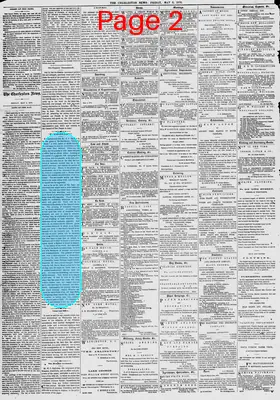
Editorial
May 6, 1870
The Charleston Daily News
Charleston, Charleston County, South Carolina
What is this article about?
Satirical editorial mocking the appointment of former Confederate T.J. Mackey as trial justice by Radical Governor Scott in South Carolina, predicting ironic law enforcement improvements and citing historical conversions to suggest possible redemption.
Clipping
OCR Quality
98%
Excellent
Full Text
"Even-Handed Justice,"
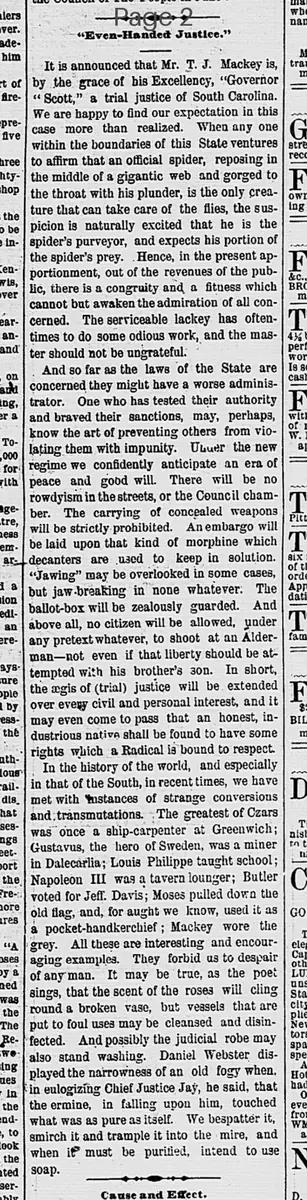
It is announced that Mr. T. J. Mackey is, by the grace of his Excellency, "Governor Scott," a trial justice of South Carolina. We are happy to find our expectation in this case more than realized. When any one within the boundaries of this State ventures to affirm that an official spider, reposing in the middle of a gigantic web and gorged to the throat with his plunder, is the only creature that can take care of the flies, the suspicion is naturally excited that he is the spider's purveyor, and expects his portion of the spider's prey. Hence, in the present apportionment, out of the revenues of the public, there is a congruity and a fitness which cannot but awaken the admiration of all concerned. The serviceable lackey has oftentimes to do some odious work, and the master should not be ungrateful. And so far as the laws of the State are concerned they might have a worse administrator. One who has tested their authority and braved their sanctions, may, perhaps, know the art of preventing others from violating them with impunity. Under the new regime we confidently anticipate an era of peace and good will. There will be no rowdyism in the streets, or the Council chamber. The carrying of concealed weapons will be strictly prohibited. An embargo will be laid upon that kind of morphine which decanters are used to keep in solution. "Jawing" may be overlooked in some cases, but jaw-breaking in none whatever. The ballot-box will be zealously guarded. And above all, no citizen will be allowed, under any pretext whatever, to shoot at an Alderman—not even if that liberty should be attempted with his brother's gun. In short the ægis of (trial) justice will be extended over every civil and personal interest, and it may even come to pass that an honest, industrious native shall be found to have some rights which a Radical is bound to respect. In the history of the world, and especially in that of the South, in recent times, we have met with instances of strange conversions and transmutations. The greatest of Czars was once a ship-carpenter at Greenwich; Gustavus, the hero of Sweden, was a miner in Dalecarlia; Louis Philippe taught school; Napoleon III was a tavern lounger; Butler voted for Jeff. Davis; Moses pulled down the old flag, and, for aught we know, used it as a pocket-handkerchief; Mackey wore the grey. All these are interesting and encouraging examples. They forbid us to despair of any man. It may be true, as the poet sings, that the scent of the roses will cling round a broken vase, but vessels that are put to foul uses may be cleansed and disinfected. And possibly the judicial robe may also stand washing. Daniel Webster displayed the narrowness of an old fogy when, in eulogizing Chief Justice Jay, he said, that the ermine, in falling upon him, touched what was as pure as itself. We bespatter it, smirch it and trample it into the mire, and when it must be purified, intend to use soap.
It is announced that Mr. T. J. Mackey is, by the grace of his Excellency, "Governor Scott," a trial justice of South Carolina. We are happy to find our expectation in this case more than realized. When any one within the boundaries of this State ventures to affirm that an official spider, reposing in the middle of a gigantic web and gorged to the throat with his plunder, is the only creature that can take care of the flies, the suspicion is naturally excited that he is the spider's purveyor, and expects his portion of the spider's prey. Hence, in the present apportionment, out of the revenues of the public, there is a congruity and a fitness which cannot but awaken the admiration of all concerned. The serviceable lackey has oftentimes to do some odious work, and the master should not be ungrateful. And so far as the laws of the State are concerned they might have a worse administrator. One who has tested their authority and braved their sanctions, may, perhaps, know the art of preventing others from violating them with impunity. Under the new regime we confidently anticipate an era of peace and good will. There will be no rowdyism in the streets, or the Council chamber. The carrying of concealed weapons will be strictly prohibited. An embargo will be laid upon that kind of morphine which decanters are used to keep in solution. "Jawing" may be overlooked in some cases, but jaw-breaking in none whatever. The ballot-box will be zealously guarded. And above all, no citizen will be allowed, under any pretext whatever, to shoot at an Alderman—not even if that liberty should be attempted with his brother's gun. In short the ægis of (trial) justice will be extended over every civil and personal interest, and it may even come to pass that an honest, industrious native shall be found to have some rights which a Radical is bound to respect. In the history of the world, and especially in that of the South, in recent times, we have met with instances of strange conversions and transmutations. The greatest of Czars was once a ship-carpenter at Greenwich; Gustavus, the hero of Sweden, was a miner in Dalecarlia; Louis Philippe taught school; Napoleon III was a tavern lounger; Butler voted for Jeff. Davis; Moses pulled down the old flag, and, for aught we know, used it as a pocket-handkerchief; Mackey wore the grey. All these are interesting and encouraging examples. They forbid us to despair of any man. It may be true, as the poet sings, that the scent of the roses will cling round a broken vase, but vessels that are put to foul uses may be cleansed and disinfected. And possibly the judicial robe may also stand washing. Daniel Webster displayed the narrowness of an old fogy when, in eulogizing Chief Justice Jay, he said, that the ermine, in falling upon him, touched what was as pure as itself. We bespatter it, smirch it and trample it into the mire, and when it must be purified, intend to use soap.
What sub-type of article is it?
Satire
Partisan Politics
Legal Reform
What keywords are associated?
South Carolina
Reconstruction
Trial Justice
Radical Republicans
Confederate Conversion
Satirical Justice
What entities or persons were involved?
T.J. Mackey
Governor Scott
Radicals
Editorial Details
Primary Topic
Appointment Of T.J. Mackey As Trial Justice Under Governor Scott
Stance / Tone
Sarcastically Mocking The Radical Regime
Key Figures
T.J. Mackey
Governor Scott
Radicals
Key Arguments
Appointment Fits Due To Mackey's Past As Confederate And Service To Radicals
Predicts Strict Enforcement Against Rowdyism, Concealed Weapons, And Violence
Cites Historical Conversions To Suggest Possible Redemption For Former Confederates
Judicial Role Can Be Purified Despite Past Stains