Thank you for visiting SNEWPapers!
Sign up free
The Virginia Gazette
Richmond, Williamsburg, Richmond County, Virginia
What is this article about?
British House of Commons debate on April 2 critiques American war expenses, especially at Boston, with motions for accounts and against extraordinary charges; administration measures upheld, opposition resolutions defeated.
Clipping
OCR Quality
Full Text
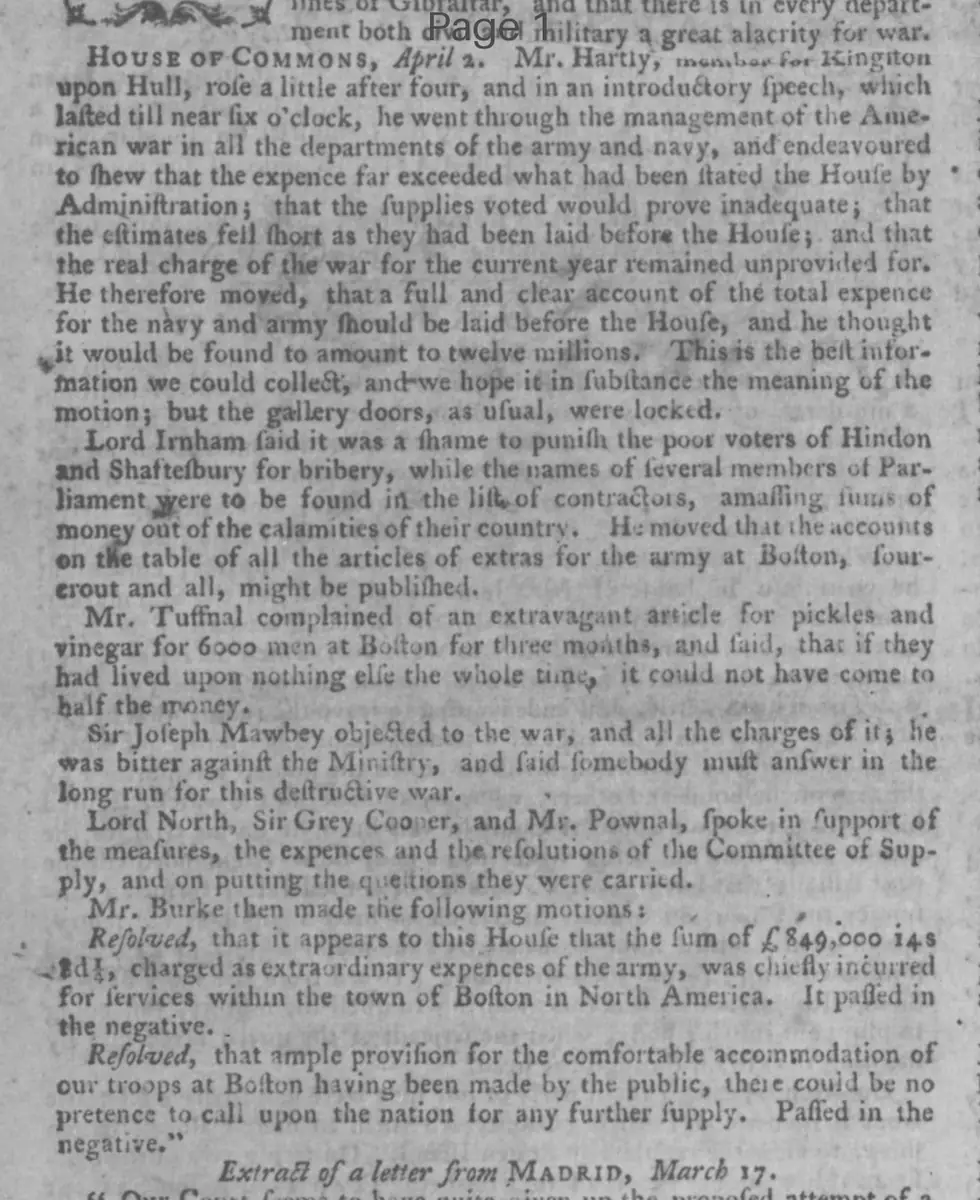
Mr. Hartley, member for Kingston upon Hull, rose a little after four, and in an introductory speech, which lasted till near six o'clock, he went through the management of the American war in all the departments of the army and navy, and endeavoured to shew that the expence far exceeded what had been stated the House by Administration; that the supplies voted would prove inadequate; that the estimates fell short as they had been laid before the House; and that the real charge of the war for the current year remained unprovided for.
He therefore moved, that a full and clear account of the total expence for the navy and army should be laid before the House, and he thought it would be found to amount to twelve millions.
This is the best information we could collect, and we hope it in substance the meaning of the motion; but the gallery doors, as usual, were locked.
Lord Irnham said it was a shame to punish the poor voters of Hindon and Shaftesbury for bribery, while the names of several members of Parliament were to be found in the list of contractors, amassing sums of money out of the calamities of their country.
He moved that the accounts on the table of all the articles of extras for the army at Boston, throughout and all, might be published.
Mr. Tuffnel complained of an extravagant article for pickles and vinegar for 6000 men at Boston for three months, and said, that if they had lived upon nothing else the whole time, it could not have come to half the money.
Sir Joseph Mawbey objected to the war, and all the charges of it; he was bitter against the Ministry, and said somebody must answer in the long run for this destructive war.
Lord North, Sir Grey Cooper, and Mr. Pownall, spoke in support of the measures, the expences and the resolutions of the Committee of Supply, and on putting the questions they were carried.
Mr. Burke then made the following motions:
Resolved, that it appears to this House that the sum of 849,000 l. 14s. 10 1/2 d, charged as extraordinary expences of the army, was chiefly incurred for services within the town of Boston in North America. It passed in the negative.
Resolved, that ample provision for the comfortable accommodation of our troops at Boston having been made by the public, there could be no pretence to call upon the nation for any further supply. Passed in the negative.
What sub-type of article is it?
What keywords are associated?
What entities or persons were involved?
Where did it happen?
Foreign News Details
Primary Location
Boston, North America
Event Date
April 2
Key Persons
Outcome
questions on motions by hartley and irnham carried; burke's resolutions passed in the negative.
Event Details
In House of Commons, Mr. Hartley criticized management and expenses of American war, moving for full accounts estimating twelve millions. Lord Irnham moved for publication of army extras at Boston. Mr. Tuffnel complained of extravagant pickle and vinegar costs. Sir Joseph Mawbey objected to war and ministry. Supporters defended measures. Burke's motions on extraordinary expenses at Boston rejected.