Thank you for visiting SNEWPapers!
Sign up free
Story
January 31, 1885
St. Landry Democrat
Opelousas, Saint Landry County, Louisiana
What is this article about?
A correspondent 'Leon' describes the harsh conditions of Galilee in Palestine, using its inhospitable environment and corrupt inhabitants to argue for the divinity of Christ, emphasizing the improbability of his teachings originating from such a place 1800 years ago.
Clipping
OCR Quality
98%
Excellent
Full Text
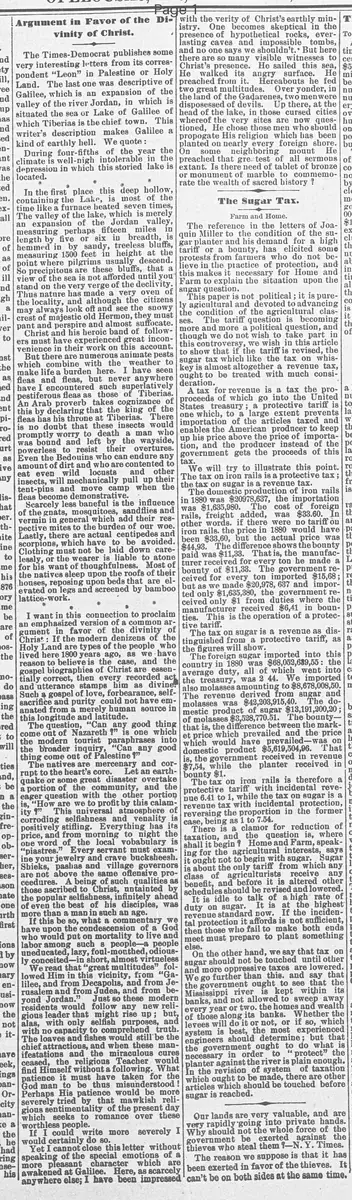
Argument in Divinity of Christ.
The Times-Democrat publishes some very interesting letters from its correspondent "Leon" in Palestine or Holy Land. The last one was descriptive of Galilee, which is an expansion of the valley of the river Jordan, in which is situated the sea or Lake of Galilee of which Tiberias is the chief town. This writer's description makes Galilee a kind of earthly hell. We quote:
During four-fifths of the year the climate is well-nigh intolerable in the depression in which this storied lake is located. In the first place this deep hollow, containing the Lake, is most of the time like a furnace heated seven times. The valley of the lake, which is merely an expansion of the Jordan valley, measuring perhaps fifteen miles in length by five or six in breadth, is hemmed in by sandy, treeless bluffs, measuring 1500 feet in height at the point where pilgrims usually descend. So precipitous are these bluffs, that a view of the sea is not afforded until you stand on the very verge of the declivity. Thus nature has made a very oven of the locality, and although the citizens may always look off and see the snowy crest of majestic old Hermon, they must pant and perspire and almost suffocate. Christ and his heroic band of followers must have experienced great inconvenience in their work on this account. But there are numerous animate pests which combine with the weather to make life a burden here. I have seen fleas and fleas, but never anywhere have I encountered such superlatively pestiferous fleas as those of Tiberias. An Arab proverb takes cognizance of this by declaring that the king of the fleas has his throne at Tiberias. There is no doubt that these insects would promptly worry to death a man who was bound and left by the wayside, powerless to resist their overtures. Even the Bedouins who can endure any amount of dirt and who are contented to eat even wild locusts and other insects, will mechanically pull up their tent-pins and move camp when the fleas become demonstrative. Scarcely less baneful is the influence of the gnats, mosquitoes, sandflies and vermin in general which add their respective mites to the burden of our woe. Lastly, there are actual centipedes and scorpions, which have to be avoided. Clothing must not be laid down carelessly, or the wearer is liable to atone for his want of thoughtfulness. Most of the natives sleep upon the roofs of their houses, reposing upon beds that are elevated on legs and screened by bamboo lattice-work.
I want in this connection to proclaim an emphasized version of a common argument in favor of the divinity of Christ: If the modern denizens of the Holy Land are types of the people who lived here 1800 years ago, as we have reason to believe is the case, and the gospel biographies of Christ are essentially correct, then every recorded act and utterance stamps him as divine. Such a gospel of love, forbearance, self-sacrifice and purity could not have emanated from a merely human source in this longitude and latitude.
The question, "Can any good thing come out of Nazareth?" is one which the modern tourist paraphrases into the broader inquiry, "Can any good thing come out of Palestine?" The natives are mercenary and corrupt to the heart's core. Let an earthquake or some great disaster overtake a portion of the community, and the eager question with the other portion is, "How are we to profit by this calamity?" This universal atmosphere of corroding selfishness and venality is positively stifling. Everything has its price, and from morning to night the one word of the local vocabulary is "piastres." Every servant must examine your jewelry and crave bucksheesh. Sheiks, pashas and village governors are not above the same offensive procedures. A being of such qualities as those ascribed to Christ, untainted by the popular selfishness, infinitely ahead of even the best of his disciples, was more than a man in such an age.
If this be so, what a commentary we have upon the condescension of a God who would put on mortality to live and labor among such a people—a people uneducated, lazy, foul-mouthed, odiously conceited—in short, almost virtueless. We read that "great multitudes" followed Him in this vicinity, from "Galilee, and from Decapolis, and from Jerusalem and from Judea, and from beyond Jordan." Just so these modern residents would follow any new religious leader that might rise up; but, alas, with only selfish purposes, and with no capacity to comprehend truth. The loaves and fishes would still be the chief attractions, and when these manifestations and the miraculous cures ceased, the religious Teacher would find Himself without a following. What patience it must have taken for the God-man to be thus misunderstood! Perhaps His patience would be more severely tried by that mawkish religious sentimentality of the present day which seeks to romance over these worthless people.
If I could write more severely I would certainly do so. Yet I cannot close this letter without speaking of the special emotions of a more pleasant character which are awakened at Galilee. Here, as scarcely anywhere else, I have been impressed with the verity of Christ's earthly ministry. One becomes skeptical in the presence of hypothetical rocks, everlasting caves and impossible tombs, and no one says we shouldn't. But here there are so many visible witnesses to Christ's presence. He sailed this sea, He walked its angry surface. He preached from it. Hereabouts he fed two great multitudes. Over yonder, in the land of the Gadarenes, two men were dispossessed of devils. Up there, at the head of the lake, in those cursed cities whereof the very sites are now questioned, He chose those men who should propagate His religion which has been planted on nearly every foreign shore. On some neighboring mount He preached that greatest of all sermons extant. Is there need of tablet of bronze or monument of marble to commemorate the wealth of sacred history?
The Times-Democrat publishes some very interesting letters from its correspondent "Leon" in Palestine or Holy Land. The last one was descriptive of Galilee, which is an expansion of the valley of the river Jordan, in which is situated the sea or Lake of Galilee of which Tiberias is the chief town. This writer's description makes Galilee a kind of earthly hell. We quote:
During four-fifths of the year the climate is well-nigh intolerable in the depression in which this storied lake is located. In the first place this deep hollow, containing the Lake, is most of the time like a furnace heated seven times. The valley of the lake, which is merely an expansion of the Jordan valley, measuring perhaps fifteen miles in length by five or six in breadth, is hemmed in by sandy, treeless bluffs, measuring 1500 feet in height at the point where pilgrims usually descend. So precipitous are these bluffs, that a view of the sea is not afforded until you stand on the very verge of the declivity. Thus nature has made a very oven of the locality, and although the citizens may always look off and see the snowy crest of majestic old Hermon, they must pant and perspire and almost suffocate. Christ and his heroic band of followers must have experienced great inconvenience in their work on this account. But there are numerous animate pests which combine with the weather to make life a burden here. I have seen fleas and fleas, but never anywhere have I encountered such superlatively pestiferous fleas as those of Tiberias. An Arab proverb takes cognizance of this by declaring that the king of the fleas has his throne at Tiberias. There is no doubt that these insects would promptly worry to death a man who was bound and left by the wayside, powerless to resist their overtures. Even the Bedouins who can endure any amount of dirt and who are contented to eat even wild locusts and other insects, will mechanically pull up their tent-pins and move camp when the fleas become demonstrative. Scarcely less baneful is the influence of the gnats, mosquitoes, sandflies and vermin in general which add their respective mites to the burden of our woe. Lastly, there are actual centipedes and scorpions, which have to be avoided. Clothing must not be laid down carelessly, or the wearer is liable to atone for his want of thoughtfulness. Most of the natives sleep upon the roofs of their houses, reposing upon beds that are elevated on legs and screened by bamboo lattice-work.
I want in this connection to proclaim an emphasized version of a common argument in favor of the divinity of Christ: If the modern denizens of the Holy Land are types of the people who lived here 1800 years ago, as we have reason to believe is the case, and the gospel biographies of Christ are essentially correct, then every recorded act and utterance stamps him as divine. Such a gospel of love, forbearance, self-sacrifice and purity could not have emanated from a merely human source in this longitude and latitude.
The question, "Can any good thing come out of Nazareth?" is one which the modern tourist paraphrases into the broader inquiry, "Can any good thing come out of Palestine?" The natives are mercenary and corrupt to the heart's core. Let an earthquake or some great disaster overtake a portion of the community, and the eager question with the other portion is, "How are we to profit by this calamity?" This universal atmosphere of corroding selfishness and venality is positively stifling. Everything has its price, and from morning to night the one word of the local vocabulary is "piastres." Every servant must examine your jewelry and crave bucksheesh. Sheiks, pashas and village governors are not above the same offensive procedures. A being of such qualities as those ascribed to Christ, untainted by the popular selfishness, infinitely ahead of even the best of his disciples, was more than a man in such an age.
If this be so, what a commentary we have upon the condescension of a God who would put on mortality to live and labor among such a people—a people uneducated, lazy, foul-mouthed, odiously conceited—in short, almost virtueless. We read that "great multitudes" followed Him in this vicinity, from "Galilee, and from Decapolis, and from Jerusalem and from Judea, and from beyond Jordan." Just so these modern residents would follow any new religious leader that might rise up; but, alas, with only selfish purposes, and with no capacity to comprehend truth. The loaves and fishes would still be the chief attractions, and when these manifestations and the miraculous cures ceased, the religious Teacher would find Himself without a following. What patience it must have taken for the God-man to be thus misunderstood! Perhaps His patience would be more severely tried by that mawkish religious sentimentality of the present day which seeks to romance over these worthless people.
If I could write more severely I would certainly do so. Yet I cannot close this letter without speaking of the special emotions of a more pleasant character which are awakened at Galilee. Here, as scarcely anywhere else, I have been impressed with the verity of Christ's earthly ministry. One becomes skeptical in the presence of hypothetical rocks, everlasting caves and impossible tombs, and no one says we shouldn't. But here there are so many visible witnesses to Christ's presence. He sailed this sea, He walked its angry surface. He preached from it. Hereabouts he fed two great multitudes. Over yonder, in the land of the Gadarenes, two men were dispossessed of devils. Up there, at the head of the lake, in those cursed cities whereof the very sites are now questioned, He chose those men who should propagate His religion which has been planted on nearly every foreign shore. On some neighboring mount He preached that greatest of all sermons extant. Is there need of tablet of bronze or monument of marble to commemorate the wealth of sacred history?
What sub-type of article is it?
Historical Event
Biography
Supernatural
What themes does it cover?
Providence Divine
Moral Virtue
Love
What keywords are associated?
Divinity Of Christ
Galilee Description
Palestine Travel
Theological Argument
Holy Land Pests
Christ Ministry
What entities or persons were involved?
Christ
Leon
Where did it happen?
Galilee, Palestine, Holy Land, Tiberias, Lake Of Galilee
Story Details
Key Persons
Christ
Leon
Location
Galilee, Palestine, Holy Land, Tiberias, Lake Of Galilee
Event Date
1800 Years Ago
Story Details
Correspondent Leon describes the intolerable climate, pests, and corrupt natives of Galilee, arguing that Christ's gospel of love and purity could only come from a divine source in such an environment, highlighting his condescension and the verity of his ministry there.