Thank you for visiting SNEWPapers!
Sign up free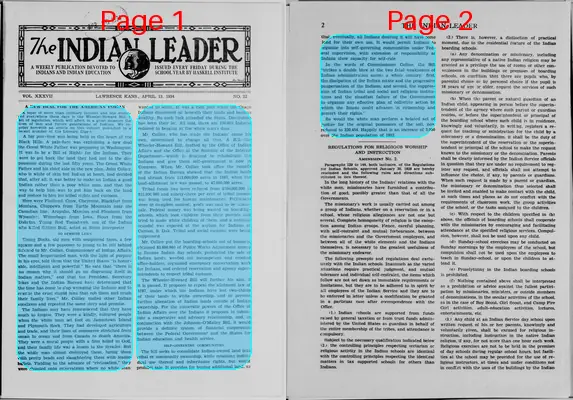
The Indian Leader
Lawrence, Douglas County, Kansas
What is this article about?
The Wheeler-Howard Bill, championed by Commissioner John Collier, aims to restore land, tribal rights, and self-government to Native Americans, reversing historical dispossession and injustices from 1887 allotment laws to present, affecting 320,454 Indians.
Merged-components note: Continuation of the article on the Wheeler-Howard Bill across pages 1 and 2.
Clippings
1 of 2
OCR Quality
Full Text
A topic of more than ordinary interest and one discussed everywhere these days is the Wheeler-Howard Bill, a bit of legislation which will affect in a great measure the lives of this and future generations of Indians. We reprint herewith an article on this subject published in a recent number of the Literary Digest:
A big pow-wow was being held in the heart of the Black Hills. A pale-face was explaining a new deal the Great White Father was preparing in Washington. It was to be a Bill of Rights for the Indians. They were to get back the land they had lost to the dispossessor during the last fifty years. The Great White Father and his chief aide in the new plan, John Collier, who is white of skin but Indian at heart, had decided that, after all, it was better to make an Indian a good Indian rather than a poor white man, and that the way to help him was to put him back on the land and restore to him his tribal rights and customs.
Here were Flathead, Crow, Cheyenne, Blackfeet from Montana, Chippewa from Turtle Mountain near the Canadian line; Arapaho, Mandan and Shoshoni from Wyoming; Winnebago from Iowa, Sioux from the Dakotas. Young Red Tomahawk, son of the Indian who killed Sitting Bull, acted as Sioux interpreter.
TO REWRITE LAWS
Young Bucks, old men with sculptured faces, a few squaws and a few papooses too young to be left behind listened to Mr. Collier, Commissioner of Indian Affairs. The small bespectacled man, with the light of purpose in his eyes, told them that the United States "is honorable, intelligent and powerful." He said that "there is no reason why it should go on disgracing itself in Indian matters," and that the President, Secretary Ickes and the Indian Bureau have determined that the time has come to stop wronging the Indians and to rewrite the cruel stupid laws that rob them and crush their family lives. Mr. Collier visited other Indian conclaves and repeated the same story and promise.
The Indians may have remembered that they have much to forgive. They were a kindly, cultured people when the white man set foot on Jamestown Island and Plymouth Rock. They had developed agriculture and trade, and their lines of commerce stretched from ocean to ocean and from Canada to South America. They were a moral people with a firm belief in God, and their family life was a lesson to the invader. But the white man almost destroyed them, luring them with pretty beads and slaughtering them with leaden bullets. Yielding to the advance of "civilization," they were shunted onto reservations where no white man wanted to settle.
It was a rich joke when the Osage Indians discovered oil beneath their lands and became wealthy. No such luck attended the Sioux. Destitution has been their lot. All told, there are 100,000 Indians reduced to begging at the white man's door.
Mr. Collier, who has made the Indians' cause his own, determined to change all that. A Bill—the Wheeler-Howard Bill, drafted by the Office of Indian Affairs and the Office of the Solicitor of the Interior Department which is designed to rehabilitate the Indians and give them self-government is now in Congress. When Mr. Collier took office the records of the Indian Bureau showed that the Indian lands had shrunk from 113,000,000 acres in 1887, when the land-allotment law was passed, to 47,000,000 acres. Tribal funds had been reduced from $500,000,000 to $120,000,000 and ninety-three per cent of tribal income was being used for bureau maintenance. Politicians were in complete control, graft was said to be widespread. Federal money was being wasted on boarding-schools, which took children from their parents and tried to make white children of them, and a national scandal was exposed at the asylum for Indians at Canton, S. Dak. Tribal and social customs were being suppressed.
Mr. Collier put the boarding-schools out of business, obtained $3,600,000 of Public Works Administration money to finance Indian day schools, prohibited the sale of Indian lands, weeded out incompetent and crooked office-holders, organized emergency conservation work for Indians, and ordered reservation and agency superintendents to respect tribal customs.
The Wheeler-Howard Bill will further his aim, if it is passed. It proposes to repeal the allotment law of 1887, under which the Indians have lost two-thirds of their lands to white ownership, and to prevent further alienation of Indian lands outside of Indian ownership. For the autocratic powers of the Office of Indian Affairs over the Indians it proposes to substitute a cooperative and advisory relationship, and, in conjunction with the Johnson-O'Malley Bill, it would provide a definite system of financial cooperation between the Federal Government and the States for Indian education and health service.
SELF-GOVERNING COMMUNITIES
The bill seeks to consolidate Indian-owned land into tribal or community ownership, while retaining individual use thereof and inheritance rights, but would prohibit sale. It provides for buying additional land, so
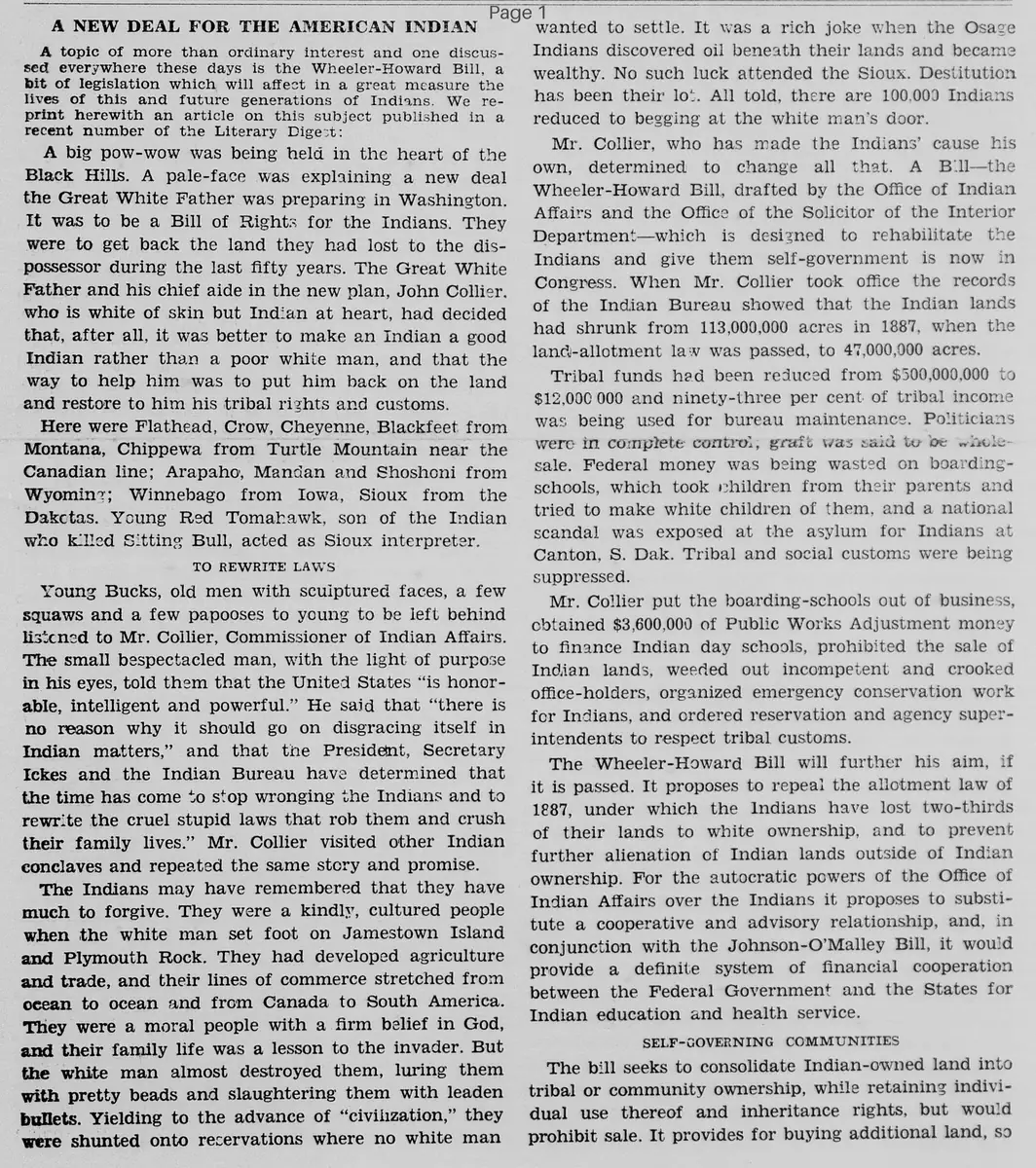
that, eventually, all Indians desiring it will have some land for their own use. It would permit Indians to organize into self-governing communities under Federal supervision, with extension of responsibility as Indians show capacity for self-rule.
In the words of Commissioner Collier, the Bill "strikes a double blow at the two fatal weaknesses of Indian administration across a whole century: first the dissipation of the Indian estate and the progressive pauperization of the Indians, and second, the suppression of Indian tribal and social and religious institutions and the steadfast failure of the Government to organize any effective plan of collective action by which the Indians could advance in citizenship and protect their rights."
So would the white man perform a belated act of justice for the original possessors of the soil, now reduced to 320,454. Happily that is an increase of 3,000 over the Indian population of 1932.
What sub-type of article is it?
What themes does it cover?
What keywords are associated?
What entities or persons were involved?
Where did it happen?
Story Details
Key Persons
Location
Black Hills, Washington, Various Reservations In Montana, Wyoming, Iowa, Dakotas
Event Date
1930s
Story Details
John Collier, Commissioner of Indian Affairs, promotes the Wheeler-Howard Bill to repeal the 1887 allotment law, restore tribal lands and customs, end suppression of Indian culture, and enable self-government, addressing historical dispossession and pauperization of Native Americans.