Thank you for visiting SNEWPapers!
Sign up free
Story
November 18, 1927
The Mahnomen Pioneer
Mahnomen, Mahnomen County, Minnesota
What is this article about?
History of fountain pens: early experiments with compressible metal tubes, 1879 US patent for stylographic self-feeding pen, evolution from rubber to pyralin barrels, now 90% use pyroxylin plastic in varied colors like green jade and burnt orange.
Clipping
OCR Quality
98%
Excellent
Full Text
Fountain Pens
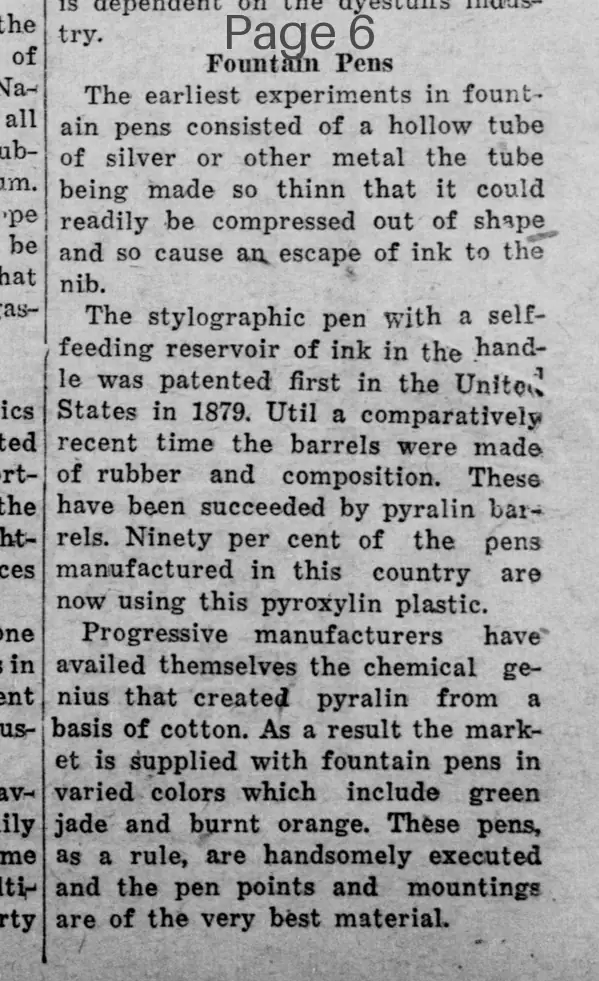
The earliest experiments in fountain pens consisted of a hollow tube of silver or other metal the tube being made so thin that it could readily be compressed out of shape and so cause an escape of ink to the nib.
The stylographic pen with a self-feeding reservoir of ink in the handle was patented first in the United States in 1879. Until a comparatively recent time the barrels were made of rubber and composition. These have been succeeded by pyralin barrels. Ninety per cent of the pens manufactured in this country are now using this pyroxylin plastic.
Progressive manufacturers have availed themselves the chemical genius that created pyralin from a basis of cotton. As a result the market is supplied with fountain pens in varied colors which include green jade and burnt orange. These pens, as a rule, are handsomely executed and the pen points and mountings are of the very best material.
The earliest experiments in fountain pens consisted of a hollow tube of silver or other metal the tube being made so thin that it could readily be compressed out of shape and so cause an escape of ink to the nib.
The stylographic pen with a self-feeding reservoir of ink in the handle was patented first in the United States in 1879. Until a comparatively recent time the barrels were made of rubber and composition. These have been succeeded by pyralin barrels. Ninety per cent of the pens manufactured in this country are now using this pyroxylin plastic.
Progressive manufacturers have availed themselves the chemical genius that created pyralin from a basis of cotton. As a result the market is supplied with fountain pens in varied colors which include green jade and burnt orange. These pens, as a rule, are handsomely executed and the pen points and mountings are of the very best material.
What sub-type of article is it?
Historical Event
Curiosity
What themes does it cover?
Triumph
What keywords are associated?
Fountain Pens
Invention History
Stylographic Pen
Pyralin Barrels
Pyroxylin Plastic
Where did it happen?
United States
Story Details
Location
United States
Event Date
1879
Story Details
Early fountain pens used compressible metal tubes for ink flow. Stylographic self-feeding pen patented in US in 1879. Barrels evolved from rubber to pyralin (pyroxylin plastic from cotton), now 90% of US pens use it in colors like green jade and burnt orange, with high-quality points and mountings.