Thank you for visiting SNEWPapers!
Sign up free
Story
May 17, 1848
Richmond Palladium
Richmond, Wayne County, Indiana
What is this article about?
The National Intelligencer refutes a Democratic claim that Gen. Taylor caused the Mexican-American War by moving troops to the Rio Grande due to Mexican forces at Matamoros. It cites Taylor's 1845 correspondence from Corpus Christi showing no significant Mexican threat or preparations for invasion.
Clipping
OCR Quality
95%
Excellent
Full Text
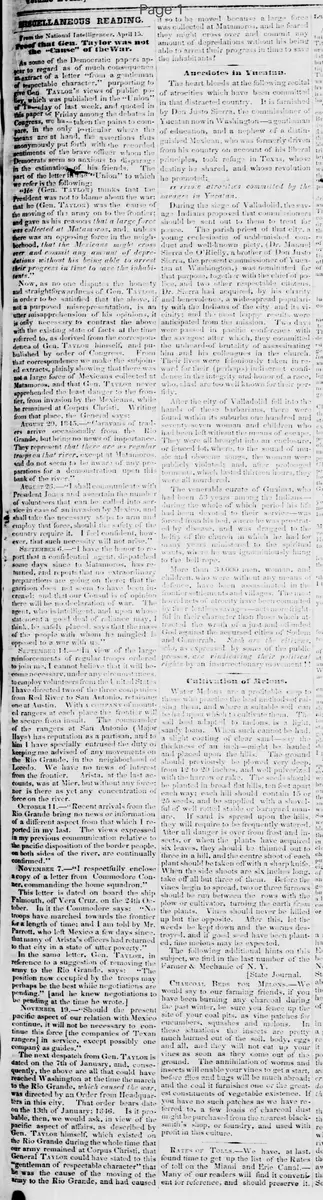
From the National Intelligencer, April 15.
That Gen. Taylor was not the "Cause" of the War.
As some of the Democratic papers appear to regard as of much consequence an extract of a letter "from a gentleman of respectable character," purporting to give Gen. Taylor's views of public policy, which was published in the "Union" of Tuesday of last week, and quoted in this paper Friday among the debates in Congress, we have taken the pains to compare, in the only particular where the means are at hand, the assertions thus anonymously put forth with the recorded sentiments of the brave officer whom the Democrats seem so anxious to disparage in the estimation of his friends. The part of the letter in the "Union" to which we refer is the following:
"He (Gen. Taylor) thinks that the President was not to blame about the war; that he (Gen. Taylor) was the cause of the moving of the army on to the frontier; and gave as his reasons that a large force was collected at Matamoros, and, unless there was an opposing force in the neighborhood, that the Mexicans might cross over and commit any amount of depredations without his being able to arrest their progress in time to save the inhabitants."
Now, as no one disputes the honesty and straightforwardness of Gen. Taylor, in order to be satisfied that the above, if not a purposed misrepresentation, is an utter misapprehension of his opinions, it is only necessary to contrast the above with the existing state of facts at the time referred to, as derived from the correspondence of Gen. Taylor himself, and published by order of Congress. From that correspondence we make the subjoined extracts, plainly showing that there was not a large force of Mexicans collected at Matamoros, and that Gen. Taylor never apprehended the least danger to the frontier, from invasion by the Mexicans, while he remained at Corpus Christi. Writing from that place, the General says:
August 20, 1845.--Caravans of traders arrive occasionally from the Rio Grande, but bring no news of importance. They represent that there are no regular troops on that river, except at Matamoros, and do not seem to be aware of any preparations for a demonstration upon this bank of the river."
August 26.--"I shall communicate with President Jones and ascertain the number of volunteers that can be called into service in case of an invasion by Mexico, and shall take the necessary steps to arm and employ that force, should the safety of the country require it. I feel confident, however, that such necessity will not arise."
SEPTEMBER 6.--"I have the honor to report that a confidential agent, dispatched some days since to Matamoros, has returned, and reports that no extraordinary preparations are going on there; that the garrison does not seem to have been increased; and that our Consul is of opinion there will be no declaration of war." The agent, who is intelligent, and upon whose statement a good deal of reliance may, I think, be safely placed, says that the mass of the people with whom he mingled is opposed to a war with us."
September 15--"In view of the large reinforcements of regular troops ordered to join me, I cannot believe that it will become necessary, under any circumstances, to employ volunteers from the United States. I have directed two of the three companies from Red River to San Antonio, retaining one at Austin. With a company of mounted rangers at each place the frontier will be secure from insult. The commander of the rangers at San Antonio (Major Hays) has reputation as a partisan, and to him I have specially entrusted the duty of keeping me advised of any movements on the Rio Grande, in the neighborhood of Laredo. We have no news of interest from the frontier. Arista, at the last accounts, was at Mier, but without any force; nor is there as yet any concentration of force on the river."
October 11.--"Recent arrivals from the Rio Grande bring no news or information of a different aspect from that which I reported in my last. The views expressed in my previous communication relative to the pacific disposition of the border people, on both sides of the river, are continually confirmed."
November 7."I respectfully enclose a copy of a letter from Commodore Conner, commanding the home squadron."
This letter is dated on board the ship Falmouth, off Vera Cruz, on the 24th October. In it the Commodore says: "No troops have marched towards the frontier for a length of time; and I am told by Mr. Parrott, who left Mexico a few days since, that many of Arista's officers had returned to that city in a state of utter poverty."
In the same letter, Gen. Taylor, in reference to a suggestion of removing the army to the Rio Grande, says:
The position now occupied by the troops may perhaps be the best while negotiations are pending." [and he knew negotiations to be pending at the time he wrote.]
November 19.-"Should the present pacific aspect of our relation with Mexico continue, it will not be necessary to continue this force [the companies of Texan rangers] in service, except possibly one company as guides."
The next despatch from Gen. Taylor is dated on the 8th of January, and, consequently, the above are all that could have reached Washington at the time the march to the Rio Grande, which caused the war, was directed by an Order from Headquarters in this city. That order bears date on the 13th of January, 1846. Is it probable, then, we would ask, in view of the pacific aspect of affairs, as described by Gen. Taylor himself, which existed on the Rio Grande during the whole time that our army remained at Corpus Christi, that General Taylor could have stated to this "gentleman of respectable character" that he was the cause of the moving of the army to the Rio Grande, and had caused it so to be moved because a large force was collected at Matamoros, and he feared they might cross over and commit any amount of depredations without his being able to arrest their progress in time to save the inhabitants?
That Gen. Taylor was not the "Cause" of the War.
As some of the Democratic papers appear to regard as of much consequence an extract of a letter "from a gentleman of respectable character," purporting to give Gen. Taylor's views of public policy, which was published in the "Union" of Tuesday of last week, and quoted in this paper Friday among the debates in Congress, we have taken the pains to compare, in the only particular where the means are at hand, the assertions thus anonymously put forth with the recorded sentiments of the brave officer whom the Democrats seem so anxious to disparage in the estimation of his friends. The part of the letter in the "Union" to which we refer is the following:
"He (Gen. Taylor) thinks that the President was not to blame about the war; that he (Gen. Taylor) was the cause of the moving of the army on to the frontier; and gave as his reasons that a large force was collected at Matamoros, and, unless there was an opposing force in the neighborhood, that the Mexicans might cross over and commit any amount of depredations without his being able to arrest their progress in time to save the inhabitants."
Now, as no one disputes the honesty and straightforwardness of Gen. Taylor, in order to be satisfied that the above, if not a purposed misrepresentation, is an utter misapprehension of his opinions, it is only necessary to contrast the above with the existing state of facts at the time referred to, as derived from the correspondence of Gen. Taylor himself, and published by order of Congress. From that correspondence we make the subjoined extracts, plainly showing that there was not a large force of Mexicans collected at Matamoros, and that Gen. Taylor never apprehended the least danger to the frontier, from invasion by the Mexicans, while he remained at Corpus Christi. Writing from that place, the General says:
August 20, 1845.--Caravans of traders arrive occasionally from the Rio Grande, but bring no news of importance. They represent that there are no regular troops on that river, except at Matamoros, and do not seem to be aware of any preparations for a demonstration upon this bank of the river."
August 26.--"I shall communicate with President Jones and ascertain the number of volunteers that can be called into service in case of an invasion by Mexico, and shall take the necessary steps to arm and employ that force, should the safety of the country require it. I feel confident, however, that such necessity will not arise."
SEPTEMBER 6.--"I have the honor to report that a confidential agent, dispatched some days since to Matamoros, has returned, and reports that no extraordinary preparations are going on there; that the garrison does not seem to have been increased; and that our Consul is of opinion there will be no declaration of war." The agent, who is intelligent, and upon whose statement a good deal of reliance may, I think, be safely placed, says that the mass of the people with whom he mingled is opposed to a war with us."
September 15--"In view of the large reinforcements of regular troops ordered to join me, I cannot believe that it will become necessary, under any circumstances, to employ volunteers from the United States. I have directed two of the three companies from Red River to San Antonio, retaining one at Austin. With a company of mounted rangers at each place the frontier will be secure from insult. The commander of the rangers at San Antonio (Major Hays) has reputation as a partisan, and to him I have specially entrusted the duty of keeping me advised of any movements on the Rio Grande, in the neighborhood of Laredo. We have no news of interest from the frontier. Arista, at the last accounts, was at Mier, but without any force; nor is there as yet any concentration of force on the river."
October 11.--"Recent arrivals from the Rio Grande bring no news or information of a different aspect from that which I reported in my last. The views expressed in my previous communication relative to the pacific disposition of the border people, on both sides of the river, are continually confirmed."
November 7."I respectfully enclose a copy of a letter from Commodore Conner, commanding the home squadron."
This letter is dated on board the ship Falmouth, off Vera Cruz, on the 24th October. In it the Commodore says: "No troops have marched towards the frontier for a length of time; and I am told by Mr. Parrott, who left Mexico a few days since, that many of Arista's officers had returned to that city in a state of utter poverty."
In the same letter, Gen. Taylor, in reference to a suggestion of removing the army to the Rio Grande, says:
The position now occupied by the troops may perhaps be the best while negotiations are pending." [and he knew negotiations to be pending at the time he wrote.]
November 19.-"Should the present pacific aspect of our relation with Mexico continue, it will not be necessary to continue this force [the companies of Texan rangers] in service, except possibly one company as guides."
The next despatch from Gen. Taylor is dated on the 8th of January, and, consequently, the above are all that could have reached Washington at the time the march to the Rio Grande, which caused the war, was directed by an Order from Headquarters in this city. That order bears date on the 13th of January, 1846. Is it probable, then, we would ask, in view of the pacific aspect of affairs, as described by Gen. Taylor himself, which existed on the Rio Grande during the whole time that our army remained at Corpus Christi, that General Taylor could have stated to this "gentleman of respectable character" that he was the cause of the moving of the army to the Rio Grande, and had caused it so to be moved because a large force was collected at Matamoros, and he feared they might cross over and commit any amount of depredations without his being able to arrest their progress in time to save the inhabitants?
What sub-type of article is it?
Historical Event
Biography
What themes does it cover?
Deception
Justice
What keywords are associated?
Mexican War
Gen Taylor
Rio Grande
Matamoros
Troop Movement
Border Peace
Democratic Papers
What entities or persons were involved?
Gen. Taylor
President Jones
Arista
Commodore Conner
Major Hays
Where did it happen?
Corpus Christi, Rio Grande, Matamoros
Story Details
Key Persons
Gen. Taylor
President Jones
Arista
Commodore Conner
Major Hays
Location
Corpus Christi, Rio Grande, Matamoros
Event Date
August 20, 1845 To January 13, 1846
Story Details
The article refutes an anonymous letter claiming Gen. Taylor believed he caused the war by moving troops due to Mexican forces at Matamoros, quoting Taylor's correspondence showing peaceful border conditions and no threat of invasion.