Thank you for visiting SNEWPapers!
Sign up free
Alexandria Gazette & Daily Advertiser
Alexandria, Virginia
What is this article about?
London merchants, ship owners, and traders met on June 26 at the City of London Tavern to oppose renewing the West India Dock Company's charter, arguing that high dock duties and monopolies harm commercial prosperity and competition with foreign ports. MP Marryat detailed trade declines in Cuba, India, America, and Brazil due to excessive charges.
Clipping
OCR Quality
Full Text
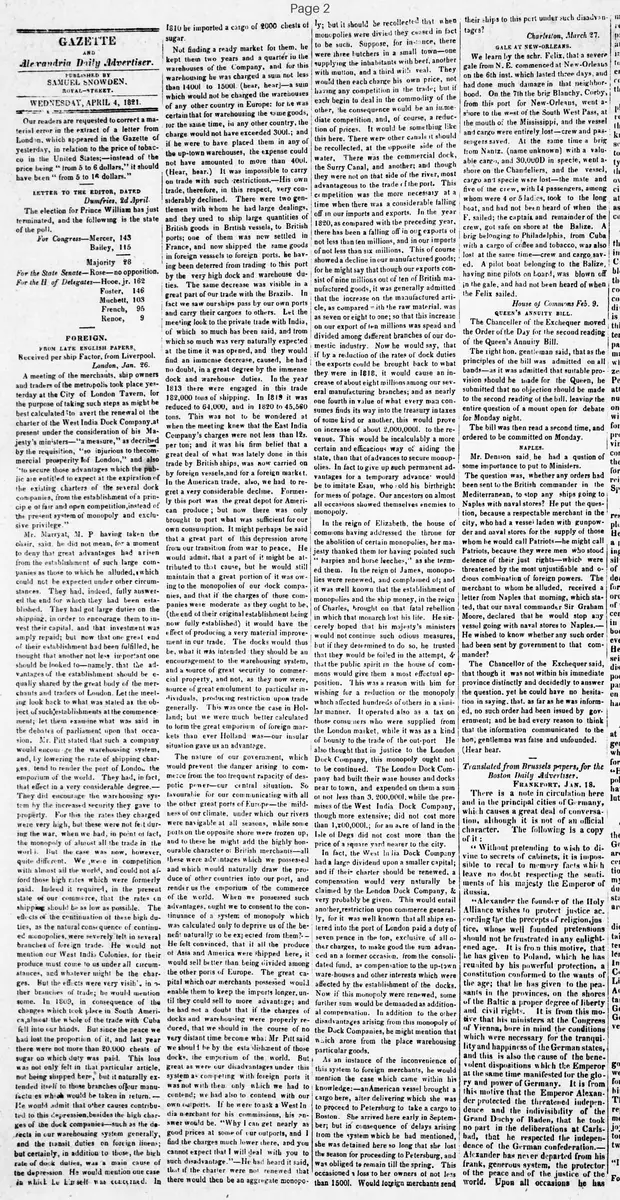
FROM LATE ENGLISH PAPERS,
Received per ship Factor, from Liverpool.
London, Jun. 26.
A meeting of the merchants, ship owners and traders of the metropolis took place yesterday at the City of London Tavern, for the purpose of taking such steps as might be best calculated to avert the renewal of the charter of the West India Dock Company, at present under the consideration of his Majesty's ministers—“a measure,” as described by the requisition, “so injurious to the commercial prosperity of London,” and also to secure those advantages which the public are entitled to expect at the expiration of the existing charters of the several dock companies, from the establishment of a principle of fair and open competition, instead of the present system of monopoly and exclusive privilege.
Mr. Marryat, M. P. having taken the chair, said, he did not mean, for a moment to deny that great advantages had arisen from the establishment of such large companies as those to which he alluded, which could not be expected under other circumstances. They had, indeed fully answered the end for which they had been established. They had got large duties on the shipping, in order to encourage them to invest their capital, and that investment was amply repaid; but now that one great end of their establishment had been fulfilled, he thought that another not less important one should be looked to—namely, that the advantages of the establishment should be equally shared by the great body of the merchants and traders of London. Let the meeting look back to what was stated as the object of such establishments at the commencement; let them examine what was said in the debates of parliament upon that occasion. Mr. Pitt stated that such a company would encourage the warehousing system, and, by lowering the rate of shipping charges, tend to render the port of London the emporium of the world. They had had that effect in a very considerable degree. They did encourage the warehousing system by the increased security they gave to property. For this the rates they charged were very high, but these were not felt during the war, when we had, in point of fact, the monopoly of almost all the trade in the world. But the case was now, however, quite different. We were in competition with almost all the world, and could not afford those high rates which were formerly paid. Indeed it required, in the present state of our commerce, that the rates on shipping should be as low as possible. The effects of the continuation of these high duties, as the natural consequence of continuing monopolies, were severely felt in several branches of foreign trade. He would not mention our West India Colonies, for their produce must come to us under all circumstances, and whatever might be the charges. But the effects were very visible in other branches of trade; he would mention some. In 1809, in consequence of the changes which took place in South America, almost the whole of the trade with Cuba fell into our hands. But since the peace we had lost the proportion of it, and last year there were not more than 20,000 chests of sugar on which duty was paid. This loss was not only felt in that particular article, not being shipped here, but it naturally extended itself to those branches of our manufactories which would be taken in return. He would admit that other causes contributed to this depression, besides the high charges of the dock companies—such as the defects in our warehousing system generally, and the transit duties on foreign linens; but certainly, in addition to those, the high rate of dock duties, was a main cause of the depression. He would mention one case in which he himself was concerned. In 1810 he imported a cargo of 2000 chests of sugar. Not finding a ready market for them, he kept them two years and a quarter in the warehouses of the Company, and for this warehousing he was charged a sum not less than 1400l. to 1500l. (hear, hear)—a sum which would not be charged the warehouses of any other country in Europe: for he was certain that for warehousing the same goods, for the same time, in any other country, the charge would not have exceeded 300l.; and if he were to have placed them in any of the up-town warehouses, the expense could not have amounted to more than 400l. (Hear, hear.) It was impossible to carry on trade with such restrictions. His own trade, therefore, in this respect, very considerably declined. There were two gentlemen with whom he had large dealings, and they used to ship large quantities of British goods in British vessels, to British ports; one of them was now settled in France, and now shipped the same goods in foreign vessels to foreign ports, he having been deterred from trading to this port by the very high dock and warehouse duties. The same decrease was visible in a great part of our trade with the Brazils. In fact we saw our ships pass by our own ports and carry their cargoes to others. Let the meeting look to the private trade with India, of which so much has been said, and from which so much was very naturally expected at the time it was opened, and they would find an immense decrease, caused, he had no doubt, in a great degree by the immense dock and warehouse duties. In the year 1813 there were engaged in this trade 182,000 tons of shipping. In 1819 it was reduced to 64,000, and in 1820 to 45,560 tons. This was not to be wondered at when the meeting knew that the East India Company's charges were not less than 12s. per ton; and it was his firm belief that a great deal of what was lately done in this trade by British ships, was now carried on by foreign vessels, and for a foreign market. In the American trade, also, we had to regret a very considerable decline. Formerly this port was the great depot for American produce; but now there was only brought to port what was sufficient for our own consumption. It might perhaps be said that a great part of this depression arose from our transition from war to peace. He would admit that a part of it might be attributed to that cause, but he would still maintain that a great portion of it was owing to the monopolies of our dock companies, and that if the charges of those companies were moderate as they ought to be, (the end of their original establishment being now fully established) it would have the effect of producing a very material improvement in our trade. The docks would thus be, what it was intended they should be an encouragement to the warehousing system, and a source of great security to commercial property, and not, as they now were, source of great emolument to particular individuals, producing restriction upon trade generally. This was once the case in Holland; but we were much better calculated to form the great emporium of foreign markets than ever Holland was—our insular situation gave us an advantage. The nature of our government, which would prevent the danger arising to commerce from the too frequent rapacity of despotic power—our central situation so favourable for our communicating with all the other great ports of Europe—the mildness of our climate, under which our rivers were navigable at all seasons, while some ports on the opposite shore were frozen up, and to these he might add the highly honourable character of British merchants—all these were advantages which we possessed and which would naturally draw the produce of other countries into our port, and render us the emporium of the commerce of the world. When we possessed such advantages, ought we to consent to the continuance of a system of monopoly which was calculated only to deprive us of the benefit naturally to be expected from them?— He felt convinced, that if all the produce of Asia and America were shipped here, it would sell better than being divided among the other ports of Europe. The great capital which our merchants possessed would enable them to keep the imports longer, until they could sell to more advantage; and he had not a doubt that if the charges of docks and warehousing were properly reduced, that we should in the course of no very distant time become what Mr. Pitt said we should be by the establishment of those docks, the emporium of the world. But great as were our disadvantages under this system as competing with foreign ports it was not with them only which we had to contend; we had also to contend with our own outports. If he were to ask a West India merchant for his commissions, his answer would be, “Why I can get nearly as good prices at some of our outports, and I find the charges much lower there, and you cannot expect that I will deal with you to such disadvantage.”—He had heard it said, that if the charter were not renewed that there would then be an aggregate monopoly; but it should be recollected that if monopolies were divided they ceased in fact to be such. Suppose, for instance, there were three butchers in a small town—one supplying the inhabitants with beef, another with mutton, and a third with veal. They would then each charge his own price, not having any competition in the trade; but if each begin to deal in the commodity of the other, the consequence would be an immediate competition, and, of course, a reduction of prices. It would be something like this here. There were other canals it should be recollected, at the opposite side of the water. There was the commercial dock, the Surrey Canal, and another; and though they were not on that side of the river, most advantageous to the trade of the port. This competition was the more necessary at a time when there was a considerable falling off in our imports and exports. In the year 1820, as compared with the preceding year, there has been a falling off in our exports of not less than ten millions, and in our imports of not less than six millions. This of course showed a decline in our manufactured goods; for he might say that though our exports consist of nine millions out of ten of British manufactured goods, it was generally admitted that the increase on the manufactured article, as compared with the raw material, was as seven or eight to one; so that this increase on our export of ten millions was spread and divided among different branches of our domestic industry. Now he would say, that if by a reduction of the rates of dock duties the exports could be brought back to what they were in 1818, it would cause an increase of about eight millions among our several manufacturing branches: and as nearly one fourth in value of what every man consumes finds its way into the treasury in taxes of some kind or another, this would prove an increase of about 2,000,000l. to the revenue. This would be incalculably a more certain and efficacious way of aiding the state, than that of advances to secure monopolies. In fact to give up such permanent advantages for a temporary advance would be to imitate Esau, who sold his birthright for a mess of pottage. Our ancestors on almost all occasions showed themselves enemies to monopoly. In the reign of Elizabeth, the house of commons having addressed the throne for the abolition of certain monopolies, her majesty thanked them for having pointed such “harpies and horse leeches,” as she termed them. In the reign of James, monopolies were renewed, and complained of; and it was well known that the establishment of monopolies and the ship money, in the reign of Charles, brought on that fatal rebellion in which that monarch lost his life. He sincerely hoped that his majesty's ministers would not continue such odious measures, but if they determined to do so, he trusted that they would be foiled in the attempt, & that the public spirit in the house of commons would give them a most effectual opposition. This was a reason with him for wishing for a reduction of the monopoly which affected hundreds of others in a similar manner. It operated also as a tax on those consumers who were supplied from the London market, while it was as a kind of bounty to the trade of the out-ports. He also thought that in justice to the London Dock Company, this monopoly ought not to be continued. The London Dock Company had built their warehouses and docks near to town, and expended on them a sum of not less than 3,200,000l. while the premises of the West India Dock Company, though more extensive, did not cost more than 1,200,000l.: for an acre of land in the Isle of Dogs did not cost more than the price of a square yard nearer to the city. In fact, the West India Dock Company had a large dividend upon a smaller capital: and if their charter should be renewed, a compensation would very naturally be claimed by the London Dock Company, & very probably be given. This would entail another restriction upon commerce generally, for it was well known that all ships entered into the port of London paid a duty of seven pence in the ton, exclusive of all other charges, to make good the sum advanced on a former occasion, from the consolidated fund, as compensation to the up-town ware-houses and other interests which were affected by the establishment of the docks. Now if this monopoly were renewed, some further sum would be demanded as additional compensation. In addition to the other disadvantages arising from this monopoly of the Dock Companies, he might mention that which arose from the place warehousing particular goods. As an instance of the inconvenience of this system to foreign merchants, he would mention the case which came within his knowledge:—an American vessel brought a cargo here, after delivering which she was to proceed to Petersburg to take a cargo to Boston. She arrived here early in September; but in consequence of delays arising from the system which he had mentioned, she was detained here so long that she lost the season for proceeding to Petersburg, and was obliged to remain till the spring. This occasioned a loss to her owners of not less than 1500l. Would foreign merchants send their ships to this port under such disadvantages?
What sub-type of article is it?
What keywords are associated?
What entities or persons were involved?
Where did it happen?
Foreign News Details
Primary Location
London
Event Date
Jun. 26
Key Persons
Outcome
meeting convened to oppose renewal of west india dock company charter and promote competition to reduce high dock duties impacting trade; no final decision reported.
Event Details
Merchants, ship owners, and traders met at the City of London Tavern to discuss averting the renewal of the West India Dock Company's charter, viewed as injurious to London's commercial prosperity due to monopoly and high duties. Chaired by Mr. Marryat, M.P., who argued that while docks initially benefited trade, current high charges now hinder competition with foreign ports and outports, citing declines in trade with Cuba, India, Brazil, and America, excessive warehousing costs, and historical precedents against monopolies.