Thank you for visiting SNEWPapers!
Sign up free
Story
September 8, 1830
The Massachusetts Spy, And Worcester County Advertiser
Worcester, Worcester County, Massachusetts
What is this article about?
An essay advocating the moral and practical duty of making wills, addressing superstitions, the risks of delay, the role of professionals, and citing Wesley and Blackstone. Emphasizes that neglecting a will can be criminal, especially for parents securing children's futures.
Clipping
OCR Quality
98%
Excellent
Full Text
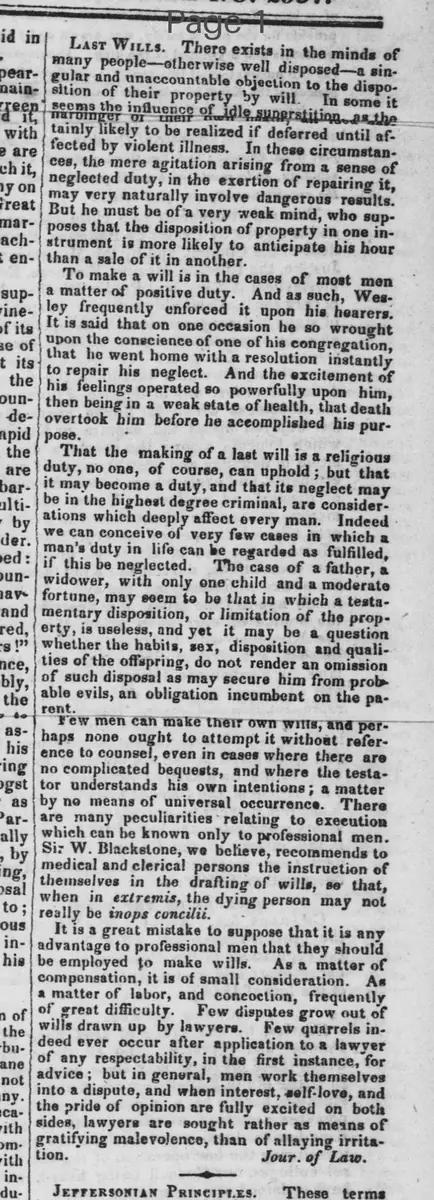
Last Wills. There exists in the minds of many people-otherwise well disposed-a singular and unaccountable objection to the disposition of their property by will. In some it seems the influence of idle superstition.as the certainly likely to be realized if deferred until affected by violent illness. In these circumstances, the mere agitation arising from a sense of neglected duty, in the exertion of repairing it, may very naturally involve dangerous results. But he must be of a very weak mind, who supposes that the disposition of property in one instrument is more likely to anticipate his hour than a sale of it in another.
To make a will is in the cases of most men a matter of positive duty. And as such, Wesley frequently enforced it upon his hearers. It is said that on one occasion he so wrought upon the conscience of one of his congregation, that he went home with a resolution instantly to repair his neglect. And the excitement of his feelings operated so powerfully upon him, then being in a weak state of health, that death overtook him before he accomplished his purpose.
That the making of a last will is a religious duty, no one, of course, can uphold; but that it may become a duty, and that its neglect may be in the highest degree criminal, are considerations which deeply affect every man. Indeed we can conceive of very few cases in which a man's duty in life can be regarded as fulfilled, if this be neglected. The case of a father, a widower, with only one child and a moderate fortune, may seem to be that in which a testamentary disposition, or limitation of the property, is useless, and yet it may be a question whether the habits, sex, disposition and qualities of the offspring, do not render an omission of such disposal as may secure him from probable evils, an obligation incumbent on the parent.
Few men can make their own wills, and perhaps none ought to attempt it without reference to counsel, even in cases where there are no complicated bequests, and where the testator understands his own intentions; a matter by no means of universal occurrence. There are many peculiarities relating to execution which can be known only to professional men.
Sir W. Blackstone, we believe, recommends to medical and clerical persons the instruction of themselves in the drafting of wills, so that, when in extremis, the dying person may not really be inops concilii.
It is a great mistake to suppose that it is any advantage to professional men that they should be employed to make wills. As a matter of compensation, it is of small consideration. As a matter of labor, and concoction, frequently of great difficulty. Few disputes grow out of wills drawn up by lawyers. Few quarrels indeed ever occur after application to a lawyer of any respectability, in the first instance, for advice; but in general, men work themselves into a dispute, and when interest, self-love, and the pride of opinion are fully excited on both sides, lawyers are sought rather as means of gratifying malevolence, than of allaying irritation.
Jour. of Law.
To make a will is in the cases of most men a matter of positive duty. And as such, Wesley frequently enforced it upon his hearers. It is said that on one occasion he so wrought upon the conscience of one of his congregation, that he went home with a resolution instantly to repair his neglect. And the excitement of his feelings operated so powerfully upon him, then being in a weak state of health, that death overtook him before he accomplished his purpose.
That the making of a last will is a religious duty, no one, of course, can uphold; but that it may become a duty, and that its neglect may be in the highest degree criminal, are considerations which deeply affect every man. Indeed we can conceive of very few cases in which a man's duty in life can be regarded as fulfilled, if this be neglected. The case of a father, a widower, with only one child and a moderate fortune, may seem to be that in which a testamentary disposition, or limitation of the property, is useless, and yet it may be a question whether the habits, sex, disposition and qualities of the offspring, do not render an omission of such disposal as may secure him from probable evils, an obligation incumbent on the parent.
Few men can make their own wills, and perhaps none ought to attempt it without reference to counsel, even in cases where there are no complicated bequests, and where the testator understands his own intentions; a matter by no means of universal occurrence. There are many peculiarities relating to execution which can be known only to professional men.
Sir W. Blackstone, we believe, recommends to medical and clerical persons the instruction of themselves in the drafting of wills, so that, when in extremis, the dying person may not really be inops concilii.
It is a great mistake to suppose that it is any advantage to professional men that they should be employed to make wills. As a matter of compensation, it is of small consideration. As a matter of labor, and concoction, frequently of great difficulty. Few disputes grow out of wills drawn up by lawyers. Few quarrels indeed ever occur after application to a lawyer of any respectability, in the first instance, for advice; but in general, men work themselves into a dispute, and when interest, self-love, and the pride of opinion are fully excited on both sides, lawyers are sought rather as means of gratifying malevolence, than of allaying irritation.
Jour. of Law.
What sub-type of article is it?
Editorial
Moral Essay
What themes does it cover?
Moral Virtue
Family
Justice
What keywords are associated?
Last Wills
Testamentary Duty
Superstition
Moral Obligation
Legal Advice
Inheritance
Professional Counsel
What entities or persons were involved?
Wesley
Sir W. Blackstone
Story Details
Key Persons
Wesley
Sir W. Blackstone
Story Details
Discusses superstitions against making wills, argues it is a positive duty often enforced by Wesley, recounts an anecdote of a congregant dying before making his will, asserts neglect can be criminal especially for parents, advises consulting professionals, cites Blackstone's recommendation, and notes lawyers prevent disputes.