Thank you for visiting SNEWPapers!
Sign up free
Atlanta Daily World
Atlanta, Fulton County, Georgia
What is this article about?
Georgia Heart Association's eighth annual report highlights eight years of progress against heart disease via research ($70,000 in 1956), education, and services through 15 clinics serving 7,000+ indigent patients, stressing interdependence to reduce it from top 10 death causes.
Clipping
OCR Quality
Full Text
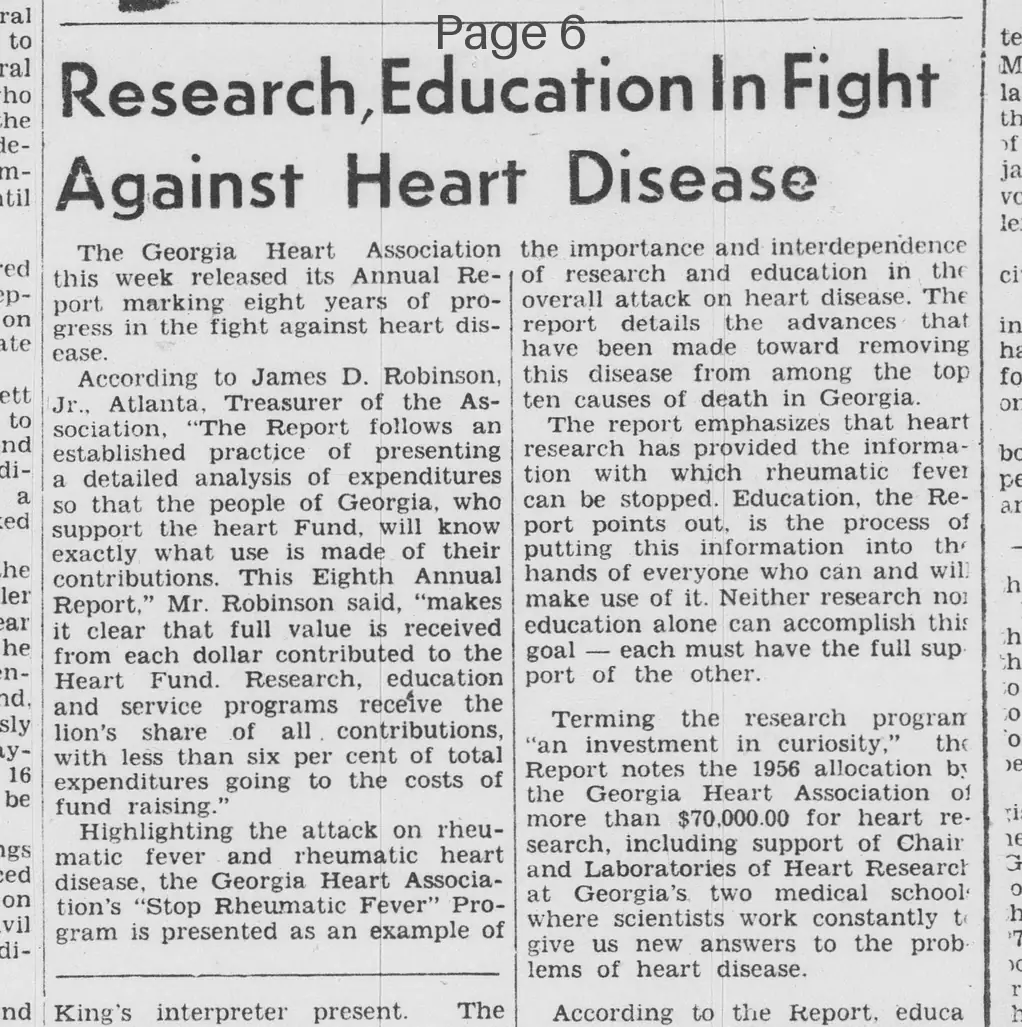
Against
Heart Disease
The Georgia Heart Association this week released its Annual Report marking eight years of progress in the fight against heart disease. The report details the advances that have been made toward removing this disease from among the top ten causes of death in Georgia.
The report emphasizes the importance and interdependence of research and education in the overall attack on heart disease.
According to James D. Robinson, Jr., Atlanta, Treasurer of the Association, "The Report follows an established practice of presenting a detailed analysis of expenditures so that the people of Georgia, who support the heart Fund, will know exactly what use is made of their contributions. This Eighth Annual Report," Mr. Robinson said, "makes it clear that full value is received from each dollar contributed to the Heart Fund. Research, education and service programs receive the lion's share of all contributions, with less than six per cent of total expenditures going to the costs of fund raising."
According to the Report, research has provided the information with which rheumatic fever can be stopped. Education, the Report points out, is the process of putting this information into the hands of everyone who can and will make use of it. Neither research nor education alone can accomplish this goal - each must have the full support of the other.
Terming the research program "an investment in curiosity," the Report notes the 1956 allocation by the Georgia Heart Association of more than $70,000.00 for heart research, including support of Chairs and Laboratories of Heart Research at Georgia's two medical schools where scientists work constantly to give us new answers to the problems of heart disease.
Highlighting the attack on rheumatic fever and rheumatic heart disease, the Georgia Heart Association's "Stop Rheumatic Fever" Program is presented as an example of research and education working together.
According to the Report, education serves to "bridge the Gap" by taking the knowledge gained from research and putting it to work in services to heart patients in Georgia.
The Report presents the details of the educational program, which uses every means available to bring this information to the people of Georgia.
It cautions, however, that "only the beginning" has been made and that "every effort must be made to put existing knowledge to work to continue and intensify the search for more adequate answers as funds permit."
Chief among services in Georgia are those provided to indigent heart patients, through the fifteen Georgia Heart Clinics, accessible to all parts of the State. Last year these clinics handled more than 7,000 patient visits; to make this possible, 127 Georgia physicians contributed more than 7,400 hours of their time.
The report features a cover designed by "Baldy," Atlanta Constitution Editorial Cartoonist, depicting the Heart Fund on Rheumatic Fever.
Copies of the Eighth Annual Report are available to anyone interested. Write to the Georgia Heart Association, Atlanta, for your copy.
What sub-type of article is it?
What keywords are associated?
What entities or persons were involved?
Where did it happen?
Domestic News Details
Primary Location
Georgia
Event Date
This Week
Key Persons
Outcome
progress in fighting heart disease; 15 clinics handled over 7,000 patient visits with 127 physicians contributing over 7,400 hours; $70,000 allocated for research in 1956
Event Details
The Georgia Heart Association released its eighth annual report detailing eight years of progress against heart disease through interdependent research and education efforts, emphasizing the 'Stop Rheumatic Fever' program, services to indigent patients via 15 statewide clinics, and allocation of funds primarily to research, education, and services with minimal fundraising costs.