Thank you for visiting SNEWPapers!
Sign up free
Sentinel Of The Valley
Woodstock, Shenandoah County, Virginia
What is this article about?
A letter to the Sentinel criticizing the 'American System' of protective tariffs as a fraudulent scheme that enriches manufacturers and planters while impoverishing farmers and laborers. It celebrates partial repeal as progress toward equal rights, contrasts with England's Corn Law repeal, and urges complete elimination of protectionism.
Clipping
OCR Quality
Full Text
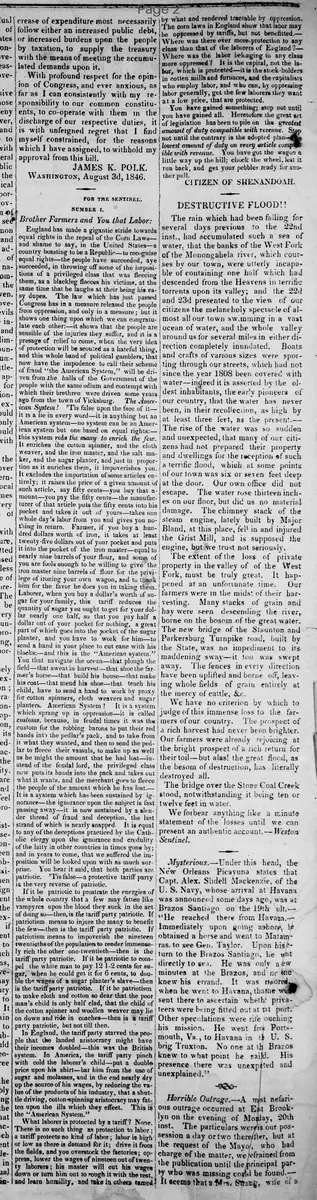
NUMBER I.
Brother Farmers and You that Labor:
England has made a gigantic stride towards equal rights in the repeal of the Corn Laws—and shame to say, in the United States—a country boasting to be a Republic—to recognise equal rights—the people have succeeded, aye succeeded, in throwing off some of the impositions of a privileged class that was fleecing them, as a blackleg fleeces his victims, at the same time that he laughs at their being his easy dupes. The law which has just passed Congress has in a measure released the people from oppression, and only in a measure; but it shows one thing upon which we can congratulate each other:—it shows that the people are sensible of the injuries they suffer, and it is a presage of relief to come, when the very idea of protection will be scouted as a hateful thing. and this whole band of political gamblers, that now have the impudence to call their scheme of fraud "the American System," will be driven from the halls of the Government of the people with the same odium and contempt with which their brethren were driven some years ago from the town of Vicksburg. The American System! It is false upon the face of it—it is a lie in every word—it is anything but an American system—no system can be an American system but one based on equal rights:— this system robs the many to enrich the few. It enriches the cotton spinner, and the cloth weaver, and the iron master, and the salt maker, and the sugar planter, and just in proportion as it enriches them, it impoverishes you. It excludes the importation of some articles entirely; it raises the price of a given amount of such article, say fifty cents—you buy that amount—you pay the fifty cents—the manufacturer of that article puts the fifty cents into his pocket and takes it out of yours—takes one whole day's labor from you and gives you nothing in return. Farmer, if you buy a hundred dollars worth of iron, it takes at least twenty-five dollars out of your pocket and puts it into the pocket of the iron master—equal to nearly nine barrels of your flour, and some of you are fools enough to be willing to give the iron master nine barrels of flour for the privilege of ironing your own wagon, and to thank him for the favor he does you in taking them. Laborer, when you buy a dollar's worth of sugar for your family, this tariff reduces the quantity of sugar you ought to get for your dollar nearly one half, so that you pay half a dollar out of your pocket for nothing, a great part of which goes into the pocket of the sugar planter, and you have to work for him—to send a hand in your place to cut cane with his blacks;—and this is the "American system." You that navigate the ocean—that plough the field—that sweat in harvest—that shoe the farmer's horse—that build his house—that make his coat—that mend his shoe—that teach his child, have to send a hand to work by proxy for cotton spinners, cloth weavers and sugar planters. American System! It is a system which sprang up in oppression—it is called customs, because, in feudal times it was the custom for the robbing barons to put their red hands into the pedlar's pack, and to take from it what they wanted, and then to send the pedlar to fleece their vassals. to make up as well as he might the amount that he had lost—instead of the feudal lord, the privileged class now puts its hands into the pack and takes out what it wants, and the merchant goes to fleece the people of the amount which he has lost.— It is a system which has been sustained by ignorance—the ignorance upon the subject is fast passing away—it is now sustained by a slender thread of fraud and deception, the last strand of which is nearly snapped. It is equal to any of the deceptions practiced by the Catholic clergy upon the ignorance and credulity of the laity in other countries in times gone by; and in years to come, that we suffered the imposition will be looked upon with as much surprise. You hear it said, that both parties are patriotic. 'Tis false—a protective tariff party is the very reverse of patriotic. If it be patriotic to prostrate the energies of the whole country that a few may fatten like vampyres upon the blood they suck in the act of doing so—then, is the tariff party patriotic. If patriotism means to injure the many to benefit the few—then is the tariff party patriotic. If patriotism means to impoverish the nineteen twentieths of the population to render immensely rich the other one-twentieth—then is the tariff party patriotic. If it be patriotic to compel the white man to pay 12 1-2 cents for sugar, when he could get it for 6 cents, to double the wages of a sugar planter's slave—then is the tariff party patriotic. If it be patriotism to make cloth and cotton so dear that the poor man's child is only half clad, that the child of the cotton spinner and woollen weaver may lie on down and ride in coaches—then is a tariff party patriotic, but not till then. In England, the tariff party starved the people that the landed aristocracy might have their incomes doubled—this was the British system. In America, the tariff party pinch with cold the laborer's child—put a double price upon his shirt—bar him from the use of sugar and molasses, and in the end nearly dry up the source of his wages, by reducing the value of the products of his industry, that a shuttle driving, cotton-spinning aristocracy may fatten upon the ills which they effect. This is the "American System."
What laborer is protected by a tariff? None. There is no such thing as protection to labor; a tariff protects no kind of labor; labor is high or low as there is demand for it; drive it from the fields, and you overstock the factories; oppress, lower the wages of nineteen out of twenty laborers; his master will cut his wages down or turn him out to rough it with the rest, and learn humility, and take in others tamed by want and rendered tractable by oppression. The corn laws in England show that labor may be oppressed by tariffs, but not benefitted.— Where was there ever more protection to any class than that of the laborers of England? Where was the labor belonging to any class more oppressed? It is the capital, not the labor, which is protected—it is the stock-holders in cotton mills and furnaces, and the capitalists who employ labor, and who can, by oppressing labor generally, get the few laborers they want at a low price, that are protected.
You have gained something; stop not until you have gained all. Heretofore the great art of legislation has been to pile on the greatest amount of duty compatible with revenue. Stop not until the contrary is the adopted plan—lowest amount of duty on every article compatible with revenue. You have got the wagon a little way up the hill; chock the wheel, lest it run back, and get your pebbles ready for another pull.
CITIZEN OF SHENANDOAH.
What sub-type of article is it?
What themes does it cover?
What keywords are associated?
What entities or persons were involved?
Letter to Editor Details
Author
Citizen Of Shenandoah.
Recipient
The Sentinel
Main Argument
the 'american system' of protective tariffs is a fraudulent scheme that robs farmers and laborers to enrich a privileged manufacturing and planting class, contrary to true american equal rights; partial repeal is progress, but complete elimination of protectionism is needed.
Notable Details