Thank you for visiting SNEWPapers!
Sign up free
The Liberator
Boston, Suffolk County, Massachusetts
What is this article about?
In a Supreme Judicial Court case, Catharine Linda, a slave from Georgia, sued Erasmus D. Hudson for malicious imprisonment after he initiated a habeas corpus writ to free her against her wishes. The jury could not agree on a verdict.
Clipping
OCR Quality
Full Text
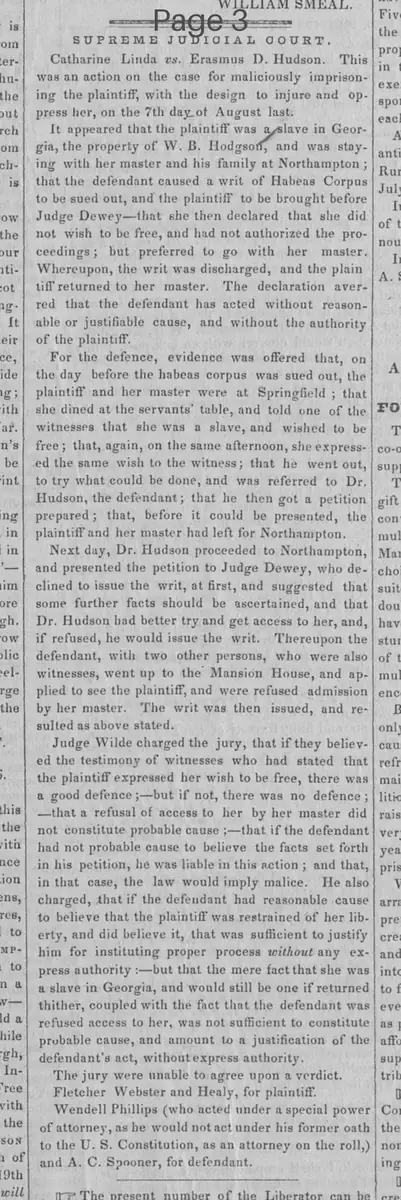
Catharine Linda vs. Erasmus D. Hudson. This was an action on the case for maliciously imprisoning the plaintiff, with the design to injure and oppress her, on the 7th day of August last.
It appeared that the plaintiff was a slave in Georgia, the property of W. B. Hodgson, and was staying with her master and his family at Northampton; that the defendant caused a writ of Habeas Corpus to be sued out, and the plaintiff to be brought before Judge Dewey—that she then declared that she did not wish to be free, and had not authorized the proceedings; but preferred to go with her master. Whereupon, the writ was discharged, and the plaintiff returned to her master. The declaration averred that the defendant had acted without reasonable or justifiable cause, and without the authority of the plaintiff.
For the defence, evidence was offered that, on the day before the habeas corpus was sued out, the plaintiff and her master were at Springfield ; that she dined at the servants' table, and told one of the witnesses that she was a slave, and wished to be free; that, again, on the same afternoon, she expressed the same wish to the witness; that he went out, to try what could be done, and was referred to Dr. Hudson, the defendant; that he then got a petition prepared; that, before it could be presented, the plaintiff and her master had left for Northampton. Next day, Dr. Hudson proceeded to Northampton, and presented the petition to Judge Dewey, who declined to issue the writ, at first, and suggested that some further facts should be ascertained, and that Dr. Hudson had better try and get access to her, and, if refused, he would issue the writ. Thereupon the defendant, with two other persons, who were also witnesses, went up to the Mansion House, and applied to see the plaintiff, and were refused admission by her master. The writ was then issued, and resulted as above stated.
Judge Wilde charged the jury, that if they believed the testimony of witnesses who had stated that the plaintiff expressed her wish to be free, there was a good defence;—but if not, there was no defence; —that a refusal of access to her by her master did not constitute probable cause :—that if the defendant had not probable cause to believe the facts set forth in his petition, he was liable in this action; and that, in that case, the law would imply malice. He also charged, that if the defendant had reasonable cause to believe that the plaintiff was restrained of her liberty, and did believe it, that was sufficient to justify him for instituting proper process without any express authority :—but that the mere fact that she was a slave in Georgia, and would still be one if returned thither, coupled with the fact that the defendant was refused access to her, was not sufficient to constitute probable cause, and amount to a justification of the defendant's act, without express authority.
The jury were unable to agree upon a verdict.
Fletcher Webster and Healy, for plaintiff
Wendell Phillips (who acted under a special power of attorney, as he would not act under his former oath to the U. S. Constitution, as an attorney on the roll,) and A. C. Spooner, for defendant.
What sub-type of article is it?
What keywords are associated?
What entities or persons were involved?
Where did it happen?
Domestic News Details
Primary Location
Northampton
Event Date
7th Day Of August Last
Key Persons
Outcome
the jury were unable to agree upon a verdict.
Event Details
Catharine Linda sued Erasmus D. Hudson for maliciously imprisoning her via a habeas corpus writ on August 7, intending to free her against her wishes. Evidence showed she initially expressed desire for freedom but later preferred to stay with her master. The writ was discharged, and she returned to him. The defense claimed probable cause based on her earlier statements and refusal of access.