Thank you for visiting SNEWPapers!
Sign up free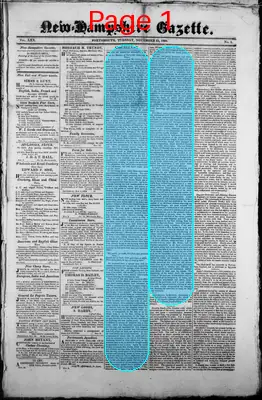
Literary
November 23, 1824
The New Hampshire Gazette
Portsmouth, Rockingham County, New Hampshire
What is this article about?
Excerpt from Prior's Memoirs of Edmund Burke detailing the sudden death of his son Richard on August 2, 1794, at age 36, from a decline. Describes Burke's profound grief, the son's final moments quoting Milton, family anguish, and lasting impact on Burke's health and spirits.
Merged-components note: Continuation of the same literary piece on the death of Edmund Burke's son, split across columns; merged for coherence.
Clipping
OCR Quality
95%
Excellent
Full Text
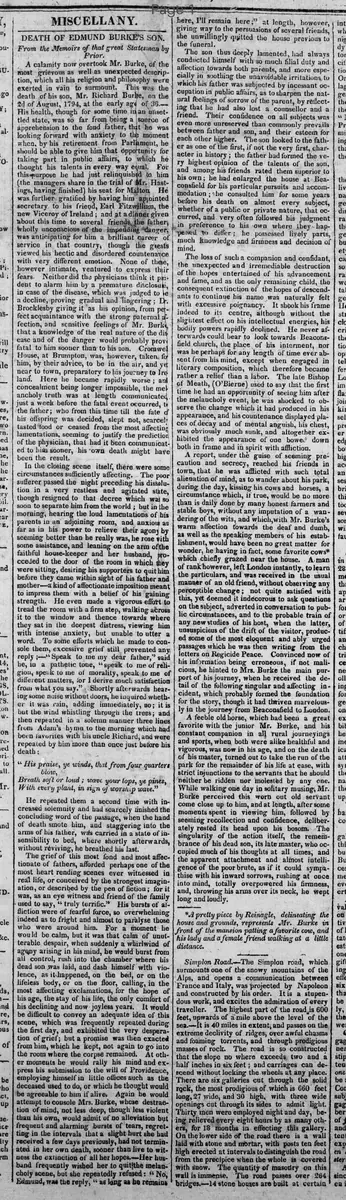
MISCELLANY.
DEATH OF EDMUND BURKE'S SON
From the Memoirs of that great Statesman by
Prior.
A calamity now overtook Mr. Burke, of the
most grievous as well as unexpected descrip-
tion, which all his religion and philosophy were
exerted in vain to surmount. This was the
death of his son, Mr. Richard Burke, on the
2d of August, 1794, at the early age of 36.—
His health, though for some time in an unset-
tled state, was so far from being a source of
apprehension to the fond father, that he was
looking forward with anxiety to the moment
when, by his retirement from Parliament, he
should be able to give him that opportunity for
taking part in public affairs, to which he
thought his talents in every way equal. For
this purpose he had just relinquished to him
(the managers share in the trial of Mr. Hast-
ings, having finished) his seat for Malton He
was further gratified by having him appointed
secretary. to his friend, Earl Fitzwilliam, the
new Viceroy of Ireland; and at a dinner given
about this time to several friends, the father
wholly unconscious of the impending danger.
was anticipating for him a brilliant career of
service in that country, though the guests
viewed his hectic and disordered countenance
with very different emotion. None of these,
however intimate, ventured to express their
fears. Neither did the physicians think it pru-
dent to alarm him by a premature disclosure,
in case of the disease, which was judged to be
a decline, proving gradual and lingering; Dr.
Brocklesby giving it as his opinion, from pe-
fect acquaintance with the strong paternal af-
fection, and sensitive feelings of Mr. Burke
that a knowledge of the real nature of the dis-
ease and of the danger would probably prove
fatal to him sooner than to his son. Cromwell
House, at Brompton, was, however, taken for
him, by their advice, to be in the air, and yet
near to town, preparatory to his journey to Ire-
land. Here he became rapidly worse; an
concealment being longer impossible, the mel-
ancholy truth was at length communicated
just a week before the fatal event occurred, to
the father; who from this time till the fate of
his offspring was decided, slept not, scarcely
tasted food or ceased from the most affecting
lamentations, seeming to justify the prediction
of the physician, that had it been communicated
to him sooner, his own death might have
been the result.
In the closing scene itself, there were some
circumstances sufficiently affecting. The poor
sufferer passed the night preceding his dissolu-
tion in a very restless and agitated state.
though resigned to that decree which was so
soon to separate him from the world; but in the
morning, hearing the loud lamentations of his
parents in an adjoining room, and anxious as
far as in his power to relieve their agony by
seeming better than he really was, he rose with
some assistance, and leaning on the arm of the
faithful house-keeper and her husband, pro-
ceeded to the door of the room in which they
were sitting, desiring his supporters to quit him
before they came within sight of his father and
mother—a kind of affectionate imposition meant
to impress them with a belief of his gaining
strength. He even made a vigorous effort to
tread the room with a firm step, walking across
it to the window and thence towards where
they sat in the deepest distress, viewing him
with intense anxiety, but unable to utter a
word. To some efforts which he made to con-
sole them, excessive grief still prevented any
reply;—"Speak to me my dear father," said
he, in a pathetic tone, "speak to me of reli-
gion, speak to me of morality, speak to me of
different matters, for I derive much satisfaction
from what you say." Shortly afterwards hear-
ing some noise without doors, he inquired wheth-
er it was rain, adding immediately, no; it is
but the wind whistling through the trees; and
then repeated in a solemn manner three lines
from Adam's hymn to the morning which had
been favorites with his uncle Richard, and were
repeated by him more than once just before his
death:
"His praise, ye winds, that from four quarters
blow,
Breath soft or loud; wave your tops, ye pines,
With every plant, in sign of worship wave."
He repeated them a second time with in-
creased solemnity and had scarcely finished the
concluding word of the passage, when the hand
of death smote him, and staggering into the
arms of his father, was carried in a state of in-
sensibility to bed, where shortly afterwards,
without reviving, he breathed his last.
The grief of this most fond and most afec-
tionate of fathers, afforded perhaps one of the
most heart rending scenes ever witnessed in
real life, or conceived by the strongest imagin-
ation, or described by the pen of fiction; for it
was, as an eye witness and friend of the family
used to say, "truly terrific." His bursts of af-
fliction were of fearful force, so overwhelming
indeed as to fright and almost to paralyse those
who were around him. For a moment he
would be calm, but it was that calm of utter-
terable despair, when suddenly a whirlwind of
agony arising in his mind, he would burst from
all control, rush into the chamber where his
dead son was laid, and dash himself with vio-
lence, as it happened, on the bed, or on the
lifeless body, or on the floor, calling, in the
most affecting exclamations, for the hope of
his age, the stay of his life, the only comfort of
his declining and now joyless years. It would
be difficult to convey an adequate idea of this
scene, which was frequently repeated during
the first day, and exhibited the very despera-
tion of grief; but a promise was then exacted
from him, which he kept, not again to go into
the room where the corpse remained. At other
moments he would rally his mind and ex-
press his submission to the will of Providence,
employing himself in little offices such as the
deceased used to do, or which he thought would
be agreeable to him if alive. Again he would
attempt to console Mrs. Burke, whose destruc-
tion of mind, not less deep, though less violent
than his own, would admit of no alleviation but
frequent and alarming bursts of tears, regret-
ting in the intervals that a slight hurt she had
received a few days previously, had not termin-
ated in her own death, sooner than live to wit-
ness the extinction of all her hopes.—Her hus-
band frequently wished her to quit the melan-
choly scene, but she repeatedly refused: "No.
Edmund," was the reply, "as long as he remains
here, I'll remain here;"
at length, however,
giving way to the persuasions of several friends,
she unwillingly quitted the house previous to
the funeral.
The son thus deeply lamented, had always
conducted himself with so much filial duty and
affection towards both parents, and more espe-
cially in soothing the unavoidable irritations, to
which his father was subjected by incessant oc-
cupation in public affairs, as to sharpen the nat-
ural feelings of sorrow of the parent, by reflect-
ing that he had also lost a counsellor and a
friend. Their confidence on all subjects was
even more unreserved than commonly prevails
between father and son, and their esteem for
each other higher. The son looked to the fath-
er as one of the first, if not the very first, char-
acter in history; the father had formed the ve-
ry highest opinion of the talents of the son,
and among his friends rated them superior to
his own; he had enlarged the house at Bea-
consfield for his particular pursuits and accom-
modation; he consulted him for some years
before his death on almost every subject,
whether of a public or private nature, that oc-
curred, and very often followed his judgment
in preference to his own where they hap-
pened to differ; he possessed lively parts,
much knowledge and firmness and decision of
mind.
The loss of such a companion and confidant.
the unexpected and irremediable destruction
of the hopes entertained of his advancement
and fame, and as the only remaining child, the
consequent extinction of the hopes of descend-
ants to continue his name was naturally felt
with excessive poignancy. It shook his frame
indeed to its centre, although without the
slightest effect on his intellectual energies, his
bodily powers rapidly declined. He never af-
terwards could bear to look towards Beacons-
field church, the place of his interment, nor
was he perhaps for any length of time ever ab-
sent from his mind, except when engaged in
literary composition, which therefore became
rather a relief than a labor. The late Bishop
of Meath, (O'Beirne) used to say that the first
time he had an opportunity of seeing him after
the melancholy event, he was shocked to ob-
serve the change which it had produced in his
appearance, and his countenance displayed pla-
ces of decay and of mental anguish, his chest,
was obviously much sunk, and altogether ex-
hibited the appearance of one bowed down
both in frame and in spirit with affliction.
A report, under the guise of seeming pre-
caution and secrecy, reached his friends in
town, that he was afflicted with such total
alienation of mind, as to wander about his park.
during the day, kissing his cows and horses, a
circumstance which, if true, would be no more
than is daily done by many honest farmers and
stable boys, without any imputation of a wan-
dering of the wits, and which, with Mr. Burke's
warm affection towards the deaf and dumb.
as well as the speaking members of his estab-
lishment, would have been no great matter for
wonder, he having in fact, some favorite cows*
which chiefly grazed near the house. A man
of rank however, left London instantly, to learn
the particulars, and was received in the usual
manner of an old friend, without observing any
perceptible change; not quite satisfied with
this, yet deemed it indecorous to ask questions
on the subject, adverted in conversation to pub-
lic circumstances, and to the probable train of
any new studies of his host, when the latter,
unsuspicious of the drift of the visitor, produc-
ed some of the most eloquent and ably urged
passages which he was then writing from the
letters on Regicide Peace. Convinced now of
his information being erroneous, if not mali-
cious, he hinted to Mrs. Burke the main pur-
port of his journey, when he received the de-
tail of the following singular and affecting in-
cident, which probably formed the foundation
for the story, though it had thriven marvelous-
ly in the journey from Beaconsfield to London.
A feeble old horse, which had been a great
favorite with the junior Mr. Burke, and his
constant companion in all rural journeyings
and sports, when both were alike healthful and
vigorous, was now in his age, and on the death
of his master, turned out to take the run of the
park for the remainder of his life at ease, with
strict injunctions to the servants that he should
neither be ridden nor molested by any one.
While walking one day in solitary musing, Mr.
Burke perceived this worn out old servant
come close up to him, and at length, after some
moments spent in viewing him, followed by
seeming recollection and confidence, deliber-
ately rested its head upon his bosom. The
singularity of the action itself, the remem-
brance of his dead son, its late master, who oc-
curied much of his thoughts at all times; and
the apparent attachment and almost intelli-
gence of the poor brute, as if it could sympa-
thize with his inward sorrows, rushing at once
into mind, totally overpowered his firmness,
and, throwing his arms over its neck, he wept
long and loudly.
*A pretty piece by Reinagle, delineating the
house and grounds, represents Mr. Burke in
front of the mansion patting a favorite cow, and
his lady and a female friend walking at a little
distance.
DEATH OF EDMUND BURKE'S SON
From the Memoirs of that great Statesman by
Prior.
A calamity now overtook Mr. Burke, of the
most grievous as well as unexpected descrip-
tion, which all his religion and philosophy were
exerted in vain to surmount. This was the
death of his son, Mr. Richard Burke, on the
2d of August, 1794, at the early age of 36.—
His health, though for some time in an unset-
tled state, was so far from being a source of
apprehension to the fond father, that he was
looking forward with anxiety to the moment
when, by his retirement from Parliament, he
should be able to give him that opportunity for
taking part in public affairs, to which he
thought his talents in every way equal. For
this purpose he had just relinquished to him
(the managers share in the trial of Mr. Hast-
ings, having finished) his seat for Malton He
was further gratified by having him appointed
secretary. to his friend, Earl Fitzwilliam, the
new Viceroy of Ireland; and at a dinner given
about this time to several friends, the father
wholly unconscious of the impending danger.
was anticipating for him a brilliant career of
service in that country, though the guests
viewed his hectic and disordered countenance
with very different emotion. None of these,
however intimate, ventured to express their
fears. Neither did the physicians think it pru-
dent to alarm him by a premature disclosure,
in case of the disease, which was judged to be
a decline, proving gradual and lingering; Dr.
Brocklesby giving it as his opinion, from pe-
fect acquaintance with the strong paternal af-
fection, and sensitive feelings of Mr. Burke
that a knowledge of the real nature of the dis-
ease and of the danger would probably prove
fatal to him sooner than to his son. Cromwell
House, at Brompton, was, however, taken for
him, by their advice, to be in the air, and yet
near to town, preparatory to his journey to Ire-
land. Here he became rapidly worse; an
concealment being longer impossible, the mel-
ancholy truth was at length communicated
just a week before the fatal event occurred, to
the father; who from this time till the fate of
his offspring was decided, slept not, scarcely
tasted food or ceased from the most affecting
lamentations, seeming to justify the prediction
of the physician, that had it been communicated
to him sooner, his own death might have
been the result.
In the closing scene itself, there were some
circumstances sufficiently affecting. The poor
sufferer passed the night preceding his dissolu-
tion in a very restless and agitated state.
though resigned to that decree which was so
soon to separate him from the world; but in the
morning, hearing the loud lamentations of his
parents in an adjoining room, and anxious as
far as in his power to relieve their agony by
seeming better than he really was, he rose with
some assistance, and leaning on the arm of the
faithful house-keeper and her husband, pro-
ceeded to the door of the room in which they
were sitting, desiring his supporters to quit him
before they came within sight of his father and
mother—a kind of affectionate imposition meant
to impress them with a belief of his gaining
strength. He even made a vigorous effort to
tread the room with a firm step, walking across
it to the window and thence towards where
they sat in the deepest distress, viewing him
with intense anxiety, but unable to utter a
word. To some efforts which he made to con-
sole them, excessive grief still prevented any
reply;—"Speak to me my dear father," said
he, in a pathetic tone, "speak to me of reli-
gion, speak to me of morality, speak to me of
different matters, for I derive much satisfaction
from what you say." Shortly afterwards hear-
ing some noise without doors, he inquired wheth-
er it was rain, adding immediately, no; it is
but the wind whistling through the trees; and
then repeated in a solemn manner three lines
from Adam's hymn to the morning which had
been favorites with his uncle Richard, and were
repeated by him more than once just before his
death:
"His praise, ye winds, that from four quarters
blow,
Breath soft or loud; wave your tops, ye pines,
With every plant, in sign of worship wave."
He repeated them a second time with in-
creased solemnity and had scarcely finished the
concluding word of the passage, when the hand
of death smote him, and staggering into the
arms of his father, was carried in a state of in-
sensibility to bed, where shortly afterwards,
without reviving, he breathed his last.
The grief of this most fond and most afec-
tionate of fathers, afforded perhaps one of the
most heart rending scenes ever witnessed in
real life, or conceived by the strongest imagin-
ation, or described by the pen of fiction; for it
was, as an eye witness and friend of the family
used to say, "truly terrific." His bursts of af-
fliction were of fearful force, so overwhelming
indeed as to fright and almost to paralyse those
who were around him. For a moment he
would be calm, but it was that calm of utter-
terable despair, when suddenly a whirlwind of
agony arising in his mind, he would burst from
all control, rush into the chamber where his
dead son was laid, and dash himself with vio-
lence, as it happened, on the bed, or on the
lifeless body, or on the floor, calling, in the
most affecting exclamations, for the hope of
his age, the stay of his life, the only comfort of
his declining and now joyless years. It would
be difficult to convey an adequate idea of this
scene, which was frequently repeated during
the first day, and exhibited the very despera-
tion of grief; but a promise was then exacted
from him, which he kept, not again to go into
the room where the corpse remained. At other
moments he would rally his mind and ex-
press his submission to the will of Providence,
employing himself in little offices such as the
deceased used to do, or which he thought would
be agreeable to him if alive. Again he would
attempt to console Mrs. Burke, whose destruc-
tion of mind, not less deep, though less violent
than his own, would admit of no alleviation but
frequent and alarming bursts of tears, regret-
ting in the intervals that a slight hurt she had
received a few days previously, had not termin-
ated in her own death, sooner than live to wit-
ness the extinction of all her hopes.—Her hus-
band frequently wished her to quit the melan-
choly scene, but she repeatedly refused: "No.
Edmund," was the reply, "as long as he remains
here, I'll remain here;"
at length, however,
giving way to the persuasions of several friends,
she unwillingly quitted the house previous to
the funeral.
The son thus deeply lamented, had always
conducted himself with so much filial duty and
affection towards both parents, and more espe-
cially in soothing the unavoidable irritations, to
which his father was subjected by incessant oc-
cupation in public affairs, as to sharpen the nat-
ural feelings of sorrow of the parent, by reflect-
ing that he had also lost a counsellor and a
friend. Their confidence on all subjects was
even more unreserved than commonly prevails
between father and son, and their esteem for
each other higher. The son looked to the fath-
er as one of the first, if not the very first, char-
acter in history; the father had formed the ve-
ry highest opinion of the talents of the son,
and among his friends rated them superior to
his own; he had enlarged the house at Bea-
consfield for his particular pursuits and accom-
modation; he consulted him for some years
before his death on almost every subject,
whether of a public or private nature, that oc-
curred, and very often followed his judgment
in preference to his own where they hap-
pened to differ; he possessed lively parts,
much knowledge and firmness and decision of
mind.
The loss of such a companion and confidant.
the unexpected and irremediable destruction
of the hopes entertained of his advancement
and fame, and as the only remaining child, the
consequent extinction of the hopes of descend-
ants to continue his name was naturally felt
with excessive poignancy. It shook his frame
indeed to its centre, although without the
slightest effect on his intellectual energies, his
bodily powers rapidly declined. He never af-
terwards could bear to look towards Beacons-
field church, the place of his interment, nor
was he perhaps for any length of time ever ab-
sent from his mind, except when engaged in
literary composition, which therefore became
rather a relief than a labor. The late Bishop
of Meath, (O'Beirne) used to say that the first
time he had an opportunity of seeing him after
the melancholy event, he was shocked to ob-
serve the change which it had produced in his
appearance, and his countenance displayed pla-
ces of decay and of mental anguish, his chest,
was obviously much sunk, and altogether ex-
hibited the appearance of one bowed down
both in frame and in spirit with affliction.
A report, under the guise of seeming pre-
caution and secrecy, reached his friends in
town, that he was afflicted with such total
alienation of mind, as to wander about his park.
during the day, kissing his cows and horses, a
circumstance which, if true, would be no more
than is daily done by many honest farmers and
stable boys, without any imputation of a wan-
dering of the wits, and which, with Mr. Burke's
warm affection towards the deaf and dumb.
as well as the speaking members of his estab-
lishment, would have been no great matter for
wonder, he having in fact, some favorite cows*
which chiefly grazed near the house. A man
of rank however, left London instantly, to learn
the particulars, and was received in the usual
manner of an old friend, without observing any
perceptible change; not quite satisfied with
this, yet deemed it indecorous to ask questions
on the subject, adverted in conversation to pub-
lic circumstances, and to the probable train of
any new studies of his host, when the latter,
unsuspicious of the drift of the visitor, produc-
ed some of the most eloquent and ably urged
passages which he was then writing from the
letters on Regicide Peace. Convinced now of
his information being erroneous, if not mali-
cious, he hinted to Mrs. Burke the main pur-
port of his journey, when he received the de-
tail of the following singular and affecting in-
cident, which probably formed the foundation
for the story, though it had thriven marvelous-
ly in the journey from Beaconsfield to London.
A feeble old horse, which had been a great
favorite with the junior Mr. Burke, and his
constant companion in all rural journeyings
and sports, when both were alike healthful and
vigorous, was now in his age, and on the death
of his master, turned out to take the run of the
park for the remainder of his life at ease, with
strict injunctions to the servants that he should
neither be ridden nor molested by any one.
While walking one day in solitary musing, Mr.
Burke perceived this worn out old servant
come close up to him, and at length, after some
moments spent in viewing him, followed by
seeming recollection and confidence, deliber-
ately rested its head upon his bosom. The
singularity of the action itself, the remem-
brance of his dead son, its late master, who oc-
curied much of his thoughts at all times; and
the apparent attachment and almost intelli-
gence of the poor brute, as if it could sympa-
thize with his inward sorrows, rushing at once
into mind, totally overpowered his firmness,
and, throwing his arms over its neck, he wept
long and loudly.
*A pretty piece by Reinagle, delineating the
house and grounds, represents Mr. Burke in
front of the mansion patting a favorite cow, and
his lady and a female friend walking at a little
distance.
What sub-type of article is it?
Essay
What themes does it cover?
Death Mortality
Political
Religious
What keywords are associated?
Edmund Burke
Richard Burke
Death
Grief
Memoir
Family
Politics
Ireland
What entities or persons were involved?
From The Memoirs Of That Great Statesman By Prior
Literary Details
Title
Death Of Edmund Burke's Son
Author
From The Memoirs Of That Great Statesman By Prior
Subject
The Death Of Richard Burke
Form / Style
Prose Memoir Excerpt On Grief And Family Loss
Key Lines
"Speak To Me My Dear Father," Said He, In A Pathetic Tone, "Speak To Me Of Religion, Speak To Me Of Morality, Speak To Me Of Different Matters, For I Derive Much Satisfaction From What You Say."
"His Praise, Ye Winds, That From Four Quarters Blow,
Breath Soft Or Loud; Wave Your Tops, Ye Pines,
With Every Plant, In Sign Of Worship Wave."