Thank you for visiting SNEWPapers!
Sign up free
Story
January 27, 1808
Alexandria Daily Advertiser
Alexandria, Virginia
What is this article about?
In the U.S. House of Representatives on January 5, Mr. Holland opposes a resolution requesting the President to investigate General Wilkinson's conduct in arresting suspects in the Burr conspiracy, arguing the House lacks authority, evidence is weak, and it could prejudice any trial.
Clipping
OCR Quality
95%
Excellent
Full Text
*CONGRESS.*
*HOUSE OF REPRESENTATIVES.*
*TUESDAY, January 5.*
*DEBATE*
On the resolution for requesting the president to cause an enquiry to be made into the conduct of general Wilkinson.
*[Continued.]*
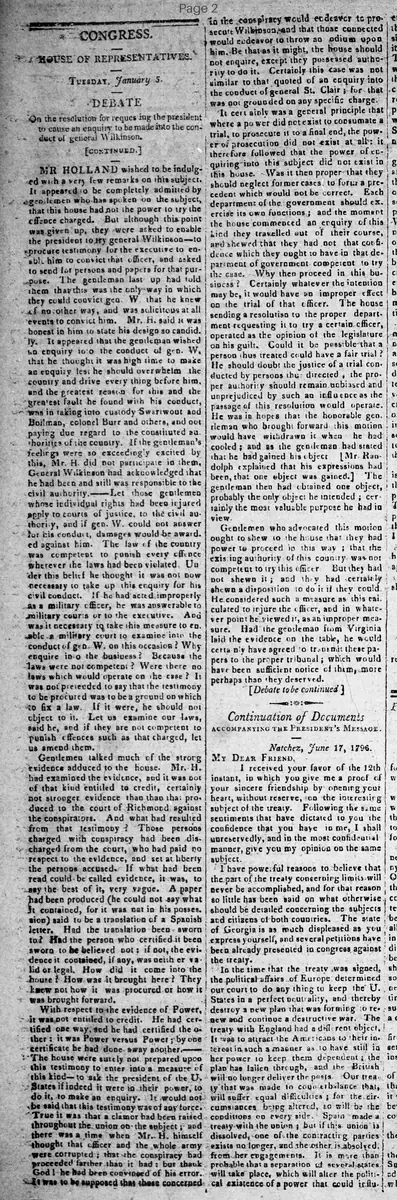
MR. HOLLAND wished to be indulged with a very few remarks on this subject. It appeared to be completely admitted by the gentleman who has spoken on the subject, that this house had not the power to try the offence charged. But although this point was given up, they were asked to enable the president to try general Wilkinson—to procure testimony for the executive to enable him to convict that officer, and asked to send for persons and papers for that purpose. The gentleman last up had told them that this was the only way in which they could convict gen. W. that he knew of no other way, and was solicitous at all events to convict him. Mr. H. said it was honest in him to state his design so candidly. It appeared that the gentleman wished no enquiry into the conduct of gen. W. that he thought it was high time to make an enquiry lest he should overwhelm the country and drive every thing before him. And the greatest reason for this and the greatest fault he found with his conduct, was in taking into custody Swartwout and Bollman, colonel Burr and others, and not paying due regard to the constituted authorities of the country. If the gentleman's feelings were so exceedingly excited by this. Mr. H. did not participate in them. General Wilkinson had acknowledged that he had been and still was responsible to the civil authority.—Let those gentlemen whose individual rights had been injured apply to courts of justice, to the civil authority, and if gen. W. could not answer for his conduct, damages would be awarded against him. The law of the country was competent to punish every offence wherever the laws had been violated. Under this belief he thought it was not now necessary to take up this enquiry for his civil conduct. If he had acted improperly as a military officer, he was answerable to military courts or to the executive. And was it necessary to take this measure to enable a military court to examine into the conduct of gen. W. on this occasion? Why enquire into the business? Because the laws were not competent? Were there no laws which would operate on the case? It was not pretended to say that the testimony to be procured was to be a ground on which to fix a law. If it were, he should not object to it. Let us examine our laws, said he, and if they are not competent to punish offences such as that charged, let us amend them. Gentlemen talked much of the strong evidence adduced to the house. Mr. H. had examined the evidence, and it was not of that kind entitled to credit, certainly not stronger evidence than that that produced to the court of Richmond against the conspirators. And what had resulted from that testimony?—Those persons charged with conspiracy had been discharged from the court, who had paid no respect to the evidence, and set at liberty the persons accused. If what had been read could be called evidence, it was, to say the best of it, very vague. A paper had been produced (he could not say what it contained, for it was not in his possession) said to be a translation of a Spanish letter. Had the translation been sworn to? Had the person who certified it been sworn to be believed not: if not, the evidence it contained, if any, was neither valid nor legal. How did it come into the house? How was it brought here? They knew not how it was procured or how it was brought forward. With respect to the evidence of Power, it was not entitled to credit. He had certified one way, and he had certified the other: it was Power versus Power; by one certificate he had done away another.—The house were surely not prepared upon this testimony to enter into a measure of this kind—to ask the president of the U. States if indeed it were in their power, to do it, to make an enquiry. It would not be said that this testimony was of any force. True it was that a clamor had been raised throughout the union on the subject; and there was a time when Mr. H. himself thought that officer and the whole army were corrupted; that the conspiracy had proceeded farther than it had: but thank God!—he had been convinced of his error. Still was to be supposed that these concerned in the conspiracy would endeavor to prosecute Wilkinson, and that those connected would endeavor to throw an odium upon him. Be that as it might, the house should not enquire, except they possessed authority to do it. Certainly this case was not similar to that quoted of an enquiry into the conduct of general St. Clair; for that was not grounded on any specific charge. It certainly was a general principle that where a power did not exist to consummate a trial, to prosecute it to a final end, the power of prosecution did not exist at all: it therefore followed that the power of enquiring into this subject did not exist in this house.—Was it then proper that they should neglect former cases, to form a precedent which would not be correct. Each department of the government should exercise its own functions; and the moment the house commenced an enquiry of this kind they travelled out of their course, and shewed that they had not that consideration which they ought to have in that department of government competent to try the case.—Why then proceed in this business? Certainly whatever the intention may be, it would have an improper effect on the trial of that officer. The house sending a resolution to the proper department requesting it to try a certain officer, operated as the opinion of the legislature on his guilt. Could it be possible that a person thus treated could have a fair trial? He should doubt the justice of a trial conducted by persons thus directed, the proper authority should remain unbiased and unprejudiced by such an influence as the passage of this resolution would operate. He was in hopes that the honorable gentleman who brought forward this motion would have withdrawn it when he had cooled; and as the gentleman had stated that he had gained his object [Mr. Randolph explained that his expressions had been, that one object was gained.] The gentleman then had obtained one object, probably the only object he intended; certainly the most valuable purpose he had in view. Gentlemen who advocated this motion ought to shew to the house that they had power to proceed in this way; that the existing authority of this country was not competent to try this officer But they had not shewn it; and they had certainly shewn a disposition to do it if they could. He considered such a measure as this calculated to injure the officer, and in whatever point he viewed it, as an improper measure. Had the gentleman from Virginia laid the evidence on the table, he would certainly have agreed to transmit these papers to the proper tribunal; which would have been sufficient notice of them, more perhaps than they deserved.
*[Debate to be continued]*
*HOUSE OF REPRESENTATIVES.*
*TUESDAY, January 5.*
*DEBATE*
On the resolution for requesting the president to cause an enquiry to be made into the conduct of general Wilkinson.
*[Continued.]*
MR. HOLLAND wished to be indulged with a very few remarks on this subject. It appeared to be completely admitted by the gentleman who has spoken on the subject, that this house had not the power to try the offence charged. But although this point was given up, they were asked to enable the president to try general Wilkinson—to procure testimony for the executive to enable him to convict that officer, and asked to send for persons and papers for that purpose. The gentleman last up had told them that this was the only way in which they could convict gen. W. that he knew of no other way, and was solicitous at all events to convict him. Mr. H. said it was honest in him to state his design so candidly. It appeared that the gentleman wished no enquiry into the conduct of gen. W. that he thought it was high time to make an enquiry lest he should overwhelm the country and drive every thing before him. And the greatest reason for this and the greatest fault he found with his conduct, was in taking into custody Swartwout and Bollman, colonel Burr and others, and not paying due regard to the constituted authorities of the country. If the gentleman's feelings were so exceedingly excited by this. Mr. H. did not participate in them. General Wilkinson had acknowledged that he had been and still was responsible to the civil authority.—Let those gentlemen whose individual rights had been injured apply to courts of justice, to the civil authority, and if gen. W. could not answer for his conduct, damages would be awarded against him. The law of the country was competent to punish every offence wherever the laws had been violated. Under this belief he thought it was not now necessary to take up this enquiry for his civil conduct. If he had acted improperly as a military officer, he was answerable to military courts or to the executive. And was it necessary to take this measure to enable a military court to examine into the conduct of gen. W. on this occasion? Why enquire into the business? Because the laws were not competent? Were there no laws which would operate on the case? It was not pretended to say that the testimony to be procured was to be a ground on which to fix a law. If it were, he should not object to it. Let us examine our laws, said he, and if they are not competent to punish offences such as that charged, let us amend them. Gentlemen talked much of the strong evidence adduced to the house. Mr. H. had examined the evidence, and it was not of that kind entitled to credit, certainly not stronger evidence than that that produced to the court of Richmond against the conspirators. And what had resulted from that testimony?—Those persons charged with conspiracy had been discharged from the court, who had paid no respect to the evidence, and set at liberty the persons accused. If what had been read could be called evidence, it was, to say the best of it, very vague. A paper had been produced (he could not say what it contained, for it was not in his possession) said to be a translation of a Spanish letter. Had the translation been sworn to? Had the person who certified it been sworn to be believed not: if not, the evidence it contained, if any, was neither valid nor legal. How did it come into the house? How was it brought here? They knew not how it was procured or how it was brought forward. With respect to the evidence of Power, it was not entitled to credit. He had certified one way, and he had certified the other: it was Power versus Power; by one certificate he had done away another.—The house were surely not prepared upon this testimony to enter into a measure of this kind—to ask the president of the U. States if indeed it were in their power, to do it, to make an enquiry. It would not be said that this testimony was of any force. True it was that a clamor had been raised throughout the union on the subject; and there was a time when Mr. H. himself thought that officer and the whole army were corrupted; that the conspiracy had proceeded farther than it had: but thank God!—he had been convinced of his error. Still was to be supposed that these concerned in the conspiracy would endeavor to prosecute Wilkinson, and that those connected would endeavor to throw an odium upon him. Be that as it might, the house should not enquire, except they possessed authority to do it. Certainly this case was not similar to that quoted of an enquiry into the conduct of general St. Clair; for that was not grounded on any specific charge. It certainly was a general principle that where a power did not exist to consummate a trial, to prosecute it to a final end, the power of prosecution did not exist at all: it therefore followed that the power of enquiring into this subject did not exist in this house.—Was it then proper that they should neglect former cases, to form a precedent which would not be correct. Each department of the government should exercise its own functions; and the moment the house commenced an enquiry of this kind they travelled out of their course, and shewed that they had not that consideration which they ought to have in that department of government competent to try the case.—Why then proceed in this business? Certainly whatever the intention may be, it would have an improper effect on the trial of that officer. The house sending a resolution to the proper department requesting it to try a certain officer, operated as the opinion of the legislature on his guilt. Could it be possible that a person thus treated could have a fair trial? He should doubt the justice of a trial conducted by persons thus directed, the proper authority should remain unbiased and unprejudiced by such an influence as the passage of this resolution would operate. He was in hopes that the honorable gentleman who brought forward this motion would have withdrawn it when he had cooled; and as the gentleman had stated that he had gained his object [Mr. Randolph explained that his expressions had been, that one object was gained.] The gentleman then had obtained one object, probably the only object he intended; certainly the most valuable purpose he had in view. Gentlemen who advocated this motion ought to shew to the house that they had power to proceed in this way; that the existing authority of this country was not competent to try this officer But they had not shewn it; and they had certainly shewn a disposition to do it if they could. He considered such a measure as this calculated to injure the officer, and in whatever point he viewed it, as an improper measure. Had the gentleman from Virginia laid the evidence on the table, he would certainly have agreed to transmit these papers to the proper tribunal; which would have been sufficient notice of them, more perhaps than they deserved.
*[Debate to be continued]*
What sub-type of article is it?
Historical Event
What themes does it cover?
Justice
Crime Punishment
What keywords are associated?
House Debate
General Wilkinson
Burr Conspiracy
Conduct Inquiry
Evidence Critique
Congressional Authority
What entities or persons were involved?
General Wilkinson
Mr. Holland
Mr. Randolph
Swartwout
Bollman
Colonel Burr
General St. Clair
Where did it happen?
House Of Representatives
Story Details
Key Persons
General Wilkinson
Mr. Holland
Mr. Randolph
Swartwout
Bollman
Colonel Burr
General St. Clair
Location
House Of Representatives
Event Date
Tuesday, January 5
Story Details
Mr. Holland argues against a resolution to request the President investigate General Wilkinson's conduct in the Burr conspiracy arrests, claiming the House lacks authority, evidence is unreliable, and it would bias any trial.