Thank you for visiting SNEWPapers!
Sign up free
Editorial
October 2, 1839
Rhode Island Temperance Herald
Providence, Providence County, Rhode Island
What is this article about?
Editorial from Springfield Gazette argues against jury nullification in License Law cases, emphasizing jurors' duty to follow court on legal and constitutional matters, not override law based on personal views. Defends presumption of legislative constitutionality.
Clipping
OCR Quality
98%
Excellent
Full Text
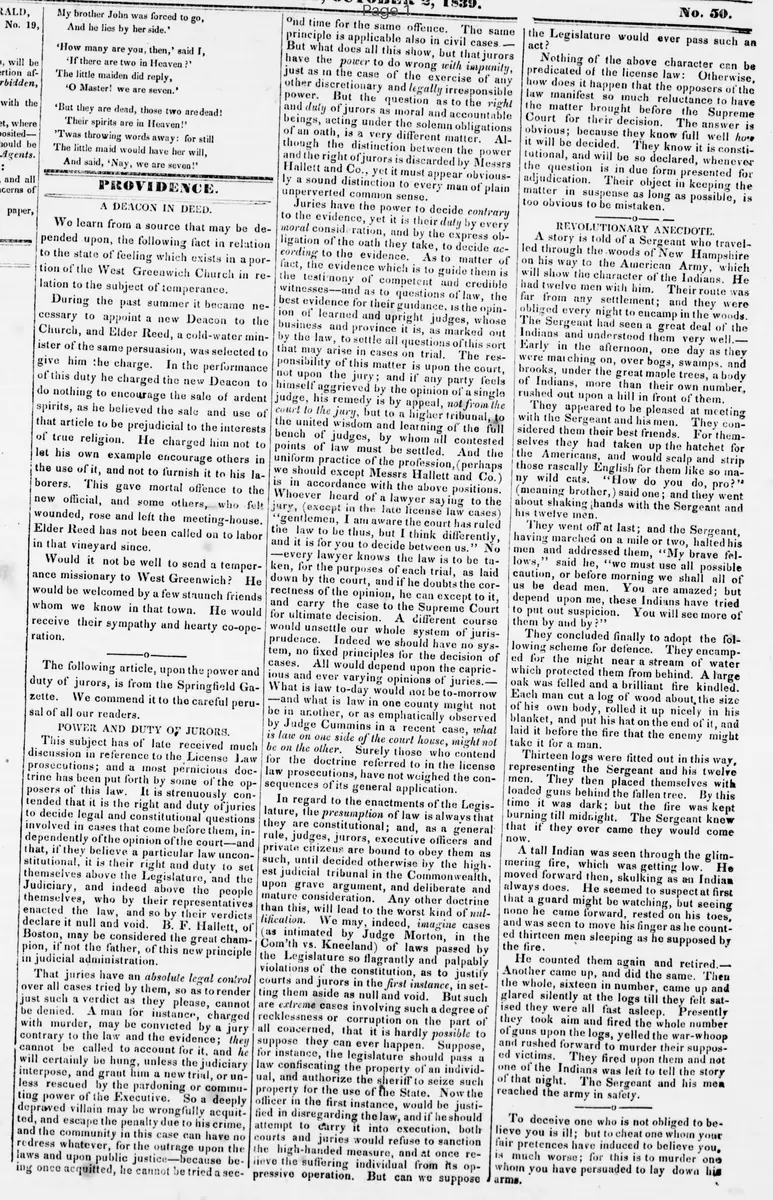
The following article, upon the power and duty of jurors, is from the Springfield Gazette.
We commend it to the careful perusal of all our readers.
POWER AND DUTY OF JURORS.
This subject has of late received much discussion in reference to the License Law prosecutions; and a most pernicious doctrine has been put forth by some of the opposers of this law. It is strenuously contended that it is the right and duty of juries to decide legal and constitutional questions involved in cases that come before them, independently of the opinion of the court—and that, if they believe a particular law unconstitutional, it is their right and duty to set themselves above the Legislature, and the Judiciary, and indeed above the people themselves, who by their representatives enacted the law, and so by their verdicts declare it null and void. B. F. Hallett, of Boston, may be considered the great champion, if not the father, of this new principle in judicial administration.
That juries have an absolute legal control over all cases tried by them, so as to render just such a verdict as they please, cannot be denied. A man for instance, charged with murder, may be convicted by a jury contrary to the law and the evidence; they cannot be called to account for it, and he will certainly be hung, unless the judiciary interpose, and grant him a new trial, or unless rescued by the pardoning or commuting power of the Executive. So a deeply depraved villain may be wrongfully acquitted, and escape the penalty due to his crime, and the community in this case can have no redress whatever, for the outrage upon the laws and upon public justice—because being once acquitted, he cannot be tried a second time for the same offence. The same principle is applicable also in civil cases.
But what does all this show, but that jurors have the power to do wrong with impunity, just as in the case of the exercise of any other discretionary and legally irresponsible power.
But the question as to the right and duty of jurors as moral and accountable beings, acting under the solemn obligations of an oath, is a very different matter. Although the distinction between the power and the right of jurors is discarded by Messrs. Hallett and Co., yet it must appear obviously a sound distinction to every man of plain unperverted common sense.
Juries have the power to decide contrary to the evidence, yet it is their duty by every moral consideration, and by the express obligation of the oath they take, to decide according to the evidence. As to matter of fact, the evidence which is to guide them is the testimony of competent and credible witnesses—and as to questions of law, the best evidence for their guidance, is the opinion of learned and upright judges, whose business and province it is, as marked out by the law, to settle all questions of this sort that may arise in cases on trial. The responsibility of this matter is upon the court, not upon the jury; and if any party feels himself aggrieved by the opinion of a single judge, his remedy is by appeal, not from the court to the jury, but to a higher tribunal, to the united wisdom and learning of the full bench of judges, by whom all contested points of law must be settled. And the uniform practice of the profession (perhaps we should except Messrs Hallett and Co.) is in accordance with the above positions.
Whoever heard of a lawyer saying to the jury, (except in the late license law cases) "gentlemen, I am aware the court has ruled the law to be thus, but I think differently, and it is for you to decide between us." No—every lawyer knows the law is to be taken, for the purposes of each trial, as laid down by the court, and if he doubts the correctness of the opinion, he can except to it, and carry the case to the Supreme Court for ultimate decision. A different course would unsettle our whole system of jurisprudence. Indeed we should have no system, no fixed principles for the decision of cases. All would depend upon the capricious and ever varying opinions of juries.—What is law to-day would not be to-morrow—and what is law in one county might not be in another, or as emphatically observed by Judge Cummins in a recent case, what is law on one side of the court house, might not be on the other. Surely those who contend for the doctrine referred to in the license law prosecutions, have not weighed the consequences of its general application.
In regard to the enactments of the Legislature, the presumption of law is always that they are constitutional; and, as a general rule, judges, jurors, executive officers and private citizens are bound to obey them as such, until decided otherwise by the highest judicial tribunal in the Commonwealth, upon grave argument, and deliberate and mature consideration.
Any other doctrine than this, will lead to the worst kind of nullification.
We may, indeed, imagine cases (as intimated by Judge Morton, in the Com'th vs. Kneeland) of laws passed by the Legislature so flagrantly and palpably violations of the constitution, as to justify courts and jurors in the first instance, in setting them aside as null and void. But such are extreme cases involving such a degree of recklessness or corruption on the part of all concerned, that it is hardly possible to suppose they can ever happen. Suppose, for instance, the legislature should pass a law confiscating the property of an individual, and authorize the sheriff to seize such property for the use of the State. Now the officer in the first instance, would be justified in disregarding the law, and if he should attempt to carry it into execution, both courts and juries would refuse to sanction the high-handed measure, and at once relieve the suffering individual from its oppressive operation.
But can we suppose the Legislature would ever pass such an act?
Nothing of the above character can be predicated of the license law: Otherwise, how does it happen that the opposers of the law manifest so much reluctance to have the matter brought before the Supreme Court for their decision. The answer is obvious; because they know full well how it will be decided. They know it is constitutional, and will be so declared, whenever the question is in due form presented for adjudication. Their object in keeping the matter in suspense as long as possible, is too obvious to be mistaken.
We commend it to the careful perusal of all our readers.
POWER AND DUTY OF JURORS.
This subject has of late received much discussion in reference to the License Law prosecutions; and a most pernicious doctrine has been put forth by some of the opposers of this law. It is strenuously contended that it is the right and duty of juries to decide legal and constitutional questions involved in cases that come before them, independently of the opinion of the court—and that, if they believe a particular law unconstitutional, it is their right and duty to set themselves above the Legislature, and the Judiciary, and indeed above the people themselves, who by their representatives enacted the law, and so by their verdicts declare it null and void. B. F. Hallett, of Boston, may be considered the great champion, if not the father, of this new principle in judicial administration.
That juries have an absolute legal control over all cases tried by them, so as to render just such a verdict as they please, cannot be denied. A man for instance, charged with murder, may be convicted by a jury contrary to the law and the evidence; they cannot be called to account for it, and he will certainly be hung, unless the judiciary interpose, and grant him a new trial, or unless rescued by the pardoning or commuting power of the Executive. So a deeply depraved villain may be wrongfully acquitted, and escape the penalty due to his crime, and the community in this case can have no redress whatever, for the outrage upon the laws and upon public justice—because being once acquitted, he cannot be tried a second time for the same offence. The same principle is applicable also in civil cases.
But what does all this show, but that jurors have the power to do wrong with impunity, just as in the case of the exercise of any other discretionary and legally irresponsible power.
But the question as to the right and duty of jurors as moral and accountable beings, acting under the solemn obligations of an oath, is a very different matter. Although the distinction between the power and the right of jurors is discarded by Messrs. Hallett and Co., yet it must appear obviously a sound distinction to every man of plain unperverted common sense.
Juries have the power to decide contrary to the evidence, yet it is their duty by every moral consideration, and by the express obligation of the oath they take, to decide according to the evidence. As to matter of fact, the evidence which is to guide them is the testimony of competent and credible witnesses—and as to questions of law, the best evidence for their guidance, is the opinion of learned and upright judges, whose business and province it is, as marked out by the law, to settle all questions of this sort that may arise in cases on trial. The responsibility of this matter is upon the court, not upon the jury; and if any party feels himself aggrieved by the opinion of a single judge, his remedy is by appeal, not from the court to the jury, but to a higher tribunal, to the united wisdom and learning of the full bench of judges, by whom all contested points of law must be settled. And the uniform practice of the profession (perhaps we should except Messrs Hallett and Co.) is in accordance with the above positions.
Whoever heard of a lawyer saying to the jury, (except in the late license law cases) "gentlemen, I am aware the court has ruled the law to be thus, but I think differently, and it is for you to decide between us." No—every lawyer knows the law is to be taken, for the purposes of each trial, as laid down by the court, and if he doubts the correctness of the opinion, he can except to it, and carry the case to the Supreme Court for ultimate decision. A different course would unsettle our whole system of jurisprudence. Indeed we should have no system, no fixed principles for the decision of cases. All would depend upon the capricious and ever varying opinions of juries.—What is law to-day would not be to-morrow—and what is law in one county might not be in another, or as emphatically observed by Judge Cummins in a recent case, what is law on one side of the court house, might not be on the other. Surely those who contend for the doctrine referred to in the license law prosecutions, have not weighed the consequences of its general application.
In regard to the enactments of the Legislature, the presumption of law is always that they are constitutional; and, as a general rule, judges, jurors, executive officers and private citizens are bound to obey them as such, until decided otherwise by the highest judicial tribunal in the Commonwealth, upon grave argument, and deliberate and mature consideration.
Any other doctrine than this, will lead to the worst kind of nullification.
We may, indeed, imagine cases (as intimated by Judge Morton, in the Com'th vs. Kneeland) of laws passed by the Legislature so flagrantly and palpably violations of the constitution, as to justify courts and jurors in the first instance, in setting them aside as null and void. But such are extreme cases involving such a degree of recklessness or corruption on the part of all concerned, that it is hardly possible to suppose they can ever happen. Suppose, for instance, the legislature should pass a law confiscating the property of an individual, and authorize the sheriff to seize such property for the use of the State. Now the officer in the first instance, would be justified in disregarding the law, and if he should attempt to carry it into execution, both courts and juries would refuse to sanction the high-handed measure, and at once relieve the suffering individual from its oppressive operation.
But can we suppose the Legislature would ever pass such an act?
Nothing of the above character can be predicated of the license law: Otherwise, how does it happen that the opposers of the law manifest so much reluctance to have the matter brought before the Supreme Court for their decision. The answer is obvious; because they know full well how it will be decided. They know it is constitutional, and will be so declared, whenever the question is in due form presented for adjudication. Their object in keeping the matter in suspense as long as possible, is too obvious to be mistaken.
What sub-type of article is it?
Legal Reform
Constitutional
What keywords are associated?
Jury Power
Jury Duty
License Law
Constitutional Questions
Judicial Administration
Nullification
What entities or persons were involved?
B. F. Hallett
Judge Cummins
Judge Morton
Springfield Gazette
Legislature
Supreme Court
Editorial Details
Primary Topic
Power And Duty Of Jurors Regarding Legal And Constitutional Questions In License Law Prosecutions
Stance / Tone
Opposition To Jury Nullification; Defense Of Judicial Hierarchy And Presumption Of Constitutionality
Key Figures
B. F. Hallett
Judge Cummins
Judge Morton
Springfield Gazette
Legislature
Supreme Court
Key Arguments
Juries Have Power To Render Any Verdict But No Right Or Duty To Decide Constitutional Questions Independently Of The Court
Jurors Must Follow Evidence And Court's Instructions On Law Under Oath
Allowing Juries To Override Law Would Unsettle Jurisprudence And Lead To Inconsistent Application
Legislative Enactments Presumed Constitutional Until Highest Court Rules Otherwise
License Law Is Constitutional; Opponents Avoid Supreme Court To Delay Inevitable Affirmation