Thank you for visiting SNEWPapers!
Sign up free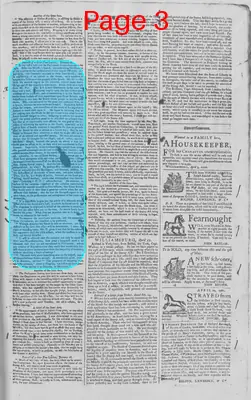
The Virginia Gazette
Richmond, Williamsburg, Richmond County, Virginia
What is this article about?
London report on January 16: Parliamentary debate on American colonies' taxation. Grenville attacks colonists; Pitt delivers eloquent defense, calling tax illegal and impolitic, highlighting trade benefits and lack of representation. No vote; discussion continues January 28.
Clipping
OCR Quality
Full Text
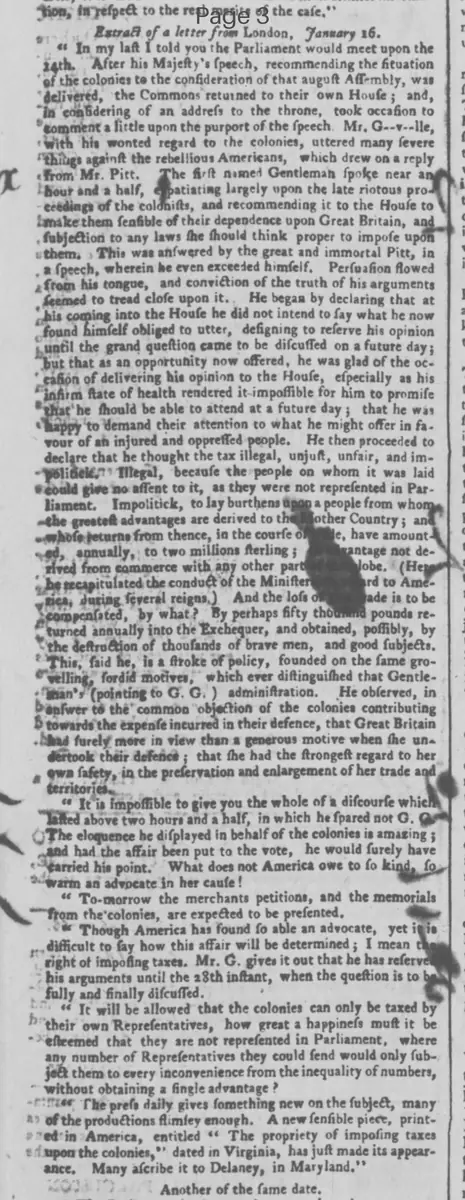
"In my last I told you the Parliament would meet upon the 11th. After his Majesty's speech, recommending the situation of the colonies to the consideration of that august Assembly, was delivered, the Commons returned to their own House; and, in considering of an address to the throne, took occasion to comment a little upon the purport of the speech Mr. G--v--lle, with his wonted regard to the colonies, uttered many severe things against the rebellious Americans, which drew on a reply from Mr. Pitt. The first named Gentleman spoke near an hour and a half, expatiating largely upon the late riotous proceedings of the colonies, and recommending it to the House to make them sensible of their dependence upon Great Britain, and subjection to any laws she should think proper to impose upon them. This was answered by the great and immortal Pitt, in a speech, wherein he even exceeded himself. Persuasion flowed from his tongue, and conviction of the truth of his arguments seemed to tread close upon it. He began by declaring that at his coming into the House he did not intend to say what he now found himself obliged to utter, designing to reserve his opinion until the grand question came to be discussed on a future day; but that as an opportunity now offered, he was glad of the occasion of delivering his opinion to the House, especially as his infirm state of health rendered it impossible for him to promise that he should be able to attend at a future day; that he was happy to demand their attention to what he might offer in favour of an injured and oppressed people. He then proceeded to declare that he thought the tax illegal, unjust, unfair, and impolitic. Illegal, because the people on whom it was laid could give no assent to it, as they were not represented in Parliament. Impolitic, to lay burdens upon a people from whom the greatest advantages are derived to the other Country; and those returns from thence, in the course of trade, have amounted annually, to two millions sterling; advantage not derived from commerce with any other part of the globe. He recapitulated the conduct of the Minister towards America, during several reigns. And the loss is to be compensated, by what? By perhaps fifty thousand pounds returned annually into the Exchequer, and obtained, possibly, by the destruction of thousands of brave men, and good subjects. This, said he, in a stroke of policy, founded on the same grovelling, sordid motives, which ever distinguished that Gentleman's (pointing to G.G.) administration. He observed, in answer to the common objection of the colonies contributing towards the expense incurred in their defence, that Great Britain had surely more in view than a generous motive when she undertook their defence; that she had the strongest regard to her own safety, in the preservation and enlargement of her trade and territories.
It is impossible to give you the whole of a discourse which lasted above two hours and a half, in which he spared not G. The eloquence he displayed in behalf of the colonies is amazing; and had the affair been put to the vote, he would surely have carried his point. What does not America owe to so kind, so warm an advocate in her cause!
To-morrow the merchants petitions, and the memorials from the colonies, are expected to be presented. Though America has found so able an advocate, yet it is difficult to say how this affair will be determined; I mean the right of imposing taxes. Mr. G. gives it out that he has reserved his arguments until the 28th instant, when the question is to be fully and finally discussed.
It will be allowed that the colonies can only be taxed by their own Representatives, how great a happiness must it be esteemed that they are not represented in Parliament, where any number of Representatives they could send would only subject them to every inconvenience from the inequality of numbers, without obtaining a single advantage?
The press daily gives something new on the subject, many of the productions flimsy enough. A new sensible piece, printed in America, entitled The propriety of imposing taxes upon the colonies, dated in Virginia, has just made its appearance. Many ascribe it to Delaney, in Maryland."
What sub-type of article is it?
What keywords are associated?
What entities or persons were involved?
Where did it happen?
Foreign News Details
Primary Location
London
Event Date
January 11 16
Key Persons
Outcome
no vote taken; debate on taxation to continue on the 28th instant
Event Details
In Parliament, after the King's speech on colonies, Mr. G--v--lle spoke against rebellious Americans for an hour and a half, advocating laws to enforce dependence on Great Britain. Mr. Pitt replied in a two-and-a-half-hour speech defending the colonies, declaring the tax illegal, unjust, unfair, and impolitic due to lack of representation and economic benefits from trade. He criticized the Minister's conduct and motives. Merchants' petitions and colonial memorials to be presented tomorrow.