Thank you for visiting SNEWPapers!
Sign up free
The Portland Gazette
Portland, Cumberland County, Maine
What is this article about?
Proceedings of the Massachusetts Legislature from January 13-15, 1819, including organization, appointment of committees, presentation of petitions and remonstrances, mourning resolution for Hon. Oliver Chace, and Governor John Brooks' address on national prosperity, agriculture, manufactures, commerce, and banking.
Merged-components note: Merged continuation of the report on the Massachusetts Legislature, including the Governor's message and subsequent proceedings.
Clippings
1 of 2
OCR Quality
Full Text
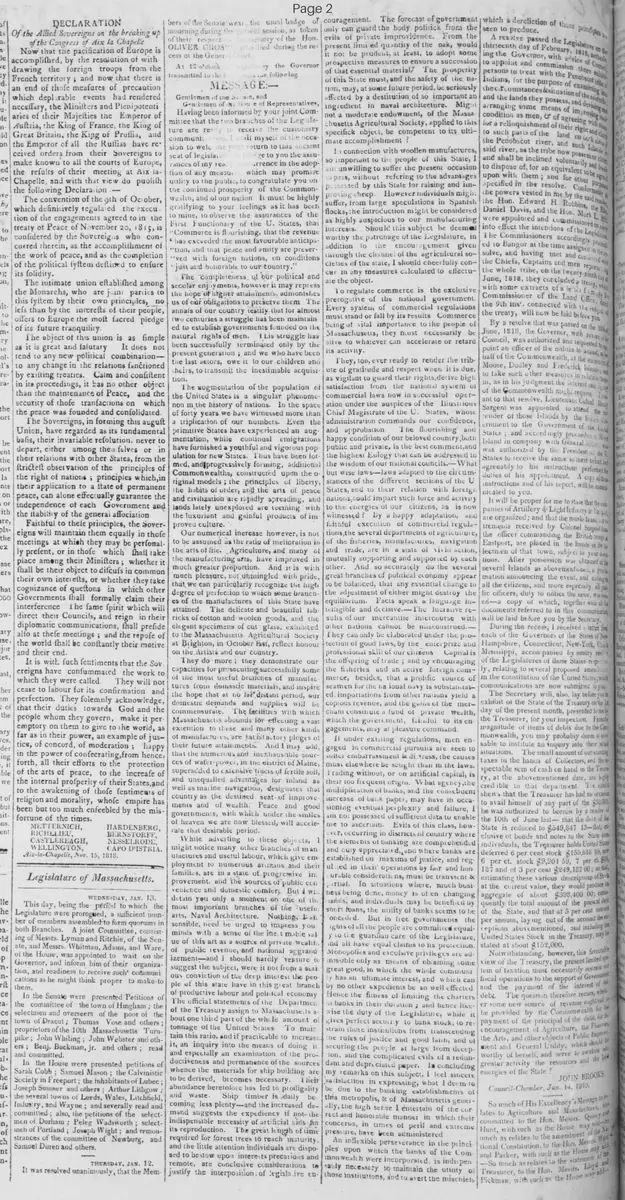
WEDNESDAY, JAN. 13.
This day, being the period to which the Legislature were prorogued, a sufficient number of members assembled to form quorums in both Branches. A joint Committee, consisting of Messrs. Lyman and Ritchie, of the Senate, and Messrs. Whitman, Adams, and Ware, of the House, was appointed to wait on the Governor, and inform him of their organization, and readiness to receive such communications as he might think proper to make to them.
In the Senate were presented Petitions of the committee of the town of Hingham; the selectmen and overseers of the poor of the town of Dracut; Thomas Vose and others; proprietors of the 10th Massachusetts Turnpike; John Whiting; John Webster and others; Benj. Buckman, jr. and others; read and committed.
In the House were presented petitions of Sarah Cobb; Samuel Mason; the Calvinistic Society in Freeport; the inhabitants of Lubec; Joseph Summer and others; Arthur Lithgow; the several towns of Leeds, Wales, Litchfield, Industry, and Wayne; and severally read and committed; also, the petitions of the selectmen of Durham; Peleg Wadsworth; selectmen of Portland; Joseph Wight; and remonstrances of the committee of Newburg, and Samuel Duren and others.
THURSDAY, JAN. 14.
It was resolved unanimously, that the Members of the Senate wear the usual badge of mourning during the present session, as token of their respect to the memory of the Hon. OLIVER CHACE, who died during the recess of the General Court.
At 12 o'clock the Governor transmitted to the two Houses the following MESSAGE:-
Gentlemen of the Senate, and Gentlemen of the House of Representatives,
Having been informed by your joint Committee that the two branches of the Legislature are ready to receive the customary communications, I avail myself of the occasion to welcome your return to this ancient seat of legislation; to you the assurances of my reliance in the adoption of any measures which may promise utility to the public, to congratulate you on the continued prosperity of the Commonwealth, and of our nation. It must be highly gratifying to your feelings as it has been to mine, to observe the assurances of the First Functionary of the U. States, that "Commerce is flourishing, that the revenue has exceeded the most favourable anticipation, and that peace and amity are preserved with foreign nations, on conditions just and honorable to our country."
The completeness of our political and secular enjoyments, however it may repress the hope of higher attainments, admonishes us of our obligations to preserve them. The annals of our country testify that for almost two centuries a struggle has been maintained to establish governments founded on the natural rights of men. This struggle has been successfully terminated only by the present generation; and we who have been the last actors, owe it to our children and heirs, to transmit the inestimable acquisition.
The augmentation of the population of the United States is a singular phenomenon in the history of nations. In the space of forty years we have witnessed more than a triplication of our numbers. Even the primitive States have experienced an augmentation, while continual emigrations have furnished a youthful and vigorous population for new States. Thus have been formed, and are progressively forming, additional Commonwealths, constructed upon the original models; the principles of liberty, the habits of order, and the arts of peace and civilization are rapidly spreading, and lands lately unexplored are teeming with the luxuriant and gainful products of improved culture.
Our numerical increase however, is not to be assumed as the ratio of melioration in the arts of life. Agriculture, and many of the manufacturing arts, have improved in much greater proportion. And it is with much pleasure, not unmingled with pride, that we can particularly recognize the high degree of perfection to which some branches of the manufactures of this State have attained. The delicate and beautiful fabrics of cotton and woolen goods, and the elegant specimens of cut glass, exhibited to the Massachusetts Agricultural Society at Brighton, in October last, reflect honour on the Artists and our country.
They do more; they demonstrate our capacities for prosecuting successfully some of the most useful branches of manufactures from domestic materials, and inspire the hope that at no far distant period, our domestic demands and supplies will be commensurate. The facilities with which Massachusetts abounds for effecting a vast extension to these and many other kinds of manufactures, are satisfactory pledges of their future attainments. And I may add, that the numerous and inexhaustible sources of water-power, in the district of Maine, superadded to extensive tracts of fertile soil, and unequalled advantages for inland as well as marine navigation, designates that country as the destined seat of improvements and of wealth. Peace and good governments, with which under the smiles of heaven we are now blessed, will accelerate that desirable period.
While adverting to these objects, I might notice many other branches of manufactures and useful labour, which give employment to numerous artisans and their families, are in a state of progressive improvement, and the sources of public convenience and domestic comfort. But I will detain you only a moment on one of the most important branches of the useful arts, Naval Architecture. Nothing pains sensible, need be urged to impress your minds with a sense of the inestimable value of this art as a source of private wealth, of public revenue, and national aggrandizement—and I should hardly venture to suggest the subject, were it not from a serious conviction of the deep interest the people of this state have in this great branch of productive labour and political economy.
The official statements of the Department of the Treasury assign to Massachusetts about one third part of the whole amount of tonnage of the United States. To maintain this ratio, and if practicable to increase it, an inquiry into the means of doing it and especially an examination of the productiveness and permanence of the sources whence the materials for ship building are to be derived, becomes necessary. Their abundance heretofore has led to prodigality and waste. Ship timber is daily becoming less plenty—and the increased demand suggests the expediency if not the indispensable necessity of artificial aids for its reproduction. The great length of time required for forest trees to reach maturity, and the little attention individuals are disposed to bestow upon interests precarious and remote, are conclusive considerations to justify the interposition of legislative encouragement. The forecast of government only can guard the body politic from the evils of private improvidence. From the present limited quantity of the oak, would it not be prudent, at least, to adopt some prospective measures to ensure a succession of that essential material? The prosperity of this State must, and the safety of the nation, may, at some future period, be seriously affected by a destitution of so important an ingredient in naval architecture. Might not a moderate endowment, of the Massachusetts Agricultural Society, applied to this specific object, be competent to its ultimate accomplishment?
In connection with woollen manufactures, so important to the people of this State, I am unwilling to suffer the present occasion to pass, without referring to the advantages possessed by this State for raising and improving sheep. However individuals might suffer, from large speculations in Spanish flocks, the introduction might be considered as highly auspicious to our manufacturing interests. Should this subject be deemed worthy the patronage of the Legislature, in addition to the encouragement given through the channel of the agricultural societies of the state, I should cheerfully concur in any measures calculated to effectuate the object.
To regulate commerce is the exclusive prerogative of the national government. Every system of commercial regulations must stand or fall by its results. Commerce being of vital importance to the people of Massachusetts, they must necessarily be alive to whatever can accelerate or retard its activity.
They, too, ever ready to render the tribute of gratitude and respect when it is due, as vigilant to guard their rights, derive high satisfaction from the national system of commercial laws now in successful operation under the auspices of the Illustrious Chief Magistrate of the U. States, whose administration commands our confidence, and approbation.
The flourishing and happy condition of our beloved country, both public and private, is the best comment, and the highest Eulogy that can be addressed to the wisdom of our national councils.—What but wise laws—laws adapted to the circumstances of the different sections of the U. States, and to their relation with foreign nations, could impart such force and activity to the energies of our citizens, as is now witnessed? By a happy adaptation, and faithful execution of commercial regulations, the several departments of agriculture, of the fisheries, manufactures, navigation and trade, are in a state of vivid action, mutually supporting and supported by each other. And so accurately do the several great branches of political economy appear to be balanced, that any essential change in the adjustment of either might destroy the equilibrium. Facts speak a language intelligible and decisive.—The lucrative results of our mercantile intercourse with other nations cannot be misconstrued.—They can only be elaborated under the protection of good laws, by the enterprize and professional skill of our citizens. Capital is the offspring of trade; and by encouraging the fisheries and an active foreign commerce, besides, that a prolific source of seamen for the National navy is substantiated, importations from other nations yield a copious revenue, and the gains of the merchant constitute a fund of private wealth, which the government, faithful to its engagements, may at pleasure command.
If under existing regulations, men engaged in commercial pursuits are seen to suffer embarrassment & distress, the causes must elsewhere be sought than in the laws. Trading without, or on artificial capital, is their too frequent origin. What agency, the multiplication of banks, and the consequent increase of bank paper, may have in occasioning eventual perplexity and failure, I am not possessed of sufficient data to enable me to ascertain. Evils of this class, however, occurring in districts of country where the elements of banking are comprehended and duly appreciated, and where banks are established on maxims of justice, and regulated in their operations by fair and honorable considerations, must be transient & partial. In situations where, much business being done, money is often changing hands, and individuals may be benefited by short loans, the utility of banks seems to be conceded. But in free governments the rights of all the people are committed equally to the guardian care of the Legislature, and all have equal claims to its protection. Monopolies and exclusive privileges are admissible only as means of obtaining some great good, in which the whole community has an ultimate interest, and which can by no other expedients be so well effected. Hence the fitness of limiting the charters of banks in their duration; and hence likewise the duty of the Legislature, while it gives perfect security to bank stock, to restrain those institutions from transcending the rules of justice and good faith, and of securing the people at large from deception, and the complicated evils of a redundant and depreciated paper. In concluding my remarks on this subject, I feel sincere satisfaction in expressing, what I deem to be due to the banking establishments of this metropolis, & of Massachusetts generally, the high sense I entertain of the correct and honorable manner in which their concerns, in times of peril and extreme pressure, have been administered.
An inflexible perseverance in the principles upon which the banks of the Commonwealth were incorporated, is indispensably necessary to maintain the utility of those institutions, and to avert the mischiefs which a dereliction of those principles seen to produce.
JOHN BROOKS
Council-Chamber, Jan. 14, 1819.
So much of His Excellency's Message as relates to Agriculture and Manufactures, was committed to the Hon. Messrs. Quincy, Davis, and Lloyd.
So much as relates to the amendment of the Constitution of the United States, to the Hon. Messrs. Holmes, Pickering, and Dexter.
So much as relates to the Treasurer, to the Hon. Messrs. Pickman, with such of the House as the House may join.
So much as relates to that part of the Message which relates to the Indians, was committed to the Hon. Messrs. Davis, with such as the House may join.
such as relates to the Penobscot Tribe of Indians, such as relates to the surrender of Moose Island, with such as the House may add—And also, to the Hon. Messrs. Bemis and Fessenden, Varnum and Williams, with such as the House may add.
I was ordered that the several Committees on the business referred to them, now resume their duties.
The Hon. Mr. Gardner was appointed on the Committee on Accounts, vice the Hon. Mr. Crosby deceased.
to complete the same.
Court who, at the last session, did not complete the same.
IN SENATE,
FRIDAY, JAN. 15.
Present 26 members.—The Hon. Mr. Varnum had leave of absence for to-morrow.
The Hon. Messrs. Cleaveland and Williams joined on the committee respecting salaries for Judges of Probate, &c.
The Hon. Mr. Humphrey was appointed on committee on Turnpikes, in the room of Hon. Mr. Gardner, who declined acting on the same.
A committee was appointed to ascertain who are the candidates to supply the vacancy in the Senate, occasioned by the death of the Hon. Oliver Crosby. We understand the candidates are, JONAS SIBLEY, Esq. who had 2963 votes—and Zadock Gates, Esq. who had 1040 votes.
A resolve passed on pet. of S. Sprague.
Petitions read—Of Selectmen of Shirley; of David Ripley; of Hampshire, Franklin, Hampden Agricultural Society; Israel Thorn; Proprietors of Great-Barrington and Monument Mountain Turnpike; of Sarah Cleves; of Selectmen of Charlestown; of Nath. Heywood; of Selectmen of Rehoboth; of Henry Darling and others; of David Johnson and others; of Selectmen of Hartford; were referred to various committees.
Remonstrances of Cyrus Thompson and others, &c. against a division of the town of Limerick; of the town of Buckfield against a division of the same; of Asa Thayer and others; and of Nath. Low and others, against a division of the town of Newbury; were read and referred.
House of Representatives.
THURSDAY, JAN. 14.
Messrs. Rantoul, Lawrence and Adams, with such as the Senate may add, were appointed to consider the expediency of establishing salaries for the Judges and Registers of the same, for the several Counties.
Messrs. Russel, Allen and Collins, were appointed to report a resolve for the usual salary of the Lt. Governor, the Secretary and the Treasurer, for the current year.
Estimates of taxes for Franklin, Middlesex, New-York, Hampshire, Hancock, Washington, Cumberland, Berkshire, Bristol, and Oxford, were received.
Petitions from T. Vose and others—D. Gardner, &c.—J. Van Deuson, 3d, &c.—D. Ripley, Selectmen of Shirley—I. Town—J. Lester, &c.—G. Cary—and J. Brewer, &c. were committed.
FRIDAY, JAN. 15.
Messrs. Goodenow, Roof, Esq. a Member from Otis; Ezra P. Blair, Esq. a Member from Westfield; Kim Hull, Esq. a Member from Sandisfield; and Reuben Hills, Esq. a member from Granville, appeared for the first time, and Mr. Goodenow, of Conway was appointed to wait on the Governor and Council to take the oaths of office.
A resolve for fixing the usual salary of the Lieutenant-Governor, Secretary, and Treasurer was reported, and passed.
House concurred with the Senate in setting the Committees appointed at the last session to complete the business referred to them.
A resolve passed on the petition of the Inhabitants of Natick.
A memorial from the Quarter-Master-General was referred to Messrs. Brauley, Parker, and Porter.
The annual Statement of the Treasury was ordered to be printed for the use of the members.
The county estimates for Norfolk and Barnstable were committed.
Remonstrances—of Thomas Howe and others—Samuel Brown and others, were committed.
Petitions—(besides those mentioned in the preceding proceedings) of Wm. Pearce and others; of Caleb B. Hall and others; of the Inhabitants of Eastport; of Jabez Maury and others; of Sarah Cleaves, were committed.
What sub-type of article is it?
What keywords are associated?
What entities or persons were involved?
Where did it happen?
Domestic News Details
Primary Location
Massachusetts
Event Date
January 13 15, 1819
Key Persons
Outcome
senate resolved to wear mourning badge for hon. oliver chace; committees appointed on various topics including agriculture, manufactures, indians, banking; petitions and remonstrances committed; resolves passed on salaries and other petitions; candidates identified for senate vacancy.
Event Details
The Massachusetts Legislature convened on January 13, 1819, with quorums formed in both branches. A joint committee informed Governor Brooks of readiness. Numerous petitions from towns and individuals were presented and committed. On January 14, mourning was resolved for deceased Hon. Oliver Chace, and Governor Brooks delivered a message on national prosperity, population growth, agriculture, manufactures, naval architecture, commerce, and banking. Parts of the message were committed to committees. Additional appointments and proceedings occurred on January 15, including new member oaths and further petition handling.