Thank you for visiting SNEWPapers!
Sign up free
Literary
March 7, 1853
Lynchburg Daily Virginian
Lynchburg, Virginia
What is this article about?
A young traveler in Paris hires an elderly French teacher who has fallen into poverty after losing his position and family. The teacher supports his grandson with lessons until the boy's death, after which the teacher himself dies, evoking the narrator's regret for not offering more help.
Clipping
OCR Quality
95%
Excellent
Full Text
The Daily
Virginian.
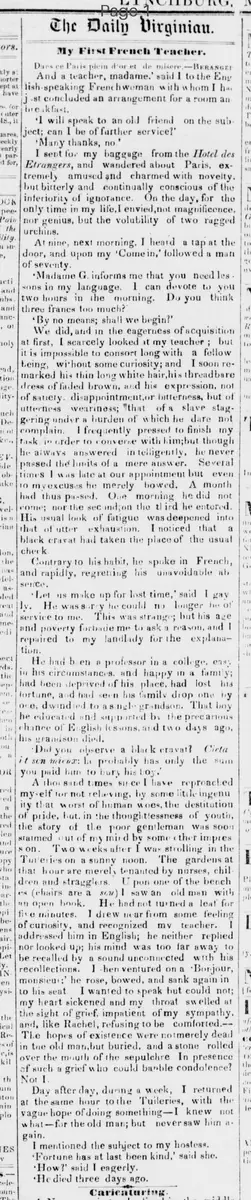
My First French Teacher.
Dans ce Pais plein d'or et de misere,—Beranger
And a teacher, madame,' said I to the English-speaking Frenchwoman with whom I had just concluded an arrangement for a room and breakfast.
'I will speak to an old friend on the subject; can I be of farther service?'
'Many thanks, no'
I sent for my baggage from the Hotel des Etrangers, and wandered about Paris, extremely amused and charmed with novelty. but bitterly and continually conscious of the inferiority of ignorance. On the day, for the only time in my life, I envied, not magnificence, nor genius, but the volubility of two ragged urchins.
At nine, next morning. I heard a tap at the door, and upon my 'Come in,' followed a man of seventy.
Madame G. informs me that you need lessons in my language. I can devote to you two hours in the morning. Do you think three francs too much?
'By no means; shall we begin?'
We did, and in the eagerness of acquisition at first, I scarcely looked at my teacher; but it is impossible to consort long with a fellow being, without some curiosity; and I soon remarked his thin long white hair, his threadbare dress of faded brown, and his expression, not of satiety, disappointment, or bitterness, but of utter weariness; 'that of a slave staggering under a burden of which he dare not complain. I frequently pressed to finish my task in order to converse with him; but though he always answered intelligently, he never passed the limits of a mere answer. Several times I was late at our appointment but even to my excuses he merely bowed. A month had thus passed. One morning he did not come; nor the second; on the third he entered. His usual look of fatigue was deepened into that of utter exhaustion. I noticed that a black cravat had taken the place of the usual check
Contrary to his habit, he spoke in French. and rapidly, regretting his unavoidable absence.
'Let us make up for lost time,' said I gayly. He was sorry he could no longer be of service to me. This was strange; but his age and poverty forbade me to ask a reason, and I repaired to my landlady for the explanation.
He had been a professor in a college, easy in his circumstances. and happy in a family; had been deprived of his place, had lost his fortune, and had seen his family drop one by one, dwindled to a single grandson. That boy he educated and supported by the precarious chance of English lessons, and two days ago, his grandson died.
'Did you observe a black cravat? C'est son mieux: He probably has only the sum you paid him to bury his boy.'
A thousand times since I have reproached myself for not relieving, by some little ingenuity that worst of human woes, the destitution of pride, but. in the thoughtlessness of youth, the story of the poor gentleman was soon stained out of my mind by some other impressions. Two weeks after I was strolling in the Tuileries on a sunny noon. The gardens at that hour are merely tenanted by nurses, children and stragglers. Upon one of the benches (chairs are a luxury) I saw an old man with an open book. He had not turned a leaf for five minutes. I drew near from some feeling of curiosity, and recognized my teacher. I addressed him in English; he neither replied nor looked up; his mind was too far away to be recalled by a sound unconnected with his recollections. I then ventured on a 'Bonjour, monsieur:' he rose, bowed, and sank again into his seat I wanted to speak but could not; my heart sickened and my throat swelled at the sight of grief, impatient of my sympathy. and, like Rachel, refusing to be comforted.— The hopes of existence were not merely dead in the old man, but buried, and a stone rolled over the mouth of the sepulchre In presence of such a grief who could babble condolence? Not I.
Day after day, during a week, I returned at the same hour to the Tuileries, with the vague hope of doing something—I knew not what—for the old man; but never saw him again.
I mentioned the subject to my hostess.
'Fortune has at last been kind,' said she.
'How?' said I eagerly.
'He died three days ago.'
Virginian.
My First French Teacher.
Dans ce Pais plein d'or et de misere,—Beranger
And a teacher, madame,' said I to the English-speaking Frenchwoman with whom I had just concluded an arrangement for a room and breakfast.
'I will speak to an old friend on the subject; can I be of farther service?'
'Many thanks, no'
I sent for my baggage from the Hotel des Etrangers, and wandered about Paris, extremely amused and charmed with novelty. but bitterly and continually conscious of the inferiority of ignorance. On the day, for the only time in my life, I envied, not magnificence, nor genius, but the volubility of two ragged urchins.
At nine, next morning. I heard a tap at the door, and upon my 'Come in,' followed a man of seventy.
Madame G. informs me that you need lessons in my language. I can devote to you two hours in the morning. Do you think three francs too much?
'By no means; shall we begin?'
We did, and in the eagerness of acquisition at first, I scarcely looked at my teacher; but it is impossible to consort long with a fellow being, without some curiosity; and I soon remarked his thin long white hair, his threadbare dress of faded brown, and his expression, not of satiety, disappointment, or bitterness, but of utter weariness; 'that of a slave staggering under a burden of which he dare not complain. I frequently pressed to finish my task in order to converse with him; but though he always answered intelligently, he never passed the limits of a mere answer. Several times I was late at our appointment but even to my excuses he merely bowed. A month had thus passed. One morning he did not come; nor the second; on the third he entered. His usual look of fatigue was deepened into that of utter exhaustion. I noticed that a black cravat had taken the place of the usual check
Contrary to his habit, he spoke in French. and rapidly, regretting his unavoidable absence.
'Let us make up for lost time,' said I gayly. He was sorry he could no longer be of service to me. This was strange; but his age and poverty forbade me to ask a reason, and I repaired to my landlady for the explanation.
He had been a professor in a college, easy in his circumstances. and happy in a family; had been deprived of his place, had lost his fortune, and had seen his family drop one by one, dwindled to a single grandson. That boy he educated and supported by the precarious chance of English lessons, and two days ago, his grandson died.
'Did you observe a black cravat? C'est son mieux: He probably has only the sum you paid him to bury his boy.'
A thousand times since I have reproached myself for not relieving, by some little ingenuity that worst of human woes, the destitution of pride, but. in the thoughtlessness of youth, the story of the poor gentleman was soon stained out of my mind by some other impressions. Two weeks after I was strolling in the Tuileries on a sunny noon. The gardens at that hour are merely tenanted by nurses, children and stragglers. Upon one of the benches (chairs are a luxury) I saw an old man with an open book. He had not turned a leaf for five minutes. I drew near from some feeling of curiosity, and recognized my teacher. I addressed him in English; he neither replied nor looked up; his mind was too far away to be recalled by a sound unconnected with his recollections. I then ventured on a 'Bonjour, monsieur:' he rose, bowed, and sank again into his seat I wanted to speak but could not; my heart sickened and my throat swelled at the sight of grief, impatient of my sympathy. and, like Rachel, refusing to be comforted.— The hopes of existence were not merely dead in the old man, but buried, and a stone rolled over the mouth of the sepulchre In presence of such a grief who could babble condolence? Not I.
Day after day, during a week, I returned at the same hour to the Tuileries, with the vague hope of doing something—I knew not what—for the old man; but never saw him again.
I mentioned the subject to my hostess.
'Fortune has at last been kind,' said she.
'How?' said I eagerly.
'He died three days ago.'
What sub-type of article is it?
Prose Fiction
What themes does it cover?
Death Mortality
What keywords are associated?
French Teacher
Paris
Poverty
Grandson Death
Grief
Tuileries
Literary Details
Title
My First French Teacher.
Key Lines
Dans Ce Pais Plein D'or Et De Misere,—Beranger
'That Of A Slave Staggering Under A Burden Of Which He Dare Not Complain.
The Hopes Of Existence Were Not Merely Dead In The Old Man, But Buried, And A Stone Rolled Over The Mouth Of The Sepulchre