Thank you for visiting SNEWPapers!
Sign up free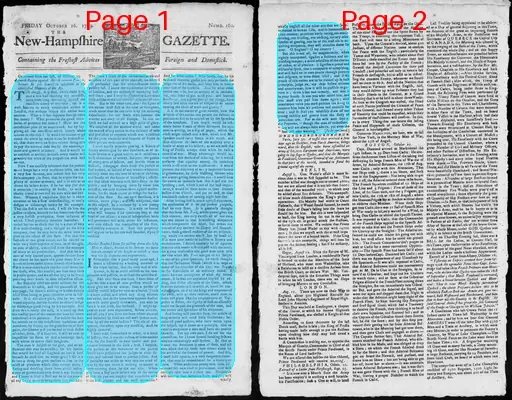
The New Hampshire Gazette
Portsmouth, Rockingham County, New Hampshire
What is this article about?
Satirical editorial continuing criticism of Mr. S-P--t (likely Pitt) for his simple lifestyle discouraging luxury essential to trade and national debt repayment, his lack of gaming, and dangerous eloquence and magnanimity that mislead and inspire youth wrongly. Urges his removal to prevent societal ills.
Merged-components note: This is a continuation of the same editorial piece across page 1 and page 2, with sequential reading order and direct text flow from the end of the first component to the start of the second.
Clippings
1 of 2
OCR Quality
Full Text
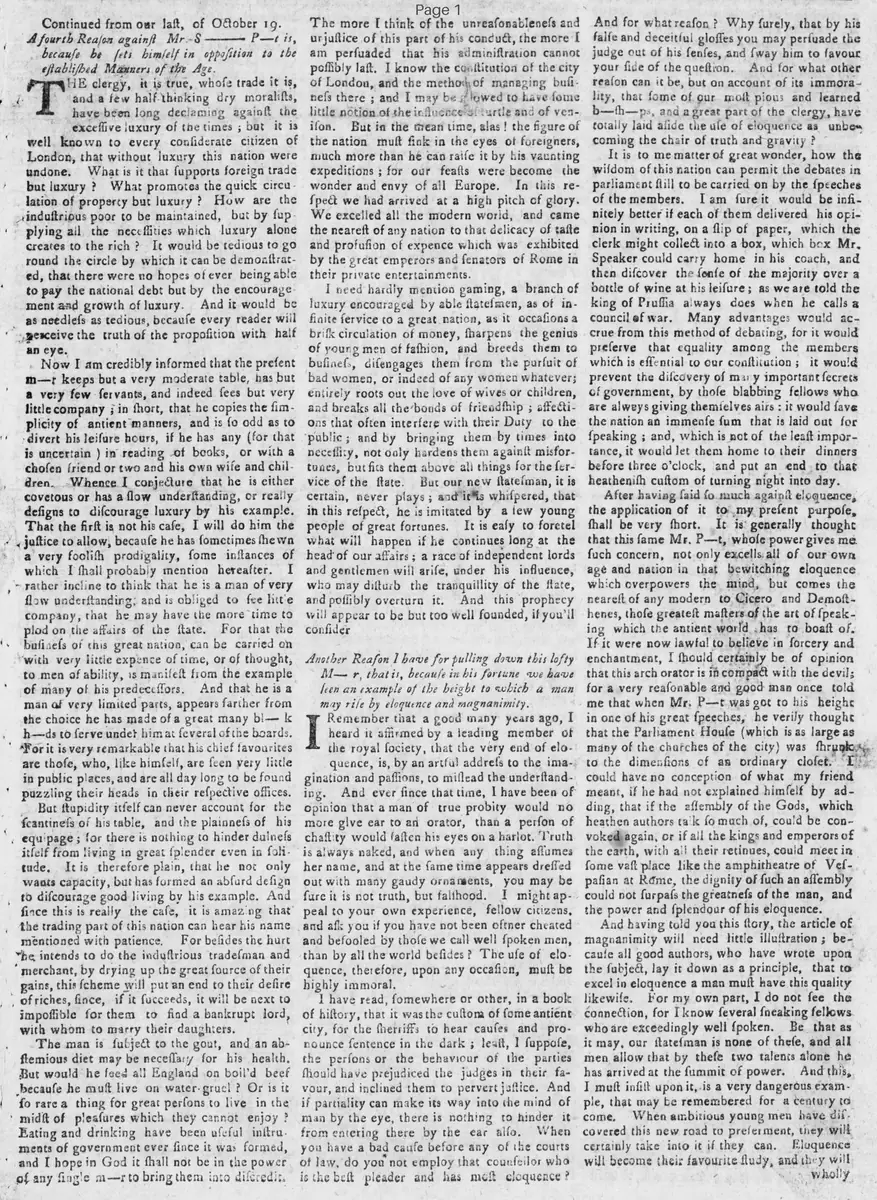
A fourth Reason against Mr. S - P--t is, because he lets himself in opposition to the established Manners of the Age.
The clergy, it is true, whose trade it is, and a few half-thinking dry moralists, have been long declaiming against the excessive luxury of the times; but it is well known to every considerate citizen of London, that without luxury this nation were undone. What is it that supports foreign trade but luxury? What promotes the quick circulation of property but luxury? How are the industrious poor to be maintained, but by supplying all the necessities which luxury alone creates to the rich? It would be tedious to go round the circle by which it can be demonstrated, that there were no hopes of ever being able to pay the national debt but by the encouragement and growth of luxury. And it would be as needless as tedious, because every reader will perceive the truth of the proposition with half an eye.
Now I am credibly informed that the present m--tr keeps but a very moderate table, has but a very few servants, and indeed sees but very little company; in short, that he copies the simplicity of antient manners, and is so odd as to divert his leisure hours, if he has any (for that is uncertain) in reading of books, or with a chosen friend or two and his own wife and children. Whence I conjecture that he is either covetous or has a slow understanding, or really designs to discourage luxury by his example. That the first is not his case, I will do him the justice to allow, because he has sometimes shewn a very foolish prodigality, some instances of which I shall probably mention hereafter. I rather incline to think that he is a man of very slow understanding: and is obliged to see little company, that he may have the more time to plod on the affairs of the state. For that the business of this great nation, can be carried on with very little expence of time, or of thought, to men of ability, is manifest from the example of many of his predecessors. And that he is a man of very limited parts, appears farther from the choice he has made of a great many bl-- k h --ds to serve under him at several of the boards. For it is very remarkable that his chief favourites are those, who, like himself, are seen very little in public places, and are all day long to be found puzzling their heads in their respective offices.
But stupidity itself can never account for the scantiness of his table, and the plainness of his equipage; for there is nothing to hinder dullness itself from living in great splendour even in solitude. It is therefore plain, that he not only wants capacity, but has formed an absurd design to discourage good living by his example. And since this is really the case, it is amazing that the trading part of this nation can hear his name mentioned with patience. For besides the hurt he intends to do the industrious tradesman and merchant, by drying up the great source of their gains, this scheme will put an end to their desire of riches, since, if it succeeds, it will be next to impossible for them to find a bankrupt lord, with whom to marry their daughters.
The man is subject to the gout, and an abstemious diet may be necessary for his health. But would he feed all England on boil'd beef because he must live on water-gruel? Or is it so rare a thing for great persons to live in the midst of pleasures which they cannot enjoy?
Eating and drinking have been useful instruments of government ever since it was formed, and I hope in God it shall not be in the power of any single m--r to bring them into discredit.
The more I think of the unreasonableness and injustice of this part of his conduct, the more I am persuaded that his administration cannot possibly last. I know the constitution of the city of London, and the method of managing business there: and I may be allowed to have some little notion of the influence of turtle and of venison. But in the mean time, alas! the figure of the nation must sink in the eyes of foreigners, much more than he can raise it by his vaunting expeditions: for our feasts were become the wonder and envy of all Europe. In this respect we had arrived at a high pitch of glory. We excelled all the modern world, and came the nearest of any nation to that delicacy of taste and profusion of expence which was exhibited by the great emperors and senators of Rome in their private entertainments.
I need hardly mention gaming, a branch of luxury encouraged by able statesmen, as of infinite service to a great nation, as it occasions a brisk circulation of money, sharpens the genius of young men of fashion, and breeds them to business, disengages them from the pursuit of bad women, or indeed of any women whatever; entirely roots out the love of wives or children, and breaks all the bonds of friendship; affections that often interfere with their Duty to the public; and by bringing them by times into necessity, not only hardens them against misfortunes, but fits them above all things for the service of the state. But our new statesman, it is certain, never plays; and it is whispered, that in this respect, he is imitated by a few young people of great fortunes. It is easy to foretell what will happen if he continues long at the head of our affairs: a race of independent lords and gentlemen will arise, under his influence, who may disturb the tranquillity of the state, and possibly overturn it. And this prophecy will appear to be but too well founded, if you'll consider
Another Reason I have for pulling down this lofty M- r, that is, because in his fortune we have seen an example of the height to which a man may rise by eloquence and magnanimity.
Remember that a good many years ago, I heard it affirmed by a leading member of the royal society, that the very end of eloquence, is, by an artful address to the imagination and passions, to mislead the understanding.
And ever since that time, I have been of opinion that a man of true probity would no more give ear to an orator, than a person of chastity would fasten his eyes on a harlot. Truth is always naked, and when any thing assumes her name, and at the same time appears dressed out with many gaudy ornaments, you may be sure it is not truth, but falsehood. I might appeal to your own experience, fellow citizens, and ask you if you have not been oftener cheated and befooled by those we call well spoken men, than by all the world besides? The use of eloquence, therefore, upon any occasion, must be highly immoral.
I have read, somewhere or other, in a book of history, that it was the custom of some antient city, for the sheriff to hear causes and pronounce sentence in the dark; least, I suppose, the persons or the behaviour of the parties should have prejudiced the judges in their favour, and inclined them to pervert justice. And if partiality can make its way into the mind of man by the eye, there is nothing to hinder it from entering there by the ear also. When you have a bad cause before any of the courts of law, do you not employ that counseller who is the best pleader and has most eloquence?
And for what reason? Why surely, that by his false and deceitful glosses you may persuade the judge out of his senses, and sway him to favour your side of the question. And for what other reason can it be, but on account of its immorality, that some of our most pious and learned b--sh--ps, and a great part of the clergy, have totally laid aside the use of eloquence as unbecoming the chair of truth and gravity?
It is to me matter of great wonder, how the wisdom of this nation can permit the debates in parliament still to be carried on by the speeches of the members. I am sure it would be infinitely better if each of them delivered his opinion in writing, on a slip of paper, which the clerk might collect into a box, which box Mr. Speaker could carry home in his coach, and then discover the sense of the majority over a bottle of wine at his leisure; as we are told the king of Prussia always does when he calls a council of war. Many advantages would accrue from this method of debating, for it would preserve that equality among the members which is essential to our constitution; it would prevent the discovery of many important secrets of government, by those blabbing fellows who are always giving themselves airs: it would save the nation an immense sum that is laid out for speaking; and, which is not of the least importance, it would let them home to their dinners before three o'clock, and put an end to that heathenish custom of turning night into day.
After having said so much against eloquence, the application of it to my present purpose, shall be very short. It is generally thought that this same Mr. P-t, whose power gives me such concern, not only excels all of our own age and nation in that bewitching eloquence which overpowers the mind, but comes the nearest of any modern to Cicero and Demosthenes, those greatest masters of the art of speaking which the antient world has to boast of.
If it were now lawful to believe in sorcery and enchantment, I should certainly be of opinion that this arch orator is in compact with the devil: for a very reasonable and good man once told me that when Mr. P-t was got to his height in one of his great speeches, he verily thought that the Parliament House (which is as large as many of the churches of the city) was shrunk to the dimensions of an ordinary closet. I could have no conception of what my friend meant, if he had not explained himself by adding, that if the assembly of the Gods, which heathen authors talk so much of, could be convened again, or if all the kings and emperors of the earth, with all their retinues, could meet in some vast place like the amphitheatre of Vespasian at Rome, the dignity of such an assembly could not surpass the greatness of the man, and the power and splendour of his eloquence.
And having told you this story, the article of magnanimity will need little illustration; because all good authors, who have wrote upon the subject, lay it down as a principle, that to excel in eloquence a man must have this quality likewise. For my own part, I do not see the connection, for I know several sneaking fellows who are exceedingly well spoken. Be that as it may, our statesman is none of these, and all men allow that by these two talents alone he has arrived at the summit of power. And this, I must insist upon it, is a very dangerous example, that may be remembered for a century to come.
When ambitious young men have discovered this new road to preferment, they will certainly take into it if they can. Eloquence will become their favourite study, and they will wholly neglect all the other arts that are ornamental to human Life, and so honourable to their country; as neither horse racing nor coach driving, nor bruising, nor cocking, nor any other species of gaming, can be of the least use in acquiring eloquence, they will abandon them for ever. O England! O my country!
But this is not all. for magnanimity, when rightly interpreted, signifies a stubborn and unyielding temper; a mind insensible of the charms of riches, or of pleasure: it signifies a proud and disdainful spirit, that is uncapable of complying, and will hold on its own course through poverty and disgrace, or even death itself; and if the youth of this nation are to be trained up in such principles, judge ye, my dear fellow citizens and countrymen, how it will be possible to govern it; there is but one remedy, and that is in your hands. It was you who raised him, and you must e'en pull him down again; with unanimous voice you must petition the king to remove him from his presence and councils for ever; and so shall you infallibly draw off our young nobility and gentry from the study of pernicious arts. For as the wise man says in the Proverbs, "though the man of understanding will not always take advice, yet even the fool will take warning." [To be continued.]
What sub-type of article is it?
What keywords are associated?
What entities or persons were involved?
Editorial Details
Primary Topic
Opposition To Mr. S P T For Discouraging Luxury And Promoting Eloquence
Stance / Tone
Satirical Mockery Against Political Figure's Simplicity And Oratory
Key Figures
Key Arguments