Thank you for visiting SNEWPapers!
Sign up free
Story
July 12, 1878
The Hickman Courier
Hickman, Fulton County, Kentucky
What is this article about?
Captain John C. Braine recounts the 1863 Confederate capture of the steamer Chesapeake from New York, defending it as legitimate warfare against piracy charges. Details the planning, execution, killing of engineer Orrin Shepherd, and arrest of Lt. Henry A. Parr for murder.
Clipping
OCR Quality
95%
Excellent
Full Text
Capture of a Cruiser.
How a New York Steamer was Seized by a Confederate Crew.—The Recent Arrest of One of Her Officers on a Charge of Murder.
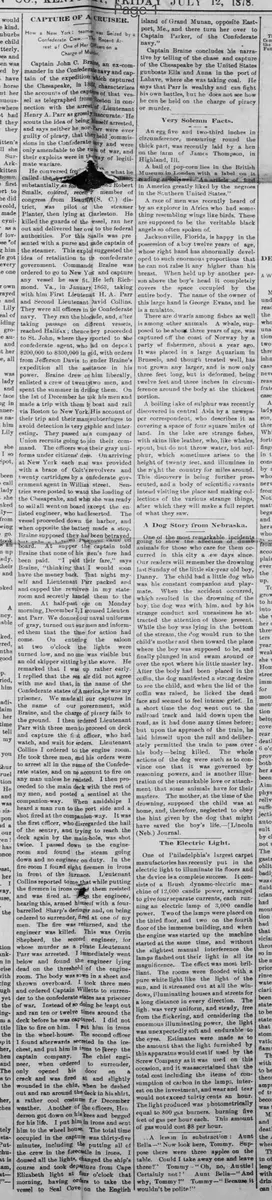
Captain John C. Braine, an ex-commander in the Confederate navy and captain of the expedition which captured the Chesapeake, in '63, characterizes the accounts of the capture of that vessel as telegraphed from Boston in connection with the arrest of Lieutenant Henry A. Parr as grossly inaccurate. He scouts the idea of being himself arrested, and says neither he nor Parr were ever guilty of piracy, that they held commissions in the Confederate navy and were only amenable to the rules of war, and their exploits were in the way of legitimate warfare.
He conversed freely what he called the substantially as follows: Robert Smalls, colored, present member of Congress from Beaufort, S. C., district, was pilot of the steamer Planter, then lying at Charleston. He killed the guards of the vessel, ran her out and delivered her over to the federal authorities. For this Smalls was presented with a purse and made captain of the steamer. This exploit suggested the idea of retaliation to the Confederate government. Commander Braine was ordered to go to New York and capture any vessel he saw fit. He left Richmond, Va., in January, 1863, taking with him First Lieutenant H. A. Parr and Second Lieutenant David Collins. They were all officers in the Confederate navy. They ran the blockade, and, after taking passage on different vessels reached Halifax; thence they proceeded to St. John, where they reported to the Confederate agent, who had on deposit $200,000 to $300,000 in gold, with orders from Jefferson Davis to render Braine's expedition all the assistance in his power. Braine drew on him liberally enlisted a crew of twenty-two men, and spent the summer in drilling them. On the 1st of December he took his men and made a trip with them by boat and rail via Boston to New York. His account of their trip and their many subterfuges to avoid detection is very graphic and interesting. They passed as a company of Union recruits going to join their command. The officers wore their gray uniforms under citizens' dress. On arriving at New York each man was provided with a brace of Colt's revolvers and twenty cartridges by a Confederate government agent in William street. Sentries were posted to watch the loading of the Chesapeake, and when she was ready to sail all went on board except the enlisted engineer, who had deserted. The vessel proceeded down the harbor, and when opposite the battery made a stop. Braine supposed they had been betrayed, but only the steward, Paneymur, came on board. At supper the captain told Braine that none of his men's fare had been paid. "I paid their fare," says Braine, "thinking that I would soon have the money back. That night myself and Lieutenant Parr packed and capped the revolvers in my state room and secretly handed them to the men. At half-past one on Monday morning, December 7, I aroused Lieutenant Parr. We donned our naval uniforms of gray, turned out our men and informed them that the time for action had come.
On entering the saloon at two o'clock the lights were turned low, and no one was visible but an old skipper sitting by the stove. He remarked that I was up rather early. I replied that the sea air did not agree with me and that, in the name of the Confederate States of America, he was my prisoner. We made all our captures in the name of our government, said Braine, and the charge of piracy falls to the ground. I then ordered Lieutenant Parr with three men to proceed on deck and capture the first officer, who had the watch, and wait for orders. Lieutenant Collins I ordered to the engine room. He took three men, and his orders were to arrest all in the name of the Confederate States, and on no account to fire on any man unless he resisted. I then proceeded to the main deck with the rest of my men, and posted a sentinel at the companion-way.
When amidships I heard a man run to the port side and a shot fired at the companion-way. It was the first officer, who disregarded the hail of the sentry, and trying to reach the deck again by the main-hatch, was shot twice. I passed down to the engine-room and found the steam going down and no engineer on duty. In the fire-room I found eight firemen in irons in front of the furnace. Lieutenant Collins reported to me that while putting the firemen in irons one of them resisted and was fired at. On the engineer, hearing this, armed himself with a four-barrelled Sharp's deringer and, on being ordered to surrender, fired at one of my men. The fire was returned, and the engineer was killed. This was Orrin Shepherd, the second engineer, for whose murder as a pirate Lieutenant Parr was arrested. I immediately went below and found the engineer lying dead on the threshold of the engine-room. The body was sewn in a sheet and thrown overboard. I took three men and ordered Captain Willetts to surrender to the Confederate States as a prisoner of war. Instead of so doing he leapt out and ran ten or twelve times around the deck before he was captured. I did not like to fire on him. I put him in irons in the wheel-house. The second officer I found afterwards secreted in the ice-chest, and put him in irons to keep the captain company.
The chief engineer, when ordered to surrender, only opened his door on a crack and was fired at and slightly wounded in the chin, when he dashed out and ran around the deck in his shirt, a rather cool costume for December weather. Another of the officers, Henderson got down on his knees and begged for his life. I put him in irons and sent him to the wheel house. The total time occupied in the capture was thirty-five minutes, including the putting all of the crew in the forecastle in irons. I doused all the lights, changed the ship's course and took departure from Cape Elizabeth light at four o'clock that morning, having orders to take the island of Grand Manan, opposite Eastport, Me., and there turn her over to Captain Parker, of the Confederate navy.
Captain Braine concludes his narrative by telling of the chase and capture of the Chesapeake by the United States gunboats Ella and Anna in the port of Lahave, where she was taking coal. He says that Parr is wealthy and can fight his own battles, but he does not see how he can be held on the charge of piracy or murder.
How a New York Steamer was Seized by a Confederate Crew.—The Recent Arrest of One of Her Officers on a Charge of Murder.
Captain John C. Braine, an ex-commander in the Confederate navy and captain of the expedition which captured the Chesapeake, in '63, characterizes the accounts of the capture of that vessel as telegraphed from Boston in connection with the arrest of Lieutenant Henry A. Parr as grossly inaccurate. He scouts the idea of being himself arrested, and says neither he nor Parr were ever guilty of piracy, that they held commissions in the Confederate navy and were only amenable to the rules of war, and their exploits were in the way of legitimate warfare.
He conversed freely what he called the substantially as follows: Robert Smalls, colored, present member of Congress from Beaufort, S. C., district, was pilot of the steamer Planter, then lying at Charleston. He killed the guards of the vessel, ran her out and delivered her over to the federal authorities. For this Smalls was presented with a purse and made captain of the steamer. This exploit suggested the idea of retaliation to the Confederate government. Commander Braine was ordered to go to New York and capture any vessel he saw fit. He left Richmond, Va., in January, 1863, taking with him First Lieutenant H. A. Parr and Second Lieutenant David Collins. They were all officers in the Confederate navy. They ran the blockade, and, after taking passage on different vessels reached Halifax; thence they proceeded to St. John, where they reported to the Confederate agent, who had on deposit $200,000 to $300,000 in gold, with orders from Jefferson Davis to render Braine's expedition all the assistance in his power. Braine drew on him liberally enlisted a crew of twenty-two men, and spent the summer in drilling them. On the 1st of December he took his men and made a trip with them by boat and rail via Boston to New York. His account of their trip and their many subterfuges to avoid detection is very graphic and interesting. They passed as a company of Union recruits going to join their command. The officers wore their gray uniforms under citizens' dress. On arriving at New York each man was provided with a brace of Colt's revolvers and twenty cartridges by a Confederate government agent in William street. Sentries were posted to watch the loading of the Chesapeake, and when she was ready to sail all went on board except the enlisted engineer, who had deserted. The vessel proceeded down the harbor, and when opposite the battery made a stop. Braine supposed they had been betrayed, but only the steward, Paneymur, came on board. At supper the captain told Braine that none of his men's fare had been paid. "I paid their fare," says Braine, "thinking that I would soon have the money back. That night myself and Lieutenant Parr packed and capped the revolvers in my state room and secretly handed them to the men. At half-past one on Monday morning, December 7, I aroused Lieutenant Parr. We donned our naval uniforms of gray, turned out our men and informed them that the time for action had come.
On entering the saloon at two o'clock the lights were turned low, and no one was visible but an old skipper sitting by the stove. He remarked that I was up rather early. I replied that the sea air did not agree with me and that, in the name of the Confederate States of America, he was my prisoner. We made all our captures in the name of our government, said Braine, and the charge of piracy falls to the ground. I then ordered Lieutenant Parr with three men to proceed on deck and capture the first officer, who had the watch, and wait for orders. Lieutenant Collins I ordered to the engine room. He took three men, and his orders were to arrest all in the name of the Confederate States, and on no account to fire on any man unless he resisted. I then proceeded to the main deck with the rest of my men, and posted a sentinel at the companion-way.
When amidships I heard a man run to the port side and a shot fired at the companion-way. It was the first officer, who disregarded the hail of the sentry, and trying to reach the deck again by the main-hatch, was shot twice. I passed down to the engine-room and found the steam going down and no engineer on duty. In the fire-room I found eight firemen in irons in front of the furnace. Lieutenant Collins reported to me that while putting the firemen in irons one of them resisted and was fired at. On the engineer, hearing this, armed himself with a four-barrelled Sharp's deringer and, on being ordered to surrender, fired at one of my men. The fire was returned, and the engineer was killed. This was Orrin Shepherd, the second engineer, for whose murder as a pirate Lieutenant Parr was arrested. I immediately went below and found the engineer lying dead on the threshold of the engine-room. The body was sewn in a sheet and thrown overboard. I took three men and ordered Captain Willetts to surrender to the Confederate States as a prisoner of war. Instead of so doing he leapt out and ran ten or twelve times around the deck before he was captured. I did not like to fire on him. I put him in irons in the wheel-house. The second officer I found afterwards secreted in the ice-chest, and put him in irons to keep the captain company.
The chief engineer, when ordered to surrender, only opened his door on a crack and was fired at and slightly wounded in the chin, when he dashed out and ran around the deck in his shirt, a rather cool costume for December weather. Another of the officers, Henderson got down on his knees and begged for his life. I put him in irons and sent him to the wheel house. The total time occupied in the capture was thirty-five minutes, including the putting all of the crew in the forecastle in irons. I doused all the lights, changed the ship's course and took departure from Cape Elizabeth light at four o'clock that morning, having orders to take the island of Grand Manan, opposite Eastport, Me., and there turn her over to Captain Parker, of the Confederate navy.
Captain Braine concludes his narrative by telling of the chase and capture of the Chesapeake by the United States gunboats Ella and Anna in the port of Lahave, where she was taking coal. He says that Parr is wealthy and can fight his own battles, but he does not see how he can be held on the charge of piracy or murder.
What sub-type of article is it?
Historical Event
Naval Engagement
Military Action
What themes does it cover?
Bravery Heroism
Justice
What keywords are associated?
Chesapeake Capture
Confederate Navy
Civil War Raid
Piracy Charge
Naval Seizure
Murder Arrest
What entities or persons were involved?
John C. Braine
Henry A. Parr
David Collins
Robert Smalls
Orrin Shepherd
Captain Willetts
Jefferson Davis
Where did it happen?
Steamer Chesapeake From New York Harbor, At Sea
Story Details
Key Persons
John C. Braine
Henry A. Parr
David Collins
Robert Smalls
Orrin Shepherd
Captain Willetts
Jefferson Davis
Location
Steamer Chesapeake From New York Harbor, At Sea
Event Date
December 7, 1863
Story Details
Confederate officers led by Capt. Braine capture the steamer Chesapeake in New York harbor as retaliation, killing engineer Orrin Shepherd in resistance; Braine defends the action as legitimate warfare against recent piracy charges and arrest of Lt. Parr for murder.