Thank you for visiting SNEWPapers!
Sign up free
Story
September 12, 1929
The Sauk Centre Herald
Sauk Centre, Stearns County, Minnesota
What is this article about?
William Herschel's discovery of Uranus in early times led to royal honors from George III. Eccentric orbit calculations predicted Neptune, first sighted by Galle at Berlin observatory.
Clipping
OCR Quality
98%
Excellent
Full Text
Won Astronomical Honors
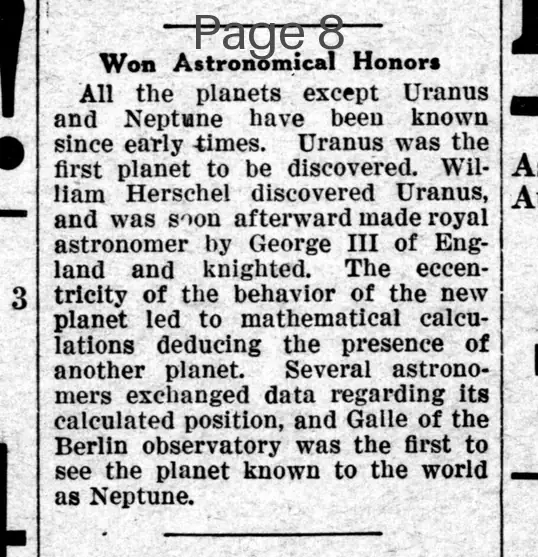
All the planets except Uranus and Neptune have been known since early times. Uranus was the first planet to be discovered. William Herschel discovered Uranus, and was soon afterward made royal astronomer by George III of England and knighted. The eccentricity of the behavior of the new planet led to mathematical calculations deducing the presence of another planet. Several astronomers exchanged data regarding its calculated position, and Galle of the Berlin observatory was the first to see the planet known to the world as Neptune.
All the planets except Uranus and Neptune have been known since early times. Uranus was the first planet to be discovered. William Herschel discovered Uranus, and was soon afterward made royal astronomer by George III of England and knighted. The eccentricity of the behavior of the new planet led to mathematical calculations deducing the presence of another planet. Several astronomers exchanged data regarding its calculated position, and Galle of the Berlin observatory was the first to see the planet known to the world as Neptune.
What sub-type of article is it?
Historical Event
Curiosity
Biography
What themes does it cover?
Exploration
Triumph
What keywords are associated?
Planet Discovery
Uranus
Neptune
William Herschel
Astronomical Honors
What entities or persons were involved?
William Herschel
George Iii
Galle
Where did it happen?
Berlin Observatory
Story Details
Key Persons
William Herschel
George Iii
Galle
Location
Berlin Observatory
Story Details
William Herschel discovered Uranus, earning him the position of royal astronomer and knighthood from George III. The planet's eccentricity led to calculations predicting another planet, which Galle first observed at the Berlin observatory, named Neptune.