Thank you for visiting SNEWPapers!
Sign up free
Editorial
October 24, 1804
The National Intelligencer And Washington Advertiser
Washington, District Of Columbia
What is this article about?
The National Intelligencer republishes and endorses an editorial from the Connecticut Herald advocating for a robust system of public education to ensure national peace, prosperity, and liberty. It emphasizes that neglecting education leads to instability, as seen in the French Revolution, and calls for better-qualified teachers, longer school terms, and legislative support to educate all youth.
Clipping
OCR Quality
95%
Excellent
Full Text
National Intelligencer
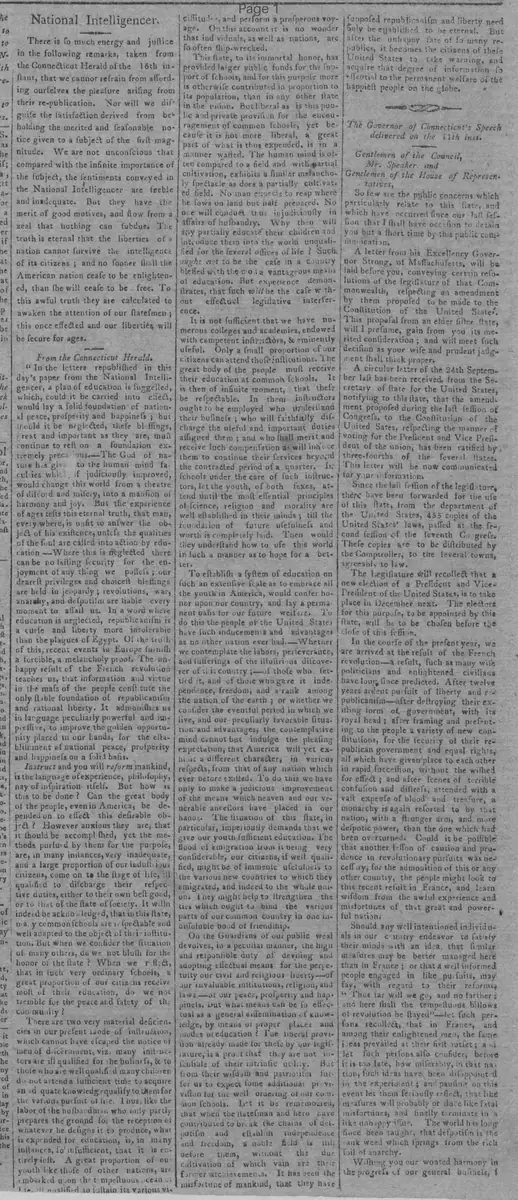
There is so much energy and justice in the following remarks, taken from the Connecticut Herald of the 16th instant, that we cannot refrain from affording ourselves the pleasure arising from their re-publication. Nor will we disguise the satisfaction derived from beholding the merited and seasonable notice given to a subject of the first magnitude. We are not unconscious that compared with the infinite importance of the subject, the sentiments conveyed in the National Intelligencer are feeble and inadequate. But they have the merit of good motives, and flow from a zeal that nothing can subdue. The truth is eternal that the liberties of a nation cannot survive the intelligence of its citizens; and no sooner shall the American nation cease to be enlightened, than she will cease to be free. To this awful truth they are calculated to awaken the attention of our statesmen: this once effected and our liberties will be secure for ages.
From the Connecticut Herald.
In the letters republished in this day's paper from the National Intelligencer, a plan of education is suggested, which, could it be carried into effect, would lay a solid foundation of national peace, prosperity and happiness; but should it be neglected, these blessings, great and important as they are, must continue to rest on a foundation extremely precarious.—The God of nature has given to the human mind faculties which, if judiciously improved, would change this world from a theatre of discord and misery, into a mansion of harmony and joy. But the experience of ages tests this eternal truth, that man, everywhere, is unfit to answer the object of his existence, unless the qualities of the soul are called into action by education—Where this is neglected there can be no lasting security for the enjoyment of any thing we possess; our dearest privileges and choicest blessings are held in jeopardy; revolutions, war, anarchy, and despotism are liable every moment to assail us. In a word where education is neglected, republicanism is a curse and liberty more intolerable than the plagues of Egypt. Of the truth of this, recent events in Europe furnish a forcible, a melancholy proof. The unhappy result of the French revolution teaches us, that information and virtue in the mass of the people constitute the only stable foundation of republicanism and rational liberty. It admonishes us in language peculiarly powerful and impressive, to improve the golden opportunity placed in our hands, for the establishment of national peace, prosperity and happiness on a solid basis.
Instruct and you will reform mankind, is the language of experience, philosophy, nay of inspiration itself. But how is this to be done? Can the great body of the people, even in America, be depended on to effect this desirable object? However anxious they are, that it should be accomplished, yet the methods pursued by them for the purpose, are, in many instances, very inadequate, and a large proportion of our industrious citizens, come on to the stage of life, ill qualified to discharge their respective duties, either to their own best good, or to that of the state of society. It will indeed be acknowledged, that in this state, many common schools are respectable and well adapted to the object of their institution. But when we consider the situation of many others, do we not blush for the honor of the state? When we reflect that in such very ordinary schools, a great proportion of our citizens receive most of their education, do we not tremble for the peace and safety of the Community?
There are two very material deficiencies in our present mode of instruction, which cannot have escaped the notice of men of discernment, viz. many instructors are ill qualified for the business, & to those who are well qualified many children do not attend a sufficient time to acquire an adequate knowledge to qualify them for the various pursuits of life. Thus, like the labor of the husbandman who only partly prepares the ground for the reception of whatever he designs it to produce, what is expended for education, is, in many instances, so insufficient, that it is entirely lost. A great proportion of our youth like those of other nations, are embarked upon the tempestuous ocean of life ill qualified to attain its various vicissitudes, and perform a prosperous voyage. On this account it is no wonder that individuals, as well as nations, are so often ship-wrecked.
This state, to its immortal honor, has provided larger public funds for the support of schools, and for this purpose more is otherwise contributed in proportion to its population, than in any other state in the union. But liberal as is this public and private provision for the encouragement of common schools, yet because it is not more liberal, a great part of what is thus expended, is in a manner wasted. The human mind is often compared to a field and with partial cultivation, exhibits a similar melancholy spectacle as does a partially cultivated field. No man expects to reap where he sows on land but half prepared. No one will conduct himself so injudiciously in affairs of husbandry. Why then will any partially educate their children and introduce them into the world unqualified for the several offices of life? Such ought not to be the case in a country blessed with the most advantageous means of education. But experience demonstrates, that such will be the case without effectual legislative interference.
It is not sufficient that we have numerous colleges and academies, endowed with competent instructors, & eminently useful. Only a small proportion of our citizens can attend those institutions. The great body of the people must receive their education at common schools. It is then of infinite moment, that they be respectable. In them instructors ought to be employed who understand their business; who will faithfully discharge the useful and important duties assigned them; and who shall merit and receive such compensation as will induce them to continue their services beyond the contracted period of a quarter. In schools under the care of such instructors, let the youth. of both sexes, attend until the most essential principles of science, religion and morality are well established in their minds: till the foundation of future usefulness and worth is completely laid. Then would they understand how to use this world in such a manner as to hope for a better.
To establish a system of education on such an extensive scale as to embrace all the youth in America, would confer honor upon our country, and lay a permanent basis for our future welfare. To do this the people of the United States have such inducements and advantages as no other nation ever had.—Whether we contemplate the labors, perseverance, and sufferings of the illustrious discoverer of this Country; of those who settled it, and of those who gave it independence, freedom, and a rank among the nations of the earth; or whether we consider the eventful period in which we live, and our peculiarly favorable situation and advantages, the contemplative mind cannot but indulge the pleasing expectation, that America will yet exhibit a different character, in various respects, from that of any nation which ever before existed. To do this we have only to make a judicious improvement of the means which heaven and our venerable ancestors have placed in our hands. The situation of this state, in particular, imperiously demands that we give our youth sufficient education. The flood of emigration from it being very considerable, our citizens, if well qualified, might be of immense usefulness to the various new countries to which they emigrate, and indeed to the whole union: They might help to strengthen the ties which ought to bind the various parts of our common Country in one indissoluble bond of friendship.
On the Guardians of our public weal devolves, in a peculiar manner, the high and responsible duty of devising and adopting effectual means for the perpetuity our civil and religious liberty—of our invaluable institutions, religion, and laws,—of our peace, prosperity and happiness. But what means Can be so effectual as a general dissemination of knowledge, by means of proper places and modes of education? The liberal provision already made for these by our legislature, is a proof that they are not insensible of their intrinsic utility. But from their wisdom and patriotism further us to expect some additional provision for the well ordering of our common schools. Let it be remembered, that when the statesman and hero have contributed to break the chains of despotism and establish independence and freedom, a noble field is still before them, without the due cultivation of which vain are their former achievements. It has been the misfortune of mankind, that they have opposed republicanism and liberty need only be established to be eternal. But after the unhappy fate of so many republics, it becomes the citizens of these United States to take warning, and acquire that degree of information so essential to the permanent welfare of the happiest people on the globe.
There is so much energy and justice in the following remarks, taken from the Connecticut Herald of the 16th instant, that we cannot refrain from affording ourselves the pleasure arising from their re-publication. Nor will we disguise the satisfaction derived from beholding the merited and seasonable notice given to a subject of the first magnitude. We are not unconscious that compared with the infinite importance of the subject, the sentiments conveyed in the National Intelligencer are feeble and inadequate. But they have the merit of good motives, and flow from a zeal that nothing can subdue. The truth is eternal that the liberties of a nation cannot survive the intelligence of its citizens; and no sooner shall the American nation cease to be enlightened, than she will cease to be free. To this awful truth they are calculated to awaken the attention of our statesmen: this once effected and our liberties will be secure for ages.
From the Connecticut Herald.
In the letters republished in this day's paper from the National Intelligencer, a plan of education is suggested, which, could it be carried into effect, would lay a solid foundation of national peace, prosperity and happiness; but should it be neglected, these blessings, great and important as they are, must continue to rest on a foundation extremely precarious.—The God of nature has given to the human mind faculties which, if judiciously improved, would change this world from a theatre of discord and misery, into a mansion of harmony and joy. But the experience of ages tests this eternal truth, that man, everywhere, is unfit to answer the object of his existence, unless the qualities of the soul are called into action by education—Where this is neglected there can be no lasting security for the enjoyment of any thing we possess; our dearest privileges and choicest blessings are held in jeopardy; revolutions, war, anarchy, and despotism are liable every moment to assail us. In a word where education is neglected, republicanism is a curse and liberty more intolerable than the plagues of Egypt. Of the truth of this, recent events in Europe furnish a forcible, a melancholy proof. The unhappy result of the French revolution teaches us, that information and virtue in the mass of the people constitute the only stable foundation of republicanism and rational liberty. It admonishes us in language peculiarly powerful and impressive, to improve the golden opportunity placed in our hands, for the establishment of national peace, prosperity and happiness on a solid basis.
Instruct and you will reform mankind, is the language of experience, philosophy, nay of inspiration itself. But how is this to be done? Can the great body of the people, even in America, be depended on to effect this desirable object? However anxious they are, that it should be accomplished, yet the methods pursued by them for the purpose, are, in many instances, very inadequate, and a large proportion of our industrious citizens, come on to the stage of life, ill qualified to discharge their respective duties, either to their own best good, or to that of the state of society. It will indeed be acknowledged, that in this state, many common schools are respectable and well adapted to the object of their institution. But when we consider the situation of many others, do we not blush for the honor of the state? When we reflect that in such very ordinary schools, a great proportion of our citizens receive most of their education, do we not tremble for the peace and safety of the Community?
There are two very material deficiencies in our present mode of instruction, which cannot have escaped the notice of men of discernment, viz. many instructors are ill qualified for the business, & to those who are well qualified many children do not attend a sufficient time to acquire an adequate knowledge to qualify them for the various pursuits of life. Thus, like the labor of the husbandman who only partly prepares the ground for the reception of whatever he designs it to produce, what is expended for education, is, in many instances, so insufficient, that it is entirely lost. A great proportion of our youth like those of other nations, are embarked upon the tempestuous ocean of life ill qualified to attain its various vicissitudes, and perform a prosperous voyage. On this account it is no wonder that individuals, as well as nations, are so often ship-wrecked.
This state, to its immortal honor, has provided larger public funds for the support of schools, and for this purpose more is otherwise contributed in proportion to its population, than in any other state in the union. But liberal as is this public and private provision for the encouragement of common schools, yet because it is not more liberal, a great part of what is thus expended, is in a manner wasted. The human mind is often compared to a field and with partial cultivation, exhibits a similar melancholy spectacle as does a partially cultivated field. No man expects to reap where he sows on land but half prepared. No one will conduct himself so injudiciously in affairs of husbandry. Why then will any partially educate their children and introduce them into the world unqualified for the several offices of life? Such ought not to be the case in a country blessed with the most advantageous means of education. But experience demonstrates, that such will be the case without effectual legislative interference.
It is not sufficient that we have numerous colleges and academies, endowed with competent instructors, & eminently useful. Only a small proportion of our citizens can attend those institutions. The great body of the people must receive their education at common schools. It is then of infinite moment, that they be respectable. In them instructors ought to be employed who understand their business; who will faithfully discharge the useful and important duties assigned them; and who shall merit and receive such compensation as will induce them to continue their services beyond the contracted period of a quarter. In schools under the care of such instructors, let the youth. of both sexes, attend until the most essential principles of science, religion and morality are well established in their minds: till the foundation of future usefulness and worth is completely laid. Then would they understand how to use this world in such a manner as to hope for a better.
To establish a system of education on such an extensive scale as to embrace all the youth in America, would confer honor upon our country, and lay a permanent basis for our future welfare. To do this the people of the United States have such inducements and advantages as no other nation ever had.—Whether we contemplate the labors, perseverance, and sufferings of the illustrious discoverer of this Country; of those who settled it, and of those who gave it independence, freedom, and a rank among the nations of the earth; or whether we consider the eventful period in which we live, and our peculiarly favorable situation and advantages, the contemplative mind cannot but indulge the pleasing expectation, that America will yet exhibit a different character, in various respects, from that of any nation which ever before existed. To do this we have only to make a judicious improvement of the means which heaven and our venerable ancestors have placed in our hands. The situation of this state, in particular, imperiously demands that we give our youth sufficient education. The flood of emigration from it being very considerable, our citizens, if well qualified, might be of immense usefulness to the various new countries to which they emigrate, and indeed to the whole union: They might help to strengthen the ties which ought to bind the various parts of our common Country in one indissoluble bond of friendship.
On the Guardians of our public weal devolves, in a peculiar manner, the high and responsible duty of devising and adopting effectual means for the perpetuity our civil and religious liberty—of our invaluable institutions, religion, and laws,—of our peace, prosperity and happiness. But what means Can be so effectual as a general dissemination of knowledge, by means of proper places and modes of education? The liberal provision already made for these by our legislature, is a proof that they are not insensible of their intrinsic utility. But from their wisdom and patriotism further us to expect some additional provision for the well ordering of our common schools. Let it be remembered, that when the statesman and hero have contributed to break the chains of despotism and establish independence and freedom, a noble field is still before them, without the due cultivation of which vain are their former achievements. It has been the misfortune of mankind, that they have opposed republicanism and liberty need only be established to be eternal. But after the unhappy fate of so many republics, it becomes the citizens of these United States to take warning, and acquire that degree of information so essential to the permanent welfare of the happiest people on the globe.
What sub-type of article is it?
Education
Moral Or Religious
Social Reform
What keywords are associated?
Public Education
Common Schools
Republican Liberty
Educational Reform
Moral Instruction
Legislative Support
French Revolution
Citizen Intelligence
What entities or persons were involved?
National Intelligencer
Connecticut Herald
Statesmen
Legislature
Editorial Details
Primary Topic
Advocacy For Comprehensive Public Education To Sustain Republican Liberty
Stance / Tone
Strong Advocacy For Educational Reform And Legislative Support
Key Figures
National Intelligencer
Connecticut Herald
Statesmen
Legislature
Key Arguments
Liberties Depend On Citizens' Intelligence; Neglect Leads To Loss Of Freedom
French Revolution Shows Need For Mass Education In Information And Virtue
Current Common Schools Inadequate Due To Poor Instructors And Short Attendance
State Provides Funds But More Liberal Support Needed To Avoid Waste
Colleges Insufficient; Common Schools Must Educate The Masses Effectively
Require Qualified Teachers With Fair Compensation For Longer Terms
Educate Youth In Science, Religion, Morality For Future Usefulness
America's Advantages Demand A National Education System For All Youth
Educated Emigrants Strengthen National Unity
Legislators Must Enhance Provisions For Common Schools To Secure Institutions