Thank you for visiting SNEWPapers!
Sign up free
Story
November 7, 1887
The Washington Critic
Washington, District Of Columbia
What is this article about?
Interview with Jay Gould by Foster Coates on success chances for young men starting out in New York, emphasizing integrity, economy, hard work, and avoiding temptations amid increased competition.
Clipping
OCR Quality
95%
Excellent
Full Text
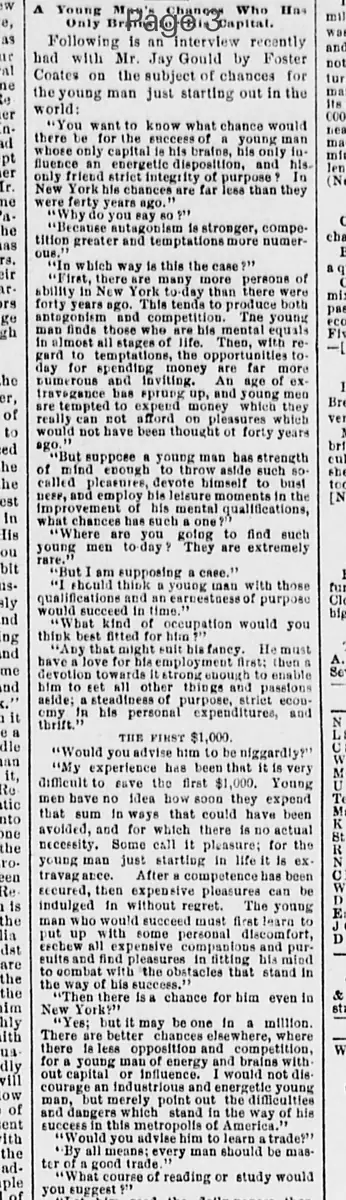
Following is an interview recently had with Mr. Jay Gould by Foster Coates on the subject of chances for the young man just starting out in the world:
"You want to know what chance would there be for the success of a young man whose only capital is his brains, his only influence an energetic disposition, and his only friend strict integrity of purpose? In New York his chances are far less than they were forty years ago."
"Why do you say so?"
"Because antagonism is stronger, competition greater and temptations more numerous."
"In which way is this the case?"
"First, there are many more persons of ability in New York to-day than there were forty years ago. This tends to produce both antagonism and competition. The young man finds those who are his mental equals in almost all stages of life. Then, with regard to temptations, the opportunities to-day for spending money are far more numerous and inviting. An age of extravagance has sprung up, and young men are tempted to expend money which they really can not afford on pleasures which would not have been thought of forty years ago. But suppose a young man has strength of mind enough to throw aside such so called pleasures, devote himself to business, and employ his leisure moments in the improvement of his mental qualifications, what chances has such a one"
"Where are you going to find such young men to-day? They are extremely rare."
"But I am supposing a case."
"I should think a young man with those qualifications and an earnestness of purpose would succeed in time."
"What kind of occupation would you think best fitted for him?"
"Any that might suit his fancy. He must have a love for his employment first; then a devotion toward it strong enough to enable him to set all other things and passions aside: a steadiness of purpose, strict economy in his personal expenditures, and thrift."
THE FIRST $1,000.
"Would you advise him to be niggardly?"
"My experience has been that it is very difficult to save the first $1,000. Young men have no idea how soon they expend that sum in ways that could have been avoided, and for which there is no actual necessity. Some call it pleasure; for the young man just starting in life it is extravagance. After a competence has been secured, then expensive pleasures can be indulged in without regret. The young man who would succeed must first learn to put up with some personal discomfort, eschew all expensive companions and pursuits and find pleasures in fitting his mind to combat with the obstacles that stand in the way of his success."
"Then there is a chance for him even in New York?"
"Yes: but it may be one in a million. There are better chances elsewhere, where there is less opposition and competition, for a young man of energy and brains without capital or influence. I would not discourage an industrious and energetic young man, but merely point out the difficulties and dangers which stand in the way of his success in this metropolis of America."
"Would you advise him to learn a trade?"
By all means; every man should be master of a good trade.
"What course of reading or study would you suggest?"
"Let him read the daily papers thoroughly. Any man can familiarize himself with all that is going on, and he can also get a good education by studying the daily papers. Books? Oh, any book that is good and well written and is clean and healthy. It is not so much the books we read as what we remember that does us good. Read anything that comes to hand. Keep out of bad company and go to work with a will. The boy who does that is bound to get on in the world."
"You want to know what chance would there be for the success of a young man whose only capital is his brains, his only influence an energetic disposition, and his only friend strict integrity of purpose? In New York his chances are far less than they were forty years ago."
"Why do you say so?"
"Because antagonism is stronger, competition greater and temptations more numerous."
"In which way is this the case?"
"First, there are many more persons of ability in New York to-day than there were forty years ago. This tends to produce both antagonism and competition. The young man finds those who are his mental equals in almost all stages of life. Then, with regard to temptations, the opportunities to-day for spending money are far more numerous and inviting. An age of extravagance has sprung up, and young men are tempted to expend money which they really can not afford on pleasures which would not have been thought of forty years ago. But suppose a young man has strength of mind enough to throw aside such so called pleasures, devote himself to business, and employ his leisure moments in the improvement of his mental qualifications, what chances has such a one"
"Where are you going to find such young men to-day? They are extremely rare."
"But I am supposing a case."
"I should think a young man with those qualifications and an earnestness of purpose would succeed in time."
"What kind of occupation would you think best fitted for him?"
"Any that might suit his fancy. He must have a love for his employment first; then a devotion toward it strong enough to enable him to set all other things and passions aside: a steadiness of purpose, strict economy in his personal expenditures, and thrift."
THE FIRST $1,000.
"Would you advise him to be niggardly?"
"My experience has been that it is very difficult to save the first $1,000. Young men have no idea how soon they expend that sum in ways that could have been avoided, and for which there is no actual necessity. Some call it pleasure; for the young man just starting in life it is extravagance. After a competence has been secured, then expensive pleasures can be indulged in without regret. The young man who would succeed must first learn to put up with some personal discomfort, eschew all expensive companions and pursuits and find pleasures in fitting his mind to combat with the obstacles that stand in the way of his success."
"Then there is a chance for him even in New York?"
"Yes: but it may be one in a million. There are better chances elsewhere, where there is less opposition and competition, for a young man of energy and brains without capital or influence. I would not discourage an industrious and energetic young man, but merely point out the difficulties and dangers which stand in the way of his success in this metropolis of America."
"Would you advise him to learn a trade?"
By all means; every man should be master of a good trade.
"What course of reading or study would you suggest?"
"Let him read the daily papers thoroughly. Any man can familiarize himself with all that is going on, and he can also get a good education by studying the daily papers. Books? Oh, any book that is good and well written and is clean and healthy. It is not so much the books we read as what we remember that does us good. Read anything that comes to hand. Keep out of bad company and go to work with a will. The boy who does that is bound to get on in the world."
What sub-type of article is it?
Biography
Personal Triumph
What themes does it cover?
Moral Virtue
Triumph
Misfortune
What keywords are associated?
Young Man Success
Jay Gould Interview
Business Advice
New York Competition
Personal Economy
Thrift And Integrity
What entities or persons were involved?
Jay Gould
Foster Coates
Where did it happen?
New York
Story Details
Key Persons
Jay Gould
Foster Coates
Location
New York
Story Details
Jay Gould discusses reduced chances for young men in New York due to competition and temptations, advises integrity, economy, devotion to work, learning a trade, and reading newspapers and good books for success.