Thank you for visiting SNEWPapers!
Sign up free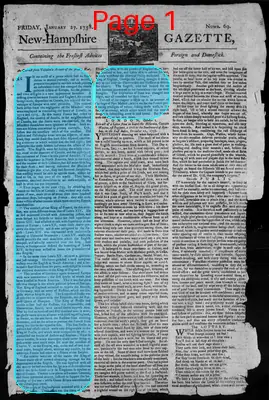
The New Hampshire Gazette
Portsmouth, Rockingham County, New Hampshire
What is this article about?
Voltaire's account details the origins of the Franco-English war over Canadian territories from the imprecise Treaty of Utrecht (1713), escalating in 1755 with English seizures of French ships. It covers French victories in North America, European diplomatic shifts including Austria-Bourbon alliance, and threats of invasion against England.
Clipping
OCR Quality
Full Text
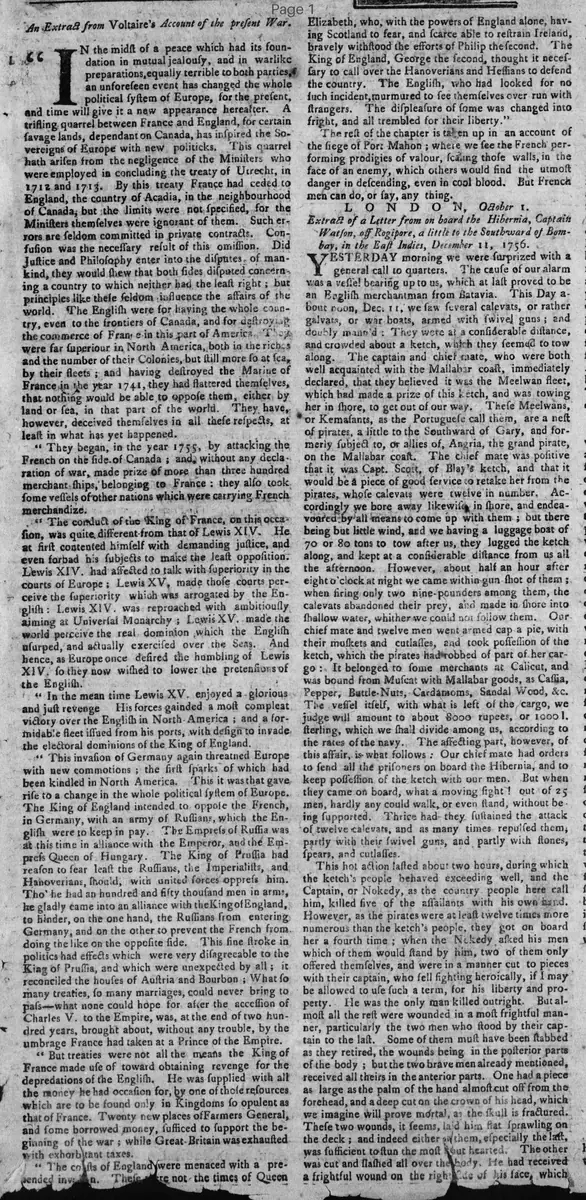
In the midst of a peace which had its foundation in mutual jealousy, and in warlike preparations, equally terrible to both parties, an unforeseen event has changed the whole political system of Europe, for the present, and time will give it a new appearance hereafter. A trifling quarrel between France and England, for certain savage lands, dependent on Canada, has inspired the Sovereigns of Europe with new politics. This quarrel has arisen from the negligence of the Ministers who were employed in concluding the treaty of Utrecht, in 1712 and 1713. By this treaty France had ceded to England, the country of Acadia, in the neighbourhood of Canada; but the limits were not specified, for the Ministers themselves were ignorant of them. Such errors are seldom committed in private contracts. Confusion was the necessary result of this omission. Did Justice and Philosophy enter into the disputes of mankind, they would shew that both sides disputed concerning a country to which neither had the least right; but principles like these seldom influence the affairs of the world. The English were for having the whole country, even to the frontiers of Canada, and for destroying the commerce of France in this part of America. They were far superior in North America, both in the riches and the number of their Colonies, but still more so at sea, by their fleets; and having destroyed the Marine of France in the year 1741, they had flattered themselves, that nothing would be able to oppose them, either, by land or sea, in that part of the world. They have, however, deceived themselves in all these respects, at least in what has yet happened.
They began, in the year 1755, by attacking the French on the side of Canada; and, without any declaration of war, made prize of more than three hundred merchant ships, belonging to France: they also took some vessels of other nations which were carrying French merchandize.
The conduct of the King of France, on this occasion, was quite different from that of Lewis XIV. He at first contented himself with demanding justice, and even forbade his subjects to make the least opposition. Lewis XIV. had affected to talk with superiority in the courts of Europe; Lewis XV. made those courts perceive the superiority which was arrogated by the English: Lewis XIV. was reproached with ambitiously aiming at Universal Monarchy; Lewis XV. made the world perceive the real dominion which the English usurped, and actually exercised over the Seas. And hence, as Europe once desired the humbling of Lewis XIV. so they now wished to lower the pretensions of the English.
In the mean time Lewis XV. enjoyed a glorious and just revenge His forces gained a most compleat victory over the English in North-America; and a formidable fleet issued from his ports, with design to invade the electoral dominions of the King of England.
This invasion of Germany again threatened Europe with new commotions; the first sparks of which had been kindled in North America. This it was that gave rise to a change in the whole political system of Europe. The King of England intended to oppose the French, in Germany, with an army of Russians, which the English were to keep in pay. The Empress of Russia was at this time in alliance with the Emperor, and the Empress Queen of Hungary. The King of Prussia had reason to fear least the Russians, the Imperialists, and Hanoverians, should, with united forces oppress him. Tho' he had an hundred and fifty thousand men in arms, he gladly came into an alliance with the King of England, to hinder, on the one hand, the Russians from entering Germany, and on the other to prevent the French from doing the like on the opposite side. This fine stroke in politics had effects which were very disagreeable to the King of Prussia, and which were unexpected by all; it reconciled the houses of Austria and Bourbon; What so many treaties, so many marriages, could never bring to pass--what none could hope for after the accession of Charles V. to the Empire, was, at the end of two hundred years, brought about, without any trouble, by the umbrage France had taken at a Prince of the Empire.
But treaties were not all the means the King of France made use of toward obtaining revenge for the depredations of the English. He was supplied with all the money he had occasion for, by one of those resources which are to be found only in Kingdoms so opulent as that of France. Twenty new places of Farmers General, and some borrowed money, sufficed to support the beginning of the war; while Great-Britain was exhausted with exorbitant taxes.
The coasts of England were menaced with a pretended invasion. These are not the times of Queen Elizabeth, who, with the powers of England alone, having Scotland to fear, and scarce able to restrain Ireland, bravely withstood the efforts of Philip the second. The King of England, George the second, thought it necessary to call over the Hanoverians and Hessians to defend the country. The English, who had looked for no such incident, murmured to see themselves over run with strangers. The displeasure of some was changed into fright, and all trembled for their liberty.
The rest of the chapter is taken up in an account of the siege of Port Mahon; where we see the French performing prodigies of valour, casting those walls, in the face of an enemy, which others would find the utmost danger in descending, even in cool blood. But French men can do, or say, any thing.
What sub-type of article is it?
What keywords are associated?
What entities or persons were involved?
Where did it happen?
Foreign News Details
Primary Location
North America
Event Date
Year 1755
Key Persons
Outcome
french forces gained a complete victory over the english in north america; reconciliation of houses of austria and bourbon; english seizure of over 300 french merchant ships; threat of french invasion of germany and england; siege of port mahon with french valor.
Event Details
Quarrel over Acadia limits from Treaty of Utrecht led to undeclared war in 1755; English captured French ships; French responded with victories in North America and fleet to invade Hanover; European alliances shifted, including Prussia-England alliance prompting Austria-Bourbon reconciliation; France funded war easily while England faced taxes and foreign troops.