Thank you for visiting SNEWPapers!
Sign up free
Literary
August 29, 1846
The Religious Herald
Hartford, Hartford County, Connecticut
What is this article about?
Personal memoir recounting the author's childhood memories of their pious grandmother's sudden death, a moral lesson from a spinning top symbolizing life, and attendance at weekly prayer meetings with elderly church members, emphasizing religious influence and gratitude.
Clipping
OCR Quality
96%
Excellent
Full Text
Memoirs of my Grandmother.
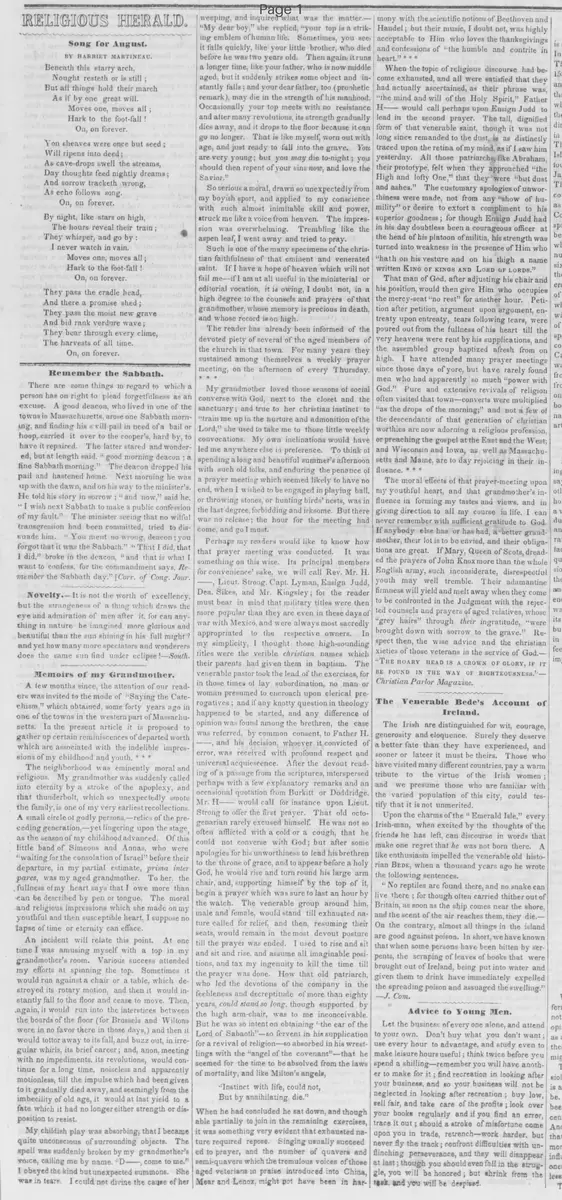
A few months since, the attention of our readers was invited to the mode of "Saving the Catechism," which obtained, some forty years ago in one of the towns in the western part of Massachusetts. In the present article it is proposed to gather up certain reminiscences of departed worth which are associated with the indelible impressions of my childhood and youth. * * *
The neighborhood was eminently moral and religious. My grandmother was suddenly called into eternity by a stroke of the apoplexy, and that thunderbolt, which so unexpectedly smote the family, is one of my very earliest recollections. A small circle of godly persons,—relics of the preceding generation,—yet lingering upon the stage as the season of my childhood advanced. Of this little band of Simeons and Annas, who were "waiting for the consolation of Israel" before their departure, in my partial estimate, prima inter pares, was my aged grandmother. To her, the fullness of my heart says that I owe more than can be described by pen or tongue. The moral and religious impressions which she made on my youthful and then susceptible heart, I suppose no lapse of time or eternity can efface.
An incident will relate this point. At one time I was amusing myself with a top in my grandmother's room. Various success attended my efforts at spinning the top. Sometimes it would run against a chair or a table, which destroyed its rotary motion, and then it would instantly fall to the floor and cease to move. Then, again, it would run into the interstices between the boards of the floor (for Brussels and Wiltons were in no favor there in those days,) and then it would totter away to its fall, and buzz out, in irregular whirls, its brief career; and, anon, meeting with no impediments, its revolutions, would continue for a long time, noiseless and apparently motionless, till the impulse which had been given to it gradually died away, and seemingly from the imbecility of old age, it would at last yield to a fate which it had no longer either strength or disposition to resist.
My childish play was absorbing, that I became quite unconscious of surrounding objects. The spell was suddenly broken by my grandmother's voice, calling me by name. "D, come to me." I obeyed the kind but unexpected summons. She was in tears. I could not divine the cause of her weeping, and inquired what was the matter.
"My dear boy," she replied, "your top is a striking emblem of human life. Sometimes, you see it falls quickly, like your little brother, who died before he was two years old. Then again, it runs a longer time, like your father, who is now middle aged, but it suddenly strikes some object and instantly falls; and your dear father, too (prophetic remark), may die in the strength of his manhood. Occasionally your top meets with no resistance and after many revolutions, its strength gradually dies away, and it drops to the floor because it can go no longer. That is like myself, worn out with age, and just ready to fall into the grave. You are very young; but you may die to-night; you should then repent of your sins now, and love the Savior."
So serious a moral, drawn so unexpectedly from my boyish sport, and applied to my conscience with such almost inimitable skill and power, struck me like a voice from heaven. The impression was overwhelming. Trembling like the aspen leaf, I went away and tried to pray.
Such is one of the many specimens of the christian faithfulness of that eminent and venerated saint. If I have a hope of heaven which will not fail me—if I am at all useful in the ministerial or editorial vocation, it is owing, I doubt not, in a high degree to the counsels and prayers of that grandmother, whose memory is precious in death, and whose record is on high.
The reader has already been informed of the devoted piety of several of the aged members of the church in that town. For many years they sustained among themselves a weekly prayer meeting, on the afternoon of every Thursday. My grandmother loved those seasons of social converse with God, next to the closet and the sanctuary; and true to her christian instinct to "train me up in the nurture and admonition of the Lord," she used to take me to those little weekly convocations. My own inclinations would have led me anywhere else in preference. To think of spending a long and beautiful summer's afternoon with such old folks, and enduring the penance of a prayer meeting which seemed likely to have no end, when I wished to be engaged in playing ball, or throwing stones, or hunting birds' nests, was in the last degree, forbidding and irksome. But there was no release; the hour for the meeting had come, and go I must.
Perhaps my readers would like to know how that prayer meeting was conducted. It was something on this wise. Its principal members for convenience' sake, we will call Rev. Mr. H., Lieut. Strong, Capt. Lyman, Ensign Judd, Dea. Sikes, and Mr. Kingsley; for the reader must bear in mind that military titles were then more popular than they are even in these days of war with Mexico, and were always most sacredly appropriated to the respective owners. In my simplicity, I thought those high-sounding titles were the veritable christian names which their parents had given them in baptism. The venerable pastor took the lead of the exercises, for in those times of lay subordination, no man or woman presumed to encroach upon clerical prerogatives; and if any knotty question in theology happened to be started, and any difference of opinion was found among the brethren, the case was referred, by common consent, to Father H., and his decision, whoever it convicted of error, was received with profound respect and universal acquiescence. After the devout reading of a passage from the scriptures, interspersed perhaps with a few explanatory remarks and an occasional quotation from Burkitt or Doddridge, Mr. H— would call for instance upon Lieut. Strong to offer the first prayer. That old octogenarian rarely excused himself. He was not so often afflicted with a cold or a cough, that he could not converse with God; but after some apologies for his unworthiness to lead his brethren to the throne of grace, and to appear before a holy God, he would rise and turn round his large arm chair, and, supporting himself by the top of it, begin a prayer which was sure to last an hour by the watch. The venerable group around him, male and female, would stand till exhausted nature called for relief, and then, resuming their seats, would remain in the most devout posture till the prayer was ended. I used to rise and sit and sit and rise, and assume all imaginable positions, and tax my ingenuity to kill the time till the prayer was done. How that old patriarch, who led the devotions of the company in the feebleness and decrepitude of more than eighty years, could stand so long, though supported by the high arm-chair, was to me inconceivable. But he was so intent on obtaining "the ear of the Lord of Sabaoth"—so fervent in his supplication for a revival of religion—so absorbed in his wrestlings with the "angel of the covenant"—that he seemed for the time to be absolved from the laws of mortality, and like Milton's angels,
Instinct with life, could not,
But by annihilating, die.
When he had concluded he sat down, and though able partially to join in the remaining exercises, it was something very evident that exhausted nature required repose. Singing usually succeeded to prayer, and the number of quavers and semi-quavers which the tremulous voices of those aged veterans in praise introduced into the hymns of Watts and Doddridge, might not have been in harmony with the scientific notions of Beethoven and Handel; but their music, I doubt not, was highly acceptable to Him who loves the thanksgivings and confessions of "the humble and contrite in heart." * * *
When the topic of religious discourse had become exhausted, and all were satisfied that they had actually ascertained, as their phrase was, "the mind and will of the Holy Spirit," Father H-- would call perhaps upon Ensign Judd to lead in the second prayer. The tall, dignified form of that venerable saint, though it was not long since remanded to the dust, is as distinctly traced upon the retina of my mind, as if I saw him yesterday. All those patriarchs, like Abraham, their prototype, felt when they approached "the High and lofty One," that they were "but dust and ashes." The customary apologies of unworthiness were made, not from any "show of humility" or desire to extort a compliment to his superior goodness; for though Ensign Judd had in his day doubtless been a courageous officer at the head of his platoon of militia, his strength was turned into weakness in the presence of Him who "hath on his vesture and on his thigh a name written King of Kings And Lord of Lords."
That man of God, after adjusting his chair and his position, would then give Him who occupies the mercy-seat "no rest" for another hour. Petition after petition, argument upon argument, entreaty upon entreaty, tears following tears, were poured out from the fullness of his heart till the very heavens were rent by his supplications, and the assembled group baptized afresh from on high. I have attended many prayer meetings since those days of yore, but have rarely found men who had apparently so much "power with God." Pure and extensive revivals of religion often visited that town—converts were multiplied "as the drops of the morning;" and not a few of the descendants of that generation of christian worthies are now adorning a religious profession or preaching the gospel at the East and the West; and Wisconsin and Iowa, as well as Massachusetts and Maine, are to day rejoicing in their influence.
The moral effects of that prayer-meeting upon my youthful heart, and that grandmother's influence in forming my tastes and views, and in giving direction to all my course in life, I can never remember with sufficient gratitude to God. If anybody else has or has had, a better grandmother, their lot is to be envied, and their obligations are great. If Mary, Queen of Scots, dreaded the prayers of John Knox more than the whole English army, such inconsiderate, disrespectful youth may well tremble. Their adamantine firmness will yield and melt away when they come to be confronted in the Judgment with the rejected counsels and prayers of aged relatives, whose "grey hairs" through their ingratitude, "were brought down with sorrow to the grave." Respect then, the wise advice and the christian anxieties of those veterans in the service of God.— "THE HOARY HEAD IS A CROWN OF GLORY, IF IT BE FOUND IN THE WAY OF RIGHTEOUSNESS." - Christian Parlor Magazine.
A few months since, the attention of our readers was invited to the mode of "Saving the Catechism," which obtained, some forty years ago in one of the towns in the western part of Massachusetts. In the present article it is proposed to gather up certain reminiscences of departed worth which are associated with the indelible impressions of my childhood and youth. * * *
The neighborhood was eminently moral and religious. My grandmother was suddenly called into eternity by a stroke of the apoplexy, and that thunderbolt, which so unexpectedly smote the family, is one of my very earliest recollections. A small circle of godly persons,—relics of the preceding generation,—yet lingering upon the stage as the season of my childhood advanced. Of this little band of Simeons and Annas, who were "waiting for the consolation of Israel" before their departure, in my partial estimate, prima inter pares, was my aged grandmother. To her, the fullness of my heart says that I owe more than can be described by pen or tongue. The moral and religious impressions which she made on my youthful and then susceptible heart, I suppose no lapse of time or eternity can efface.
An incident will relate this point. At one time I was amusing myself with a top in my grandmother's room. Various success attended my efforts at spinning the top. Sometimes it would run against a chair or a table, which destroyed its rotary motion, and then it would instantly fall to the floor and cease to move. Then, again, it would run into the interstices between the boards of the floor (for Brussels and Wiltons were in no favor there in those days,) and then it would totter away to its fall, and buzz out, in irregular whirls, its brief career; and, anon, meeting with no impediments, its revolutions, would continue for a long time, noiseless and apparently motionless, till the impulse which had been given to it gradually died away, and seemingly from the imbecility of old age, it would at last yield to a fate which it had no longer either strength or disposition to resist.
My childish play was absorbing, that I became quite unconscious of surrounding objects. The spell was suddenly broken by my grandmother's voice, calling me by name. "D, come to me." I obeyed the kind but unexpected summons. She was in tears. I could not divine the cause of her weeping, and inquired what was the matter.
"My dear boy," she replied, "your top is a striking emblem of human life. Sometimes, you see it falls quickly, like your little brother, who died before he was two years old. Then again, it runs a longer time, like your father, who is now middle aged, but it suddenly strikes some object and instantly falls; and your dear father, too (prophetic remark), may die in the strength of his manhood. Occasionally your top meets with no resistance and after many revolutions, its strength gradually dies away, and it drops to the floor because it can go no longer. That is like myself, worn out with age, and just ready to fall into the grave. You are very young; but you may die to-night; you should then repent of your sins now, and love the Savior."
So serious a moral, drawn so unexpectedly from my boyish sport, and applied to my conscience with such almost inimitable skill and power, struck me like a voice from heaven. The impression was overwhelming. Trembling like the aspen leaf, I went away and tried to pray.
Such is one of the many specimens of the christian faithfulness of that eminent and venerated saint. If I have a hope of heaven which will not fail me—if I am at all useful in the ministerial or editorial vocation, it is owing, I doubt not, in a high degree to the counsels and prayers of that grandmother, whose memory is precious in death, and whose record is on high.
The reader has already been informed of the devoted piety of several of the aged members of the church in that town. For many years they sustained among themselves a weekly prayer meeting, on the afternoon of every Thursday. My grandmother loved those seasons of social converse with God, next to the closet and the sanctuary; and true to her christian instinct to "train me up in the nurture and admonition of the Lord," she used to take me to those little weekly convocations. My own inclinations would have led me anywhere else in preference. To think of spending a long and beautiful summer's afternoon with such old folks, and enduring the penance of a prayer meeting which seemed likely to have no end, when I wished to be engaged in playing ball, or throwing stones, or hunting birds' nests, was in the last degree, forbidding and irksome. But there was no release; the hour for the meeting had come, and go I must.
Perhaps my readers would like to know how that prayer meeting was conducted. It was something on this wise. Its principal members for convenience' sake, we will call Rev. Mr. H., Lieut. Strong, Capt. Lyman, Ensign Judd, Dea. Sikes, and Mr. Kingsley; for the reader must bear in mind that military titles were then more popular than they are even in these days of war with Mexico, and were always most sacredly appropriated to the respective owners. In my simplicity, I thought those high-sounding titles were the veritable christian names which their parents had given them in baptism. The venerable pastor took the lead of the exercises, for in those times of lay subordination, no man or woman presumed to encroach upon clerical prerogatives; and if any knotty question in theology happened to be started, and any difference of opinion was found among the brethren, the case was referred, by common consent, to Father H., and his decision, whoever it convicted of error, was received with profound respect and universal acquiescence. After the devout reading of a passage from the scriptures, interspersed perhaps with a few explanatory remarks and an occasional quotation from Burkitt or Doddridge, Mr. H— would call for instance upon Lieut. Strong to offer the first prayer. That old octogenarian rarely excused himself. He was not so often afflicted with a cold or a cough, that he could not converse with God; but after some apologies for his unworthiness to lead his brethren to the throne of grace, and to appear before a holy God, he would rise and turn round his large arm chair, and, supporting himself by the top of it, begin a prayer which was sure to last an hour by the watch. The venerable group around him, male and female, would stand till exhausted nature called for relief, and then, resuming their seats, would remain in the most devout posture till the prayer was ended. I used to rise and sit and sit and rise, and assume all imaginable positions, and tax my ingenuity to kill the time till the prayer was done. How that old patriarch, who led the devotions of the company in the feebleness and decrepitude of more than eighty years, could stand so long, though supported by the high arm-chair, was to me inconceivable. But he was so intent on obtaining "the ear of the Lord of Sabaoth"—so fervent in his supplication for a revival of religion—so absorbed in his wrestlings with the "angel of the covenant"—that he seemed for the time to be absolved from the laws of mortality, and like Milton's angels,
Instinct with life, could not,
But by annihilating, die.
When he had concluded he sat down, and though able partially to join in the remaining exercises, it was something very evident that exhausted nature required repose. Singing usually succeeded to prayer, and the number of quavers and semi-quavers which the tremulous voices of those aged veterans in praise introduced into the hymns of Watts and Doddridge, might not have been in harmony with the scientific notions of Beethoven and Handel; but their music, I doubt not, was highly acceptable to Him who loves the thanksgivings and confessions of "the humble and contrite in heart." * * *
When the topic of religious discourse had become exhausted, and all were satisfied that they had actually ascertained, as their phrase was, "the mind and will of the Holy Spirit," Father H-- would call perhaps upon Ensign Judd to lead in the second prayer. The tall, dignified form of that venerable saint, though it was not long since remanded to the dust, is as distinctly traced upon the retina of my mind, as if I saw him yesterday. All those patriarchs, like Abraham, their prototype, felt when they approached "the High and lofty One," that they were "but dust and ashes." The customary apologies of unworthiness were made, not from any "show of humility" or desire to extort a compliment to his superior goodness; for though Ensign Judd had in his day doubtless been a courageous officer at the head of his platoon of militia, his strength was turned into weakness in the presence of Him who "hath on his vesture and on his thigh a name written King of Kings And Lord of Lords."
That man of God, after adjusting his chair and his position, would then give Him who occupies the mercy-seat "no rest" for another hour. Petition after petition, argument upon argument, entreaty upon entreaty, tears following tears, were poured out from the fullness of his heart till the very heavens were rent by his supplications, and the assembled group baptized afresh from on high. I have attended many prayer meetings since those days of yore, but have rarely found men who had apparently so much "power with God." Pure and extensive revivals of religion often visited that town—converts were multiplied "as the drops of the morning;" and not a few of the descendants of that generation of christian worthies are now adorning a religious profession or preaching the gospel at the East and the West; and Wisconsin and Iowa, as well as Massachusetts and Maine, are to day rejoicing in their influence.
The moral effects of that prayer-meeting upon my youthful heart, and that grandmother's influence in forming my tastes and views, and in giving direction to all my course in life, I can never remember with sufficient gratitude to God. If anybody else has or has had, a better grandmother, their lot is to be envied, and their obligations are great. If Mary, Queen of Scots, dreaded the prayers of John Knox more than the whole English army, such inconsiderate, disrespectful youth may well tremble. Their adamantine firmness will yield and melt away when they come to be confronted in the Judgment with the rejected counsels and prayers of aged relatives, whose "grey hairs" through their ingratitude, "were brought down with sorrow to the grave." Respect then, the wise advice and the christian anxieties of those veterans in the service of God.— "THE HOARY HEAD IS A CROWN OF GLORY, IF IT BE FOUND IN THE WAY OF RIGHTEOUSNESS." - Christian Parlor Magazine.
What sub-type of article is it?
Essay
What themes does it cover?
Religious
Moral Virtue
Death Mortality
What keywords are associated?
Grandmother Piety
Prayer Meetings
Religious Influence
Childhood Memories
Moral Lessons
Spinning Top Emblem
Christian Faithfulness
What entities or persons were involved?
Christian Parlor Magazine
Literary Details
Title
Memoirs Of My Grandmother.
Author
Christian Parlor Magazine
Subject
Reminiscences Of Grandmother's Piety And Childhood Religious Experiences
Form / Style
Personal Memoir In Prose
Key Lines
"My Dear Boy," She Replied, "Your Top Is A Striking Emblem Of Human Life. Sometimes, You See It Falls Quickly, Like Your Little Brother, Who Died Before He Was Two Years Old. Then Again, It Runs A Longer Time, Like Your Father, Who Is Now Middle Aged, But It Suddenly Strikes Some Object And Instantly Falls; And Your Dear Father, Too (Prophetic Remark), May Die In The Strength Of His Manhood. Occasionally Your Top Meets With No Resistance And After Many Revolutions, Its Strength Gradually Dies Away, And It Drops To The Floor Because It Can Go No Longer. That Is Like Myself, Worn Out With Age, And Just Ready To Fall Into The Grave. You Are Very Young; But You May Die To Night; You Should Then Repent Of Your Sins Now, And Love The Savior."
"The Hoary Head Is A Crown Of Glory, If It Be Found In The Way Of Righteousness."