Thank you for visiting SNEWPapers!
Sign up free
The Bismarck Tribune
Bismarck, Mandan, Burleigh County, Morton County, North Dakota
What is this article about?
A Chicago report on Sept. 23 details North Dakota's largest relative dairy production surge among seven Midwestern states, spurred by banking mandates for livestock diversification, enhancing farm income stability after 1919 grain crisis. Regional dairy values reach hundreds of millions annually.
Merged-components note: Title and body text form a single article on dairy production increases in North Dakota; merged due to sequential reading order and shared subject matter.
Clipping
OCR Quality
Full Text
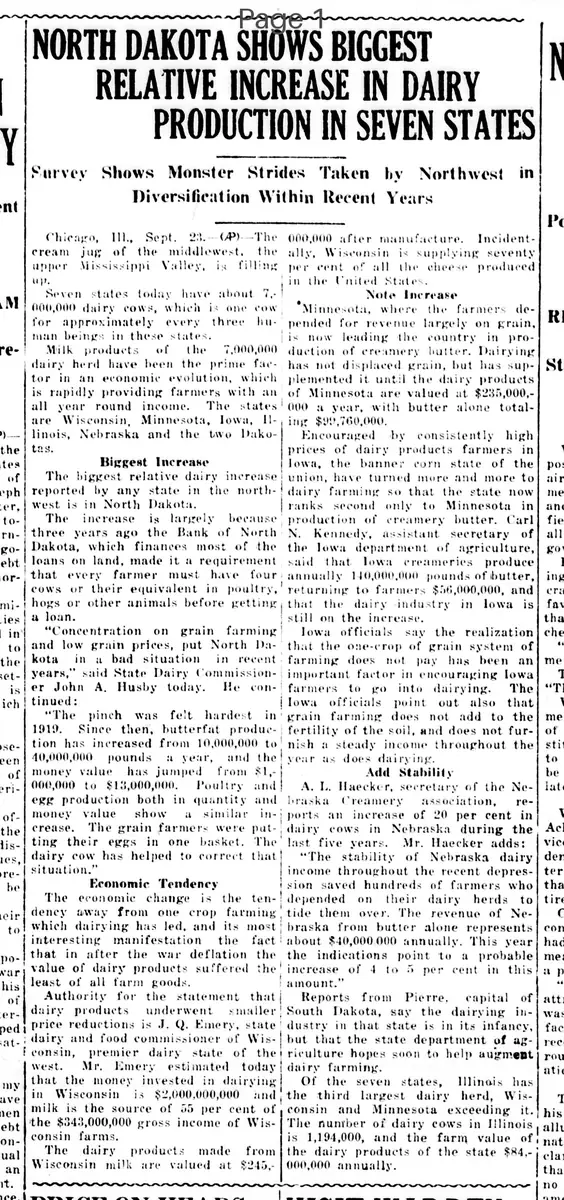
Survey Shows Monster Strides Taken by Northwest in Diversification Within Recent Years
Chicago, Ill., Sept. 23.--The cream jug of the middlewest, the upper Mississippi Valley, is filling up.
Seven states today have about 7,000,000 dairy cows, which is one cow for approximately every three human beings in these states.
Milk products of the 7,000,000 dairy herd have been the prime factor in an economic evolution, which is rapidly providing farmers with an all year round income. The states are Wisconsin, Minnesota, Iowa, Illinois, Nebraska and the two Dakotas.
Biggest Increase
The biggest relative dairy increase reported by any state in the northwest is in North Dakota.
The increase is largely because three years ago the Bank of North Dakota, which finances most of the loans on land, made it a requirement that every farmer must have four cows or their equivalent in poultry, hogs or other animals before getting a loan.
"Concentration on grain farming and low grain prices, put North Dakota in a bad situation in recent years," said State Dairy Commissioner John A. Husby today. He continued:
"The pinch was felt hardest in 1919. Since then, butterfat production has increased from 10,000,000 to 40,000,000 pounds a year, and the money value has jumped from $1,000,000 to $13,000,000. Poultry and egg production both in quantity and money value show a similar increase. The grain farmers were putting their eggs in one basket. The dairy cow has helped to correct that situation."
Economic Tendency
The economic change is the tendency away from one crop farming which dairying has led, and its most interesting manifestation the fact that in after the war deflation the value of dairy products suffered the least of all farm goods.
Authority for the statement that dairy products underwent smaller price reductions is J. Q. Emery, state dairy and food commissioner of Wisconsin, premier dairy state of the west. Mr. Emery estimated today that the money invested in dairying in Wisconsin is $2,000,000,000 and milk is the source of 55 per cent of the $343,000,000 gross income of Wisconsin farms.
The dairy products made from Wisconsin milk are valued at $245,000,000 after manufacture. Incidentally, Wisconsin is supplying seventy per cent of all the cheese produced in the United States.
Note Increase
Minnesota, where the farmers depended for revenue largely on grain, is now leading the country in production of creamery butter. Dairying has not displaced grain, but has supplemented it until the dairy products of Minnesota are valued at $235,000,000 a year, with butter alone totaling $90,760,000.
Encouraged by consistently high prices of dairy products farmers in Iowa, the banner corn state of the union, have turned more and more to dairy farming so that the state now ranks second only to Minnesota in production of creamery butter. Carl N. Kennedy, assistant secretary of the Iowa department of agriculture, said that Iowa creameries produce annually 140,000,000 pounds of butter, returning to farmers $56,000,000, and that the dairy industry in Iowa is still on the increase.
Iowa officials say the realization that the one-crop of grain system of farming does not pay has been an important factor in encouraging Iowa farmers to go into dairying. The Iowa officials point out also that grain farming does not add to the fertility of the soil, and does not furnish a steady income throughout the year as does dairying.
Add Stability
A. L. Haecker, secretary of the Nebraska Creamery association, reports an increase of 20 per cent in dairy cows in Nebraska during the last five years. Mr. Haecker adds:
"The stability of Nebraska dairy income throughout the recent depression saved hundreds of farmers who depended on their dairy herds to tide them over. The revenue of Nebraska from butter alone represents about $40,000,000 annually. This year the indications point to a probable increase of 4 to 5 per cent in this amount."
Reports from Pierre, capital of South Dakota, say the dairying industry in that state is in its infancy, but that the state department of agriculture hopes soon to help augment dairy farming.
Of the seven states, Illinois has the third largest dairy herd. Wisconsin and Minnesota exceeding it. The number of dairy cows in Illinois is 1,194,000, and the farm value of the dairy products of the state $84,000,000 annually.
What sub-type of article is it?
What keywords are associated?
What entities or persons were involved?
Where did it happen?
Domestic News Details
Primary Location
North Dakota
Event Date
Sept. 23
Key Persons
Outcome
butterfat production in north dakota increased from 10,000,000 to 40,000,000 pounds a year, money value from $1,000,000 to $13,000,000; similar increases in poultry and eggs; dairy products value in wisconsin $245,000,000; minnesota $235,000,000 with butter $90,760,000; iowa butter 140,000,000 pounds worth $56,000,000; nebraska butter $40,000,000 annually, expected 4-5% increase; illinois dairy products $84,000,000 annually
Event Details
Survey shows North Dakota with biggest relative dairy increase in seven states (Wisconsin, Minnesota, Iowa, Illinois, Nebraska, North Dakota, South Dakota) due to Bank of North Dakota requiring four cows or equivalent for loans, leading to diversification from grain farming; provides year-round income and economic stability post-1919 pinch; Wisconsin leads in cheese (70% US), Minnesota in creamery butter, Iowa second in butter; Nebraska 20% cow increase in five years; South Dakota industry in infancy; Illinois third largest herd with 1,194,000 cows