Thank you for visiting SNEWPapers!
Sign up free
Story
January 26, 1843
Litchfield Enquirer
Litchfield, Litchfield County, Connecticut
What is this article about?
Reminiscences of David Crockett's political career in Congress during Jackson's era, his shift from Democrat to supporting Judge White, electoral defeat, and heroic death at the Alamo in Texas.
Clipping
OCR Quality
95%
Excellent
Full Text
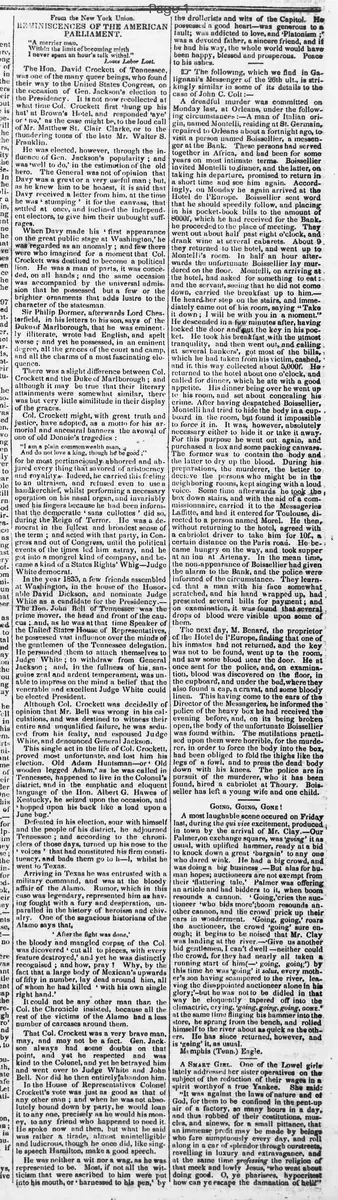
From the New York Union.
REMINISCENCES OF THE AMERICAN
PARLIAMENT.
"A merrier man,
Within the limit of becoming mirth
I never spent an hour's talk withal."
Love's Labor Lost.
The Hon. David Crockett of Tennessee, was one of the many queer beings, who found their way to the United States Congress, on the occasion of Gen. Jackson's election to the Presidency. It is not now recollected at what time Col. Crockett first hung up his hat at Brown's Hotel, and responded 'aye' or 'no,' as the case might be, to the loud call of Mr. Matthew St. Clair Clarke. or to the thundering tones of the late Mr. Walter S. Franklin.
He was elected, however, through the influence of Gen. Jackson's popularity ; and was 'well to do,' in the estimation of the old hero. The General was not of opinion that Davy was a great or a very useful man ; but, as he knew him to be honest, it is said that Davy received a letter from him, at the time he was 'stumping' it for the canvass, that settled at once, and inclined the independent electors, to give him their unbought suffrages.
When Davy made his 'first appearance on the great public stage at Washington,' he was regarded as an anomaly; and few there were who imagined for a moment that Col. Crockett was destined to become a political lion. He was a man of parts, it was conceded, on all hands; and the same occasion was accompanied by the universal admission that he possessed but a few of the brighter ornaments that add lustre to the character of the statesman.
Sir Philip Dormer. afterwards Lord Chesterfield, in his letters to his son, says of the Duke of Marlborough, that he was eminently illiterate, wrote bad English, and spelt worse ; and yet he possessed, in an eminent degree, all the graces of the court and camp, and all the charms of a most fascinating eloquence.
There was a slight difference between Col. Crockett and the Duke of Marlborough; and although it may be true that their literary attainments were somewhat similar, there was but very little similitude in their display of the graces.
Col. Crockett might, with great truth and justice, have adopted, as a motto for his armorial and ancestral banners the avowal of one of old Dennie's tragedies :
"I am a plain commonwealth man,
And do not love a king, though he be good ;"
for he most pertinaciously, abhorred and abjured every thing that savored of aristocracy and royalty Indeed, he carried this feeling to an ultraism, and refused even to use a handkerchief, whilst performing a necessary operation on his nasal organ, and invariably used his fingers because he had been informed that the democratic 'sans culottes ' did so, during the Reign of Terror. He was a democrat in the fullest and broadest sense of the term ; and acted with that party, in Congress and out of Congress, until the political events of the times led him astray, and he got into a mongrel kind of company, and became a kind of a States Rights' Whig—Judge White democrat.
In the year 1835, a few friends assembled at Washington, in the house of the Honorable David Dickson, and nominate Judge White as a candidate for the Presidency.— The Hon. John Bell of Tennessee was the prime mover, the head and front of the caucus ; and, as he was at that time Speaker of the United States House of Representatives, he possessed vast influence over the minds of the gentlemen of the Tennessee delegation. He persuaded them to attach themselves to Judge White; to withdraw from General Jackson; and, in the fullness of his, sanguine zeal and ardent temperament, was unable to impress on the minds a belief that the venerable and excellent Judge White could be elected President.
Although Col. Crockett was decidedly of opinion that Mr. Bell was wrong in his calculations, and was destined to witness their entire and unqualified failure, he was seduced from his fealty, and espoused Judge White, and denounced General Jackson.
This single act in the life of Col. Crockett proved most unfortunate, and lost him his election. Old Adam Huntsman—or 'Old wooden legged Adam,' as he was called in Tennessee. happened to live in the Colonel's district, and in the emphatic and eloquent language of the Hon. Albert G. Hawes of Kentucky, he seized upon the occasion, and hopped upon his back like a load upon a June bug.
Defeated in his election. sour with himself and the people of his district, he adjourned Tennessee ; and according to the chroniclers of those days, turned up his nose to the ' voices ' that had constituted his firm constituency, and bade them go to h—l, whilst he went to Texas.
Arriving in Texas he was entrusted with a military command, and was at the bloody affair of the Alamo. Rumor, which in this case was legendary, represented him as having fought with a fury and desperation, unparalleled in the history of heroism and chivalry. One of the sagacious historians of the Alamo says that,
After the fight was done,
the bloody and mangled corpse of the Col. was discovered ' cut all to pieces, with every feature destroyed,' and yet he was distinctly recognised ; and how, pray ? Why, by the fact that a large body of Mexicans upwards of fifty in number, lay dead around him, all of whom he had killed with his own single right hand.'
It could not be any other man than the Col. the Chronicle insisted, because all the rest of the victims of the Alamo had a less number of carcases around them.
That Col. Crockett was a very brave man, may, and may not be a fact. Gen. Jackson always had some doubts on that point, and yet he respected and was kind to the Colonel, and yet he betrayed him and went over to Judge White and John Bell. Nor did he then entirely abandon him. In the House of Representatives Colonel Crockett's vote was just as good as that of any other man ; and when he was not absolutely bound down by party, he would loan it to any one, precisely as he would his money, to any friend who happened to need it.
He spoke now and then, but what he said was rather a tirade, almost unintelligible and ludicrous, though he once did, like single speech Hamilton, make a good speech.
He was neither a wit nor a wag, as he was represented to be. Most, if not all the witticisms that were ascribed to him were put into his mouth, or ' harnessed to his pen,' by the drollest wits of the Capitol. He possessed a good heart—was generous to fault; was addicted to love, and Platonism; was a devoted father, a sincere friend, and if he had his way, the whole world would have been happy, blessed and prosperous. Peace to his ashes.
REMINISCENCES OF THE AMERICAN
PARLIAMENT.
"A merrier man,
Within the limit of becoming mirth
I never spent an hour's talk withal."
Love's Labor Lost.
The Hon. David Crockett of Tennessee, was one of the many queer beings, who found their way to the United States Congress, on the occasion of Gen. Jackson's election to the Presidency. It is not now recollected at what time Col. Crockett first hung up his hat at Brown's Hotel, and responded 'aye' or 'no,' as the case might be, to the loud call of Mr. Matthew St. Clair Clarke. or to the thundering tones of the late Mr. Walter S. Franklin.
He was elected, however, through the influence of Gen. Jackson's popularity ; and was 'well to do,' in the estimation of the old hero. The General was not of opinion that Davy was a great or a very useful man ; but, as he knew him to be honest, it is said that Davy received a letter from him, at the time he was 'stumping' it for the canvass, that settled at once, and inclined the independent electors, to give him their unbought suffrages.
When Davy made his 'first appearance on the great public stage at Washington,' he was regarded as an anomaly; and few there were who imagined for a moment that Col. Crockett was destined to become a political lion. He was a man of parts, it was conceded, on all hands; and the same occasion was accompanied by the universal admission that he possessed but a few of the brighter ornaments that add lustre to the character of the statesman.
Sir Philip Dormer. afterwards Lord Chesterfield, in his letters to his son, says of the Duke of Marlborough, that he was eminently illiterate, wrote bad English, and spelt worse ; and yet he possessed, in an eminent degree, all the graces of the court and camp, and all the charms of a most fascinating eloquence.
There was a slight difference between Col. Crockett and the Duke of Marlborough; and although it may be true that their literary attainments were somewhat similar, there was but very little similitude in their display of the graces.
Col. Crockett might, with great truth and justice, have adopted, as a motto for his armorial and ancestral banners the avowal of one of old Dennie's tragedies :
"I am a plain commonwealth man,
And do not love a king, though he be good ;"
for he most pertinaciously, abhorred and abjured every thing that savored of aristocracy and royalty Indeed, he carried this feeling to an ultraism, and refused even to use a handkerchief, whilst performing a necessary operation on his nasal organ, and invariably used his fingers because he had been informed that the democratic 'sans culottes ' did so, during the Reign of Terror. He was a democrat in the fullest and broadest sense of the term ; and acted with that party, in Congress and out of Congress, until the political events of the times led him astray, and he got into a mongrel kind of company, and became a kind of a States Rights' Whig—Judge White democrat.
In the year 1835, a few friends assembled at Washington, in the house of the Honorable David Dickson, and nominate Judge White as a candidate for the Presidency.— The Hon. John Bell of Tennessee was the prime mover, the head and front of the caucus ; and, as he was at that time Speaker of the United States House of Representatives, he possessed vast influence over the minds of the gentlemen of the Tennessee delegation. He persuaded them to attach themselves to Judge White; to withdraw from General Jackson; and, in the fullness of his, sanguine zeal and ardent temperament, was unable to impress on the minds a belief that the venerable and excellent Judge White could be elected President.
Although Col. Crockett was decidedly of opinion that Mr. Bell was wrong in his calculations, and was destined to witness their entire and unqualified failure, he was seduced from his fealty, and espoused Judge White, and denounced General Jackson.
This single act in the life of Col. Crockett proved most unfortunate, and lost him his election. Old Adam Huntsman—or 'Old wooden legged Adam,' as he was called in Tennessee. happened to live in the Colonel's district, and in the emphatic and eloquent language of the Hon. Albert G. Hawes of Kentucky, he seized upon the occasion, and hopped upon his back like a load upon a June bug.
Defeated in his election. sour with himself and the people of his district, he adjourned Tennessee ; and according to the chroniclers of those days, turned up his nose to the ' voices ' that had constituted his firm constituency, and bade them go to h—l, whilst he went to Texas.
Arriving in Texas he was entrusted with a military command, and was at the bloody affair of the Alamo. Rumor, which in this case was legendary, represented him as having fought with a fury and desperation, unparalleled in the history of heroism and chivalry. One of the sagacious historians of the Alamo says that,
After the fight was done,
the bloody and mangled corpse of the Col. was discovered ' cut all to pieces, with every feature destroyed,' and yet he was distinctly recognised ; and how, pray ? Why, by the fact that a large body of Mexicans upwards of fifty in number, lay dead around him, all of whom he had killed with his own single right hand.'
It could not be any other man than the Col. the Chronicle insisted, because all the rest of the victims of the Alamo had a less number of carcases around them.
That Col. Crockett was a very brave man, may, and may not be a fact. Gen. Jackson always had some doubts on that point, and yet he respected and was kind to the Colonel, and yet he betrayed him and went over to Judge White and John Bell. Nor did he then entirely abandon him. In the House of Representatives Colonel Crockett's vote was just as good as that of any other man ; and when he was not absolutely bound down by party, he would loan it to any one, precisely as he would his money, to any friend who happened to need it.
He spoke now and then, but what he said was rather a tirade, almost unintelligible and ludicrous, though he once did, like single speech Hamilton, make a good speech.
He was neither a wit nor a wag, as he was represented to be. Most, if not all the witticisms that were ascribed to him were put into his mouth, or ' harnessed to his pen,' by the drollest wits of the Capitol. He possessed a good heart—was generous to fault; was addicted to love, and Platonism; was a devoted father, a sincere friend, and if he had his way, the whole world would have been happy, blessed and prosperous. Peace to his ashes.
What sub-type of article is it?
Biography
Historical Event
What themes does it cover?
Fortune Reversal
Betrayal
Bravery Heroism
What keywords are associated?
David Crockett
Us Congress
Andrew Jackson
Judge White
Alamo Battle
Tennessee Politics
Political Betrayal
What entities or persons were involved?
David Crockett
Gen. Jackson
Judge White
John Bell
Adam Huntsman
Albert G. Hawes
Matthew St. Clair Clarke
Walter S. Franklin
David Dickson
Where did it happen?
Washington, Tennessee, Texas, Alamo
Story Details
Key Persons
David Crockett
Gen. Jackson
Judge White
John Bell
Adam Huntsman
Albert G. Hawes
Matthew St. Clair Clarke
Walter S. Franklin
David Dickson
Location
Washington, Tennessee, Texas, Alamo
Event Date
1835
Story Details
David Crockett enters Congress via Jackson's influence as a honest but unpolished Democrat, shifts allegiance to Judge White in 1835 leading to electoral defeat by Adam Huntsman, then joins Texas forces and dies heroically at the Alamo surrounded by slain Mexicans.