Thank you for visiting SNEWPapers!
Sign up free
Daily National Intelligencer
Washington, District Of Columbia
What is this article about?
In August 1819, Aristides urges the editors to republish a critical piece from the Aurora by Observator accusing the Post Office and Treasury of corruption, favoritism, and delays in accountability, while providing remarks defending the Treasury Secretary and Postmaster General, refuting claims of indulgence and explaining departmental structures.
Clipping
OCR Quality
Full Text
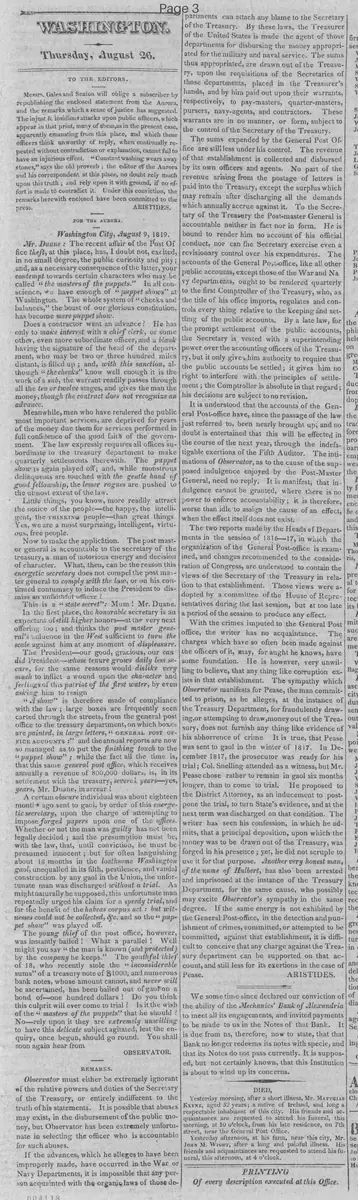
Thursday, August 26.
TO THE EDITORS.
Messrs. Gales and Seaton will oblige a subscriber by republishing the enclosed statement from the Aurora, and the remarks which a sense of justice has suggested. The unjust and insidious attacks upon public officers, which appear in that print, many of them, as in the present case, apparently emanating from this place, and which those officers think unworthy of reply, when continually repeated without contradiction or explanation, cannot fail to have an injurious effect. "Constant washing wears away stones," says the old proverb; the editor of the Aurora and his correspondent at this place, no doubt rely much upon this truth; and rely upon it with ground, if no effort is made to contradict it. Under this conviction, the remarks herewith enclosed have been committed to the press.
ARISTIDES.
FOR THE AURORA.
Washington City, August 9, 1819.
Mr. Duane: The recent affair of the Post Office theft, at this place, has, I doubt not, excited, in no small degree, the public curiosity and pity; and, as a necessary consequence of the latter, your contempt towards certain characters who may be called "the masters of the puppets." In all conscience, we have enough of "puppet shows" at Washington. The whole system of "checks and balances," the boast of our glorious constitution, has become mere puppet show.
Does a contractor want an advance? He has only to make interest with a chief clerk, or some other, even more subordinate officer, and a blank having the signature of the head of the department, who may be two or three hundred miles distant, is filled up; and, with this sanction, although "the checks" know well enough it is the work of a sub, the warrant readily passes through all the ten or twelve stages, and gives the man the money, though the contract does not recognize an advance.
Meanwhile, men who have rendered the public most important services, are deprived for years of the money due them for services performed in full confidence of the good faith of the government. The law expressly requires all offices subordinate to the treasury department to make quarterly settlements therewith. The puppet show is again played off; and, while monstrous delinquents are touched with the gentle hand of good fellowship, the lesser rogues are pushed to the utmost extent of the law.
Little things, you know, more readily attract the notice of the people—the happy, the intelligent, the thinking people—than great things. Yes, we are a most surprising, intelligent, virtuous, free people.
Now to make the application. The post master general is accountable to the secretary of the treasury, a man of notorious energy and decision of character. What, then, can be the reason this energetic secretary does not compel the post master general to comply with the law, or on his continued contumacy to induce the President to dismiss an unfaithful officer?
This is a "state secret": Mum! Mr. Duane.
In the first place, the honorable secretary is an expectant of still higher honors—at the very next offering too; and thinks the post master general's influence in the West sufficient to turn the scale against him at any moment of displeasure.
The President—our good, gracious, our candid President—whose tenure grows daily less secure, for the same reasons would dislike very much to inflict a wound upon the character and feelings of this patriot of the first water, by even asking him to resign.
"A short" is therefore made of compliance with the law; large boxes are frequently seen carted through the streets, from the general post office to the treasury department, on which boxes are painted, in large letters, "GENERAL POST OFFICE ACCOUNTS:" and the annual reports are now so managed as to put the finishing touch to the "puppet show"; while the fact all the time is, that this same general post office, which receives annually a revenue of 800,000 dollars, is, in its settlement with the treasury, several years—yes, years, Mr. Duane, in arrear!
A certain obscure individual was about eighteen months ago sent to gaol, by order of this energetic secretary, upon the charge of attempting to impose forged papers upon one of the offices. Whether or not the man was guilty has not been legally decided; and the presumption must be, with the law, that, until conviction, he must be presumed innocent; but for often languishing about 18 months in the loathsome Washington gaol, unequalled in its filth, pestilence, and vandal construction by any gaol in the Union, the unfortunate man was discharged without a trial. As might naturally be supposed, this unfortunate man repeatedly urged his claim for a speedy trial, and for the benefit of the habeas corpus act: but witnesses could not be collected, &c. and so the "puppet show" was played off.
The young thief of the post office, however, was instantly bailed! What a parallel! Well might you say "the man is known (and protected) by the company he keeps." The youthful thief of 18, who recently stole the "inconsiderable sums" of a treasury note of $1000, and numerous bank notes, whose amount cannot, and never will be ascertained, has been bailed out of gaol on a bond of one hundred dollars! Do you think this culprit will ever come to trial? Is it the wish of the "masters of the puppets" that he should?
No—rely upon it they are extremely unwilling to have this delicate subject agitated, lest the enquiry, once begun, should go round. You shall soon again hear from
OBSERVATOR.
REMARKS.
Observator must either be extremely ignorant of the relative powers and duties of the Secretary of the Treasury, or entirely indifferent to the truth of his statements. It is possible that abuses may exist, in the disbursement of the public money, but Observator has been extremely unfortunate in selecting the officer who is accountable for such abuses.
If the advances, which he alleges to have been improperly made, have occurred in the War or Navy Departments, it is impossible that any person acquainted with the organic laws of those departments can attach any blame to the Secretary of the Treasury. By these laws, the Treasurer of the United States is made the agent of those departments for disbursing the money appropriated for the military and naval service. The sums thus appropriated, are drawn out of the Treasury, upon the requisitions of the Secretaries of those departments, placed in the Treasurer's hands, and by him paid out upon their warrants, respectively, to pay-masters, quarter-masters, pursers, navy-agents, and contractors. These warrants are in no manner, or form, subject to the control of the Secretary of the Treasury.
The sums expended by the General Post Office are still less under his control. The revenue of that establishment is collected and disbursed by its own officers and agents. No part of the revenue arising from the postage of letters is paid into the Treasury, except the surplus which may remain after discharging all the demands which annually accrue against it. To the Secretary of the Treasury the Post-master General is accountable neither in fact nor in form. He is bound to render him no account of his official conduct, nor can the Secretary exercise even a revisionary control over his expenditures. The accounts of the General Post-office, like all other public accounts, except those of the War and Navy departments, ought to be rendered quarterly to the first Comptroller of the Treasury, who, as the title of his office imports, regulates and controls every thing relative to the keeping and settling of the public accounts. By a late law, for the prompt settlement of the public accounts, the Secretary is vested with a superintending power over the accounting officers of the Treasury, but it only gives him authority to require that the public accounts be settled; it gives him no right to interfere with the principles of settlement; the Comptroller is absolute in that regard; his decisions are subject to no revision.
It is understood that the accounts of the General Post-office have, since the passage of the law just referred to, been nearly brought up; and no doubt is entertained that this will be effected in the course of the next year, through the indefatigable exertions of the Fifth Auditor. The intimations of Observator, as to the cause of the supposed indulgence enjoyed by the Post-Master General, need no reply. It is manifest, that indulgence cannot be granted, where there is no power to enforce accountability; it is therefore worse than idle to assign the cause of an effect, when the effect itself does not exist.
The two reports made by the Heads of Departments in the session of 1816--17, in which the organization of the General Post-office is examined, and changes recommended to the consideration of Congress, are understood to contain the views of the Secretary of the Treasury in relation to that establishment. Those views were adopted by a committee of the House of Representatives during the last session, but at too late a period of the session to produce any effect.
With the crimes imputed to the General Post office, the writer has no acquaintance. The charges which have so often been made against the officers of it, may, for aught he knows, have some foundation. He is however, very unwilling to believe, that any thing like corruption exists in that establishment. The sympathy which Observator manifests for Pease, the man committed to prison, as he alleges, at the instance of the Treasury Department, for fraudulently drawing, or attempting to draw, money out of the Treasury, does not furnish any thing like evidence of his abhorrence of crime. It is true, that Pease was sent to gaol in the winter of 1817. In December 1817, the prosecutor was ready for his trial; Col. Snelling attended as a witness, but Mr. Pease chose rather to remain in gaol six months longer, than to come to trial. He proposed to the District Attorney, as an inducement to postpone the trial, to turn State's evidence, and at the next term was discharged on that condition. The writer has seen his confession, in which he admits, that a principal deposition, upon which the money was to be drawn out of the Treasury, was forged in his presence; yet, he did not scruple to use it for that purpose. Another very honest man, of the name of Hulbert, has also been arrested and imprisoned at the instance of the Treasury Department, for the same cause, who possibly may excite Observator's sympathy in the same degree. If the same energy is not exhibited by the General Post-office, in the detection and punishment of crimes, committed, or attempted to be committed, against that establishment, it is difficult to conceive that any charge against the Treasury department can be supported on that account, and still less for its exertions in the case of Pease.
ARISTIDES.
What sub-type of article is it?
What themes does it cover?
What keywords are associated?
What entities or persons were involved?
Letter to Editor Details
Author
Aristides
Recipient
Messrs. Gales And Seaton
Main Argument
republish the aurora's critical piece on post office and treasury abuses and provide remarks refuting observator's claims of corruption, favoritism, and lack of accountability, explaining that the treasury secretary has no direct control over post office finances or certain departmental disbursements.
Notable Details