Thank you for visiting SNEWPapers!
Sign up free
Story
September 22, 1869
Smyrna Times
Smyrna, Kent County, Delaware
What is this article about?
Satirical critique of American parents marrying daughters to titled but broke Europeans, exemplified by Paris court forcing father-in-law to pay lifelong support to widower son-in-law after wife's death.
Clipping
OCR Quality
98%
Excellent
Full Text
KEEPING A SON-IN-LAW.
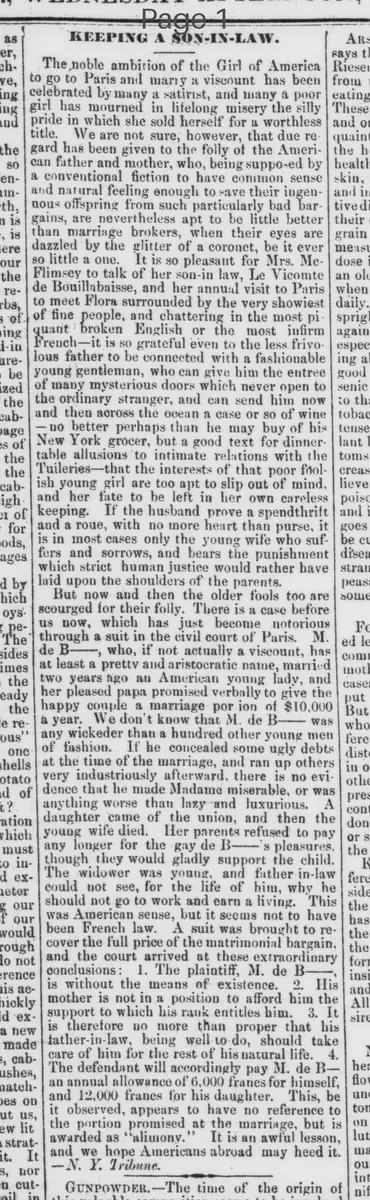
The noble ambition of the Girl of America to go to Paris and marry a viscount has been celebrated by many a satirist, and many a poor girl has mourned in lifelong misery the silly pride in which she sold herself for a worthless title. We are not sure, however, that due regard has been given to the folly of the American father and mother, who, being supposed by a conventional fiction to have common sense and natural feeling enough to save their ingenuous offspring from such particularly bad bargains, are nevertheless apt to be little better than marriage brokers, when their eyes are dazzled by the glitter of a coronet, be it ever so little a one. It is so pleasant for Mrs. McFlimsey to talk of her son-in-law, Le Vicomte de Bouillabaisse, and her annual visit to Paris to meet Flora surrounded by the very showiest of fine people, and chattering in the most picturesque broken English or the most infirm French—it is so grateful even to the less frivolous father to be connected with a fashionable young gentleman, who can give him the entree of many mysterious doors which never open to the ordinary stranger, and can send him now and then across the ocean a case or so of wine—no better perhaps than he may buy of his New York grocer, but a good text for dinner-table allusions to intimate relations with the Tuileries—that the interests of that poor foolish young girl are too apt to slip out of mind, and her fate to be left in her own careless keeping. If the husband prove a spendthrift and a roue, with no more heart than purse, it is in most cases only the young wife who suffers and sorrows, and bears the punishment which strict human justice would rather have laid upon the shoulders of the parents.
But now and then the older fools too are scourged for their folly. There is a case before us now, which has just become notorious through a suit in the civil court of Paris. M. de B—, who, if not actually a viscount, has at least a pretty and aristocratic name, married two years ago an American young lady, and her pleased papa promised verbally to give the happy couple a marriage portion of $10,000 a year. We don't know that M. de B— was any wickeder than a hundred other young men of fashion. If he concealed some ugly debts at the time of the marriage, and ran up others very industriously afterward, there is no evidence that he made Madame miserable, or was anything worse than lazy and luxurious. A daughter came of the union, and then the young wife died. Her parents refused to pay any longer for the gay de B—'s pleasures, though they would gladly support the child. The widower was young, and father-in-law could not see, for the life of him, why he should not go to work and earn a living. This was American sense, but it seems not to have been French law. A suit was brought to recover the full price of the matrimonial bargain, and the court arrived at these extraordinary conclusions: 1. The plaintiff, M. de B—, is without the means of existence. 2. His mother is not in a position to afford him the support to which his rank entitles him. 3. It is therefore no more than proper that his father-in-law, being well to do, should take care of him for the rest of his natural life. 4. The defendant will accordingly pay M. de B— an annual allowance of 6,000 francs for himself, and 12,000 francs for his daughter. This, be it observed, appears to have no reference to the portion promised at the marriage, but is awarded as 'alimony.' It is an awful lesson, and we hope Americans abroad may heed it.
—N. Y. Tribune.
The noble ambition of the Girl of America to go to Paris and marry a viscount has been celebrated by many a satirist, and many a poor girl has mourned in lifelong misery the silly pride in which she sold herself for a worthless title. We are not sure, however, that due regard has been given to the folly of the American father and mother, who, being supposed by a conventional fiction to have common sense and natural feeling enough to save their ingenuous offspring from such particularly bad bargains, are nevertheless apt to be little better than marriage brokers, when their eyes are dazzled by the glitter of a coronet, be it ever so little a one. It is so pleasant for Mrs. McFlimsey to talk of her son-in-law, Le Vicomte de Bouillabaisse, and her annual visit to Paris to meet Flora surrounded by the very showiest of fine people, and chattering in the most picturesque broken English or the most infirm French—it is so grateful even to the less frivolous father to be connected with a fashionable young gentleman, who can give him the entree of many mysterious doors which never open to the ordinary stranger, and can send him now and then across the ocean a case or so of wine—no better perhaps than he may buy of his New York grocer, but a good text for dinner-table allusions to intimate relations with the Tuileries—that the interests of that poor foolish young girl are too apt to slip out of mind, and her fate to be left in her own careless keeping. If the husband prove a spendthrift and a roue, with no more heart than purse, it is in most cases only the young wife who suffers and sorrows, and bears the punishment which strict human justice would rather have laid upon the shoulders of the parents.
But now and then the older fools too are scourged for their folly. There is a case before us now, which has just become notorious through a suit in the civil court of Paris. M. de B—, who, if not actually a viscount, has at least a pretty and aristocratic name, married two years ago an American young lady, and her pleased papa promised verbally to give the happy couple a marriage portion of $10,000 a year. We don't know that M. de B— was any wickeder than a hundred other young men of fashion. If he concealed some ugly debts at the time of the marriage, and ran up others very industriously afterward, there is no evidence that he made Madame miserable, or was anything worse than lazy and luxurious. A daughter came of the union, and then the young wife died. Her parents refused to pay any longer for the gay de B—'s pleasures, though they would gladly support the child. The widower was young, and father-in-law could not see, for the life of him, why he should not go to work and earn a living. This was American sense, but it seems not to have been French law. A suit was brought to recover the full price of the matrimonial bargain, and the court arrived at these extraordinary conclusions: 1. The plaintiff, M. de B—, is without the means of existence. 2. His mother is not in a position to afford him the support to which his rank entitles him. 3. It is therefore no more than proper that his father-in-law, being well to do, should take care of him for the rest of his natural life. 4. The defendant will accordingly pay M. de B— an annual allowance of 6,000 francs for himself, and 12,000 francs for his daughter. This, be it observed, appears to have no reference to the portion promised at the marriage, but is awarded as 'alimony.' It is an awful lesson, and we hope Americans abroad may heed it.
—N. Y. Tribune.
What sub-type of article is it?
Family Drama
Deception Fraud
What themes does it cover?
Social Manners
Deception
Moral Virtue
What keywords are associated?
American Marriage
European Nobility
Paris Court
Son In Law Alimony
Family Folly
What entities or persons were involved?
M. De B—
American Young Lady
Her Papa
Where did it happen?
Paris
Story Details
Key Persons
M. De B—
American Young Lady
Her Papa
Location
Paris
Event Date
Two Years Ago
Story Details
American parents encourage daughter's marriage to impoverished French nobleman M. de B— for social status, promising $10,000 annual portion. After wife's death, parents refuse further payments; court awards widower lifelong alimony of 6,000 francs plus 12,000 for daughter, punishing parents' folly.