Thank you for visiting SNEWPapers!
Sign up free
Editorial
September 18, 1900
The Hawaiian Gazette
Honolulu, Honolulu County, Hawaii
What is this article about?
This editorial warns of the economic peril in Hawaii from a potential anti-haole (anti-white) government under the Wilcox party, which could deter investments and development despite President McKinley's re-election. It stresses the need for stable local governance and low taxes to attract capital, comparing to Southern states' post-Reconstruction stagnation.
Clipping
OCR Quality
85%
Good
Full Text
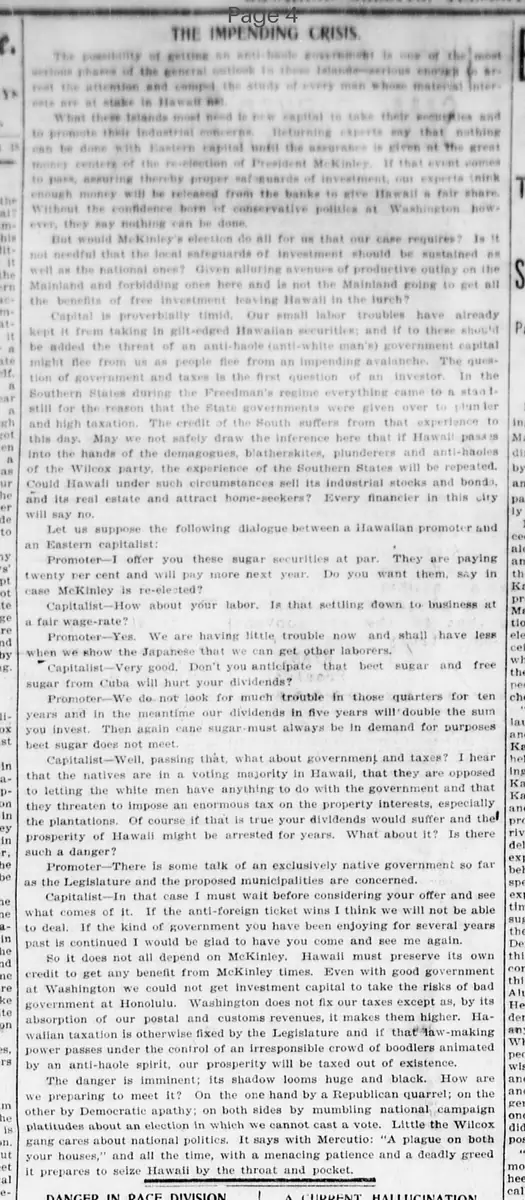
THE IMPENDING CRISIS.
The position of getting an anti-haole government out of the slough of the shame of the federal election in the Islands is quite serious enough to compel the attention and study of every man whose material interests are at stake in Hawaii now.
What the Islanders most need now is capital to take their properties and to promote their industrial development. Returning experts say that nothing can be done until the reassurance given in the event of the re-election of President McKinley. If that event comes to pass there will be proper safeguards for investment; our experts think enough money will be released from the banks to give us all a fair share.
Without the confidence born of conservative politics at Washington however, they say nothing can be done.
Would McKinley's election do all for us that our case requires? Is it not needful that the local safeguards of investment should be sustained as well as the national ones? Given alluring avenues of productive outlay on the Mainland and forbidding ones here and is not the Mainland going to get all the benefits of free investment leaving Hawaii in the lurch?
Capital is proverbially timid. Our small labor troubles have already kept it from taking in gilt-edged Hawaiian securities: and if to these should be added the threat of an anti-haole (anti-white man's) government capital might flee from us as people flee from an impending avalanche. The question of government and taxes is the first question of an investor. In the Southern States during the Freedman's regime everything came to a standstill for the reason that the State governments were given over to plunder and high taxation. The credit of the South suffers from that experience to this day. May we not safely draw the inference here that if Hawaii passes into the hands of the demagogues, blatherskites, plunderers and anti-haoles of the Wilcox party, the experience of the Southern States will be repeated.
Could Hawaii under such circumstances sell its industrial stocks and bonds, and its real estate and attract home-seekers? Every financier in this city will say no.
Let us suppose the following dialogue between a Hawaiian promoter and an Eastern capitalist:
Promoter—I offer you these sugar securities at par. They are paying twenty per cent and will pay more next year. Do you want them, say in case McKinley is re-elected?
Capitalist—How about your labor. Is that settling down to business at a fair wage-rate?
Promoter—Yes. We are having little trouble now and shall have less when we show the Japanese that we can get other laborers.
Capitalist—Very good. Don't you anticipate that beet sugar and free sugar from Cuba will hurt your dividends?
Promoter—We do not look for much trouble in those quarters for ten years and in the meantime our dividends in five years will double the sum you invest. Then again cane sugar must always be in demand for purposes beet sugar does not meet.
Capitalist—Well, passing that, what about government and taxes? I hear that the natives are in a voting majority in Hawaii, that they are opposed to letting the white men have anything to do with the government and that they threaten to impose an enormous tax on the property interests, especially the plantations. Of course if that is true your dividends would suffer and the prosperity of Hawaii might be arrested for years. What about it? Is there such a danger?
Promoter—There is some talk of an exclusively native government so far as the Legislature and the proposed municipalities are concerned.
Capitalist—In that case I must wait before considering your offer and see what comes of it. If the anti-foreign ticket wins I think we will not be able to deal. If the kind of government you have been enjoying for several years past is continued I would be glad to have you come and see me again.
So it does not all depend on McKinley. Hawaii must preserve its own credit to get any benefit from McKinley times. Even with good government at Washington we could not get investment capital to take the risks of bad government at Honolulu. Washington does not fix our taxes except as, by its absorption of our postal and customs revenues, it makes them higher. Hawaiian taxation is otherwise fixed by the Legislature and if that law-making power passes under the control of an irresponsible crowd of boodlers animated by an anti-haole spirit, our prosperity will be taxed out of existence.
The danger is imminent; its shadow looms huge and black. How are we preparing to meet it? On the one hand by a Republican quarrel; on the other by Democratic apathy; on both sides by mumbling national campaign platitudes about an election in which we cannot cast a vote. Little the Wilcox gang cares about national politics. It says with Mercutio: "A plague on both your houses," and all the time, with a menacing patience and a deadly greed it prepares to seize Hawaii by the throat and pocket.
The position of getting an anti-haole government out of the slough of the shame of the federal election in the Islands is quite serious enough to compel the attention and study of every man whose material interests are at stake in Hawaii now.
What the Islanders most need now is capital to take their properties and to promote their industrial development. Returning experts say that nothing can be done until the reassurance given in the event of the re-election of President McKinley. If that event comes to pass there will be proper safeguards for investment; our experts think enough money will be released from the banks to give us all a fair share.
Without the confidence born of conservative politics at Washington however, they say nothing can be done.
Would McKinley's election do all for us that our case requires? Is it not needful that the local safeguards of investment should be sustained as well as the national ones? Given alluring avenues of productive outlay on the Mainland and forbidding ones here and is not the Mainland going to get all the benefits of free investment leaving Hawaii in the lurch?
Capital is proverbially timid. Our small labor troubles have already kept it from taking in gilt-edged Hawaiian securities: and if to these should be added the threat of an anti-haole (anti-white man's) government capital might flee from us as people flee from an impending avalanche. The question of government and taxes is the first question of an investor. In the Southern States during the Freedman's regime everything came to a standstill for the reason that the State governments were given over to plunder and high taxation. The credit of the South suffers from that experience to this day. May we not safely draw the inference here that if Hawaii passes into the hands of the demagogues, blatherskites, plunderers and anti-haoles of the Wilcox party, the experience of the Southern States will be repeated.
Could Hawaii under such circumstances sell its industrial stocks and bonds, and its real estate and attract home-seekers? Every financier in this city will say no.
Let us suppose the following dialogue between a Hawaiian promoter and an Eastern capitalist:
Promoter—I offer you these sugar securities at par. They are paying twenty per cent and will pay more next year. Do you want them, say in case McKinley is re-elected?
Capitalist—How about your labor. Is that settling down to business at a fair wage-rate?
Promoter—Yes. We are having little trouble now and shall have less when we show the Japanese that we can get other laborers.
Capitalist—Very good. Don't you anticipate that beet sugar and free sugar from Cuba will hurt your dividends?
Promoter—We do not look for much trouble in those quarters for ten years and in the meantime our dividends in five years will double the sum you invest. Then again cane sugar must always be in demand for purposes beet sugar does not meet.
Capitalist—Well, passing that, what about government and taxes? I hear that the natives are in a voting majority in Hawaii, that they are opposed to letting the white men have anything to do with the government and that they threaten to impose an enormous tax on the property interests, especially the plantations. Of course if that is true your dividends would suffer and the prosperity of Hawaii might be arrested for years. What about it? Is there such a danger?
Promoter—There is some talk of an exclusively native government so far as the Legislature and the proposed municipalities are concerned.
Capitalist—In that case I must wait before considering your offer and see what comes of it. If the anti-foreign ticket wins I think we will not be able to deal. If the kind of government you have been enjoying for several years past is continued I would be glad to have you come and see me again.
So it does not all depend on McKinley. Hawaii must preserve its own credit to get any benefit from McKinley times. Even with good government at Washington we could not get investment capital to take the risks of bad government at Honolulu. Washington does not fix our taxes except as, by its absorption of our postal and customs revenues, it makes them higher. Hawaiian taxation is otherwise fixed by the Legislature and if that law-making power passes under the control of an irresponsible crowd of boodlers animated by an anti-haole spirit, our prosperity will be taxed out of existence.
The danger is imminent; its shadow looms huge and black. How are we preparing to meet it? On the one hand by a Republican quarrel; on the other by Democratic apathy; on both sides by mumbling national campaign platitudes about an election in which we cannot cast a vote. Little the Wilcox gang cares about national politics. It says with Mercutio: "A plague on both your houses," and all the time, with a menacing patience and a deadly greed it prepares to seize Hawaii by the throat and pocket.
What sub-type of article is it?
Partisan Politics
Economic Policy
Taxation
What keywords are associated?
Hawaii Politics
Anti Haole Government
Investment Capital
Mckinley Election
Wilcox Party
Taxation Risks
Economic Development
What entities or persons were involved?
President Mckinley
Wilcox Party
Anti Haoles
Republicans
Democrats
Hawaiian Natives
Editorial Details
Primary Topic
Risks Of Anti Haole Government Deterring Investment In Hawaii
Stance / Tone
Alarmist Warning Against Wilcox Party And Anti Haole Politics
Key Figures
President Mckinley
Wilcox Party
Anti Haoles
Republicans
Democrats
Hawaiian Natives
Key Arguments
Anti Haole Government Would Deter Capital Investment Despite Mckinley's Re Election
Stable Local Government And Low Taxes Are Essential For Economic Development
Parallels To Southern States' Stagnation Under Corrupt Regimes
Investor Concerns Include Labor, Competition, But Primarily Government And Taxes
Wilcox Party's Rise Threatens Prosperity Through High Taxation And Plunder
National Politics Alone Insufficient; Local Credit Must Be Preserved