Thank you for visiting SNEWPapers!
Sign up free
Story
October 26, 1930
Douglas Daily Dispatch
Douglas, Cochise County, Arizona
What is this article about?
In various U.S. states, party lines are tangled ahead of November elections due to prohibition stances and other issues, causing Republicans and Democrats to support opponents, with examples from Pennsylvania to Massachusetts involving key candidates like Pinchot and Hemphill.
Clipping
OCR Quality
98%
Excellent
Full Text
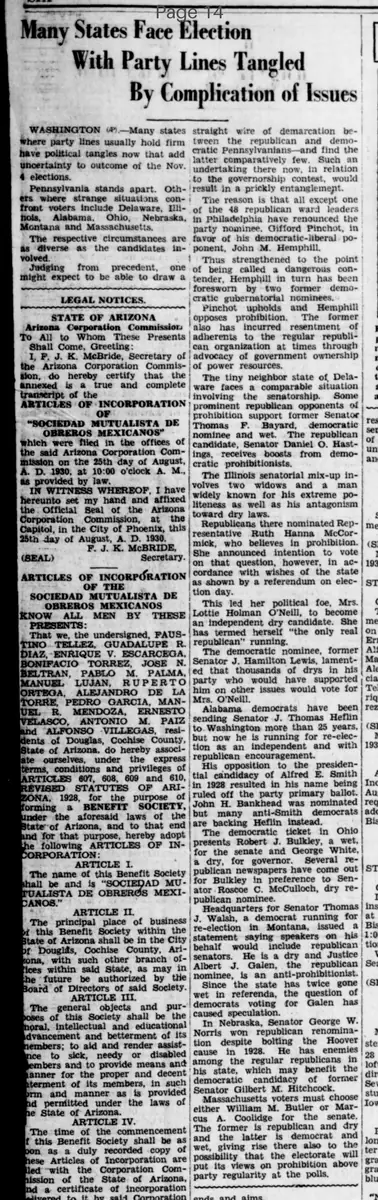
Many States Face Election
With Party Lines Tangled
By Complication of Issues
WASHINGTON.—Many states where party lines usually hold firm have political tangles now that add uncertainty to outcome of the Nov. elections.
Pennsylvania stands apart. Others where strange situations confront voters include Delaware, Illinois, Alabama, Ohio, Nebraska, Montana and Massachusetts.
The respective circumstances are as diverse as the candidates involved.
Judging from precedent, one might expect to be able to draw a straight wire of demarcation between the republican and democratic Pennsylvanians and find the latter comparatively few. Such an undertaking there now, in relation to the governorship contest, would result in a prickly entanglement.
The reason is that all except one of the 48 republican ward leaders in Philadelphia have renounced the party nominee, Gifford Pinchot, in favor of his democratic-liberal opponent, John M. Hemphill.
Thus strengthened to the point of being called a dangerous contender, Hemphill in turn has been foresworn by two former democratic gubernatorial nominees.
Pinchot upholds and Hemphill opposes prohibition.
The former also has incurred resentment of adherents to the regular republican organization at times through advocacy of government ownership of power resources.
The tiny neighbor state of Delaware faces a comparable situation involving the senatorship. Some prominent republican opponents of prohibition support former Senator Thomas F. Bayard, democratic nominee and wet. The republican candidate, Senator Daniel O. Hastings, receives boosts from democratic prohibitionists.
The Illinois senatorial mix-up involves two widows and a man widely known for his extreme politeness as well as his antagonism toward dry laws.
Republicans there nominated Representative Ruth Hanna McCormick, who believes in prohibition.
She announced intention to vote on that question, however, in accordance with wishes of the state as shown by a referendum on election day.
This led her political foe, Mrs. Lottie Holman O'Neill, to become an independent dry candidate. She has termed herself "the only real republican" running.
The democratic nominee, former Senator J. Hamilton Lewis, lamented that thousands of drys in his party who would have supported him on other issues would vote for Mrs. O'Neill.
Alabama democrats have been sending Senator J. Thomas Heflin to Washington more than 25 years, but now he is running for re-election as an independent and with republican encouragement.
His opposition to the presidential candidacy of Alfred E. Smith in 1928 resulted in his name being ruled off the party primary ballot.
John H. Bankhead was nominated but many anti-Smith democrats are backing Heflin instead.
The democratic ticket in Ohio presents Robert J. Bulkley, a wet, for the senate and George White, a dry, for governor. Several republican newspapers have come out for Bulkley in preference to Senator Roscoe C. McCulloch, dry republican nominee.
Headquarters for Senator Thomas J. Walsh, a democrat running for re-election in Montana, issued a statement saying speakers on his behalf would include republican senators. He is a dry and Justice Albert J. Galen, the republican nominee, is an anti-prohibitionist.
Since the state has twice gone wet in referenda, the question of democrats voting for Galen has caused speculation.
In Nebraska, Senator George W. Norris won republican renomination despite bolting the Hoover cause in 1928. He has enemies among the regular republicans in his state, which may benefit the democratic candidacy of former Senator Gilbert M. Hitchcock.
Massachusetts voters must choose either William M. Butler or Marcus A. Coolidge for the senate.
The former is republican and dry and the latter is democrat and wet, giving rise there also to the possibility that the electorate will put its views on prohibition above party regularity at the polls.
With Party Lines Tangled
By Complication of Issues
WASHINGTON.—Many states where party lines usually hold firm have political tangles now that add uncertainty to outcome of the Nov. elections.
Pennsylvania stands apart. Others where strange situations confront voters include Delaware, Illinois, Alabama, Ohio, Nebraska, Montana and Massachusetts.
The respective circumstances are as diverse as the candidates involved.
Judging from precedent, one might expect to be able to draw a straight wire of demarcation between the republican and democratic Pennsylvanians and find the latter comparatively few. Such an undertaking there now, in relation to the governorship contest, would result in a prickly entanglement.
The reason is that all except one of the 48 republican ward leaders in Philadelphia have renounced the party nominee, Gifford Pinchot, in favor of his democratic-liberal opponent, John M. Hemphill.
Thus strengthened to the point of being called a dangerous contender, Hemphill in turn has been foresworn by two former democratic gubernatorial nominees.
Pinchot upholds and Hemphill opposes prohibition.
The former also has incurred resentment of adherents to the regular republican organization at times through advocacy of government ownership of power resources.
The tiny neighbor state of Delaware faces a comparable situation involving the senatorship. Some prominent republican opponents of prohibition support former Senator Thomas F. Bayard, democratic nominee and wet. The republican candidate, Senator Daniel O. Hastings, receives boosts from democratic prohibitionists.
The Illinois senatorial mix-up involves two widows and a man widely known for his extreme politeness as well as his antagonism toward dry laws.
Republicans there nominated Representative Ruth Hanna McCormick, who believes in prohibition.
She announced intention to vote on that question, however, in accordance with wishes of the state as shown by a referendum on election day.
This led her political foe, Mrs. Lottie Holman O'Neill, to become an independent dry candidate. She has termed herself "the only real republican" running.
The democratic nominee, former Senator J. Hamilton Lewis, lamented that thousands of drys in his party who would have supported him on other issues would vote for Mrs. O'Neill.
Alabama democrats have been sending Senator J. Thomas Heflin to Washington more than 25 years, but now he is running for re-election as an independent and with republican encouragement.
His opposition to the presidential candidacy of Alfred E. Smith in 1928 resulted in his name being ruled off the party primary ballot.
John H. Bankhead was nominated but many anti-Smith democrats are backing Heflin instead.
The democratic ticket in Ohio presents Robert J. Bulkley, a wet, for the senate and George White, a dry, for governor. Several republican newspapers have come out for Bulkley in preference to Senator Roscoe C. McCulloch, dry republican nominee.
Headquarters for Senator Thomas J. Walsh, a democrat running for re-election in Montana, issued a statement saying speakers on his behalf would include republican senators. He is a dry and Justice Albert J. Galen, the republican nominee, is an anti-prohibitionist.
Since the state has twice gone wet in referenda, the question of democrats voting for Galen has caused speculation.
In Nebraska, Senator George W. Norris won republican renomination despite bolting the Hoover cause in 1928. He has enemies among the regular republicans in his state, which may benefit the democratic candidacy of former Senator Gilbert M. Hitchcock.
Massachusetts voters must choose either William M. Butler or Marcus A. Coolidge for the senate.
The former is republican and dry and the latter is democrat and wet, giving rise there also to the possibility that the electorate will put its views on prohibition above party regularity at the polls.
What sub-type of article is it?
Historical Event
What themes does it cover?
Social Manners
Betrayal
What keywords are associated?
Election Tangles
Party Lines
Prohibition
Cross Party Support
Senatorial Races
Gubernatorial Contest
What entities or persons were involved?
Gifford Pinchot
John M. Hemphill
Thomas F. Bayard
Daniel O. Hastings
Ruth Hanna Mccormick
Lottie Holman O'neill
J. Hamilton Lewis
J. Thomas Heflin
John H. Bankhead
Robert J. Bulkley
George White
Roscoe C. Mcculloch
Thomas J. Walsh
Albert J. Galen
George W. Norris
Gilbert M. Hitchcock
William M. Butler
Marcus A. Coolidge
Where did it happen?
Pennsylvania, Delaware, Illinois, Alabama, Ohio, Montana, Nebraska, Massachusetts
Story Details
Key Persons
Gifford Pinchot
John M. Hemphill
Thomas F. Bayard
Daniel O. Hastings
Ruth Hanna Mccormick
Lottie Holman O'neill
J. Hamilton Lewis
J. Thomas Heflin
John H. Bankhead
Robert J. Bulkley
George White
Roscoe C. Mcculloch
Thomas J. Walsh
Albert J. Galen
George W. Norris
Gilbert M. Hitchcock
William M. Butler
Marcus A. Coolidge
Location
Pennsylvania, Delaware, Illinois, Alabama, Ohio, Montana, Nebraska, Massachusetts
Event Date
Nov. Elections
Story Details
Article details political tangles in several states where party lines are blurred due to prohibition and other issues, leading to cross-party support and independent candidacies in gubernatorial and senatorial races.