Thank you for visiting SNEWPapers!
Sign up free
Literary
July 29, 1834
Alexandria Gazette
Alexandria, Alexandria County, District Of Columbia
What is this article about?
First-person account of a British schooner 'Fire Fly' encountering the pirate 'Freya the Fearless,' the Black Buccaneer of Barbados, in the West Indies in 1810. After a fierce nighttime battle, the pirate brig sinks with all hands.
Clipping
OCR Quality
98%
Excellent
Full Text
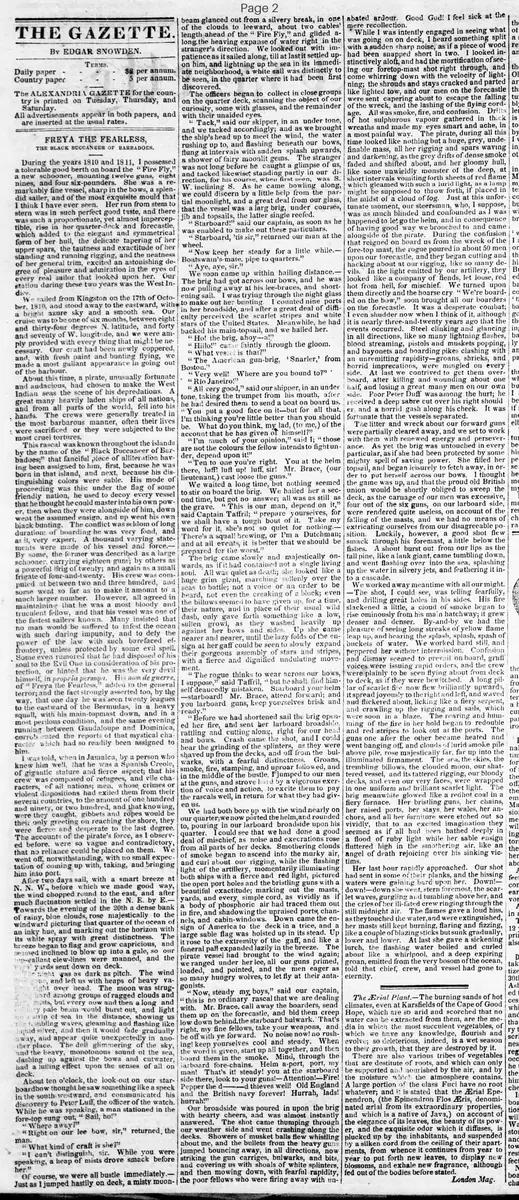
FREYA THE FEARLESS.
THE BLACK BUCCANEER OF BARBADOES.
During the years 1810 and 1811, I possessed a tolerable good berth on board the "Fire Fly," a new schooner, mounting twelve guns, eight nines, and four six-pounders. She was a remarkably fine vessel, sharp in the bows, a splendid sailer, and of the most exquisite mould that I think I have ever seen. Her run from stem to stern was in such perfect good taste, and there was such a proportionate, yet almost imperceptible, rise in her quarter-deck and forecastle, which added to the elegant and symmetrical form of her hull, the delicate tapering of her upper spars, the tautness and exactitude of her standing and running rigging, and the neatness of her general trim, excited an astonishing degree of pleasure and admiration in the eyes of every real sailor that looked upon her. Our station during these two years was the West Indies.
We sailed from Kingston on the 17th of October, 1810, and stood away to the eastward, with a bright azure sky and a smooth sea. Our cruise was to be one of six months, between eight and thirty-four degrees N. latitude, and forty and seventy of W. longitude, and we were amply provided with every thing that might be necessary. Our craft had been newly coppered, and, with fresh paint and bunting flying, we made a most gallant appearance in going out of the harbour.
About this time, a pirate, unusually fortunate and audacious, had chosen to make the West Indian seas the scene of his depredations. A great many heavily laden ships of all nations, and from all parts of the world, fell into his hands. The crews were generally treated in the most barbarous manner, often their lives were sacrificed or they were subjected to the most cruel tortures.
This rascal was known throughout the islands by the name of the "Black Buccaneer of Barbadoes;" that fanciful piece of alliteration having been assigned to him, first, because he was born in that island, and next, because his distinguishing colors were sable. His mode of proceeding was this: under the flag of some friendly nation, he used to decoy every vessel that he thought he could master into his own power, then when they were alongside of him, down went the assumed ensign, and up went his own black bunting. The conflict was seldom of long duration: of boarding he was very fond, and at it, very expert. A thousand varying statements were made of his vessel and force. By some, the former was described as a large schooner, carrying eighteen guns; by others as a powerful brig of twenty; and again as a small frigate of four-and-twenty. His crew was computed at between two and three hundred, and some went so far as to make it amount to a much larger number. However, all agreed in maintaining that he was a most bloody and truculent fellow, and that his vessel was one of the fastest sailers known. Many insisted that no man would be suffered to infest the ocean with such daring impunity, and to defy the power of the law with such barefaced effrontery, unless protected by some evil spell. Some even rumored that he had disposed of his soul to the Evil One in consideration of his protection, or hinted that he was the very devil himself, in propria persona. His nom de guerre of "Freya the Fearless," added to the general terror; and the fact strongly asserted too, by the way, that one day he was seen twenty leagues to the eastward of the Bermudas, in a heavy squall, with his main-topmast down, and in a most perilous condition, and the same evening running between Guadeloupe and Dominica, corroborated the reports of that mystical character which had so readily been assigned to him.
I was told, when in Jamaica, by a person who knew him well, that he was a Spanish Creole, of gigantic stature and fierce aspect; that his crew was composed of refugees, and vile characters, of all nations; men, whose crimes or violent dispositions had exiled them from their several countries, to the amount of one hundred and ninety, or two hundred, and that knowing, were they caught, gibbets and ropes would be their only greeting on reaching the shore, they were fierce and desperate to the last degree. The accounts of the pirate's force, as I observed before, were so vague and contradictory, that no reliance could be placed on them. We went off, notwithstanding, with no small expectation of coming up with, taking, and bringing him into port.
After two days sail, with a smart breeze at N. N. W., before which we made good way, the wind chopped round to the east, and after much fluctuation settled in the N. E. by E. Towards the evening of the 20th a dense bank of rainy, blue clouds, rose majestically to the windward picturing that quarter of the ocean of its white spray with great distinctness. The breeze began to flag and grow capricious, and seemed inclined to blow up into a gale, so our top-gallant clew-lines were manned, and the yards sent down on deck.
Night was as dark as pitch. The wind gone, and left us with heaps of heavy vapour over head. The moon was struggling hard among groups of ragged clouds and mists, but every now and then a long and pale beam would burst out, and light up a strip of sea in the distance, showing us the trembling waves, gleaming and flashing like quick silver, and then it would fade gradually away, and appear quite unexpectedly in another place. The dull glimmering of the sky, and the heavy, monotonous sound of the sea, dashing up against the bows and cutwater, had a lulling effect upon the senses of all on deck.
About ten o'clock, the look-out on our starboard bow thought he saw something like a speck in the south-westward, and communicated his discovery to Peter Luff, the officer of the watch. While he was speaking, a man stationed in the fore-top sung out, "Sail, ho!"
"Right on our lee bow, sir," returned the man.
"Where away?"
"What kind of craft is she?"
"I can't distinguish, sir. While you were speaking, a heap of mists drove smack before her."
Of course, we were all bustle immediately. Just as I jumped hastily on deck, a misty moonbeam glanced out from a silvery break, in one of the clouds to leeward, about two cables' length ahead of the "Fire Fly," and glided along the heaving expanse of water right in the stranger's direction. We looked out with impatience as it sailed along, till at last it settled upon him, and lighting up the sea in its immediate neighborhood, a white sail was distinctly to be seen, in the quarter where it had been first discovered.
The officers began to collect in close groups on the quarter deck, scanning the object of our curiosity, some with glasses, and the remainder with their unaided eyes.
"Tack," said our skipper, in an under tone, and we tacked accordingly; and as we brought the ship's head up to meet the wind, the water rushing up to, and flashing beneath our bows, flung at intervals with sudden splash upwards a shower of fairy moonlit gems. The stranger was not long before he caught a glimpse of us and tacked likewise; standing partly in our direction, for his course, when first seen, was S. W. inclining S. As he came bowling along, we could discern by a little help from the partial moonlight, and a great deal from our glass that the vessel was a large brig, under courses, jib and topsails, the latter single reefed.
"Starboard!" said our captain, as soon as he was enabled to make out these particulars.
"Starboard, 'tis sir," returned our man at the wheel.
"Now keep her steady for a little while. Boatswain's-mate, pipe to quarters."
"Aye, aye, sir."
We soon came up within hailing distance. The brig had got across our bows, and he was now pulling away at his lee-braces, and shortening sail. I was trying through the night glass to make out her bunting. I counted nine ports in her broadside, and after a great deal of difficulty perceived the scarlet stripes and white stars of the United States. Meanwhile, he had backed his main-topsail, and we hailed her.
"Ho! the brig, ahoy!"
"Hillo!" came faintly through the gloom.
"What vessel is that?"
"The American gun-brig, 'Snarler,' from Boston."
"Very well! Where are you bound to?"
"Rio Janeiro!"
"All very good," said our skipper, in an under tone, taking the trumpet from his mouth, after he had desired them to send a boat on board us "You put a good face on it--but for all that, I'm thinking you're little better than you should be. What do you think, my lad, (to me,) of the account that he has given of himself?"
"I'm much of your opinion," said I; "those are not the colours the fellow intends to fight under, depend upon it!"
"Ten to one you're right. You at the helm there, luff! luff up! luff, sir! Mr. Brace, (our lieutenant,) cast loose the guns."
We waited a long time, but nothing seemed to stir on board the brig. We hailed her a second time, but got no answer; all was as still as the grave. "This is our man, depend on it," said Captain Taffril; "prepare yourselves, for we shall have a tough bout of it. Take my word for it, she's not so quiet for nothing. There's a squall brewing, or I'm a Dutchman; and at all events, it is better that we should be prepared for the worst."
The brig came slowly and majestically onwards, as if it had contained not a single living soul. All was quiet as death; she looked like a huge grim giant, marching sullenly over the seas to battle; not a voice or an order to be heard, not even the creaking of a block; even the billows seemed to have given up, for a time, their nature, and in place of their usual wild dash, only gave forth something like a low, sullen growl, as they washed heavily up against her bows and sides. Up she came nearer and nearer, until the lazy folds of the ensign at her gaff could be seen to slowly expand their gorgeous assembly of stars and stripes, with a fierce and dignified undulating movement.
"The rogue thinks to wear across our bows, I suppose," said Taffril, "but he shall find himself damnedly mistaken. Starboard your helm --starboard! Mr. Brace, attend forward; and you larboard guns, keep yourselves brisk and ready."
Before we had shortened sail the brig opened her fire, and sent her larboard broadside, rattling and cutting along, right for our head and bows. Crash came the shot, and I could hear the grinding of the splinters, as they were shaved up from the decks, and off from the bulwarks, with a fearful distinctness. Groans, smoke, fire, stamping, and uproar followed, and in the middle of the bustle, I jumped to our men at the guns, and strove hard by a vigorous exertion of voice and action, to excite them to pay the rascals well, in return for what they had given us.
We had both bore up with the wind nearly on our quarter; we now ported the helm, and rounded to, pouring in our larboard broadside upon his quarter. I could see that we had done a good deal of mischief, as noise and execrations rose from all parts of her decks. Smothering clouds of smoke began to ascend into the murky air, and curl about our rigging, while the flashing light of the artillery, momentarily illuminating both ships with a fierce and red light, pictured the open port holes and the bristling guns with a beautiful exactitude; marking out the masts, yards, and every simple cord, as vividly as if a body of phosphoric air had traced them out in fire, and shadowing the upraised ports; channels, and cabin-windows. Down came the ensign of America to the deck in a trice, and a large sable flag was hoisted up in its stead. Up it rose to the extremity of the gaff, and like a funeral pall expanded lazily in the breeze. The pirate vessel had brought to the wind again; we ranged under her lee, all our guns primed, loaded, and pointed, and the men eager as so many hungry wolves, to let fly at their antagonists.
"Now, steady my boys," said our captain, "this is no ordinary rascal that we are dealing with. Mr. Brace, call away the boarders, send them low down behind the starboard bulwark. That's them up on the forecastle, and bid them creep right. my fine fellows, take your weapons, and be off with ye forward. No noise now! no rushing! keep yourselves cool and steady. When the word is given, start up all together, and then board them in the smoke. Mind, through the larboard fore-chains. Helm a-port, port, my man! That's it! steady! you at the starboard side there, look to your guns!--Attention!--Fire! Pepper the d--d thieves well! Old England and the British navy forever! Hurrah, lads! hurrah!"
Our broadside was poured in upon the brig with hearty cheers, and was almost instantly answered. The shot came thumping through our weather side and went crashing along the decks. Showers of musket balls flew whistling about me, and the bullets from the heavy guns jumped bouncing away, in all directions, now striking the gun carriages, bulwarks, and bits, and covering us with shoals of white splinters, and then mowing down, with fearful rapidity, the poor fellows who were firing away with unabated ardour. Good God! I feel sick at the mere recollection.
While I was intently engaged in seeing what was going on on deck, I heard something split with a sudden sharp noise, as if a piece of wood had been snapped short in two. I looked instinctively aloft, and had the mortification of seeing our foretop-mast shot right through, and come whirring down with the velocity of lightning; the shrouds and stays cracked and parted like lighted tow, and our men on the forecastle were sent capering about to escape the falling of the wreck, and the lashing of the flying cordage. All was smoke, fire, and confusion. Drifts of hot sulphurous vapour gathered in thick wreaths and made my eyes smart and ache, in a most painful way. The pirate, during all this time looked like nothing but a huge, grey, undefinable mass, all her rigging and spars waving and darkening, as the grey drifts of dense smoke faded and shifted about, and her gloomy hull, like some unwieldy monster of the deep, at short intervals vomiting forth sheets of red flame which gleamed with such a lurid light, as a lamp might be supposed to throw forth, if placed in the midst of a cloud of fog. Just at this unfortunate moment, our steersman, who, I suppose, was as much blinded and confounded as I was happened to let go the helm, and in consequence of having good way we broached to and came alongside of the pirate. During the confusion that reigned on board us from the wreck of the fore-top mast, the rogue poured in about 50 men upon our forecastle, and they began cutting and hacking about at our rigging, like so many devils. In the light emitted by our artillery, they looked like a company of fiends, let loose, red hot from hell, for mischief. We turned upon them directly and the hoarse cry "We're boarded on the bow." soon brought all our boarders on the forecastle. It was a desperate combat; I even shudder now when I think of it, although it is nearly three-and-twenty years ago that the events occurred. Steel clinking and glancing in all directions, like so many lightning flashes, blood streaming, pistols and muskets popping and bayonets and boarding pikes clashing with an unremitting rapidity--groans, shrieks, and horrid imprecations, were mingled on every side. At last we contrived to get them overboard, after killing and wounding about one half, and losing a great many men on our own side. Poor Peter Duff was among the hurt; he received a deep sabre cut over his right shoulder, and a horrid gash along his cheek. It was fortunate that the vessels separated.
The litter and wreck about our forward guns were partially cleared away, and we set to work with them with renewed energy and perseverance. As yet the brig was untouched in every particular, as if she had been protected by some mighty spell of saving power. She filled her topsail, and began leisurely to fetch away, in order to put herself across our bows. I thought the game was up, and that the proud old British union would be shortly obliged to sweep the deck, as the carnage of our men was excessive, four out of the six guns, on our larboard side, were rendered quite useless, on account of the falling of the masts, and we had no means of extricating ourselves from our disagreeable position. Luckily, however, a good shot flew smack through his foremast, a little below the fishes. A shout burst out from our lips as the tall pine, like a lank giant, came tumbling down, and went flashing over into the sea, splashing up the water in silvery jets, and feathering it into a cascade.
We worked away meantime with all our might. The shot, I could see, was telling fearfully and drilling great holes in his sides. His fire slackened a little, a cloud of smoke began to rise ominously from his main hatchway; it grew denser and denser. By-and-by we had the pleasure of seeing long streaks of yellow flame leap up, and hearing the splash, splash, splash of buckets of water. We worked hard still, and peppered her without intermission. Confusion and dismay seemed to prevail on board, gruff voices were issuing rapid orders, and the crew were plainly to be seen flying about from deck to deck, as if they were bewitched. A long pillar of scarlet fire now flew brilliantly upwards it spread joyously to the right and left, and waved and flickered about, licking like a fiery serpent, and crawling up the rigging and sails, which were soon in a blaze. The roaring and humming of the fire in her hold began to redouble and red stripes to look out at the ports. The guns one after the other became heated and went banging off, and clouds of lurid smoke pile above pile, rose majestically far, far up into the illuminated firmament. The sea, the skies, the trembling billows, the clouded moon, our shattered vessel, and its tattered rigging, our bloody decks, and even our very faces, were wrapped in one uniform and brilliant scarlet light. The brig meantime glowed like a red-hot coal in a fiery furnace. Her bristling guns, her chains her raised ports, her stays, her wales, her anchors, and all her furniture were etched out so vividly, that to an excited imagination they seemed as if all had been bathed deeply in a flood of ruby light while her sable ensign fluttered high in the smothering air, like an angel of death rejoicing over his sinking victims.
Her last hour rapidly approached. Our shot had sent in some of their planks, and the hissing waters were gaining hard upon her. Down!-- down!-- down she went, stern foremost, the scarlet waves, gurgling and tumbling above her, and the cries of her ill-fated crew ringing through the still midnight air. The flames gave a loud hiss, as they touched the water, and were extinguished, her masts still kept burning, flaring and fizzing, like a couple of blazing sticks but sunk gradually, lower and lower. At last she gave a sickening lurch, the flashing water boiled and curled about like a whirlpool, and a deep expiring groan, emitted from the very bosom of the ocean, told that chief, crew, and vessel had gone to eternity.
THE BLACK BUCCANEER OF BARBADOES.
During the years 1810 and 1811, I possessed a tolerable good berth on board the "Fire Fly," a new schooner, mounting twelve guns, eight nines, and four six-pounders. She was a remarkably fine vessel, sharp in the bows, a splendid sailer, and of the most exquisite mould that I think I have ever seen. Her run from stem to stern was in such perfect good taste, and there was such a proportionate, yet almost imperceptible, rise in her quarter-deck and forecastle, which added to the elegant and symmetrical form of her hull, the delicate tapering of her upper spars, the tautness and exactitude of her standing and running rigging, and the neatness of her general trim, excited an astonishing degree of pleasure and admiration in the eyes of every real sailor that looked upon her. Our station during these two years was the West Indies.
We sailed from Kingston on the 17th of October, 1810, and stood away to the eastward, with a bright azure sky and a smooth sea. Our cruise was to be one of six months, between eight and thirty-four degrees N. latitude, and forty and seventy of W. longitude, and we were amply provided with every thing that might be necessary. Our craft had been newly coppered, and, with fresh paint and bunting flying, we made a most gallant appearance in going out of the harbour.
About this time, a pirate, unusually fortunate and audacious, had chosen to make the West Indian seas the scene of his depredations. A great many heavily laden ships of all nations, and from all parts of the world, fell into his hands. The crews were generally treated in the most barbarous manner, often their lives were sacrificed or they were subjected to the most cruel tortures.
This rascal was known throughout the islands by the name of the "Black Buccaneer of Barbadoes;" that fanciful piece of alliteration having been assigned to him, first, because he was born in that island, and next, because his distinguishing colors were sable. His mode of proceeding was this: under the flag of some friendly nation, he used to decoy every vessel that he thought he could master into his own power, then when they were alongside of him, down went the assumed ensign, and up went his own black bunting. The conflict was seldom of long duration: of boarding he was very fond, and at it, very expert. A thousand varying statements were made of his vessel and force. By some, the former was described as a large schooner, carrying eighteen guns; by others as a powerful brig of twenty; and again as a small frigate of four-and-twenty. His crew was computed at between two and three hundred, and some went so far as to make it amount to a much larger number. However, all agreed in maintaining that he was a most bloody and truculent fellow, and that his vessel was one of the fastest sailers known. Many insisted that no man would be suffered to infest the ocean with such daring impunity, and to defy the power of the law with such barefaced effrontery, unless protected by some evil spell. Some even rumored that he had disposed of his soul to the Evil One in consideration of his protection, or hinted that he was the very devil himself, in propria persona. His nom de guerre of "Freya the Fearless," added to the general terror; and the fact strongly asserted too, by the way, that one day he was seen twenty leagues to the eastward of the Bermudas, in a heavy squall, with his main-topmast down, and in a most perilous condition, and the same evening running between Guadeloupe and Dominica, corroborated the reports of that mystical character which had so readily been assigned to him.
I was told, when in Jamaica, by a person who knew him well, that he was a Spanish Creole, of gigantic stature and fierce aspect; that his crew was composed of refugees, and vile characters, of all nations; men, whose crimes or violent dispositions had exiled them from their several countries, to the amount of one hundred and ninety, or two hundred, and that knowing, were they caught, gibbets and ropes would be their only greeting on reaching the shore, they were fierce and desperate to the last degree. The accounts of the pirate's force, as I observed before, were so vague and contradictory, that no reliance could be placed on them. We went off, notwithstanding, with no small expectation of coming up with, taking, and bringing him into port.
After two days sail, with a smart breeze at N. N. W., before which we made good way, the wind chopped round to the east, and after much fluctuation settled in the N. E. by E. Towards the evening of the 20th a dense bank of rainy, blue clouds, rose majestically to the windward picturing that quarter of the ocean of its white spray with great distinctness. The breeze began to flag and grow capricious, and seemed inclined to blow up into a gale, so our top-gallant clew-lines were manned, and the yards sent down on deck.
Night was as dark as pitch. The wind gone, and left us with heaps of heavy vapour over head. The moon was struggling hard among groups of ragged clouds and mists, but every now and then a long and pale beam would burst out, and light up a strip of sea in the distance, showing us the trembling waves, gleaming and flashing like quick silver, and then it would fade gradually away, and appear quite unexpectedly in another place. The dull glimmering of the sky, and the heavy, monotonous sound of the sea, dashing up against the bows and cutwater, had a lulling effect upon the senses of all on deck.
About ten o'clock, the look-out on our starboard bow thought he saw something like a speck in the south-westward, and communicated his discovery to Peter Luff, the officer of the watch. While he was speaking, a man stationed in the fore-top sung out, "Sail, ho!"
"Right on our lee bow, sir," returned the man.
"Where away?"
"What kind of craft is she?"
"I can't distinguish, sir. While you were speaking, a heap of mists drove smack before her."
Of course, we were all bustle immediately. Just as I jumped hastily on deck, a misty moonbeam glanced out from a silvery break, in one of the clouds to leeward, about two cables' length ahead of the "Fire Fly," and glided along the heaving expanse of water right in the stranger's direction. We looked out with impatience as it sailed along, till at last it settled upon him, and lighting up the sea in its immediate neighborhood, a white sail was distinctly to be seen, in the quarter where it had been first discovered.
The officers began to collect in close groups on the quarter deck, scanning the object of our curiosity, some with glasses, and the remainder with their unaided eyes.
"Tack," said our skipper, in an under tone, and we tacked accordingly; and as we brought the ship's head up to meet the wind, the water rushing up to, and flashing beneath our bows, flung at intervals with sudden splash upwards a shower of fairy moonlit gems. The stranger was not long before he caught a glimpse of us and tacked likewise; standing partly in our direction, for his course, when first seen, was S. W. inclining S. As he came bowling along, we could discern by a little help from the partial moonlight, and a great deal from our glass that the vessel was a large brig, under courses, jib and topsails, the latter single reefed.
"Starboard!" said our captain, as soon as he was enabled to make out these particulars.
"Starboard, 'tis sir," returned our man at the wheel.
"Now keep her steady for a little while. Boatswain's-mate, pipe to quarters."
"Aye, aye, sir."
We soon came up within hailing distance. The brig had got across our bows, and he was now pulling away at his lee-braces, and shortening sail. I was trying through the night glass to make out her bunting. I counted nine ports in her broadside, and after a great deal of difficulty perceived the scarlet stripes and white stars of the United States. Meanwhile, he had backed his main-topsail, and we hailed her.
"Ho! the brig, ahoy!"
"Hillo!" came faintly through the gloom.
"What vessel is that?"
"The American gun-brig, 'Snarler,' from Boston."
"Very well! Where are you bound to?"
"Rio Janeiro!"
"All very good," said our skipper, in an under tone, taking the trumpet from his mouth, after he had desired them to send a boat on board us "You put a good face on it--but for all that, I'm thinking you're little better than you should be. What do you think, my lad, (to me,) of the account that he has given of himself?"
"I'm much of your opinion," said I; "those are not the colours the fellow intends to fight under, depend upon it!"
"Ten to one you're right. You at the helm there, luff! luff up! luff, sir! Mr. Brace, (our lieutenant,) cast loose the guns."
We waited a long time, but nothing seemed to stir on board the brig. We hailed her a second time, but got no answer; all was as still as the grave. "This is our man, depend on it," said Captain Taffril; "prepare yourselves, for we shall have a tough bout of it. Take my word for it, she's not so quiet for nothing. There's a squall brewing, or I'm a Dutchman; and at all events, it is better that we should be prepared for the worst."
The brig came slowly and majestically onwards, as if it had contained not a single living soul. All was quiet as death; she looked like a huge grim giant, marching sullenly over the seas to battle; not a voice or an order to be heard, not even the creaking of a block; even the billows seemed to have given up, for a time, their nature, and in place of their usual wild dash, only gave forth something like a low, sullen growl, as they washed heavily up against her bows and sides. Up she came nearer and nearer, until the lazy folds of the ensign at her gaff could be seen to slowly expand their gorgeous assembly of stars and stripes, with a fierce and dignified undulating movement.
"The rogue thinks to wear across our bows, I suppose," said Taffril, "but he shall find himself damnedly mistaken. Starboard your helm --starboard! Mr. Brace, attend forward; and you larboard guns, keep yourselves brisk and ready."
Before we had shortened sail the brig opened her fire, and sent her larboard broadside, rattling and cutting along, right for our head and bows. Crash came the shot, and I could hear the grinding of the splinters, as they were shaved up from the decks, and off from the bulwarks, with a fearful distinctness. Groans, smoke, fire, stamping, and uproar followed, and in the middle of the bustle, I jumped to our men at the guns, and strove hard by a vigorous exertion of voice and action, to excite them to pay the rascals well, in return for what they had given us.
We had both bore up with the wind nearly on our quarter; we now ported the helm, and rounded to, pouring in our larboard broadside upon his quarter. I could see that we had done a good deal of mischief, as noise and execrations rose from all parts of her decks. Smothering clouds of smoke began to ascend into the murky air, and curl about our rigging, while the flashing light of the artillery, momentarily illuminating both ships with a fierce and red light, pictured the open port holes and the bristling guns with a beautiful exactitude; marking out the masts, yards, and every simple cord, as vividly as if a body of phosphoric air had traced them out in fire, and shadowing the upraised ports; channels, and cabin-windows. Down came the ensign of America to the deck in a trice, and a large sable flag was hoisted up in its stead. Up it rose to the extremity of the gaff, and like a funeral pall expanded lazily in the breeze. The pirate vessel had brought to the wind again; we ranged under her lee, all our guns primed, loaded, and pointed, and the men eager as so many hungry wolves, to let fly at their antagonists.
"Now, steady my boys," said our captain, "this is no ordinary rascal that we are dealing with. Mr. Brace, call away the boarders, send them low down behind the starboard bulwark. That's them up on the forecastle, and bid them creep right. my fine fellows, take your weapons, and be off with ye forward. No noise now! no rushing! keep yourselves cool and steady. When the word is given, start up all together, and then board them in the smoke. Mind, through the larboard fore-chains. Helm a-port, port, my man! That's it! steady! you at the starboard side there, look to your guns!--Attention!--Fire! Pepper the d--d thieves well! Old England and the British navy forever! Hurrah, lads! hurrah!"
Our broadside was poured in upon the brig with hearty cheers, and was almost instantly answered. The shot came thumping through our weather side and went crashing along the decks. Showers of musket balls flew whistling about me, and the bullets from the heavy guns jumped bouncing away, in all directions, now striking the gun carriages, bulwarks, and bits, and covering us with shoals of white splinters, and then mowing down, with fearful rapidity, the poor fellows who were firing away with unabated ardour. Good God! I feel sick at the mere recollection.
While I was intently engaged in seeing what was going on on deck, I heard something split with a sudden sharp noise, as if a piece of wood had been snapped short in two. I looked instinctively aloft, and had the mortification of seeing our foretop-mast shot right through, and come whirring down with the velocity of lightning; the shrouds and stays cracked and parted like lighted tow, and our men on the forecastle were sent capering about to escape the falling of the wreck, and the lashing of the flying cordage. All was smoke, fire, and confusion. Drifts of hot sulphurous vapour gathered in thick wreaths and made my eyes smart and ache, in a most painful way. The pirate, during all this time looked like nothing but a huge, grey, undefinable mass, all her rigging and spars waving and darkening, as the grey drifts of dense smoke faded and shifted about, and her gloomy hull, like some unwieldy monster of the deep, at short intervals vomiting forth sheets of red flame which gleamed with such a lurid light, as a lamp might be supposed to throw forth, if placed in the midst of a cloud of fog. Just at this unfortunate moment, our steersman, who, I suppose, was as much blinded and confounded as I was happened to let go the helm, and in consequence of having good way we broached to and came alongside of the pirate. During the confusion that reigned on board us from the wreck of the fore-top mast, the rogue poured in about 50 men upon our forecastle, and they began cutting and hacking about at our rigging, like so many devils. In the light emitted by our artillery, they looked like a company of fiends, let loose, red hot from hell, for mischief. We turned upon them directly and the hoarse cry "We're boarded on the bow." soon brought all our boarders on the forecastle. It was a desperate combat; I even shudder now when I think of it, although it is nearly three-and-twenty years ago that the events occurred. Steel clinking and glancing in all directions, like so many lightning flashes, blood streaming, pistols and muskets popping and bayonets and boarding pikes clashing with an unremitting rapidity--groans, shrieks, and horrid imprecations, were mingled on every side. At last we contrived to get them overboard, after killing and wounding about one half, and losing a great many men on our own side. Poor Peter Duff was among the hurt; he received a deep sabre cut over his right shoulder, and a horrid gash along his cheek. It was fortunate that the vessels separated.
The litter and wreck about our forward guns were partially cleared away, and we set to work with them with renewed energy and perseverance. As yet the brig was untouched in every particular, as if she had been protected by some mighty spell of saving power. She filled her topsail, and began leisurely to fetch away, in order to put herself across our bows. I thought the game was up, and that the proud old British union would be shortly obliged to sweep the deck, as the carnage of our men was excessive, four out of the six guns, on our larboard side, were rendered quite useless, on account of the falling of the masts, and we had no means of extricating ourselves from our disagreeable position. Luckily, however, a good shot flew smack through his foremast, a little below the fishes. A shout burst out from our lips as the tall pine, like a lank giant, came tumbling down, and went flashing over into the sea, splashing up the water in silvery jets, and feathering it into a cascade.
We worked away meantime with all our might. The shot, I could see, was telling fearfully and drilling great holes in his sides. His fire slackened a little, a cloud of smoke began to rise ominously from his main hatchway; it grew denser and denser. By-and-by we had the pleasure of seeing long streaks of yellow flame leap up, and hearing the splash, splash, splash of buckets of water. We worked hard still, and peppered her without intermission. Confusion and dismay seemed to prevail on board, gruff voices were issuing rapid orders, and the crew were plainly to be seen flying about from deck to deck, as if they were bewitched. A long pillar of scarlet fire now flew brilliantly upwards it spread joyously to the right and left, and waved and flickered about, licking like a fiery serpent, and crawling up the rigging and sails, which were soon in a blaze. The roaring and humming of the fire in her hold began to redouble and red stripes to look out at the ports. The guns one after the other became heated and went banging off, and clouds of lurid smoke pile above pile, rose majestically far, far up into the illuminated firmament. The sea, the skies, the trembling billows, the clouded moon, our shattered vessel, and its tattered rigging, our bloody decks, and even our very faces, were wrapped in one uniform and brilliant scarlet light. The brig meantime glowed like a red-hot coal in a fiery furnace. Her bristling guns, her chains her raised ports, her stays, her wales, her anchors, and all her furniture were etched out so vividly, that to an excited imagination they seemed as if all had been bathed deeply in a flood of ruby light while her sable ensign fluttered high in the smothering air, like an angel of death rejoicing over his sinking victims.
Her last hour rapidly approached. Our shot had sent in some of their planks, and the hissing waters were gaining hard upon her. Down!-- down!-- down she went, stern foremost, the scarlet waves, gurgling and tumbling above her, and the cries of her ill-fated crew ringing through the still midnight air. The flames gave a loud hiss, as they touched the water, and were extinguished, her masts still kept burning, flaring and fizzing, like a couple of blazing sticks but sunk gradually, lower and lower. At last she gave a sickening lurch, the flashing water boiled and curled about like a whirlpool, and a deep expiring groan, emitted from the very bosom of the ocean, told that chief, crew, and vessel had gone to eternity.
What sub-type of article is it?
Prose Fiction
What themes does it cover?
War Peace
Commerce Trade
What keywords are associated?
Pirate Encounter
Naval Battle
West Indies
Black Buccaneer
Fire Fly Schooner
Freya The Fearless
Barbados Pirate
Literary Details
Title
Freya The Fearless. The Black Buccaneer Of Barbadoes.
Key Lines
His Nom De Guerre Of "Freya The Fearless," Added To The General Terror;
Down Came The Ensign Of America To The Deck In A Trice, And A Large Sable Flag Was Hoisted Up In Its Stead.
Old England And The British Navy Forever! Hurrah, Lads! Hurrah!
It Was A Desperate Combat; I Even Shudder Now When I Think Of It, Although It Is Nearly Three And Twenty Years Ago That The Events Occurred.
Down! Down! Down She Went, Stern Foremost, The Scarlet Waves, Gurgling And Tumbling Above Her,