Thank you for visiting SNEWPapers!
Sign up free
The Litchfield County Post
Litchfield, Litchfield County, Connecticut
What is this article about?
Proceedings of the Connecticut House of Representatives from May 19-24, covering bills on banking, fisheries, taxes, liquor sales penalties, juror pay, state senate districting debates, boundary resolutions, and a lottery for an academy.
Clipping
OCR Quality
Full Text
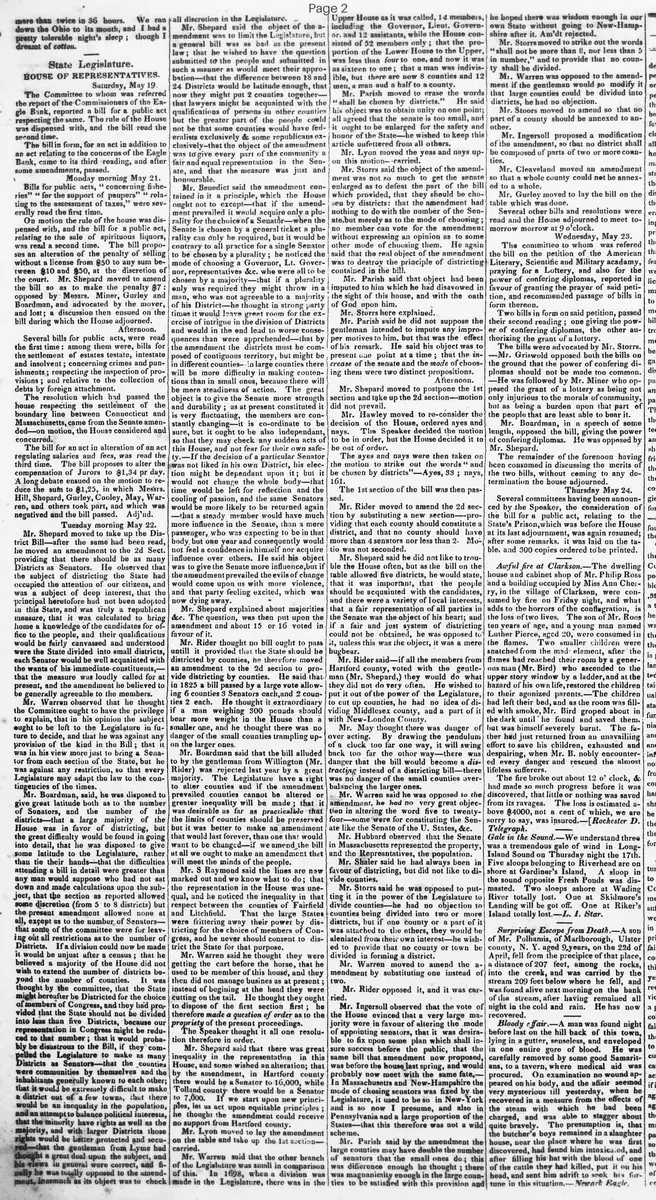
HOUSE OF REPRESENTATIVES.
Saturday, May 19.
The Committee to whom was referred the report of the Commissioners of the Eagle Bank, reported a bill for a public act respecting the same. The rule of the House was dispensed with, and the bill read the second time.
The bill in form, for an act in addition to an act relating to the concerns of the Eagle Bank, came to its third reading, and after some amendments, passed.
Monday morning May 21.
Bills for public acts, "concerning fisheries" "for the support of paupers" "relating to the assessment of taxes," were severally read the first time.
On motion the rule of the house was dispensed with, and the bill for a public act, relating to the sale of spirituous liquors, was read a second time. The bill proposes an alteration of the penalty of selling without a license from $50 to any sum between 10 and $50, at the discretion of the court. Mr. Shepard moved to amend the bill so as to make the penalty $7: opposed by Messrs. Miner, Gurley and Boardman, and advocated by the mover, and lost; a discussion then ensued on the bill during which the House adjourned.
Afternoon.
Several bills for public acts, were read the first time: among them were, bills for the settlement of estates testate, intestate and insolvent; concerning crimes and punishments; respecting the inspection of provisions: and relative to the collection of debts by foreign attachment.
The resolution which had passed the house respecting the settlement of the boundary line between Connecticut and Massachusetts, came from the Senate amended—on motion, the House considered and concurred.
The bill for an act in alteration of an act regulating salaries and fees, was read the third time. The bill proposes to alter the compensation of Jurors to $1.34 pr day.
A long debate ensued on the motion to reduce the sum to $1.25, in which Messrs. Hill, Shepard, Gurley, Cooley, May, Warren, and others took part, and which was negatived and the bill passed. Adj'd.
Tuesday morning May 22.
Mr. Shepard moved to take up the District Bill—after the same had been read. he moved an amendment to the 2d Sect. providing that there should be as many Districts as Senators. He observed that the subject of districting the State had occupied the attention of our citizens, and was a subject of deep interest, that the principal heretofore had not been adopted in this State, and was truly a republican measure, that it was calculated to bring home a knowledge of the candidates for office to the people. and their qualifications would be fairly canvassed and understood were the State divided into small districts, each Senator would be well acquainted with the wants of his immediate-constituents,— that the measure was loudly called for at present, and the amendment he believed to be generally agreeable to the members.
Mr. Warren observed that he thought the Committee ought to have the privilege to explain, that in his opinion the subject ought to be-left to the Legislature in future to decide, and that he was against any provision of the kind in tho Bill; that it was in his view more just to bring a Senator from each section of the State, but he was against any restriction, so that every Legislature may adapt the law to the contingencies of the times.
Mr. Boardman, said, he was disposed to give great latitude both as to the number of Sopators. and the number of the districts—that a large majority of the House was in favor of districting, but the great diffieulty would be found in going into detail, that he was disposed to give some latitude to the Legislature, rather than tie their hands—that the difficulties attending a bill in detail were greater than any man would suppose who had not sat down and made calculations upon the subject, that the section as reported allowed some discretion (from 5 to 8 districts) but the present amendment allowed none at all, except as to the number of Senators— that sone of the committee were for leaving out all restrictions as to the number of Districts. If a division could now be made it would be unjust after a census ; that he believed a majority of the House did not wish to extend the number of districts beyond the number of counties. It was thought by the committee, that the State might hereafter be Districted for the choice of members of Congress, and they had provided that the State should not be divided into less than five Districts, because our representation in Congress might be reduced to that number; that it would probably be disastrous to the Bill, if they compelled the Legislature to make as many Districts as Senators—that the counties were communities by themselves and the inhabitants generally known to each other; that it would be extremely difficult to make a district out of a few towns, thut there would be an inequality in the population, and an attempt to balance political interests, that the minority have rights as well as the majority, and with larger Districts those rights would be better protected and secured—that the gentleman from Lyme had thought a groat deal upon the subject, and his views in general were correct, and finally he was totally opposed to the amendment, inasmuch as its object was to check all discrotion in the Legislature.
Mr. Shepard said the object of the amendment was to limit the Legislature, but a general bill was as bad as the present law; that he wished to have the question submitted to the people and submitted in such a manner as would meet their approbation—that the difference between 18 and 24 Districts would be latitude enough, that now they might put 2 counties together— that lawyers might be acquainted with the qualifications of persons in other counties but the greater part of the people could not be that some counties would have federalists exclusively & some republicans exclusively—that the object of the amendment was to give every part of the community a fair and equal representation in the Senate, and that the measure was just and honourable.
Mr. Benedict said the amendment contained in it a principle, which the House ought not to except—that if the amendment prevailed it would acquire only a plurality for the choice of a Senator—when the Senate is chosen by a general ticket a plurality can only be required, but it would be contrary to all practice for a single Senator to be chosen by a plurality; he noticed the mode of choosing a Governor, Lt. Governor, representatives &c. who were all to be chosen by a majority—that if a plurality only was required they might throw in a man, who was not agreeable to a majority of his District—he thought in strong party times it would leave great room for the exercise of intrigue in the division of Districts and would in the end lead to worse consequences than were apprehended—that by the amendment the districts must be composed of contiguous territory, but might be in different counties—in large counties there will be more difficulty in making contentions than in small ones. because there will be more steadiness of action. The great object is to give the Senate more strength and durability ; as at present constituted it is very fluctuating, the members are constantly changing—it is co-ordinate to be sure, but it ought to be also independent, so that they may check any sudden acts of this House, and not fear for their own safety.—If the decision of a particular Senator was not liked in his own District, his election might be dependant upon it; but it would not change the whole body—that time would be left for reflection and the cooling of passion, and the same Senators would be more likely to be returned again —that a steady member would have much more influence in the Senate, than a mere passenger, who was expecting to be in that body, but one year and consequently would not feel a confidence in himself nor acquire influence over others. He said his object was to give the Senate more influence, but if the amendment prevailed the evils of change would come upon us with more violence, and that party feeling excited, which was now dying away.
Mr. Shepard explained about majorities &c. The question, was then put upon the amendment and about 15 or 16 voted in favour of it.
Mr. Rider thought no bill ought to pass untill it provided that the State should be districted by counties. he therefore moved an amendment to the 2d section to provide districting by counties. He said that in 1825 a bill passed by a large vote allowing 6 counties 3 Senators each, and 2 counties 2 each. He thought it extraordinary if a man weighing 300 pounds should bear more weight in the House than a smaller one, and he thought there was no danger of the small counties trampling upon the larger ones.
Mr. Boardman said that the bill alluded to by the gentleman from Willington (Mr. Rider) was rejected last year by a great majority. The Legislature have a right to alter counties and if the amendment prevailed counties cannot be altered or greater inequality will be made; that it was desirable as far as practicable that the limits of counties should be preserved but it was better to make an amendment that would last forever, than one that would want to be changed—if we amend the bill at all we ought to make an amendment that will meet the minds of the people.
Mr. S Raymond said the lines are now marked out and wo know what to do; that the representation in the House was unequal, and he noticed the inequality in that respect between the counties of Fairfield and Litchfield. That the large States were frittering away their power by districting for the choice of members of Congress, and he never should consent to district the State for that purpose.
Mr. Warren said he thought they were getting the cart before the horse, that he used to be member of this house, and they then did not manage business as at present ; instead of beginning at the head they were cutting on the tail. He thought they ought to dispose of the first section first; he therefore made a question of order as to the propriety of the present proceedings.
The Speaker thought it all one resolution therefore in order.
Mr. Shepard said that there was great inequality in the representation in this House, and some wished an alteration; that by the amendment, in Hartford county there would be a Senator to 16,000, while in Tolland county there would be a Senator to 7,000. If we start upon new principles, let us act upon equitable principles ; he thought the amendment could receive no support from Hartford county.
Mr. Lyon moved to lay the amendment on the table and take up the 1st section— carried.
Mr. Warren said that the other branch of the Legislature was small in comparison of this. In 1698, when a division was made in the Legislature, there was in the Upper House as it was called, 14 members, including the Governor, Lieut. Governor. and 12 assistants, while the House consisted of 52 members only ; that the proportion of the Lower House to the Upper, was less than four to one, and now it was as sixteen to one ; that a man was indivisible. but there are now 8 counties and 12 men, a man and a half to a county.
Mr. Parish moved to erase the words "shall be chosen by districts."
He said his object was to obtain unity on one point; all agreed that the senate is too small, and it ought to be enlarged for the safety and honor of the State—he wished to keep this article unfettered from all others.
Mr. Lyon moved the yeas and nays upon this motion—carried.
Mr. Storrs said the object of the amendment was not so much to get the senate enlarged as to defeat the part of the bill which provided, that they should be chosen by districts: that the amendment had nothing to do with the number of the Senate, but merely as to the mode of choosing ; no member can vote for the amendment without expressing an opinion as to some other mode of choosing them. He again said that the real object of the amendment was to destroy the principle of districting contained in the bill.
Mr. Parish said that object had been imputed to him which he had disavowed in the sight of this house, and with the oath of God upon him.
Mr. Storrs here explained.
Mr. Parish said he did not suppose the gentleman intended to impute any improper motives to him. but that was the effect of his remark. He said his object was to present one point at a time; that the increase of the senate and the mode of choosing them were two distinct propositions.
Afternoon.
Mr. Shepard moved to postpone the 1st section and take up the 2d section—motion did not prevail.
Mr. Hawley moved to re-consider the decision of the House, ordered ayes and nays.
The Speaker decided the motion to be in order. but the House decided it to be out of order.
The ayes and nays were then taken on the motion to strike out the words "and be chosen by districts"—Ayes, 33 ; nays, 161.
The 1st section of the bill was then passed.
Mr. Rider moved to amend the 2d section by substituting a new section—providing that each county should constitute a district, and that no county should have more than 4 senators nor less than 2. Motion was not seconded.
Mr. Shepard said he did not like to trouble the House often, but as the bill on the table allowed five districts, he would state, that it was important, that the people should be acquainted with the candidates, and there were a variety of local interests, that a fair representation of all parties in the Senate was the object of his heart; and if a fair and just system of districting could not be obtained, he was opposed to it, unless this was the object, it was a mere bugbear.
Mr. Rider said—if all the members from Hartford county, voted with the gentleman (Mr. Shepard,) they would do what they did not do very often. He wished to put it out of the power of the Legislature, to cut up counties, he had no idea of dividing Middlesex county, and a part of it with New-London County.
Mr. May thought there was danger of over acting. By drawing the pendulum of a clock too far one way, it will swing back too far the other way—there was danger that the bill would become a distracting instead of a districting bill—there was no danger of the small counties over-balancing the larger ones.
Mr. Warren said he was opposed to the amendment, ho had no very great objection in altering the word five to twenty-four—some were for constituting the Senate like the Senate of the U. States, &c.
Mr. Hubbard observed that the Senate in Massachusetts represented the property, and the Representatives, the population.
Mr. Shaler said he had always been in favour of districting, but did not like to divide counties.
Mr. Storrs said he was opposed to putting it in the power of the Legislature to divide counties—he had no objection to counties being divided into two or more districts, but if one county or a part of it was attached to the others, they would be alienated from their own interest—he wished to provide that no county or town be divided in forming a district.
Mr. Warren moved to amend the amendment by substituting one instead of two.
Mr. Rider opposed it, and it was carried.
Mr. Ingersoll observed that the vote of the House evinced that a very large majority were in favour of altering the mode of appointing senators, that it was desirable to fix upon some plan which shall insure success before the public, that the same bill that amendment now proposed, was before the house last spring, and would probably now meet with the same fate.— In Massachusetts and New-Hampshire the mode of chosing senators was fixed by the Legislature, it used to be so in New-York and is so now I presume, and also in Pennsylvania and a large proportion of the States—that this therefore was not a wild scheme.
Mr. Parish said by the amendment the large counties may have double the number of senators that the small ones do; this was difference enough he thought ; there was magnanimity enough in the large counties to be satisfied with this provision and he hoped there was wisdom enough in our own State without going to New-Hampshire after it. Am'dt rejected.
Mr. Storrs moved to strike out the words "shall not be more than 8. nor less than 5 in number," and to provide that no county shall be divided.
Mr. Warren was opposed to the amendment if the gentleman would so modify it that large counties could be divided into districts, he had no objection.
Mr. Storrs moved to amend so that no part of a county should be annexed to another.
Mr. Ingersoll proposed a modification of the amendment, so that no district shall be composed of parts of two or more counties.
Mr. Cleveland moved an amendment so that a whole county could not be annexed to a whole.
Mr. Gurley moved to lay the bill on the table which was done.
Several other bills and resolutions were read and the House adjourned to meet tomorrow at 9 o'clock.
Wednesday, May 23.
The committee to whom was referred the bill on the petition of the American Literary, Scientific and Military academy, praying for a Lottery, and also for the power of conferring diplomas, reported in favour of granting the prayer of said petition, and recommended passage of bills in form thereon.
Two bills in form on said petition, passed their second reading : one giving the power of conferring diplomas, the other authorizing the grant of a lottery.
The bills were advocated by Mr. Storrs. -Mr. Griswold opposed both the bills on the ground that the power of conferring diplomas should not be made too common. -He was followed by Mr. Miner who opposed the grant of a lottery as being not only injurious to the morals of community, but as being a burden upon that part of the people that are least able to bear it.
Mr. Boardman, in a speech of some length, opposed the bill, giving the power of conferring diplomas. He was opposed by Mr. Shepard.
The remainder of the forenoon having been consumed in discussing the merits of the two bills, without coming to any determination the house adjourned.
Thursday May 24.
Several committees having been announced by the Speaker, the consideration of the bill for a public act, relating to the State's Prison, which was before the House at its last adjournment, was again resumed; after some remarks. it was laid on the table, and 300 copies ordered to be printed.
What sub-type of article is it?
What keywords are associated?
What entities or persons were involved?
Where did it happen?
Domestic News Details
Primary Location
Connecticut
Event Date
May 19 To May 24
Key Persons
Outcome
bills passed on eagle bank concerns, fisheries support, pauper support, tax assessment, boundary resolution with massachusetts, juror compensation at $1.34 per day; debates on liquor penalty amendment (failed), senate districting (amendments debated and voted down, first section passed); lottery and diploma bills for american literary, scientific and military academy advanced to debate; state's prison bill tabled and printed.
Event Details
The text details daily proceedings in the Connecticut House of Representatives, including readings, amendments, debates, and votes on various public acts related to banking, fisheries, taxes, liquor sales, estates, crimes, provisions inspection, debts, salaries, senate districting, boundary settlement, lottery authorization, and state prison.