Thank you for visiting SNEWPapers!
Sign up free
Bismarck Weekly Tribune
Bismarck, Burleigh County, North Dakota
What is this article about?
Account of the 1876 Battle of Little Bighorn: Gen. Custer's 7th Cavalry attacked a massive Sioux village, resulting in the death of Custer and 261 men. Reno's survivors held a defensive position. Includes details of fighting, mutilations, and casualty lists.
Merged-components note: Merged continuation of the detailed Custer massacre story across pages, including the tables of killed and wounded which are integral to the article content. Tables relabeled as part of the story.
Clippings
1 of 2
OCR Quality
Full Text
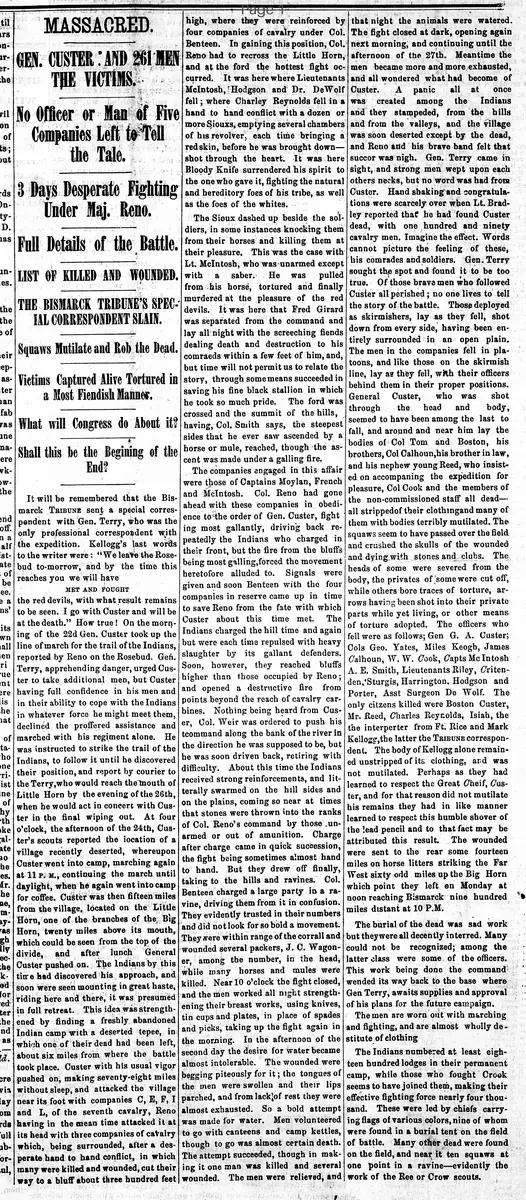
GEN. CUSTER AND 261 MEN
THE VICTIMS
No Officer or Man of Five Companies Left to Tell the Tale.
3 Days Desperate Fighting Under Maj. Reno.
Full Details of the Battle.
LIST OF KILLED AND WOUNDED
THE BISMARCK TRIBUNE'S SPECIAL CORRESPONDENT SLAIN
Squaws Mutilate and Rob the Dead.
Victims Captured Alive Tortured in a Most Fiendish Manner.
What will Congress do About it?
Shall this be the Beginning of the End?
It will be remembered that the Bismarck Tribune sent a special correspondent with Gen. Terry, who was the only professional correspondent with the expedition. Kellogg's last words to the writer were: "We leave the Rosebud to-morrow, and by the time this reaches you we will have MET AND FOUGHT the red devils, with what result remains to be seen. I go with Custer and will be at the death." How true! On the morning of the 22d Gen. Custer took up the line of march for the trail of the Indians, reported by Reno on the Rosebud. Gen. Terry, apprehending danger, urged Custer to take additional men, but Custer having full confidence in his men and in their ability to cope with the Indians in whatever force he might meet them, declined the proffered assistance and marched with his regiment alone. He was instructed to strike the trail of the Indians, to follow it until he discovered their position, and report by courier to Terry, who would reach the mouth of Little Horn by the evening of the 26th, when he would act in concert with Custer in the final wiping out. At four o'clock, the afternoon of the 24th, Custer's scouts reported the location of a village recently deserted, whereupon Custer went into camp, marching again at 11 p. m., continuing the march until daylight, when he again went into camp for coffee. Custer was then fifteen miles from the village, located on the Little Horn, one of the branches of the Big Horn, twenty miles above its mouth, which could be seen from the top of the divide, and after lunch General Custer pushed on. The Indians by this time had discovered his approach, and soon were seen mounting in great haste, riding here and there, it was presumed in full retreat. This idea was strengthened by finding a freshly abandoned Indian camp with a deserted tepee, in which one of their dead had been left, about six miles from where the battle took place. Custer with his usual vigor pushed on, making seventy-eight miles without sleep, and attacked the village near its foot with companies C, E, F, I and L, of the Seventh cavalry, Reno having in the mean time attacked it at its head with three companies of cavalry which, being surrounded, after a desperate hand to hand conflict, in which many were killed and wounded, cut their way to a bluff about three hundred feet high, where they were reinforced by four companies of cavalry under Col. Benteen. In gaining this position, Col. Reno had to recross the Little Horn, and at the ford the hottest fight occurred. It was here where Lieutenants McIntosh, Hodgson and Dr. DeWolf fell; where Charley Reynolds fell in a hand to hand conflict with a dozen or more Sioux, emptying several chambers of his revolver, each time bringing a redskin, before he was brought down - shot through the heart. It was here Bloody Knife surrendered his spirit to the one who gave it, fighting the natural and hereditary foes of his tribe, as well as the foes of the whites.
The Sioux dashed up beside the soldiers, in some instances knocking them from their horses and killing them at their pleasure. This was the case with Lt. McIntosh, who was unarmed except with a saber. He was pulled from his horse, tortured and finally murdered at the pleasure of the red devils. It was here that Fred Girard was separated from the command and lay all night with the screeching fiends dealing death and destruction to his comrades within a few feet of him, and, but time will not permit us to relate the story, through some means succeeded in saving his fine black stallion in which he took so much pride. The ford was crossed and the summit of the hills, having, Col. Smith says, the steepest sides that he ever saw ascended by a horse or mule, reached, though the ascent was made under a galling fire.
The companies engaged in this affair were those of Captains Moylan, French and McIntosh. Col. Reno had gone ahead with these companies in obedience to the order of Gen. Custer, fighting most gallantly, driving back repeatedly the Indians who charged in their front, but the fire from the bluffs being most galling, forced the movement heretofore alluded to. Signals were given and soon Benteen with the four companies in reserve came up in time to save Reno from the fate with which Custer about this time met. The Indians charged the hill time and again but were each time repulsed with heavy slaughter by its gallant defenders. Soon, however, they reached bluffs higher than those occupied by Reno; and opened a destructive fire from points beyond the reach of cavalry carbines. Nothing being heard from Custer, Col. Weir was ordered to push his command along the bank of the river in the direction he was supposed to be, but he was soon driven back, retiring with difficulty. About this time the Indians received strong reinforcements, and literally swarmed on the hill sides and on the plains, coming so near at times that stones were thrown into the ranks of Col. Reno's command by those unarmed or out of ammunition. Charge after charge came in quick succession, the fight being sometimes almost hand to hand. But they drew off finally, taking to the hills and ravines. Col. Benteen charged a large party in a ravine, driving them from it in confusion. They evidently trusted in their numbers and did not look for so bold a movement. They were within range of the corral and wounded several packers, J. C. Wagoner, among the number, in the head, while many horses and mules were killed. Near 10 o'clock the fight closed, and the men worked all night strengthening their breastworks, using knives, tin cups and plates, in place of spades and picks, taking up the fight again in the morning. In the afternoon of the second day the desire for water became almost intolerable. The wounded were begging piteously for it; the tongues of the men were swollen and their lips parched, and from lack of rest they were almost exhausted. So a bold attempt was made for water. Men volunteered to go with canteens and camp kettles, though to go was almost certain death. The attempt succeeded, though in making it one man was killed and several wounded. The men were relieved, and that night the animals were watered.
The fight closed at dark, opening again next morning; and continuing until the afternoon of the 27th. Meantime the men became more and more exhausted, and all wondered what had become of Custer. A panic all at once was created among the Indians and they stampeded, from the hills and from the valleys, and the village was soon deserted except by the dead, and Reno and his brave band felt that succor was nigh. Gen. Terry came in sight, and strong men wept upon each other's necks, but no word was had from Custer. Hand shaking and congratulations were scarcely over when Lt. Bradley reported that he had found Custer dead, with one hundred and ninety cavalry men. Imagine the effect: Words cannot picture the feeling of these, his comrades and soldiers. Gen. Terry sought the spot and found it to be too true. Of those brave men who followed Custer all perished: no one lives to tell the story of the battle. Those deployed as skirmishers, lay as they fell, shot down from every side, having been entirely surrounded in an open plain. The men in the companies fell in platoons, and like those on the skirmish line, lay as they fell, with their officers behind them in their proper positions. General Custer, who was shot through the head and body, seemed to have been among the last to fall, and around and near him lay the bodies of Col. Tom and Boston, his brothers, Col. Calhoun, his brother-in-law, and his nephew young Reed, who insisted on accompanying the expedition for pleasure, Col. Cook and the members of the non-commissioned staff all dead - all stripped of their clothing and many of them with bodies terribly mutilated. The squaws seem to have passed over the field and crushed the skulls of the wounded and dying with stones and clubs. The heads of some were severed from the body, the privates of some were cut off, while others bore traces of torture, arrows having been shot into their private parts while yet living, or other means of torture adopted. The officers who fell were as follows: Gen. G. A. Custer; Cols. Geo. Yates, Miles Keogh, James Calhoun, W. W. Cook, Capts. McIntosh, A. E. Smith, Lieutenants Riley, Crittenden, Sturgis, Harrington, Hodgson and Porter, Asst. Surgeon De Wolf. The only citizens killed were Boston Custer, Mr. Reed, Charles Reynolds, Isaiah, the interpreter from Ft. Rice and Mark Kellogg, the latter the Tribune correspondent. The body of Kellogg alone remained unstripped of its clothing, and was not mutilated. Perhaps as they had learned to respect the Great Chief, Custer, and for that reason did not mutilate his remains they had in like manner learned to respect this humble wielder of the lead pencil and to that fact may be attributed this result. The wounded were sent to the rear some fourteen miles on horse litters, striking the Far West sixty odd miles up the Big Horn which point they left on Monday at noon reaching Bismarck nine hundred miles distant at 10 P.M. The burial of the dead was sad work but they were all decently interred. Many could not be recognized; among the latter class were some of the officers. This work being done the command wended its way back to the base where Gen. Terry awaits supplies and approval of his plans for the future campaign. The men are worn out with marching and fighting, and are almost wholly destitute of clothing. The Indians numbered at least eighteen hundred lodges in their permanent camp, while those who fought Crook seem to have joined them, making their effective fighting force nearly four thousand. These were led by chiefs carrying flags of various colors, nine of whom were found in a burial tent on the field of battle. Many other dead were found on the field, and near it ten squaws at one point in a ravine--evidently the work of the Ree or Crow scouts.
The Indian dead were great in number, as they were constantly assaulting an inferior force. The camp had the appearance of having been abandoned in haste. The most gorgeous ornaments were found on the bodies of the dead chiefs, and hundreds of finely dressed and painted robes and skins were thrown about the camp. The Indians were certainly severely punished.
We said of those who went into battle with Custer none are living—one Crow scout hid himself on the field, and witnessed and survived the battle. His story is plausible, and is accepted, but we have not room for it now. The names of the wounded are as follows:
LIST OF WOUNDED.
Private Davis Covey, Co. I, 7th Cav., right hip; Patrick McDonnall, D, left leg; Sergt John Pahl, H, back; Privt Michael C Madden, K right leg; Wm George, H, left side, died July 3d, at 4 a. m.; 1st Sergt Wm Heyn, A, left knee; Privt John McVay, G, hips; Patrick Corcoran, K, right shoulder; Max Wilke, K, left foot; Alfred Whitaker, C, right elbow; Peter Thompson, C, right hand; Jacob Deal, A, face; J H Meyer, M, neck; Roman Rutler, M, right shoulder; Daniel Newall, M, left thigh, Jas Muller, H, right thigh; Elijah T Stroude, A, right leg; Sergt Patrick Carey, M, right hip; Privt James E Bennett, C, body, died July 5th, at 3 o'clock; Francis W Reeves, A, left side and body; James Wilbur, M, left leg; Jasper Marshall, L, left foot; Sergt Jas T Riley, E, back and left leg; Pvt John J Philips, H, face and both hands; Samuel Severn, H, both thighs; Frank Brunn, M, face and left thigh; Corpl Alex B Bishop, H, right arm; Pvt James Foster, A, right arm; W E Harris, M, left breast; Chas H Bishop, H, right arm; Fred Holmsted, A, left wrist; Sergt Chas White, M, right arm, Pvt Thos P Varner, M, right ear; Chas Campbell, G, right shoulder; John Cooper, H, right elbow; John McGuire, C, right arm; Henry Black, H, right hand; Daniel McWilliams, H, right leg.
An Indian scout, name unknown, left off at Berthold; Sergt M. Riley, Co I, 7th Infantry, left off at Buford, Consumption; Pvt David Ackison, Co. E, 7th cav., left off, July 4th, at Buford, Constipation.
The total number of killed was two hundred and sixty-one; wounded 52. Thirty-eight of the wounded were brought down on the Far West; three of them died en route. The remainder are cared for at the field hospital.
De Rudio had a narrow escape, and his escape is attributed to the noise of beavers, jumping into the river during the engagement. De Rudio followed them, got out of sight, and after hiding for twelve hours or more finally reached the command in safety.
The body of Lt. Hodgson did not fall into the hands of the Indians; that of Lt. McIntosh did, and was badly mutilated. McIntosh, though a half breed, was a gentleman of culture and esteemed by all who knew him. He leaves a family at Lincoln, as does Gen. Custer, Cols. Calhoun, Yates, Capt. Smith, and Lt. Porter. The unhappy Mrs. Calhoun, loses a husband, three brothers and a nephew. Lt. Harrington also had a family, but no trace of his remains was found. We are indebted to Col. Smith for the following full list of the dead: to Dr. Porter for the list of wounded, which is also full:
KILLED.
Field and staff, George A. Custer, Brevt. Major General. W. W Cook, Brevt Lt-Colonel. Lord, Asst. Surgeon, J. M. DeWolf, Acting Asst. Surgeon. N. C. O. Staff, W. W. Sharron Henry Voss, Chief Bugler, Co. A Henry Dallam, Corpl., G. K. King, J E Armstrong, Privt. 61 James Drinan, Wm Moody. 4 R Rowlins, James McDonald, John Sullivan, Thos P Switzer B Bepj Hodgson 2d Lieut, Richard Doran Privt. George Mask O T W Custer Brevt Lt Col., H M Harrington 2d Lt The body of Lt. Harrington was not found, but it is reasonably certain he was killed. Edwin Baba 1st Sergt, Finley Sergt. 46 Winkle French Corpl. Foley Kylaur. Allen Privy Criudte kiog •6 Bucknall Hisman s6 Eogle Brightfield 6• Fanand Gridn Hamel Hattisoll Kingsouts Lewis Mayer Mayer Phillpe Bussell Bx : Ranter Short Shea Shade Stuart St J.ha Tliadius Van Allen Warren Wyodbam Wright Vincent Chas Farrier.. Patrick Golden Privt. Edward Hansen A E Smith Brevt Capt. , Sturgis 2d lt. The body of Lt Sturgis was not found, but it is reasonably certain he was killed. F Hohmeyer Ist Sergt rgden Sergt Jimes Hagali (Co) Mas oD Blount Mejer MeKiroy Prptr Nootey Baker riyt Boyle: Hauth
There is much else that might be detailed of interest in connection with the above if time and space permitted, but our time is too limited, space too confined, and force too light. We cannot put our regular edition to press, however, without giving a few incidents in addition.
Grant Marsh, one of the characters of the campaign, than whom a braver man never lived, or a nobler heart ever beat, pushed his boat, the Far West, a seven hundred ton boat, up the Big Horn, an unexplored river, to the mouth of the Little Horn, sixty-four miles, taking position where he believed he could do the most good. He was then within fifteen miles of the battle field, and received the wounded at about two a. m., on the morning of the 26th. The night was so dark that Gen. Terry caused fires to be built to light the way of litter bearers over rough and steep places. This action on Marsh's part gave fifteen miles along the Little Horn valley for the transportation of the wounded instead of forty miles over a dry prairie.
While the Far West lay there, on the morning of the 27th, and before Terry had found the remains of Custer's command, or learned of the precarious position Reno was in, Curly, a Crow scout, came out of the bushes near the boat and was recognized as one who was with Custer; he proves to be the only survivor. Curly could not make his gestures understood, but, obtaining a pencil, he drew, a correct sketch, as it afterwards proved, of the battle field. Making a few dots he conveyed by signs and broken English the fact that he intended them to represent white men. These he surrounded with innumerable dots intended to represent Indians; he went through the motions of shooting, and represented white men as having been all shot. Motions of scalping followed, and Curly said in fair English, 'white men all dead—I got two ponies.' His story, though not fully understood, seemed incredible, and was not accepted, but it proved too true in all its details. Curly says he saw the troops were certain to be massacred and he managed to reach the river where he washed off his Crow paint, changed the dress of his hair which was peculiar to the Crows, pulled it over his face, put on a Sioux blanket and pretended to engage in the fight with the Sioux accompanying them in one of their charges on Custer. Watching his opportunity he escaped, and in doing so he managed to pick up two ponies, and reported at the mouth of the Little Horn where he knew Terry was to arrive on the evening of the 26th.
Too much cannot be said in favor of Col. Benteen. His prompt movements saved Reno from utter annihilation, his gallantry cleared the ravine of Indians, and opened the way for water to the suffering wounded. In Col. Benteen Maj. Reno found one whose advice and assistance was invaluable.
Dr. Porter, who was in the thickest of the fray, who was in that wild run for life made by Reno and his men in their effort to reach the ford, passing and being passed by Indians in their chase for scalps, officers and soldiers, passing and being passed by each other at length rushing pell mell into the jam of men and horses in the narrow pass at the ford, concedes the highest praise to Lt. Mathey, who, so soon as the crest of the hill was reached, with his own hand, made a barricade of dead animals and commissary and medical stores from the pack mules, behind which the wounded, which rapidly increased from ten to fifty-two, were placed. Dr. Porter also speaks in the highest terms of Fred Girard, who aided him during the battle to make two amputations—and gave him invaluable assistance in other respects. Girard was the only one in the command aside from Porter having any medical knowledge, Doctors Lord and DeWolf having been killed.
The force of the Indians was estimated at 1800 lodges—at least six thousand persons.
The Indians were expecting battle and prepared for it, choosing their own ground, and seem to have been led by whites. English voices were heard urging the Indians to the attack, as has been the case in almost every attack on Black Hills trains.
While we do not desire to criticise General Custer, or characterize his charge as a rash one, it seems he was too anxious for glory for his regiment, if not for himself, and declined with thanks the proffered assistance of a portion of Gibbon's cavalry, desiring to make the victory, of which he felt certain, exclusively a seventh cavalry affair, and it is related that when he came in sight of the village, though the trail leading to it was five times as great as his own, he swung high in the air his hat, and congratulated those near him that they were about to strike the biggest Indian village on the American continent. Dr. Porter thinks the whole regiment would have been wiped out as Custer was, had they followed him in the charge, but had Terry and Gibbon been in supporting distance, as it was arranged they should be, and they did not fail in any particular to make the points agreed upon, instead of a disastrous massacre, we should have had a decisive victory. Still it is believed that Custer had reason to suppose the Indians were in full retreat, and as he had troops that none would hesitate to pit against three times their number, those in authority are not inclined to censure. Gen. Sheridan insists no mistakes have been made, and that the Indians shall be made to pay dearly for the death of Custer's brave band.
The Tribune correspondent, Mark H. Kellogg, Col. Smith, A. D. C. to Gen. Terry, informs us—was a general favorite with the command. He was the only accredited correspondent, and was given unusual facilities for gaining news. He was energetic, intelligent, interesting, ready to endure any hardship; and that too without a murmur. Being well known to the seventh cavalry, he became its guest and was ever with them, in camp and on the trail. Mounted on a mule, with saddle bags loaded with pencil and paper he looked odd, but he was the same true friend and live man that those who knew him best had ever found him to be. His body lay some distance from the main body of the troops; it was not stripped and was not in any respect mutilated. Custer escaped mutilation because he was a great warrior, but even the Indians in their treatment of Kellogg acknowledged that in their estimation the pen was mightier than the sword. They treated Kellogg's body with greater consideration than was shown to that of Custer. Of all the dead Kellogg alone was unstripped and lay as he fell, except that his pockets were rifled.
There are others of whom we should like to speak but cannot. Of General Terry, however, we must say a word. He is the same true gentleman and brave soldier that he ever was. His plans were well laid, but in some respects they miscarried, and that too through no fault of his. Major Reno exceeded his instructions, and it was feared interfered seriously with his plans, on his three days scout, but as it turned out no harm was done. Custer, probably, believed the Indians were in full retreat and brought on a general engagement before Terry had intended. Had Terry's plans been carried out, Kellogg, probably would have had the pleasure of recording a glorious victory, instead of others recording a terrible massacre.
To Gen. Terry the Tribune owes much for courtesies extended; to Col. Smith much for information so freely and fully given; to Dr. Porter, Grant Marsh, Major Carland, H. G. Coykendall, and others, we are under no small obligations for the time so cheerfully conceded to the Tribune interviewer through which our readers gain much information interesting or valuable.
| James Calhoun | 1st Lt | Miller | Pivrt |
| Tweed | Veller | Cashan | Kiefer |
| Andrews | Crisfield | Haugge | Kavaugh |
| Mahoney | Schmidt | Limon | Riebold |
| Ltt Crittenden | Butler | Warren | Harrison |
| G Ibert | G | Seiller | Walsh |
| Asdely | Burke | Cheever | McGue |
| Maxwell | Scott | Rabcock | Perkins |
| Tibor | Tibor | Dye | Tessler |
| Galven | Graham | Hamilton | Rodgers |
| Snow | Hughes | D Winney | J Hughes |
| J J Callahan | J J Callahan | Julius Helmer | Eli U T Clair |
| M W Klogh | M W Klogh | J E Porter—the body of | J E Porter—the body of |
| J Porter was not found, | J Porter was not found, | J E Porter—the body of | J E Porter—the body of |
| J E Porter—the body of | J E Porter—the body of | J E Porter—the body of | J E Porter—the body of |
| J E Porter—the body of | J E Porter—the body of | J E Porter |
| ... Davis | ... A McIchargey | ... |
| ... Farrell | ... J Mitchell | ... |
| ... Hiley | ... J Noshaug | ... |
| ... Huber | ... J O'Bryan | ... |
| ... Hime | ... J Parker | ... |
| ... Henderson | ... F J Pitter | ... |
| ... Henderson | ... Geo Post | ... |
| ... Leddisson | ... Jas Quinn | ... |
| ... O'Conner | ... Wm Reed | ... |
| ... Rood | ... J W Rossburg | ... |
| ... R.ese | ... D L Lymons | ... |
| ... Smith 1st | ... J E Troy | ... |
| ... Smith 2d | ... Chas Van Bramer | ... |
| ... Smith 3d | ... W B Whaley | ... |
| ... Stella | ... G Daniel McIntosh 1st Lt | ... |
| ... Stafford | ... Edward Botzer | Sergt |
| ... Schoole | ... M Considine | ... |
| ... Smallwood | ... Jas Martin | Capt |
| ... Tarr | ... Otto Hageman | ... |
| ... Vaugant | ... Benj Wells | Farrier |
| ... Walker | ... Henry Dose | Trptr |
| ... Bragew | ... Crawford SelbySaddler | ... |
| ... Knight | ... Beuj F Rogers | Privt |
| ... F G W Yates | ... Andrew J Moore | ... |
| ... W Van Rielly | ... Jno J McGinniss | ... |
| ... Kenny | ... Edward Stanley | ... |
| ... Nursey | ... Henry Seaferman | ... |
| ... Vickory | ... John Papp | ... |
| ... Wilkinson | ... H Geo Lee | Corpl |
| ... Coleman | ... Julian D Jones | Privt |
| ... Feeman | ... Thos E Meador | ... |
| ... Briody | ... M Miles F O'Hara | Sergt |
| ... Brandon | ... Henry M Scollier | Corpl |
| ... Manning | ... Fred Stringer | ... |
| ... Atchison | ... Henry Gordon | Privt |
| ... Brown 1st | ... H Klotzburger | ... |
| ... Brown 2d | ... G Lawrence | ... |
| ... Bruce | ... W D Meyer | ... |
| ... Brady | ... G E Smith | ... |
| ... Burnham | ... D Somers | ... |
| ... Cather | ... J Tanner | ... |
| ... Carney | ... H Tenley | ... |
| ... Dohman | ... H C Voyt | ... |
| ... Donnelly | ... Boston Custer | Civilian |
| ... Gardiner | ... Arthur Reed | ... |
| ... Hammon | ... Mark Kellogg | ... |
| ... Kline | ... Chas Reynolds | ... |
| ... Krianth | ... Frank O Mann | ... |
| ... Luman | ... | ... |
| ... Losse | ... INDIAN SCOUTS. | ... |
| ... Milton Jas | ... | ... |
| ... Madison | ... Bloody Knife | ... |
| ... Monroe | ... Bobtailed Bull, | ... |
| ... Ruddew | ... Stab | ... |
| ... Omeling | ... Total number of | Com- |
| ... Sicfous | ... missioned officers killed 14 | 1 |
| ... Sanders | ... Actg asst Surg | 237 |
| ... Wanew | ... Enlisted men | 5 |
| ... Way | ... Civilians | 3 |
| ... Lerock | ... Indian scouts | ... |
| ... Kiley | ... | ... |
What sub-type of article is it?
What themes does it cover?
What keywords are associated?
What entities or persons were involved?
Where did it happen?
Story Details
Key Persons
Location
Little Horn River, Big Horn Area
Event Date
June 24 27, 1876
Story Details
General Custer's 7th Cavalry regiment attacked a large Sioux village on the Little Horn, leading to the massacre of Custer and 261 men after three days of fighting. Reno's command survived on a bluff after heavy losses. Details include brutal combat, mutilations, and lists of killed and wounded.