Thank you for visiting SNEWPapers!
Sign up free
The National Intelligencer And Washington Advertiser
Washington, District Of Columbia
What is this article about?
In Portsmouth on August 3-4, 1801, five young men previously inoculated with cowpox were exposed to smallpox via inoculation and close contact, proving cowpox's effectiveness as a preventive, as they showed no symptoms. Reported by Wm. Cutter and L. Spalding.
Clipping
OCR Quality
Full Text
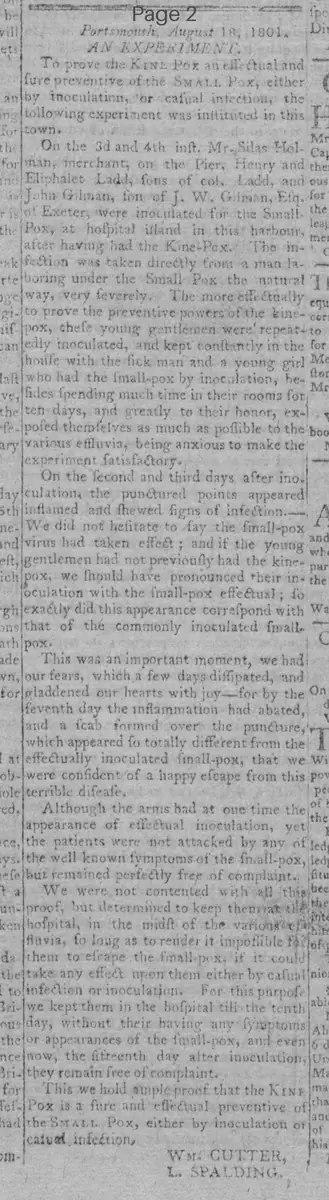
AN EXPERIMENT
To prove the Kine Pox an effectual and sure preventive of the Small Pox, either by inoculation, or casual infection, the following experiment was instituted in this town.
On the 3d and 4th inst. Mr. Silas Holman, merchant, on the Pier, Henry and Eliphalet Ladd, sons of col. Ladd, and John Gilman, son of J. W. Gilman, Esq. of Exeter, were inoculated for the Small Pox, at hospital island in this harbour, after having had the Kine-Pox. The infection was taken directly from a man labouring under the Small Pox the natural way, very severely. The more effectually to prove the preventive powers of the kine-pox, these young gentlemen were repeatedly inoculated, and kept constantly in the house with the sick man and a young girl who had the small-pox by inoculation, besides spending much time in their rooms or ten days, and greatly to their honor, exposed themselves as much as possible to the various effluvia, being anxious to make the experiment satisfactory.
On the second and third days after inoculation, the punctured points appeared inflamed and shewed signs of infection.-- We did not hesitate to say the small-pox virus had taken effect; and if the young gentlemen had not previously had the kine-pox, we should have pronounced their inoculation with the small-pox effectual; so exactly did this appearance correspond with that of the commonly inoculated small pox.
This was an important moment, we had our fears, which a few days dissipated, and gladdened our hearts with joy-for by the seventh day the inflammation had abated, and a scab formed over the puncture, which appeared so totally different from the effectually inoculated small-pox, that we were confident of a happy escape from this terrible disease.
Although the arms had at one time the appearance of effectual inoculation, yet the patients were not attacked by any of the well known symptoms of the small-pox, but remained perfectly free of complaint.
We were not contented with all this proof, but determined to keep them at the hospital, in the midst of the various effluvia, so long as to render it impossible for them to escape the small-pox, if it could take any effect upon them either by casual infection or inoculation. For this purpose we kept them in the hospital till the tenth day, without their having any symptoms or appearances of the small-pox, and even now, the fifteenth day after inoculation, they remain free of complaint.
This we hold ample proof that the Kine Pox is a sure and effectual preventive of the Small Pox, either by inoculation or casual infection,
WM. CUTTER,
L. SPALDING.
What sub-type of article is it?
What keywords are associated?
What entities or persons were involved?
Where did it happen?
Domestic News Details
Primary Location
Portsmouth
Event Date
3d And 4th Inst.
Key Persons
Outcome
the participants remained free of smallpox symptoms despite repeated inoculation and exposure, confirming cowpox as an effective preventive.
Event Details
Five young men, previously inoculated with kine-pox, were inoculated with smallpox and kept in close contact with infected individuals at hospital island to test cowpox's preventive power. Initial inflammation subsided without developing into smallpox.