Thank you for visiting SNEWPapers!
Sign up free
Story
July 26, 1878
Springfield Weekly Republican
Springfield, Hampden County, Massachusetts
What is this article about?
General Ulysses S. Grant shares candid reminiscences on Civil War generals' performances, key campaigns like the Wilderness and Lookout Mountain, leadership decisions, and post-war topics including the San Domingo annexation, in interviews with New York Herald correspondent John Russell Young.
Clipping
OCR Quality
98%
Excellent
Full Text
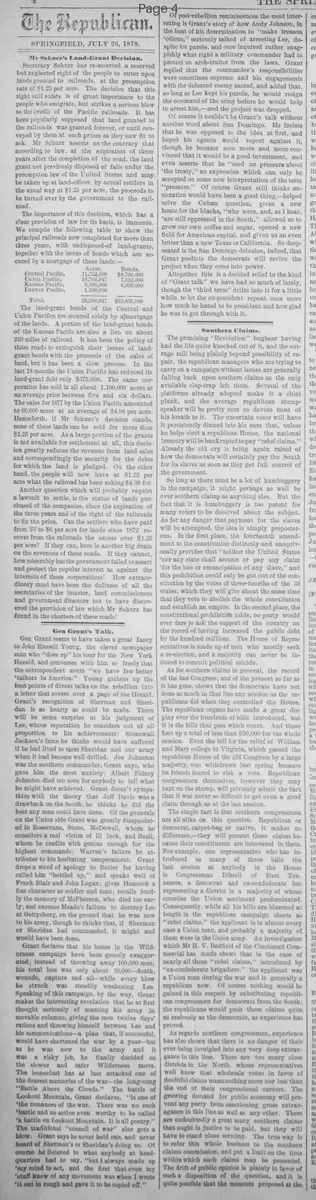
Gen. Grant's Talk.
Gen. Grant seems to have taken a great fancy to John Russell Young, the clever newspaper man who "does up" his tour for the New York Herald, and converses with him so freely that the correspondent avers "we have few better 'talkers' in America." Young gathers up the best points of divers talks on the rebellion into a letter that covers over a page of the Herald. Grant's recognition of Sherman and Sheridan is as hearty as could be made. There will be some surprise at his judgment of Lee, whose reputation he considers out of all proportion to his achievements; Stonewall Jackson's fame he thinks would have suffered if he had lived to meet Sheridan and our army when it had become well drilled. Joe Johnston was the southern commander, Grant says, who gave him the most anxiety; Albert Sidney Johnston died too soon for anybody to tell what he might have achieved. Grant doesn't sympathize with the theory that Jeff. Davis was a drawback on the South: he thinks he did the best any man could have done. Of the generals on the Union side Grant was greatly disappointed in Rosecrans, Stone, McDowell, whom he considers a real victim of ill luck, and Buell, whom he credits with genius enough for the highest commands; Warren's failure he attributes to his hesitating temperament. Grant drops a word of apology to Butler for having called him "bottled up," and speaks well of Frank Blair and John Logan: gives Hancock a fine character as soldier and man; recalls fondly the memory of McPherson, who died too early; and excuses Meade's failure to destroy Lee at Gettysburg, on the ground that he was new to his army, though he thinks that, if Sherman or Sheridan had commanded, it might and would have been done.
Grant declares that his losses in the Wilderness campaign have been grossly exaggerated; instead of throwing away 100,000 men, his total loss was only about 39,000—death, wounds, capture and all—while every blow he struck was steadily weakening Lee.
Speaking of this campaign, by the way, Grant makes the interesting revelation that he at first thought seriously of massing his army in movable columns, giving the men twelve days' rations and throwing himself between Lee and his communications—a plan that, if successful, would have shortened the war by a year—but as he was new to the army and it was a risky job, he finally decided on the slower and safer Wilderness move.
The iconoclast has at last attacked one of the dearest memories of the war—the long-sung "Battle Above the Clouds." The battle of Lookout Mountain, Grant declares, "is one of 'the romances of the war. There was no such battle and no action even worthy to be called 'a battle on Lookout Mountain. It is all poetry."
The traditional "council of war" also gets a blow. Grant says he never held one, and never heard of Sherman's or Sheridan's doing so. Of course he listened to what anybody at headquarters had to say, "but I always made up my mind to act, and the first that even my 'staff knew of any movement was when I wrote 'it out in rough and gave it to be copied off."
Of post-rebellion reminiscences the most interesting is Grant's story of how Andy Johnson, in the heat of his determination to "make treason odious," seriously talked of arresting Lee, despite his parole, and once inquired rather snappishly what right a military commander had to protect an arch-traitor from the laws. Grant replied that the commander's responsibilities were sometimes supreme and his engagements with the defeated enemy sacred, and added that, so long as Lee kept his parole, he would resign the command of the army before he would help to arrest him,—and the project was dropped.
Of course it couldn't be Grant's talk without another word about San Domingo. He insists that he was opposed to the idea at first, and hoped his agents would report against it, though he became soon more and more convinced that it would be a good investment, and even asserts that he "used no pressure about 'the treaty," an expression which can only be accepted on some new interpretation of the term "pressure." Of course Grant still thinks annexation would have been a good thing,—helped solve the Cuban question, given a new home for the blacks, "who were, and, as I hear, 'are still oppressed in the South," allowed us to grow our own coffee and sugar, opened a new field for American capital, and given us an even better than a new Texas or California. So deep-seated is the San Domingo delusion, indeed, that Grant predicts the democrats will revive the project when they come into power.
Altogether this is a decided relief to the kind of "Grant talk" we have had so much of lately, though the "third term" drifts into it for a little while, to let the ex-president repeat once more how much he hated to be president and how glad he was to get through with it.
Gen. Grant seems to have taken a great fancy to John Russell Young, the clever newspaper man who "does up" his tour for the New York Herald, and converses with him so freely that the correspondent avers "we have few better 'talkers' in America." Young gathers up the best points of divers talks on the rebellion into a letter that covers over a page of the Herald. Grant's recognition of Sherman and Sheridan is as hearty as could be made. There will be some surprise at his judgment of Lee, whose reputation he considers out of all proportion to his achievements; Stonewall Jackson's fame he thinks would have suffered if he had lived to meet Sheridan and our army when it had become well drilled. Joe Johnston was the southern commander, Grant says, who gave him the most anxiety; Albert Sidney Johnston died too soon for anybody to tell what he might have achieved. Grant doesn't sympathize with the theory that Jeff. Davis was a drawback on the South: he thinks he did the best any man could have done. Of the generals on the Union side Grant was greatly disappointed in Rosecrans, Stone, McDowell, whom he considers a real victim of ill luck, and Buell, whom he credits with genius enough for the highest commands; Warren's failure he attributes to his hesitating temperament. Grant drops a word of apology to Butler for having called him "bottled up," and speaks well of Frank Blair and John Logan: gives Hancock a fine character as soldier and man; recalls fondly the memory of McPherson, who died too early; and excuses Meade's failure to destroy Lee at Gettysburg, on the ground that he was new to his army, though he thinks that, if Sherman or Sheridan had commanded, it might and would have been done.
Grant declares that his losses in the Wilderness campaign have been grossly exaggerated; instead of throwing away 100,000 men, his total loss was only about 39,000—death, wounds, capture and all—while every blow he struck was steadily weakening Lee.
Speaking of this campaign, by the way, Grant makes the interesting revelation that he at first thought seriously of massing his army in movable columns, giving the men twelve days' rations and throwing himself between Lee and his communications—a plan that, if successful, would have shortened the war by a year—but as he was new to the army and it was a risky job, he finally decided on the slower and safer Wilderness move.
The iconoclast has at last attacked one of the dearest memories of the war—the long-sung "Battle Above the Clouds." The battle of Lookout Mountain, Grant declares, "is one of 'the romances of the war. There was no such battle and no action even worthy to be called 'a battle on Lookout Mountain. It is all poetry."
The traditional "council of war" also gets a blow. Grant says he never held one, and never heard of Sherman's or Sheridan's doing so. Of course he listened to what anybody at headquarters had to say, "but I always made up my mind to act, and the first that even my 'staff knew of any movement was when I wrote 'it out in rough and gave it to be copied off."
Of post-rebellion reminiscences the most interesting is Grant's story of how Andy Johnson, in the heat of his determination to "make treason odious," seriously talked of arresting Lee, despite his parole, and once inquired rather snappishly what right a military commander had to protect an arch-traitor from the laws. Grant replied that the commander's responsibilities were sometimes supreme and his engagements with the defeated enemy sacred, and added that, so long as Lee kept his parole, he would resign the command of the army before he would help to arrest him,—and the project was dropped.
Of course it couldn't be Grant's talk without another word about San Domingo. He insists that he was opposed to the idea at first, and hoped his agents would report against it, though he became soon more and more convinced that it would be a good investment, and even asserts that he "used no pressure about 'the treaty," an expression which can only be accepted on some new interpretation of the term "pressure." Of course Grant still thinks annexation would have been a good thing,—helped solve the Cuban question, given a new home for the blacks, "who were, and, as I hear, 'are still oppressed in the South," allowed us to grow our own coffee and sugar, opened a new field for American capital, and given us an even better than a new Texas or California. So deep-seated is the San Domingo delusion, indeed, that Grant predicts the democrats will revive the project when they come into power.
Altogether this is a decided relief to the kind of "Grant talk" we have had so much of lately, though the "third term" drifts into it for a little while, to let the ex-president repeat once more how much he hated to be president and how glad he was to get through with it.
What sub-type of article is it?
Biography
Historical Event
What themes does it cover?
Justice
Moral Virtue
What keywords are associated?
Civil War Reminiscences
Grant Interviews
Generals Evaluation
Wilderness Campaign
Lookout Mountain
San Domingo Annexation
Lee Parole
What entities or persons were involved?
Gen. Grant
John Russell Young
Sherman
Sheridan
Lee
Stonewall Jackson
Joe Johnston
Albert Sidney Johnston
Jeff. Davis
Rosecrans
Stone
Mcdowell
Buell
Warren
Butler
Frank Blair
John Logan
Hancock
Mcpherson
Meade
Andy Johnson
Story Details
Key Persons
Gen. Grant
John Russell Young
Sherman
Sheridan
Lee
Stonewall Jackson
Joe Johnston
Albert Sidney Johnston
Jeff. Davis
Rosecrans
Stone
Mcdowell
Buell
Warren
Butler
Frank Blair
John Logan
Hancock
Mcpherson
Meade
Andy Johnson
Story Details
In interviews with John Russell Young, Gen. Grant evaluates Civil War generals' abilities and reputations, corrects misconceptions about campaigns like the Wilderness and Lookout Mountain, recounts defending Lee's parole against President Johnson, and defends the San Domingo annexation idea.