Thank you for visiting SNEWPapers!
Sign up free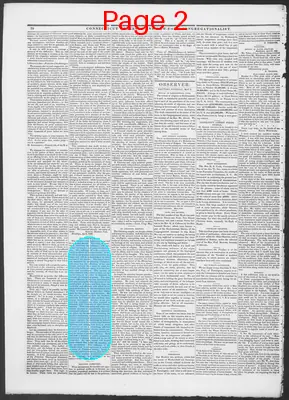
Story
May 2, 1840
The Connecticut Observer, And New York Congregationalist
Hartford, Hartford County, Connecticut
What is this article about?
An essay on how a beloved pastor's influence extends beyond his home church through moral power, respect from other Christians, and courteous, manly interactions across denominations, avoiding sectarianism or sycophancy.
Clipping
OCR Quality
98%
Excellent
Full Text
THE PASTOR ABROAD.
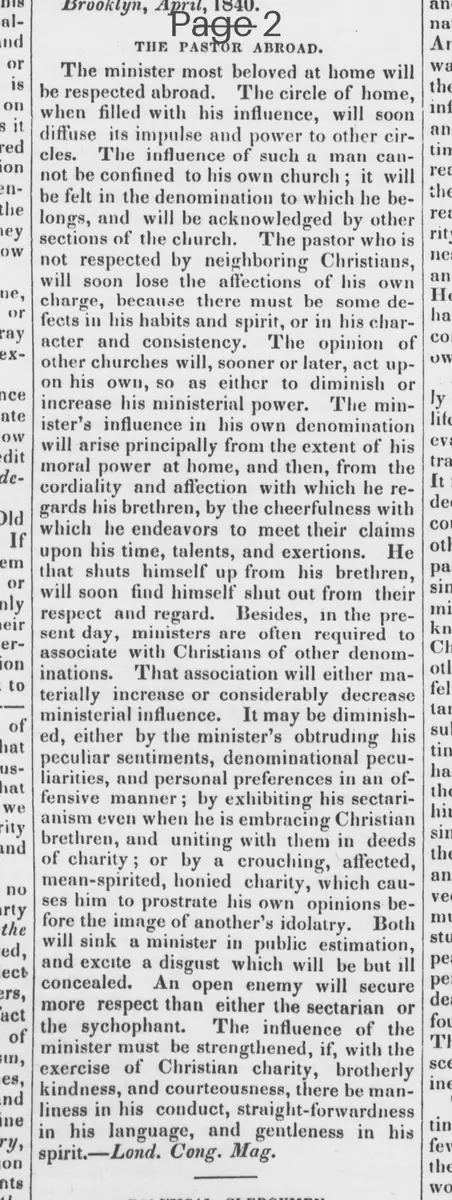
The minister most beloved at home will be respected abroad. The circle of home, when filled with his influence, will soon diffuse its impulse and power to other circles. The influence of such a man cannot be confined to his own church: it will be felt in the denomination to which he belongs, and will be acknowledged by other sections of the church. The pastor who is not respected by neighboring Christians, will soon lose the affections of his own charge, because there must be some defects in his habits and spirit, or in his character and consistency. The opinion of other churches will, sooner or later, act upon his own, so as either to diminish or increase his ministerial power. The minister's influence in his own denomination will arise principally from the extent of his moral power at home, and then, from the cordiality and affection with which he regards his brethren, by the cheerfulness with which he endeavors to meet their claims upon his time, talents, and exertions. He that shuts himself up from his brethren, will soon find himself shut out from their respect and regard. Besides, in the present day, ministers are often required to associate with Christians of other denominations. That association will either materially increase or considerably decrease ministerial influence. It may be diminished, either by the minister's obtruding his peculiar sentiments, denominational peculiarities, and personal preferences in an offensive manner; by exhibiting his sectarianism even when he is embracing Christian brethren, and uniting with them in deeds of charity; or by a crouching, affected, mean-spirited, honied charity, which causes him to prostrate his own opinions before the image of another's idolatry. Both will sink a minister in public estimation, and excite a disgust which will be but ill concealed. An open enemy will secure more respect than either the sectarian or the sychophant. The influence of the minister must be strengthened, if, with the exercise of Christian charity, brotherly kindness, and courteousness, there be manliness in his conduct, straight-forwardness in his language, and gentleness in his spirit.—Lond. Cong. Mag.
The minister most beloved at home will be respected abroad. The circle of home, when filled with his influence, will soon diffuse its impulse and power to other circles. The influence of such a man cannot be confined to his own church: it will be felt in the denomination to which he belongs, and will be acknowledged by other sections of the church. The pastor who is not respected by neighboring Christians, will soon lose the affections of his own charge, because there must be some defects in his habits and spirit, or in his character and consistency. The opinion of other churches will, sooner or later, act upon his own, so as either to diminish or increase his ministerial power. The minister's influence in his own denomination will arise principally from the extent of his moral power at home, and then, from the cordiality and affection with which he regards his brethren, by the cheerfulness with which he endeavors to meet their claims upon his time, talents, and exertions. He that shuts himself up from his brethren, will soon find himself shut out from their respect and regard. Besides, in the present day, ministers are often required to associate with Christians of other denominations. That association will either materially increase or considerably decrease ministerial influence. It may be diminished, either by the minister's obtruding his peculiar sentiments, denominational peculiarities, and personal preferences in an offensive manner; by exhibiting his sectarianism even when he is embracing Christian brethren, and uniting with them in deeds of charity; or by a crouching, affected, mean-spirited, honied charity, which causes him to prostrate his own opinions before the image of another's idolatry. Both will sink a minister in public estimation, and excite a disgust which will be but ill concealed. An open enemy will secure more respect than either the sectarian or the sychophant. The influence of the minister must be strengthened, if, with the exercise of Christian charity, brotherly kindness, and courteousness, there be manliness in his conduct, straight-forwardness in his language, and gentleness in his spirit.—Lond. Cong. Mag.
What sub-type of article is it?
Pastoral Advice
Religious Essay
What themes does it cover?
Moral Virtue
Social Manners
What keywords are associated?
Pastor Influence
Ministerial Power
Church Associations
Christian Charity
Denominational Relations
Story Details
Story Details
Advice on how pastors can extend their influence beyond their local church by maintaining moral consistency, earning respect from neighboring Christians, and engaging courteously with other denominations without sectarianism or excessive deference.