Thank you for visiting SNEWPapers!
Sign up free
Editorial
October 11, 1894
Southern Christian Advocate
Charleston, Charleston County, South Carolina
What is this article about?
Rev. J. Thos. Pate argues for five types of preaching needed today: from a converted heart, informed by study, rooted in pastoral association, presenting relevant truths, and delivered reverently in God's presence. Examples include Bishop Simpson and Spurgeon. Greenville, S.C.
Clipping
OCR Quality
100%
Excellent
Full Text
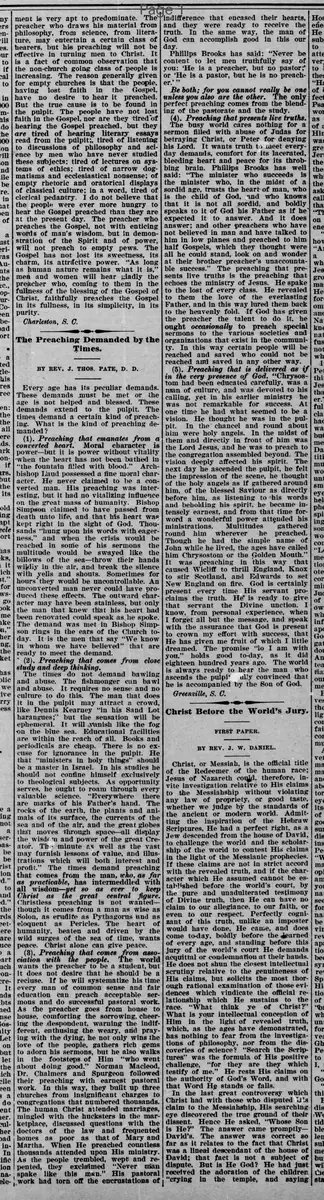
The Preaching Demanded by the Times.
BY REV. J. THOS. PATE, D. D.
Every age has its peculiar demands. These demands must be met or the age is not helped and blessed. These demands extend to the pulpit. The times demand a certain kind of preaching. What is the kind of preaching demanded?
(1). Preaching that emanates from a converted heart. Moral character is power-but it is power without vitality when the heart has not been bathed in "the fountain filled with blood." Archbishop Laud possessed a fine moral character. He never claimed to be a converted man. His preaching was interesting, but it had no vitalizing influence on the great mass of humanity. Bishop Simpson claimed to have passed from death unto life, and that his heart was kept right in the sight of God. Thousands "hung upon his words with eagerness," and when the crisis would be reached in some of his sermons the multitude would be swayed like the billows of the sea-throw their hands wildly in the air, and break the silence with yells and shouts. Sometimes for hours they would be uncontrollable. An unconverted man never could have produced these effects. The outward character may have been stainless, but only the man that knew that his heart had been renovated could speak as he spoke. The demand was met in Bishop Simpson's preaching. It rings in the ears of the Church to-day. It is the men that say "We know in whom we have believed" that are ready to meet the demand.
(2). Preaching that comes from close study and deep thinking.
The times do not demand bawling and abuse. The fishmonger can bawl and abuse. It requires no sense and no culture to do this. The man that does it in the pulpit may attract a crowd, like Dennis Kearney "in his Sand Lot harangues;" but the sensation will be ephemeral. It will vanish like the fog on the blue sea. Educational facilities are within the reach of all. Books and periodicals are cheap. There is no excuse for ignorance in the pulpit. He that "ministers in holy things" should be a master in Israel. In his studies he should not confine himself exclusively to theological subjects. As opportunity serves, he ought to roam through every valuable science. "Everywhere there are marks of his Father's hand. The rocks of the earth, the plants and animals of its surface, the currents of the sea and of the air, and the great globes that move through space-all display the wisdom and power of the great Creator. The minute as well as the vast may furnish lessons of value, and illustrations which will both interest and profit." The times demand preaching that comes from the man, who, as far as practicable, has intermeddled with all wisdom-yet so as ever to keep Christ as the great central figure. Christless preaching is not wanted- though it comes from a man as wise as Solon, as erudite as Pythagoras and as eloquent as Pericles. The heart of humanity, beaten and driven by the wild surges of the sea of time, wants peace. Christ alone can give peace.
(3). Preaching that comes from association with the people. The world wants the preacher to be a student, but it does not desire that he should be a recluse. If he will systematize his time every man of common sense and fair education can preach acceptable sermons and do successful pastoral work. As the preacher goes from house to house, comforting the sorrowing, cheering the despondent, warning the indifferent, enthusing the weary, and praying with the dying, he not only wins the love of the people, gathers rich gems to adorn his sermons, but he also walks in the footsteps of Him "who went about doing good." Norman Macleod, Dr. Chalmers and Spurgeon followed their preaching with earnest pastoral work. In this way, they built up three churches from insignificant charges to congregations that numbered thousands. The human Christ attended marriages, mingled with the hucksters in the marketplace, discussed questions with the doctors of the law and frequented homes as poor as that of Mary and Martha. When He preached countless thousands attended upon His ministry. As the people trembled, wept and repented, they exclaimed "Never man spake like this man." His pastoral work had torn off the encrustations of indifference that encased their hearts, and they were ready to receive the truth. In the same way, the man of God can accomplish good in this our day.
Phillips Brooks has said: "Never be content to let men truthfully say of you: He is a preacher, but no pastor; or 'He is a pastor, but he is no preacher.'" Be both: for you cannot really be one unless you also are the other. The only perfect preaching comes from the blending of the pastorate and the study.
(4). Preaching that presents live truths
The busy world cares nothing for a sermon filled with abuse of Judas for betraying Christ, or Peter for denying his Lord. It wants truth to meet every-day demands, comfort for its lacerated, bleeding heart and peace for its throbbing brain. Phillips Brooks has well said: "The minister who succeeds is the minister who, in the midst of a sordid age, trusts the heart of man, who is the child of God, and who knows that it is not all sordid, and boldly speaks to it of God his Father as if he expected it to answer. And it does answer; and other preachers who have not believed in man and have talked to him in low planes and preached to him half Gospels, which they thought were all he could stand, look on and wonder at their brother preacher's unaccountable success." The preaching that presents live truths is the preaching that echoes the ministry of Jesus. He spake to the lost of every class. He revealed to them the love of the everlasting Father, and in this way lured them back to the heavenly fold. If God has given the preacher the talent to do it, he ought occasionally to preach special sermons to the various societies and organizations that exist in the community. In this way certain people will be reached and saved who could not be reached and saved in any other way.
(5). Preaching that is delivered as if in the very presence of God. "Chrysostom had been educated carefully, was a man of culture, and was devoted to his calling, yet in his earlier ministry he was not remarkable for success. At one time he had what seemed to be a vision. He thought he was in the pulpit. In the chancel and round about him were holy angels. In the midst of them and directly in front of him was the Lord Jesus, and he was to preach to the congregation assembled beyond. The vision deeply affected his spirit. The next day he ascended the pulpit, he felt the impression of the scene, he thought of the holy angels as if gathered around him, of the blessed Saviour as directly before him, as listening to his words and beholding his spirit, he became intensely earnest, and from that time forward a wonderful power attended his ministrations. Multitudes gathered round him wherever he preached. Though he had the simple name of John while he lived, the ages have called him Chrysostom or the Golden Mouth."
It was preaching in this way that caused Wicliff to thrill England, Knox to stir Scotland, and Edwards to set New England on fire. God is certainly present every time His servant proclaims the truth. He is ready to give that servant the Divine unction. I know, from personal experience, when I forget all but the message, and speak with the assurance that God is present to crown my effort with success, that He has given me fruit of which I little dreamed. The promise "Lo I am with you," holds good to-day, as it did eighteen hundred years ago. The world is always ready to hear the man who ascends the pulpit fully convinced that he is accompanied by the Son of God.
Greenville, S. C.
BY REV. J. THOS. PATE, D. D.
Every age has its peculiar demands. These demands must be met or the age is not helped and blessed. These demands extend to the pulpit. The times demand a certain kind of preaching. What is the kind of preaching demanded?
(1). Preaching that emanates from a converted heart. Moral character is power-but it is power without vitality when the heart has not been bathed in "the fountain filled with blood." Archbishop Laud possessed a fine moral character. He never claimed to be a converted man. His preaching was interesting, but it had no vitalizing influence on the great mass of humanity. Bishop Simpson claimed to have passed from death unto life, and that his heart was kept right in the sight of God. Thousands "hung upon his words with eagerness," and when the crisis would be reached in some of his sermons the multitude would be swayed like the billows of the sea-throw their hands wildly in the air, and break the silence with yells and shouts. Sometimes for hours they would be uncontrollable. An unconverted man never could have produced these effects. The outward character may have been stainless, but only the man that knew that his heart had been renovated could speak as he spoke. The demand was met in Bishop Simpson's preaching. It rings in the ears of the Church to-day. It is the men that say "We know in whom we have believed" that are ready to meet the demand.
(2). Preaching that comes from close study and deep thinking.
The times do not demand bawling and abuse. The fishmonger can bawl and abuse. It requires no sense and no culture to do this. The man that does it in the pulpit may attract a crowd, like Dennis Kearney "in his Sand Lot harangues;" but the sensation will be ephemeral. It will vanish like the fog on the blue sea. Educational facilities are within the reach of all. Books and periodicals are cheap. There is no excuse for ignorance in the pulpit. He that "ministers in holy things" should be a master in Israel. In his studies he should not confine himself exclusively to theological subjects. As opportunity serves, he ought to roam through every valuable science. "Everywhere there are marks of his Father's hand. The rocks of the earth, the plants and animals of its surface, the currents of the sea and of the air, and the great globes that move through space-all display the wisdom and power of the great Creator. The minute as well as the vast may furnish lessons of value, and illustrations which will both interest and profit." The times demand preaching that comes from the man, who, as far as practicable, has intermeddled with all wisdom-yet so as ever to keep Christ as the great central figure. Christless preaching is not wanted- though it comes from a man as wise as Solon, as erudite as Pythagoras and as eloquent as Pericles. The heart of humanity, beaten and driven by the wild surges of the sea of time, wants peace. Christ alone can give peace.
(3). Preaching that comes from association with the people. The world wants the preacher to be a student, but it does not desire that he should be a recluse. If he will systematize his time every man of common sense and fair education can preach acceptable sermons and do successful pastoral work. As the preacher goes from house to house, comforting the sorrowing, cheering the despondent, warning the indifferent, enthusing the weary, and praying with the dying, he not only wins the love of the people, gathers rich gems to adorn his sermons, but he also walks in the footsteps of Him "who went about doing good." Norman Macleod, Dr. Chalmers and Spurgeon followed their preaching with earnest pastoral work. In this way, they built up three churches from insignificant charges to congregations that numbered thousands. The human Christ attended marriages, mingled with the hucksters in the marketplace, discussed questions with the doctors of the law and frequented homes as poor as that of Mary and Martha. When He preached countless thousands attended upon His ministry. As the people trembled, wept and repented, they exclaimed "Never man spake like this man." His pastoral work had torn off the encrustations of indifference that encased their hearts, and they were ready to receive the truth. In the same way, the man of God can accomplish good in this our day.
Phillips Brooks has said: "Never be content to let men truthfully say of you: He is a preacher, but no pastor; or 'He is a pastor, but he is no preacher.'" Be both: for you cannot really be one unless you also are the other. The only perfect preaching comes from the blending of the pastorate and the study.
(4). Preaching that presents live truths
The busy world cares nothing for a sermon filled with abuse of Judas for betraying Christ, or Peter for denying his Lord. It wants truth to meet every-day demands, comfort for its lacerated, bleeding heart and peace for its throbbing brain. Phillips Brooks has well said: "The minister who succeeds is the minister who, in the midst of a sordid age, trusts the heart of man, who is the child of God, and who knows that it is not all sordid, and boldly speaks to it of God his Father as if he expected it to answer. And it does answer; and other preachers who have not believed in man and have talked to him in low planes and preached to him half Gospels, which they thought were all he could stand, look on and wonder at their brother preacher's unaccountable success." The preaching that presents live truths is the preaching that echoes the ministry of Jesus. He spake to the lost of every class. He revealed to them the love of the everlasting Father, and in this way lured them back to the heavenly fold. If God has given the preacher the talent to do it, he ought occasionally to preach special sermons to the various societies and organizations that exist in the community. In this way certain people will be reached and saved who could not be reached and saved in any other way.
(5). Preaching that is delivered as if in the very presence of God. "Chrysostom had been educated carefully, was a man of culture, and was devoted to his calling, yet in his earlier ministry he was not remarkable for success. At one time he had what seemed to be a vision. He thought he was in the pulpit. In the chancel and round about him were holy angels. In the midst of them and directly in front of him was the Lord Jesus, and he was to preach to the congregation assembled beyond. The vision deeply affected his spirit. The next day he ascended the pulpit, he felt the impression of the scene, he thought of the holy angels as if gathered around him, of the blessed Saviour as directly before him, as listening to his words and beholding his spirit, he became intensely earnest, and from that time forward a wonderful power attended his ministrations. Multitudes gathered round him wherever he preached. Though he had the simple name of John while he lived, the ages have called him Chrysostom or the Golden Mouth."
It was preaching in this way that caused Wicliff to thrill England, Knox to stir Scotland, and Edwards to set New England on fire. God is certainly present every time His servant proclaims the truth. He is ready to give that servant the Divine unction. I know, from personal experience, when I forget all but the message, and speak with the assurance that God is present to crown my effort with success, that He has given me fruit of which I little dreamed. The promise "Lo I am with you," holds good to-day, as it did eighteen hundred years ago. The world is always ready to hear the man who ascends the pulpit fully convinced that he is accompanied by the Son of God.
Greenville, S. C.
What sub-type of article is it?
Moral Or Religious
What keywords are associated?
Preaching Demands
Converted Heart
Deep Study
Pastoral Work
Live Truths
Presence Of God
Religious Ministry
Pulpit Power
What entities or persons were involved?
Rev. J. Thos. Pate
Archbishop Laud
Bishop Simpson
Dennis Kearney
Norman Macleod
Dr. Chalmers
Spurgeon
Phillips Brooks
Chrysostom
Wicliff
Knox
Edwards
Jesus Christ
Editorial Details
Primary Topic
Qualities Of Effective Preaching Demanded By The Times
Stance / Tone
Advocacy For Vital Converted Heartfelt Preaching
Key Figures
Rev. J. Thos. Pate
Archbishop Laud
Bishop Simpson
Dennis Kearney
Norman Macleod
Dr. Chalmers
Spurgeon
Phillips Brooks
Chrysostom
Wicliff
Knox
Edwards
Jesus Christ
Key Arguments
Preaching Must Emanate From A Converted Heart To Have Vitalizing Influence
Preaching Requires Close Study And Deep Thinking Across Sciences While Centering On Christ
Preaching Benefits From Association With People Through Pastoral Work
Preaching Should Present Live Truths Addressing Everyday Needs And Revealing God's Love
Preaching Must Be Delivered As In The Presence Of God For Divine Power And Success