Thank you for visiting SNEWPapers!
Sign up free
The Massachusetts Spy, And Worcester County Advertiser
Worcester, Worcester County, Massachusetts
What is this article about?
The coronation of King Charles X occurred in Rheims on May 29, 1825, with ceremonies mirroring those of Louis XVI. Attended by dignitaries including foreign ambassadors, the event included oaths, anointing, and investiture. Charles X proclaimed amnesty for Napoleonic partisans. Minor accidents injured General Curial.
Clipping
OCR Quality
Full Text
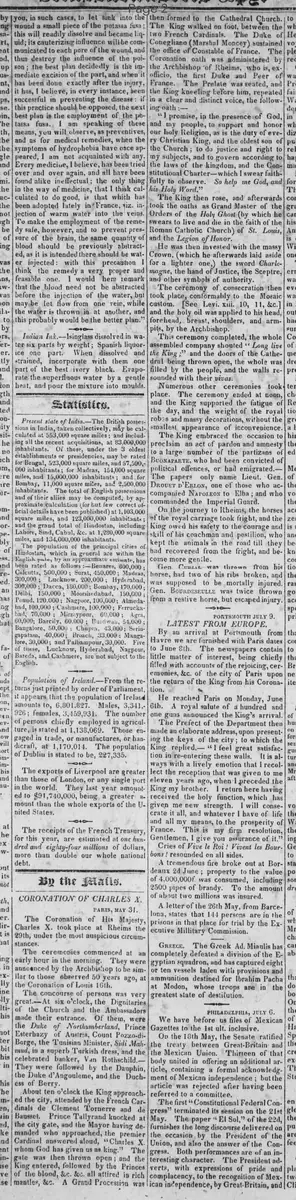
PARIS, MAY 31.
The Coronation of His Majesty, Charles X. took place at Rheims the 29th, under the most auspicious circumstances.
The ceremonies commenced at an early hour in the morning. They were announced by the Archbishop to be similar to those observed 50 years ago, at the Coronation of Louis 16th.
The concourse of persons was very great.—At six o'clock, the Dignitaries of the Church and the Ambassadors made their entrance. Of them, were the Duke of Northumberland, Prince Esterhazy of Austria, Count Pozzo-di-Borgo, the Tunisian Minister, Sidi Mahmund, in a superb Turkish dress, and the celebrated banker, Van Rothschild.—
They were followed by the Dauphin, the Duke d'Angoulême, and the Duchess of Berry.
About ten o'clock the King approached the city, attended by the French Cardinals de Clement Tornerre and de Bausset. Prince Talleyrand knocked at the city gate, and the Mayor having demanded who approached, the premier Cardinal answered aloud, "Charles X. whom God has given us as king." The gate was then thrown open; and the King entered, followed by the Princes of the blood, &c. &c. all attired in rich mantles, &c. A Grand Procession was then formed to the Cathedral Church.
The King walked on foot, between the two French Cardinals. The Duke of Conegliano (Marshal Moncey) sustained the office of Constable of France. The Coronation oath was administered by the Archbishop of Rheims, who is, ex officio, the first Duke and Peer of France. The Prelate was seated, and the King kneeling before him, repeated in a clear and distinct voice, the following oath :-
"I promise, in the presence of God, and my people, to support and honor our holy Religion, as is the duty of every Christian King, and the oldest son of the Church ; to do justice and right to my subjects, and to govern according to the laws of the kingdom, and the Constitutional Charter—which I swear faithfully to observe. So help me God, and his Holy Word."
The King then rose, and afterwards took the oaths as Grand Master of the Orders of the Holy Ghost (by which he swears to live and die in the faith of the Roman Catholic Church) of St. Louis, and the Legion of Honor.
He was then invested with the massy Crown, (which he afterwards laid aside for a lighter one,) the sword Charlemagne, the hand of Justice, the Sceptre, and other symbols of authority.
The ceremony of consecration then took place, conformably to the Mosaic custom. [See Levit. xiii. 10, 11, &c.] and the holy oil was applied to his head, forehead, breast, shoulders, and arm-pits, by the Archbishop.
This ceremony completed, the whole assembled company shouted "Long live the King ;" and the doors of the Cathedral being thrown open, the whole was filled by the people, and the walls re-echoed with their vivas.
Numerous other ceremonies took place. The ceremony ended at noon, and the King supported the fatigue of the day, and the weight of the royal robes and massy decorations, without the smallest appearance of inconvenience.
The King embraced the occasion to proclaim an act of pardon and amnesty to a large number of the partizans of Bonaparte, who had been convicted of political offences, or had emigrated.— The papers only name Lieut. Gen. Drouet D'Erlon, one of those who accompanied Napoleon to Elba; and who commanded the Imperial Guard.
On the journey to Rheims, the horses of the royal carriage took fright, and the King owed his safety to the courage and skill of his coachman and postilion, who kept the animals in the road till they had recovered from the fright, and become more gentle.
Gen. Curial was thrown from his horse, had two of his ribs broken, and was supposed to be mortally injured.
Gen. Bourdesoulle was twice thrown from a restive horse, but escaped injury.
What sub-type of article is it?
What keywords are associated?
What entities or persons were involved?
Where did it happen?
Foreign News Details
Primary Location
Rheims
Event Date
May 29
Key Persons
Outcome
proclamation of pardon and amnesty for bonaparte partisans including lieut. gen. drouet d'erlon; gen. curial suffered two broken ribs and possible mortal injury; gen. bourdesoulle escaped injury after falls; successful coronation ceremony.
Event Details
The coronation ceremonies began early in Rheims, similar to Louis XVI's 50 years prior. Dignitaries and ambassadors entered at 6 AM, followed by the Dauphin and others. At 10 AM, Charles X approached the city gate, announced by Prince Talleyrand and a cardinal. A procession went to the cathedral where the Archbishop administered the coronation oath, oaths for orders, investiture with crown and symbols, and consecration with holy oil. The event ended at noon with public acclaim. Minor incidents occurred en route: frightened horses in the royal carriage and injuries to generals.