Thank you for visiting SNEWPapers!
Sign up free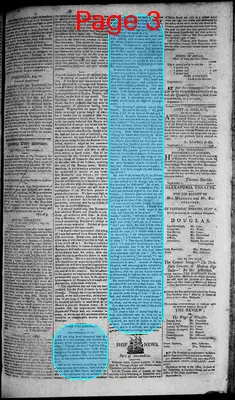
Literary
September 5, 1807
Alexandria Daily Advertiser
Alexandria, Virginia
What is this article about?
An essay observing the world's comedic contrasts, exemplified by two intimate friends with opposite outlooks: one celebrates saving 500 pounds after a theft of 250, ignoring the loss; the other rages at doubled expenses despite quadrupled crops. It concludes that half the world laughs at the other, and experience fosters indulgence.
Clipping
OCR Quality
95%
Excellent
Full Text
FROM THE EMERALD.
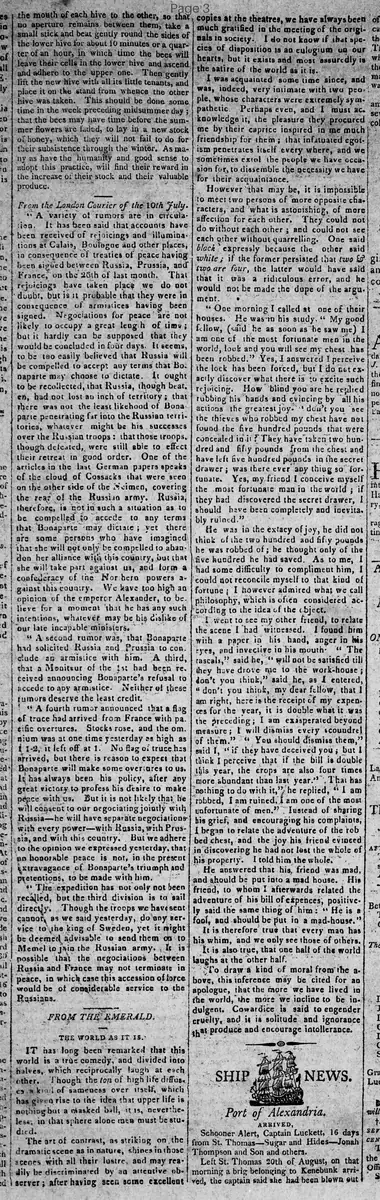
THE WORLD AS IT IS.
It has long been remarked that this world is a true comedy, and divided into halves, which reciprocally laugh at each other. Though the ton of high life differs a kind of sameness over itself, which has given rise to the idea that upper life is nothing but a masked ball, it is, nevertheless, in that sphere alone men must be studied.
The art of contrast, as striking on the dramatic scene as in nature, shines in those scenes with all their lustre, and may readily be discriminated by an attentive observer; after having seen some excellent copies at the theatres, we have always been much gratified in the meeting of the originals in society. I do not know if that species of disposition is an eulogium on our hearts, but it exists and most assuredly is the satire of the world as it is.
I was acquainted some time since, and was, indeed, very intimate with two people, whose characters were extremely sympathetic. Perhaps even, and I must acknowledge it, the pleasure they procured me by their caprice inspired in me much friendship for them; that infatuated egotism penetrates itself everywhere, and we sometimes extol the people we have occasion for, to dissemble the necessity we have for their acquaintance.
However that may be, it is impossible to meet two persons of more opposite characters, and what is astonishing, of more affection for each other. They could not do without each other: and could not see each other without quarrelling. One said black expressly because the other said white; if the former persisted that two and two are four, the latter would have said that it was a ridiculous error, and he would not be made the dupe of the argument.
One morning I called at one of their houses. He was in his study. "My good fellow, (said he as soon as he saw me) I am one of the most fortunate men in the world, look and you will see my chest has been robbed." Yes, I answered I perceive the lock has been forced, but I do exactly discover what there is to excite such rejoicing. How blind you are he replied rubbing his hands and evincing by all his actions the greatest joy. "Don't you see the thieves who robbed my chest have not found the five hundred pounds that were concealed in it? They have taken two hundred and fifty pounds from the chest and have left five hundred pounds in the secret drawer; was there ever anything so fortunate. Yes, my friend I conceive myself the most fortunate man in the world: if they had discovered the secret drawer, I should have been completely and inevitably ruined."
He was in the ecstasy of joy, he did not think of the two hundred and fifty pounds he was robbed of; he thought only of the five hundred he had saved. As to me, I had some difficulty to compliment him, I could not reconcile myself to that kind of fortune: I however admired what we call philosophy, which is often considered according to the idea of the object.
I went to see my other friend, to relate the scene I had witnessed. I found him with a paper in his hand, anger in his eyes, and invective in his mouth: "The rascals," said he, "will not be satisfied till they have drove me to the work-house don't you think," said he, as I entered, "don't you think, my dear fellow, that I am right, here is the receipt of my expenses for the year, it is double what it was the preceding; I am exasperated beyond measure; I will dismiss every scoundrel of them." "You should dismiss them," said I, "if they have deceived you; but I think I perceive that if the bill is double this year, the crops are also four times more abundant than last year." "That has nothing to do with it," he replied, "I am robbed, I am ruined, I am one of the most unfortunate of men." Instead of sharing his grief, and encouraging his complaints, I began to relate the adventure of the robbed chest, and the joy his friend evinced in discovering he had not lost the whole of his property. I told him the whole.
He answered that his friend was mad, and should be put into a mad house. His friend, to whom I afterwards related the adventure of his bill of expenses; positively said the same thing of him: "He is a fool, and should be put in a mad-house."
It is therefore true that every man has his whim, and we only see those of others.
It is also true, that one half of the world laughs at the other half.
To draw a kind of moral from the above, this inference may be cited for an apologue, that the more we have lived in the world, the more we incline to be indulgent. Cowardice is said to engender cruelty, and it is solitude and ignorance that produce and encourage intolerance.
THE WORLD AS IT IS.
It has long been remarked that this world is a true comedy, and divided into halves, which reciprocally laugh at each other. Though the ton of high life differs a kind of sameness over itself, which has given rise to the idea that upper life is nothing but a masked ball, it is, nevertheless, in that sphere alone men must be studied.
The art of contrast, as striking on the dramatic scene as in nature, shines in those scenes with all their lustre, and may readily be discriminated by an attentive observer; after having seen some excellent copies at the theatres, we have always been much gratified in the meeting of the originals in society. I do not know if that species of disposition is an eulogium on our hearts, but it exists and most assuredly is the satire of the world as it is.
I was acquainted some time since, and was, indeed, very intimate with two people, whose characters were extremely sympathetic. Perhaps even, and I must acknowledge it, the pleasure they procured me by their caprice inspired in me much friendship for them; that infatuated egotism penetrates itself everywhere, and we sometimes extol the people we have occasion for, to dissemble the necessity we have for their acquaintance.
However that may be, it is impossible to meet two persons of more opposite characters, and what is astonishing, of more affection for each other. They could not do without each other: and could not see each other without quarrelling. One said black expressly because the other said white; if the former persisted that two and two are four, the latter would have said that it was a ridiculous error, and he would not be made the dupe of the argument.
One morning I called at one of their houses. He was in his study. "My good fellow, (said he as soon as he saw me) I am one of the most fortunate men in the world, look and you will see my chest has been robbed." Yes, I answered I perceive the lock has been forced, but I do exactly discover what there is to excite such rejoicing. How blind you are he replied rubbing his hands and evincing by all his actions the greatest joy. "Don't you see the thieves who robbed my chest have not found the five hundred pounds that were concealed in it? They have taken two hundred and fifty pounds from the chest and have left five hundred pounds in the secret drawer; was there ever anything so fortunate. Yes, my friend I conceive myself the most fortunate man in the world: if they had discovered the secret drawer, I should have been completely and inevitably ruined."
He was in the ecstasy of joy, he did not think of the two hundred and fifty pounds he was robbed of; he thought only of the five hundred he had saved. As to me, I had some difficulty to compliment him, I could not reconcile myself to that kind of fortune: I however admired what we call philosophy, which is often considered according to the idea of the object.
I went to see my other friend, to relate the scene I had witnessed. I found him with a paper in his hand, anger in his eyes, and invective in his mouth: "The rascals," said he, "will not be satisfied till they have drove me to the work-house don't you think," said he, as I entered, "don't you think, my dear fellow, that I am right, here is the receipt of my expenses for the year, it is double what it was the preceding; I am exasperated beyond measure; I will dismiss every scoundrel of them." "You should dismiss them," said I, "if they have deceived you; but I think I perceive that if the bill is double this year, the crops are also four times more abundant than last year." "That has nothing to do with it," he replied, "I am robbed, I am ruined, I am one of the most unfortunate of men." Instead of sharing his grief, and encouraging his complaints, I began to relate the adventure of the robbed chest, and the joy his friend evinced in discovering he had not lost the whole of his property. I told him the whole.
He answered that his friend was mad, and should be put into a mad house. His friend, to whom I afterwards related the adventure of his bill of expenses; positively said the same thing of him: "He is a fool, and should be put in a mad-house."
It is therefore true that every man has his whim, and we only see those of others.
It is also true, that one half of the world laughs at the other half.
To draw a kind of moral from the above, this inference may be cited for an apologue, that the more we have lived in the world, the more we incline to be indulgent. Cowardice is said to engender cruelty, and it is solitude and ignorance that produce and encourage intolerance.
What sub-type of article is it?
Essay
Satire
What themes does it cover?
Moral Virtue
Social Manners
What keywords are associated?
World Comedy
Contrasting Characters
Human Whims
Moral Indulgence
Social Satire
Fortune Perspectives
Literary Details
Title
The World As It Is
Key Lines
It Is Therefore True That Every Man Has His Whim, And We Only See Those Of Others.
It Is Also True, That One Half Of The World Laughs At The Other Half.
To Draw A Kind Of Moral From The Above, This Inference May Be Cited For An Apologue, That The More We Have Lived In The World, The More We Incline To Be Indulgent.